
Investing is a game of billions.
Literally.
Individuals and institutions across the United States pour in billions of dollars every year with the sole intent of growing their money. The goal is simple: achieve a return rate as high as possible.
Decades since the inception of the stock market, multiple asset classes and investment options have emerged. What began as a simple marketplace for trading the shares of companies has transformed into a thriving ecosystem of raising finance and earning a return on money.
With an ever-increasing number of asset classes, investment thesis, and financial instruments flooding the market every year, investors have a ton of options to select from. However, amidst all the new disruption and change, two distinct ways of investing have remained constant – active and passive investing.
The Difference Between Active and Passive Investing
Simply put, an active investor buys and sells shares more frequently. It requires a more ‘hands-on’ approach from investors. The intent is to beat the market rate of return by actively trading the shares and timing the entry and exit of the investment smartly. There is a very heavy emphasis on researching the company, its financials, the sector it operates in, its plans, as well as the management guiding its trajectory. Usually, day traders, mutual fund managers, and professionals having qualifications like an online business analytics degree indulge in this approach to investing. Knowledge of technical charts and patterns is also used.
On the other hand, a passive investor simply invests the money in a collection of shares or a mutual fund which mimics the movement of the index in a financial market. The frequency of buying and selling in this type of investing is minimal and the intent is mainly to match the market’s return. Passive investors believe that beating the markets is an almost impossible job and it is better to invest in indexes and benchmarks than picking individual stocks. The investors have a very long time horizon, typically of more than three years.
What are the Pros and Cons of Active Investing?
The main advantage of active investing is that there is potential to perform better than the market. The upside can be much higher than the typical growth rate of 8 to 10%. Active investors can also react more swiftly to changing market dynamics. This is because they regularly keep a watch on the prices and also, invest in individual financial instruments like shares or commodities, which can be quickly sold. For instance, if an active investor senses that the market is in a freefall, he can immediately switch to more defensive blue-chip shares. Finally, an active investor can also easily capitalize on short-term opportunities and market inefficiencies. For example, if an established company’s share prices fall due to misleading news reporting, the investor can buy the shares and sell them later when they rebound.
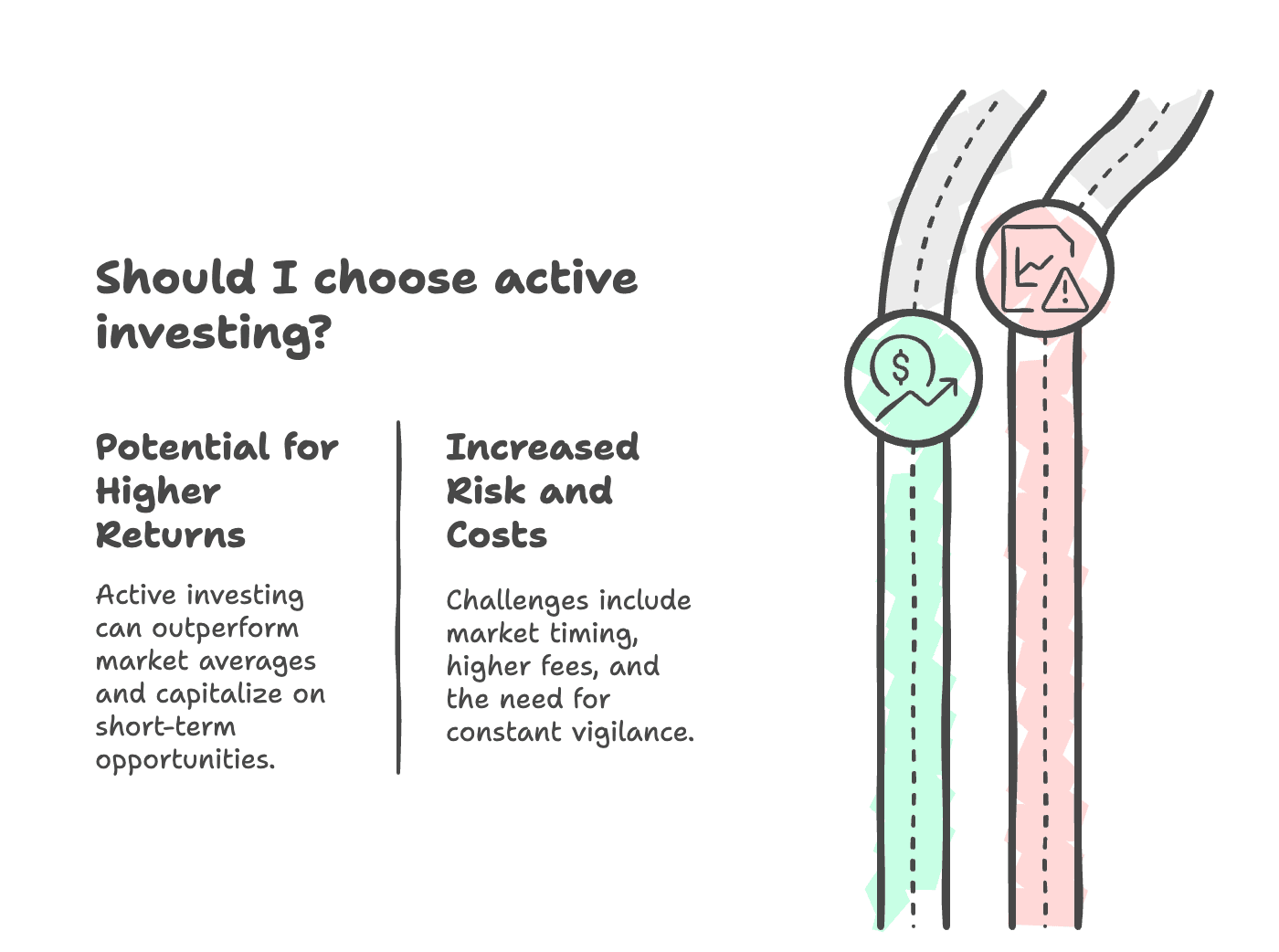
Conversely, active investing is fraught with risk. It is not easy to beat the markets and consistently pick good investments. Timing the market can be an especially tough gig. Investing in actively managed mutual funds can also attract higher management fees that increase the cost of investment. There is the added pressure of checking the prices, doing research, and staying abreast of emerging news headlines to act swiftly to major events.
What are the Pros and Cons of Passive Investing?
The beauty of passive investing is in its simplicity and accessibility. There is no need to be a financial maestro to put money in index tracking funds. This also eliminates the need to conduct research and stay in the loop for market events. Passive investing also mimics the performance of the market, which has a solid historical track record. The cost of passive investing is also less, as such funds only track the indexes and benchmarks. Finally, there is no room for emotional bias. Selling shares as a knee-jerk reaction to a major blip in the share price or buying shares after seeing a sudden jump in prices can be avoided.
On the flip side, the upside potential is limited. The returns are restricted to the performance of the market. This could lead to an increase in the opportunity cost when the market is on an upswing. There are also missed opportunities in niche markets. Investing in sunrise sectors or high-growth industries is missed out. Finally, there is an overexposure to market trends. In times when the market is in the doldrums for an extended period, this can lead to erosion of wealth.
Which Investing Approach is Right for You?
The answer is simple – it depends on your goals and other considerations.
If your risk appetite is high, active investing could be a better fit. The length of your investment horizon is also a factor. How much flexibility you want in timing and picking your stocks also needs to be considered. Finally, the amount of time you have for deciding your investment options is also critical. It is key to balance out all the factors and try to strike a healthy balance between both the approaches.