
In today’s fast-paced digital world, having a robust and scalable database management system (DBMS) is crucial for running high-performance web applications.
Whether you’re managing a simple website, an e-commerce store, or a large-scale enterprise application, selecting the best database management systems for web applications can significantly impact speed, security, and scalability.
A poorly chosen DBMS can lead to performance bottlenecks, security vulnerabilities, and high operational costs, whereas the right choice can enhance user experience, improve data integrity, and support business growth.
With so many options available, choosing the right database for web applications can be overwhelming. Should you opt for a traditional SQL-based database like MySQL, or should you go for a NoSQL alternative like MongoDB? Each system has its strengths and weaknesses, making it essential to understand which one aligns best with your needs.
This article explores the 10 best database management systems for web applications, their unique features, and how to choose the most suitable one for your project. Additionally, we provide insights into future trends in database technology to help you stay ahead in this ever-evolving landscape.
What is a Database Management System (DBMS)?
A Database Management System (DBMS) is software that allows users to store, retrieve, manage, and manipulate data efficiently. It acts as an interface between the database and end users or applications, ensuring seamless data transactions.
DBMSs are critical for web applications because they ensure data is organized, easily accessible, and securely stored.
For web applications, a well-optimized DBMS ensures fast load times, smooth data processing, and high security. Without a reliable database system, websites may suffer from slow performance, data loss, or security vulnerabilities. Popular applications like Amazon, Netflix, and Facebook rely on powerful database management systems to handle vast amounts of user data while maintaining high availability and performance.
Types of Database Management Systems
The best database management systems for web applications fall into different categories based on their data structure and query language:
| Type of Database | Characteristics | Examples |
| Relational Databases (SQL) | Structured tables with predefined relationships | MySQL, PostgreSQL, SQL Server |
| NoSQL Databases | Flexible schema, often document-based or key-value stores | MongoDB, DynamoDB, Redis |
| NewSQL Databases | Combines scalability of NoSQL with ACID compliance of SQL | Google Spanner, CockroachDB |
| In-Memory Databases | Data is stored in RAM for ultra-fast performance | Redis, Memcached |
How to Choose the Right DBMS for Web Applications?
Before selecting a database management system for web applications, consider the following key factors:
- Performance & Speed: Choose a database with efficient query execution and indexing mechanisms to ensure fast response times.
- Scalability & Flexibility: Ensure it can handle increasing data loads as your application grows, supporting vertical and horizontal scaling.
- Security & Data Integrity: Look for features like encryption, access control, and data recovery to protect sensitive information.
- Compatibility with Web Frameworks: Ensure the DBMS integrates seamlessly with your web stack (e.g., PHP, Python, Node.js) to prevent compatibility issues.
- Cost & Licensing: Open-source databases (MySQL, PostgreSQL) may be cost-effective, while enterprise solutions (Oracle, SQL Server) can be expensive but offer premium support.
SQL vs NoSQL: Which One is Better for Web Applications?
The best database management systems for web applications often fall under SQL or NoSQL categories. Here’s a comparison:
| Feature | SQL Databases | NoSQL Databases |
| Data Structure | Structured tables with predefined schema | Flexible schema (documents, key-value, graph, etc.) |
| Query Language | SQL (Structured Query Language) | Various (JSON, GraphQL, key-value pairs) |
| Scalability | Vertical scaling (adding more power to a single server) | Horizontal scaling (distributing across multiple servers) |
| Use Cases | Banking, e-commerce, CRM systems | Real-time analytics, IoT, social media platforms |
10 Best Database Management Systems for Web Applications
Choosing the right database management system is crucial for web applications to ensure high performance, scalability, and security. With an increasing number of database options available, understanding their capabilities and use cases can help developers and businesses make informed decisions.
Below is a list of the best database management systems for web applications, categorized into relational and NoSQL databases.
Relational (SQL) Databases
Relational databases follow a structured format using tables, making them highly reliable for transactional applications. They support SQL (Structured Query Language) for managing data and are widely used for business applications, e-commerce platforms, and enterprise solutions. Below are some of the best relational database management systems for web applications.
-
MySQL
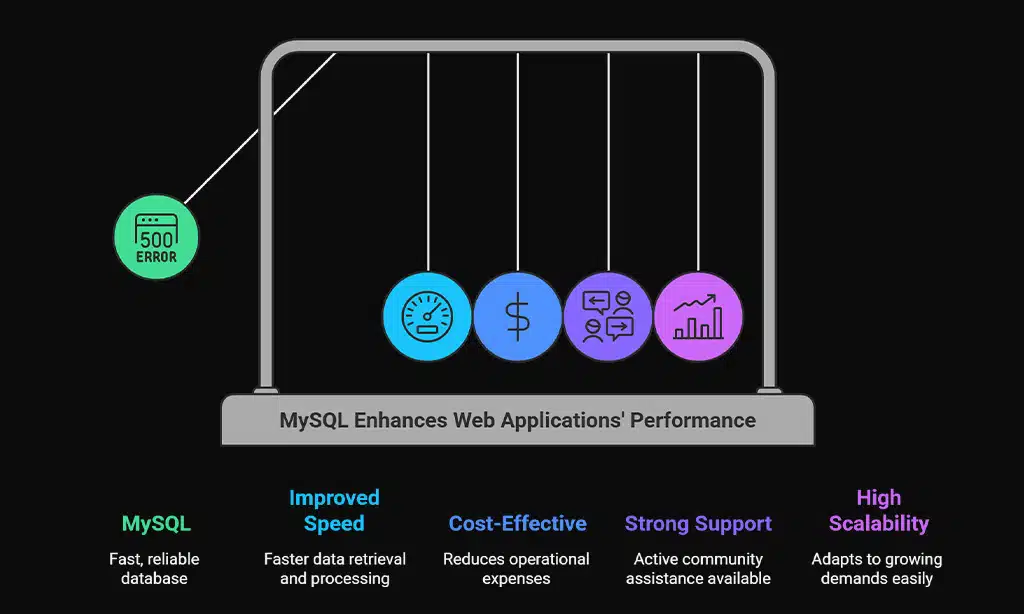
MySQL is an open-source relational database known for its speed, reliability, and ease of use. It supports a variety of web applications, including CMS platforms like WordPress, Magento, and Joomla. MySQL is widely adopted for its cost-effectiveness and strong community support. With replication, clustering, and storage engine support, it is highly scalable and efficient for dynamic web applications.
| Feature | Details |
| Type | SQL |
| Best For | CMS, e-commerce, web applications |
| Scalability | Vertical scaling |
| Security | Strong access controls |
-
PostgreSQL
PostgreSQL is a highly extensible, open-source relational database designed for performance and scalability. It provides robust security features, ACID compliance, and support for JSON, making it a preferred choice for applications requiring advanced data analytics, high concurrency, and strong data integrity. PostgreSQL is often used in scientific and financial applications.
| Feature | Details |
| Type | SQL |
| Best For | Large-scale applications, data analytics |
| Scalability | Horizontal and vertical scaling |
| Security | Advanced security features |
-
Microsoft SQL Server
Microsoft SQL Server is an enterprise-grade relational database developed by Microsoft. It provides high performance, security, and integration with various Microsoft services. It is best suited for large-scale business applications, financial services, and organizations that require seamless integration with Windows-based solutions.
| Feature | Details |
| Type | SQL |
| Best For | Enterprise applications, business intelligence |
| Scalability | Vertical scaling with cloud options |
| Security | Advanced encryption and role-based access control |
-
SQLite
SQLite is a lightweight, file-based database designed for small-scale applications. It requires minimal setup and is often used in mobile applications, IoT devices, and small web applications. Despite its simplicity, SQLite supports transactions, indexing, and JSON functions.
| Feature | Details |
| Type | SQL |
| Best For | Mobile applications, lightweight applications |
| Scalability | Limited to single-file storage |
| Security | Basic authentication support |
-
Oracle Database
Oracle Database is a high-performance, enterprise-class database system designed for large-scale applications. It provides powerful features such as automated indexing, multi-tenant architecture, and robust security mechanisms. Oracle is widely used in banking, telecommunications, and data warehousing.
| Feature | Details |
| Type | SQL |
| Best For | Enterprise applications, financial institutions |
| Scalability | High scalability with clustering options |
| Security | Comprehensive security policies and encryption |
NoSQL Databases
NoSQL databases provide flexibility and scalability for modern web applications, handling unstructured or semi-structured data efficiently. They are particularly useful for applications requiring high-speed transactions, real-time analytics, and distributed storage across multiple servers. Below are some of the best NoSQL database management systems for web applications.
-
MongoDB
MongoDB is a popular NoSQL database that stores data in a flexible JSON-like format. It is ideal for applications that require fast scalability, such as real-time analytics and content management systems. MongoDB provides automatic sharding and indexing, making it suitable for large datasets.
| Feature | Details |
| Type | NoSQL |
| Best For | Real-time apps, unstructured data |
| Scalability | Horizontal scaling |
| Security | Role-based access control and encryption |
-
Firebase Realtime Database
Firebase Realtime Database is a cloud-based NoSQL database provided by Google. It enables real-time data synchronization across multiple clients, making it ideal for chat applications, live collaboration tools, and gaming platforms.
| Feature | Details |
| Type | NoSQL |
| Best For | Mobile and web applications |
| Scalability | Cloud-based horizontal scaling |
| Security | Firebase Authentication and database rules |
-
CouchDB
Apache CouchDB is a document-oriented NoSQL database designed for distributed applications. It stores data as JSON documents and provides built-in replication for offline support. CouchDB is ideal for applications needing robust data synchronization across devices.
| Feature | Details |
| Type | NoSQL |
| Best For | Distributed and offline-first applications |
| Scalability | Horizontal scaling |
| Security | SSL encryption and user authentication |
-
Redis
Redis is an in-memory NoSQL database known for its lightning-fast performance. It is often used as a caching layer, session store, or real-time messaging queue. Redis supports data structures such as lists, sets, and sorted sets for efficient data processing.
| Feature | Details |
| Type | NoSQL |
| Best For | Caching, real-time processing |
| Scalability | Horizontal scaling with clustering |
| Security | Authentication and access control |
-
Amazon DynamoDB
Amazon DynamoDB is a fully managed NoSQL database service by AWS. It offers automatic scaling, low-latency performance, and seamless integration with AWS services. DynamoDB is widely used for e-commerce platforms, gaming applications, and IoT solutions.
| Details |
| NoSQL |
| Large-scale web applications, IoT |
| Fully managed horizontal scaling |
| Encryption at rest and AWS IAM integration |
These databases are the best database management systems for web applications, offering various capabilities to meet different project requirements.
Wrap Up
Choosing the best database management systems for web applications depends on your project’s needs. If you require structured data integrity, SQL databases like MySQL or PostgreSQL are excellent choices.
However, if scalability and flexibility are your priorities, NoSQL databases like MongoDB or Firebase offer great solutions.
With emerging technologies, database management is evolving rapidly. Whether you’re a startup, developer, or enterprise, investing in the right DBMS will enhance performance, security, and user experience.