

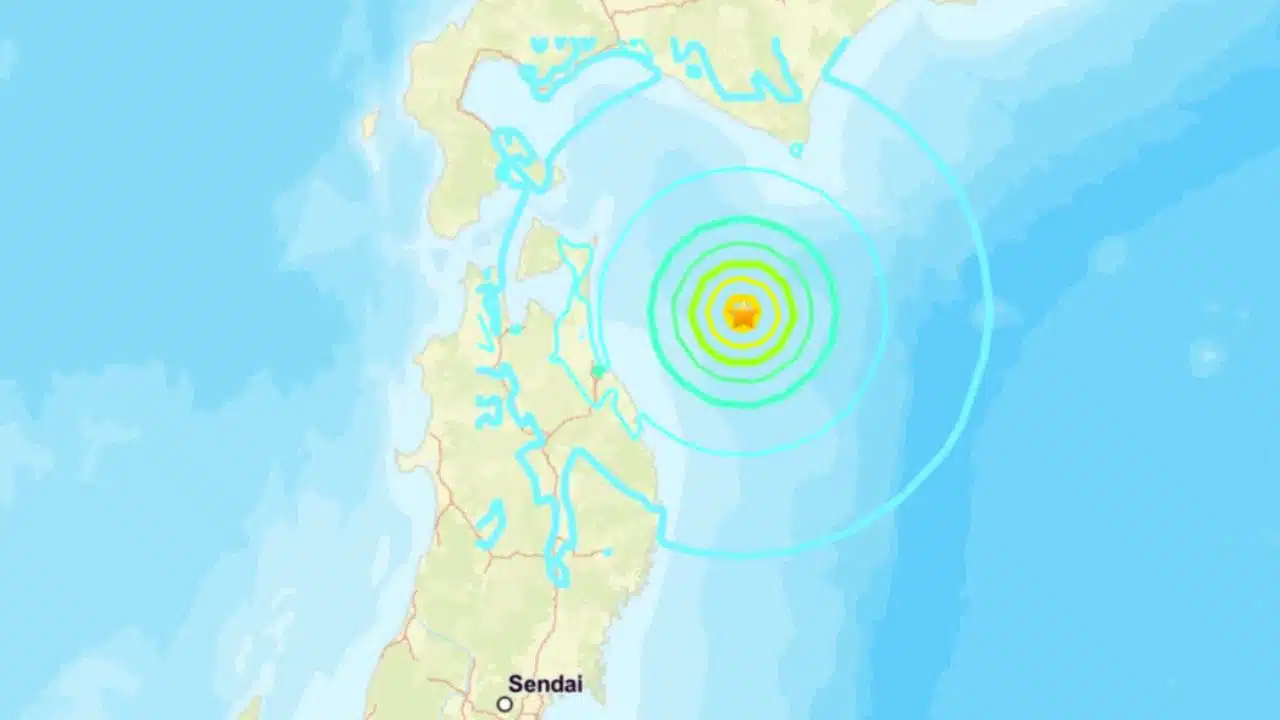
The offshore quake struck near Japan’s northeast coast days after a stronger temblor, briefly putting northern shorelines under tsunami alerts as authorities monitored wave activity.
A magnitude 6.9 earthquake struck off Japan’s Aomori Prefecture on Friday, prompting the Japan Meteorological Agency (JMA) to issue a tsunami advisory for parts of northern Japan’s Pacific coast before later lifting it. The quake hit at about 11:44 a.m. local time and was initially assessed at a lower magnitude before being updated, while the U.S. Geological Survey (USGS) listed it at magnitude 6.7. Officials said small tsunami waves were recorded at coastal monitoring points, and Japan’s nuclear regulator reported no immediate abnormalities at regional nuclear facilities.
What happened offshore Aomori
The JMA reported the earthquake occurred off the coast of Aomori in northeastern Japan at a depth of about 20 km. Public broadcaster reports cited by international outlets said shaking registered at intensity 4 on Japan’s 1–7 seismic intensity scale. The quake was widely described as occurring in the same broader offshore area impacted by a stronger earthquake earlier in the week.
Magnitude assessments varied in early reporting, reflecting the rapid updates typical after offshore events. The JMA’s preliminary magnitude was widely reported as 6.7 before the event was later described as a 6.9 quake in multiple reports, while the USGS maintained a 6.7 reading and placed it about 130 km from Kuji in Iwate Prefecture.
Tsunami advisory and observed waves
Soon after the quake, the JMA issued a tsunami advisory for sections of the Pacific coast in northern Japan, warning that waves could reach up to 1 meter in some areas before the advisory was lifted. Channel NewsAsia reported that two waves of about 20 cm were recorded—one at Erimo in Hokkaido at 12:35 p.m., and another minutes later along the Aomori coast—while officials checked for port impacts. Broadcasters cited in the same report said there was no obvious change observed at the ports referenced during the advisory period.
Authorities repeatedly urged residents to stay away from the shoreline while advisories remained in effect, a standard safety approach because even small waves can create hazardous currents in ports and harbors. The advisory was later lifted after monitoring data showed limited wave activity.
Why this aftershock drew extra attention
The 6.9 quake came days after a powerful magnitude 7.5 earthquake struck offshore of Aomori late Monday night, triggering tsunami warnings that were later downgraded. Reuters reported the earlier quake struck at about 11:15 p.m. local time, about 80 km offshore from Aomori, at a depth of roughly 54 km. The JMA initially warned tsunami waves could reach up to 3 meters after the Monday quake, and authorities issued evacuation orders affecting around 90,000 people.
Reports later in the week said that Monday’s stronger quake injured at least 50 people and produced tsunami waves of up to 70 cm in some locations. Against that backdrop, the government issued a special advisory covering a wide stretch from Hokkaido to Chiba, warning residents to be on alert for an increased possibility of another strong earthquake within about a week. ABC News also described Japan’s advisory as a measure linked to temporarily heightened risk in the Hokkaido and Sanriku areas, where offshore trenches have generated major earthquakes in the past.
Key quake and tsunami data
| Item | What was reported | Source |
| Aftershock time | About 11:44 a.m. local time (Dec. 12) | |
| Aftershock magnitude | JMA/coverage widely reported 6.9; USGS reported 6.7 | |
| Aftershock depth | About 20 km | |
| Tsunami advisory area | Northern Japan Pacific coast, including Hokkaido and parts of Tohoku in early reports | |
| Recorded waves | Two waves about 20 cm (Erimo, Hokkaido; then Aomori coast) | |
| Earlier main quake (same week) | Magnitude 7.5 offshore Aomori (late Monday) | |
| Earlier tsunami warning height | Up to 3 meters initially forecast | |
Timeline: from the main quake to the aftershock
| Date (local) | Event | What authorities did | Source |
| Dec. 8 (late night) | Offshore M7.5 quake hits northeast Japan | Tsunami warnings issued, later downgraded; evacuations ordered in affected areas | |
| Dec. 9 (following day) | Heightened alert period begins | Government issues special advisory from Hokkaido to Chiba urging readiness for another strong quake | |
| Dec. 12 (late morning) | Offshore quake reported as M6.9 after updates | JMA issues tsunami advisory; coastal monitoring begins | |
| Dec. 12 (early afternoon) | Small waves recorded | About 20 cm waves observed at monitoring points; ports monitored | |
| Dec. 12 (later) | Advisory lifted | JMA lifts tsunami advisory once monitoring shows limited impact | |
Infrastructure checks and public safety measures
Japan’s Nuclear Regulation Authority said there were no immediate signs of abnormalities at nuclear facilities in the region following the 6.9 quake. Local authorities and transport operators also continued assessing disruptions after the earlier 7.5 quake, which Reuters described as strong enough in some places to produce severe shaking and trigger broad evacuation orders. Government messaging during the week emphasized reviewing evacuation routes, securing furniture, and remaining ready to move if stronger shaking returns.
Officials continued to distinguish between an advisory and a warning in their public communications as wave forecasts and observations evolved. In practice, coastal residents were urged to follow local instructions and avoid approaching the sea during the advisory window even when predicted wave heights were relatively small.
Why Japan faces frequent quake and tsunami risk
Japan sits along the western edge of the Pacific Ring of Fire, and is one of the world’s most seismically active countries. Channel NewsAsia reported Japan experiences around 1,500 earthquakes per year, with impacts varying by location and depth. The same report noted that disaster preparedness remains shaped by the legacy of the 2011 magnitude 9.0 undersea earthquake and tsunami that left about 18,500 people dead or missing.
Experts and officials have also highlighted the role of offshore trenches in producing very large earthquakes, including the Japan Trench and the Kuril/Chishima trench system referenced in coverage of the government’s heightened advisory this week. ABC News reported these trench regions have generated major events historically, and that Monday’s quake temporarily raised concern levels for northern coastal areas.
What happens next
Authorities are expected to keep monitoring aftershocks and seabed activity in the offshore zone north of Honshu, particularly because the 6.9 event occurred soon after the larger quake earlier in the week. Residents in coastal areas covered by the government’s special advisory have been urged in multiple reports to maintain readiness, including checking evacuation routes and staying alert to official bulletins. Updates from the JMA and local governments are likely to remain the primary reference points for any renewed tsunami advisories, evacuation guidance, or coastal access restrictions.






















