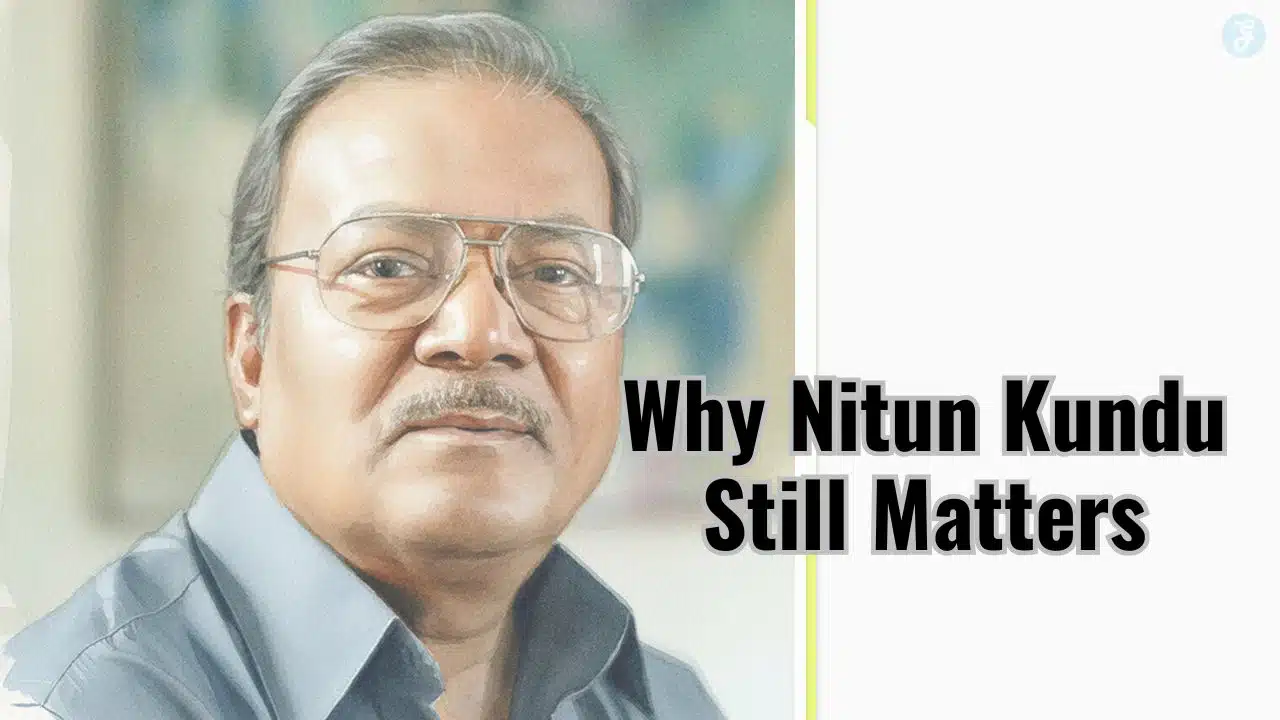
Have you ever walked past a stunning sculpture or sat on a beautifully designed chair and wondered who created it? It’s easy to name movie stars or cricketers, but the artists who shape our daily world often stay in the shadows. Nitun Kundu is one of those hidden heroes.
He didn’t just paint on canvas. He built an entire legacy that touches your life today, from the “Shabash Bangladesh” statue you might have seen in photos to the Otobi furniture that might be in your living room right now. He was a man who could wield a paintbrush and a welding torch with equal skill.
So, pull up a chair—maybe even an Otobi one—and let’s chat about this incredible journey. I’m going to share the story of how a boy from a small village became a national icon, starting with just a few thousand taka and a dream.
Key Takeaways
- From Humble Beginnings: Nitun Kundu was born on December 3, 1935, in the village of Khandakerpara, Khulna. He graduated top of his class from the Institute of Fine Arts in 1959.
- War Hero with a Brush: During the 1971 Liberation War, he designed the legendary poster “Sada Jagrata Banglar Muktibahini” and worked with the government-in-exile at Mujibnagar.
- Business Pioneer: He founded Otobi in 1975 with an initial investment of just 5,000 taka. The name “Otobi” means “forest,” symbolizing growth and nature.
- Public Art Icons: He created the massive “Shabash Bangladesh” sculpture at Rajshahi University and the gleaming steel “SAARC Fountain” in Dhaka.
- National Honors: His shelf was full of awards, including the prestigious Ekushey Padak (1997) and the National Film Award.

Early Life and Education
Imagine growing up in a home where art wasn’t just a hobby but a way of life. Nitun Kundu was born into a Bengali Hindu family in Khandakerpara, Khulna, where his father’s work as a folk artist filled their house with color and creativity. These early days surrounded by Patachitra and terracotta set the stage for everything he would achieve later.
What were the key moments in Nitun Kundu’s early life?
His childhood was a mix of creative exploration and historical turmoil. While he learned about traditional crafts at home, he also witnessed the end of colonial rule and the partition of India.
- A Creative Household: His father’s role as a folk artist meant Nitun was handling brushes and clay before he could even read.
- Living History: Growing up during the partition gave him a front-row seat to the struggles of his people, which later fueled his patriotic art.
- Meeting the Masters: His home was a hub for creative minds. Hearing names like Quamrul Hassan in family conversations sparked a fire in him to pursue art seriously.
- The Spark of Independence: Even as a young boy, the stories of resistance and the dream of a free nation began to shape his worldview.
Where did Nitun Kundu receive his education?
In the early 1950s, Nitun took a big leap. He moved to the bustling city to join the Government College of Arts and Crafts (now the Faculty of Fine Arts, University of Dhaka). He didn’t just attend; he excelled.
He graduated in 1959, securing the top position in the Department of Drawing and Painting. Under the guidance of legends like Zainul Abedin and artist Quamrul Hassan, he mastered the balance between academic realism and abstract expression. This formal education gave him the technical skills to later revolutionize everything from canvas painting to furniture design.
Role in the Liberation War of Bangladesh
When the 1971 Liberation War broke out, Nitun Kundu didn’t pick up a gun. He picked up his art supplies. He believed that an image could be just as powerful as a weapon when it came to inspiring hope and courage.
How did Nitun Kundu contribute to the Liberation War of Bangladesh?
He joined the public relations department of the Bangladesh government-in-exile at Mujibnagar. There, working alongside other creative giants, he produced materials that defined the visual language of the resistance.
- The Iconic Poster: He designed the famous poster “Sada Jagrata Banglar Muktibahini” (The Ever Vigilant Liberation Force of Bengal). It featured a determined freedom fighter and became a symbol of resilience.
- A Message of Unity: He also created the poster “Amra Sabai Bangali” (We Are All Bengalis), which helped unify people of different faiths under one national identity.
- Supporting the Cause: Beyond posters, he worked relentlessly to design exhibits and propaganda materials that garnered international support for the freedom fighters.
What impact did the war have on his artistic vision?
The war changed him forever. You can see the shift in his work from simple beauty to deep, emotional storytelling. Themes of struggle, victory, and nationalism became the core of his art.
After 1971, his paintings and sculptures often featured bold, aggressive lines and vibrant colors that reflected the turbulence and triumph of the war. This period cemented his status not just as an artist but as a “Banglar Bir Muktijoddha” (Heroic Freedom Fighter of Bengal) in the cultural arena.
Contributions to the Art and Cultural Identity of Bangladesh
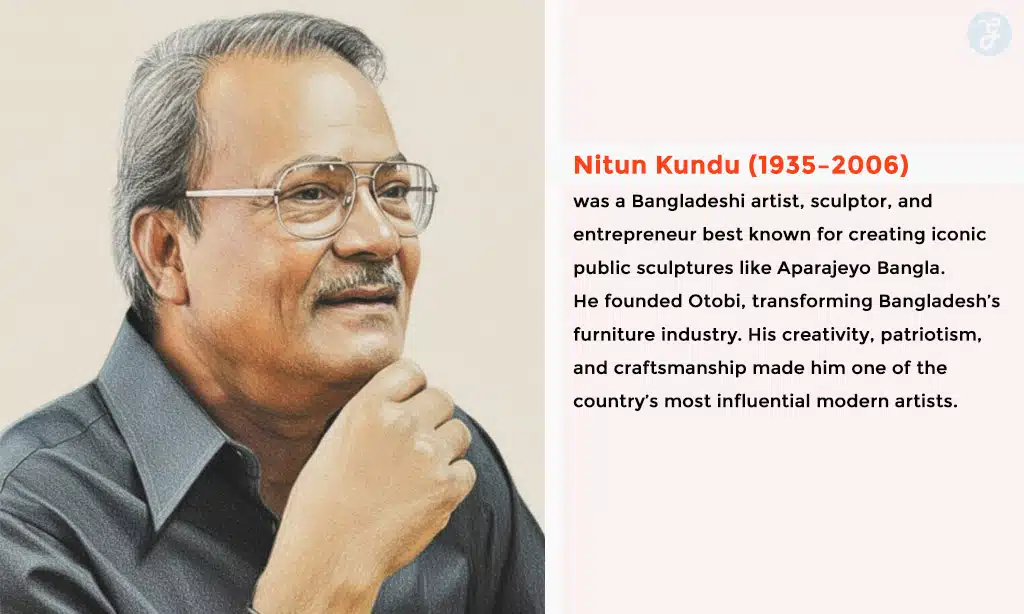
Nitun Kundu had a unique talent for blending the old with the new. He took the rustic soul of Bengali folk art and gave it a modern, abstract twist. This didn’t just make his art look cool; it helped a young nation find its visual voice.
How did Nitun Kundu influence Bangladesh’s cultural identity?
He refused to let traditional art die out. Instead, he revitalized it. By mixing folk motifs with modern abstract art, he showed that Bangladeshi culture could be contemporary and global.
“Art is not just for the gallery. It is for the people, the streets, and the homes.” — This philosophy drove him to bring art out of museums and into public spaces.
His work served as a bridge. On one side was the rich history of rural Bengal, and on the other was the futuristic vision of a modern state. This fusion is visible everywhere, from his paintings to the sleek lines of his furniture design.
What artistic styles and themes did he promote?
Nitun loved to experiment. While he started with realistic sketches, he eventually embraced abstract expressionism. He worked with a variety of mediums that many others avoided.
| Medium/Style | How He Used It |
|---|---|
| Oil & Acrylic | Used for bold, colorful paintings like “Freedom Flame” (1969) to express energy and hope. |
| Screen Print | Essential for mass-producing his war posters to reach as many people as possible. |
| Metal & Steel | He pioneered the use of industrial materials in sculpture, famously seen in the SAARC Fountain. |
He frequently explored themes of poverty, resilience, and the eternal spirit of the Mukti Bahini. His ability to move between delicate watercolors and heavy metal welding set him apart from his peers.
Founding of Otobi and Impact on Industrial Design
This is where the story gets really interesting for the entrepreneurs out there. In 1975, just a few years after the war, Nitun Kundu decided to try something risky. He wanted to change how Bangladeshis lived in their own homes.
How did Nitun Kundu establish Otobi?
It started in his own living room on Topkhana Road. With a tiny capital of just 5,000 taka, he founded a company he named “Otobi,” which is a Bengali word for “forest.”
At first, it was just a small workshop called “Art in Craft.” He didn’t have a massive factory or a marketing team. He had a vision that furniture should be elegant, modern, and affordable. The breakthrough came when he landed an order for 500 garden chairs. That success proved that his designs had a market, and Otobi began its rapid expansion.
What changes did Otobi bring to industrial design in Bangladesh?
Before Otobi, furniture in Bangladesh was mostly heavy, ornate, and made of solid wood. It was beautiful but expensive and bulky. Nitun Kundu introduced the concept of “laminated board” and metal furniture.
- Modern Aesthetics: He brought in sleek lines and minimalist designs that fit perfectly in modern apartments.
- Affordability: By using alternative materials like metal and processed wood, he made stylish furniture accessible to the middle class.
- Industry Standard: Otobi became the market leader, at one point holding a massive share of the branded furniture market. It forced other manufacturers to upgrade their designs and quality to compete.
He proved that an artist could also be a shrewd businessman, using customer relationship management principles before it was even a buzzword in Dhaka.
Iconic Works and Sculptures
If you live in or visit Bangladesh, you have likely stood in the shadow of a Nitun Kundu creation. He believed that art should belong to the public, not just be hidden away in private collections.
What are some of Nitun Kundu’s most famous sculptures?
His sculptures are massive, durable, and deeply symbolic. They often use industrial materials like steel to signify strength and progress.
- Shabash Bangladesh: Located at Rajshahi University, this is perhaps his most famous work. Built in 1991, it depicts freedom fighters in action. The name comes from a poem by Sukanta Bhattacharya, and the last four lines of the poem are engraved on the structure.
- SAARC Fountain: Constructed in 1985 for the SAARC summit, this steel structure stands near the Pan Pacific Sonargaon Hotel. It was a marvel of engineering at the time, with its gleaming metal reflecting the light of a developing nation.
- Sampan: Situated at Shah Amanat International Airport in Chittagong, this sculpture honors the traditional boat of the region, blending local heritage with modern abstract art forms.
- Kadamphul Fountain: Located near the National Press Club and Foreign Ministry, this delicate fountain mimics the Kadam flower, a beloved symbol of the rainy season in Bengal.
Where can these iconic works be seen today?
These landmarks are easy to find. The “Shabash Bangladesh” memorial dominates the campus of Rajshahi University, serving as a constant reminder of the Liberation War to students. In Dhaka, the SAARC Fountain at Kawran Bazar is a central landmark that millions pass by every year.
Next time you are stuck in traffic near Karwan Bazar or walking through the airport in Chittagong, look up. You are looking at the legacy of a man who welded his love for his country into steel and stone.
Awards and Recognitions
Nitun Kundu’s contribution was so immense that the nation couldn’t help but applaud. He received recognition not just for his art, but for his business acumen and his service during the war.
What major awards did Nitun Kundu receive?
His trophy cabinet was impressive. Here are a few of the standout honors he received during his lifetime:
- Ekushey Padak (1997): The second-highest civilian award in Bangladesh, recognizing his immense contribution to the arts.
- National Film Award: He won this for Best Art Direction, proving his versatility extended to cinema.
- Daily Star Business Award: This recognized his success with Otobi, bridging the gap between creativity and commerce.
- Banglar Bir Muktijoddha: A title honoring his direct role in the fight for independence.
How was his work recognized nationally and internationally?
Beyond the medals, his real recognition was in his ubiquity. His designs were everywhere. He held four solo exhibitions in his lifetime, and his work was displayed in major galleries across South Asia. Even after his death on September 15, 2006, retrospectives of his work continue to draw crowds.
He was a rare figure who was respected equally by the art critics at the Institute of Fine Arts and the business leaders at the Chamber of Commerce. His legacy is a testament to a life lived fully in service of creativity.
Legacy in Creativity and Innovation
Nitun Kundu passed away in 2006, but his influence is arguably stronger now than ever. He left behind a blueprint for how to be a creative professional in a developing world.
In what ways does Nitun Kundu’s legacy continue to inspire creativity?
He showed that you don’t have to choose between being an artist and being practical. You can do both. Today, young designers at Otobi and students at art colleges look at his career as the ultimate model.
His use of technology in art was pioneering. He was one of the first in Bangladesh to use heavy machinery to create delicate art, a technique that is now standard in sculpture departments. His fearless experimentation encourages today’s youth to mix disciplines, perhaps combining coding with canvas or engineering with sculpture.
How has his innovation influenced modern design?
The furniture industry in Bangladesh owes its modern existence to him. He created a demand for stylish, quality interiors that simply didn’t exist before. By standardizing sizes and using durable materials, he brought “designed living” to the masses.
Every time a local brand launches a new line of minimalist furniture or a city planner commissions a new abstract sculpture for a roundabout, they are walking on the path that Nitun Kundu paved.
Influence on Future Generations
The torch has been passed. A new generation of Bangladeshi artists and entrepreneurs is rising, and they are standing on the shoulders of this giant.
How have future artists and designers been influenced by Nitun Kundu?
You can see his DNA in the current art scene. Young sculptors are increasingly using metal and mixed media, moving away from traditional clay. In the business world, startups are focusing more on “design thinking,” realizing that good aesthetics can drive sales, a lesson Nitun taught us decades ago.
His son, Animesh Kundu, and the team at Otobi have continued to push the boundaries of furniture design, keeping the brand relevant in a competitive global market. They honor his vision by keeping innovation at the center of their operations.
What initiatives exist to preserve and promote his legacy?
Institutions like the Bengal Foundation often highlight his work. His sculptures are maintained as national heritage sites. But perhaps the most living initiative is the continued success of the industry he helped build.
Universities often use his life story as a case study. Whether it’s a history class discussing the “Sada Jagrata” poster or a business class analyzing Otobi’s growth, Nitun Kundu remains a relevant, active part of the curriculum.
Takeaways
Nitun Kundu was more than just a name in a history book. He was a visionary who colored the dreams of a nation and built the chairs we sit on to reflect. From the fiery posters of the Liberation War to the calm steel of the SAARC Fountain, he gave Bangladesh a visual language.
His journey from a village boy in Khulna to a titan of industry and art proves one thing: passion has no limits. Whether you are an aspiring artist or a budding entrepreneur, his life offers a roadmap for success.
So, the next time you see that “Shabash Bangladesh” sculpture, take a moment to remember the man behind it. He didn’t just shape metal and wood; he shaped the very soul of a country.
FAQs on Nitun Kundu
1. Who was Nitun Kundu, and why does his legacy still matter today?
Nitun Kundu was a visionary artist and freedom fighter who founded Otobi, effectively bridging the gap between fine art and daily life in Bangladesh. He is best known for the iconic Shabash Bangladesh sculpture at Rajshahi University, a tribute to the Liberation War that helped define the nation’s cultural identity.
2. What are some famous works by Nitun Kundu?
He created the towering Shabash Bangladesh at Rajshahi University and the famous SAARC Fountain in Karwan Bazar, which is often confused with his Kadam Fountain on Topkhana Road. During the war, his Mukti Bahini posters, such as “Sada Jagrata Banglar Muktibahini,” became historic symbols of resistance.
3. Did Nitun Kundu receive any major awards or honors?
He received the prestigious Ekushey Padak in 1997, but he also famously designed the trophies for the National Film Award, President Gold Cup, and Notun Kuri Award. This unique contribution highlighted his versatility in both fine arts and industrial design.
4. How did Nitun Kundu influence younger artists or students?
Mentored by legends like Quamrul Hassan, Kundu inspired students at the Institute of Fine Arts by proving art could be a sustainable career through his success with Otobi. His journey encouraged young artists to embrace bold, modern ideas in their work.
5. In what ways did his creativity go beyond traditional artwork?
He revolutionized home decor by founding Otobi, where he applied abstract art principles to practical furniture design. By combining wood and metal, he created functional pieces that brought modern aesthetics into countless Bangladeshi homes.
6. Why do people connect Nitun Kundu’s name with resilience during tough times?
His iconic works, including the Shabash Bangladesh sculpture and Banglar Bir Muktijoddha poster, immortalize the courage of the Mukti Bahini and the nation’s resilience.