

Many readers wonder what is Eric Weinstein known for when they see his name in math, economics, or on Twitter. He first shared his Geometric Unity idea at Oxford University in 2013.
This post will clear up his math work, his economic critiques, and his role at Thiel Capital, plus his audio show The Portal. Keep reading.
Key Takeaways
- He earned a math PhD from Harvard in 1992. He first shared his Geometric Unity idea at Oxford University in 2013. He studies Riemannian geometry and gauge theory as a visiting fellow at Oxford’s Mathematical Institute.
- In 2002, he published a paper on Coasian market fixes for immigration. He criticizes neo-classical theory, rent-seeking, and the math behind mortgage-backed bonds in the 2008 crisis. He calls for an “Economic Manhattan Project” to remake core models.
- As Managing Director at Thiel Capital and Co-Founder of the Natron Group, he leads deal flow, uses curved-space math to model market risk, and funds new economic ventures.
- He launched The Portal podcast in June 2019 on YouTube and major platforms. He hosts guests like Sam Harris, Jordan Peterson, Peter Thiel, Bret Weinstein, and Stephon Alexander. He coined “Intellectual Dark Web” in a 2018 New York Magazine piece by Bari Weiss.
- He gives keynote talks that link curved-space math, general relativity, and the Standard Model. He fights academic credentialism and rent-seeking with clear examples and visual aids. He sparks fresh debate on physics, economics, and society.
Who is Eric Weinstein?
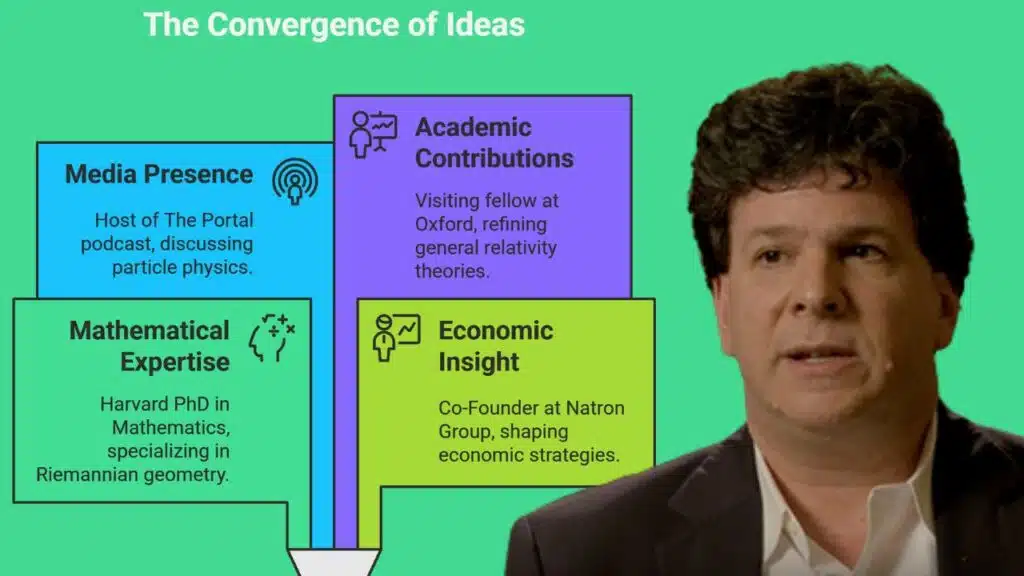
Eric Weinstein mixes math, economics, and media like a smooth recipe. He earned a PhD in Mathematics from Harvard University in 1992. He dove into Riemannian geometry and gauge theoretic methods.
New York’s Natron Group lists him as Co-Founder and Principal. He probes puzzles in the standard model and theory of everything. As Managing Director at Thiel Capital in San Francisco, he shapes bets on economic manhattan project efforts.
He works at Oxford University’s Mathematical Institute as a visiting research fellow, refining general relativity and geometric unity.
Listeners tune in to The Portal podcast for his clear talk on particle physics and society. That idea led him to coin Intellectual Dark Web and spark lively YouTube interviews. He brings in experts like Timothy Nguyen to discuss self-dual Yang-Mills equations.
Views on mortgage backed securities, labor market theory, and academic credentialism flow in every chat. He speaks with the proof of a Harvard and Oxford alum.
Contributions to Mathematics
He uses gauge theory and curved-space math to merge general relativity with the standard model. His Geometric Unity plan weaves in self-dual Yang–Mills rules and bundle math to sketch new particle symmetries.
Geometric Unity and its implications
Eric Weinstein proposes geometric unity as a new framework. It merges Riemannian geometry with Ehresmannian geometry. The first provides the foundation for general relativity, the second supports the standard model.
He applies gauge theoretic methods to link spacetime curvature with internal symmetries. That idea draws on work from Oxford University and Harvard University.
Researchers at Oxford University and other research centers probe predictions from this proposal. Some tests might probe particle properties and force carriers beyond the standard model.
The concept could reshape studies in gravity and fields. That effort might spark fresh models for a theory of everything. New talks could follow at the mathematical institute.
Impact on Economics
He blows the whistle on rent-seeking in big banks, he unpacks how mortgage bonds trip up credit models. He throws a curveball at labor market theory, he dares quants to rewrite their neo-classical playbook.
Critiques of economic systems
Eric Weinstein attacks neo-classical theory as too rigid. He links mortgage backed securities to flawed risk math in the 2008 crisis. He slams academic credentialism as a gatekeeper.
He labels rent-seeking behavior a drag on real invention. Weinstein published a 2002 paper offering a canonical Coasian market solution to immigration issues.
Weinstein calls for an economic manhattan project to rewrite core assumptions. He draws a metaphor of rusted gears to show how systems stall. He applies gauge theoretic methods from math physics to spark new models.
He pushes fresh labor market theory that respects human value.
Advocacy for new economic thinking
Fans grin when he pitches an Economic Manhattan Project. That plan rewrites neo-classical theory. It links test tubes with venture funds. Thiel Capital could fuel these missions.
Critics nod as he blasts rent-seeking behavior and faulty mortgage backed securities. The pitch tackles labor market theory too. A call to merge science with entrepreneurship lands like a bolt of lightning.
Work in Media
He hosts The Portal podcast, where he talks with minds like Sam Harris and Jordan Peterson on YouTube. He coined the term Intellectual Dark Web and fuels debate in alternative media.
Host of “The Portal” podcast
Weinstein launched The Portal podcast in June 2019. He records with professional microphones and editing software. Episodes go live on YouTube and podcast platforms. He invites big thinkers.
They debate new ideas.
Past guests include investor Peter Thiel, science researcher Bret Weinstein, critic Anna Khachiyan and physicist Stephon Alexander. The podcast coined the intellectual dark web label.
Fans of alternative media follow lively talks and deep debate. It explores economics, physics and society.
Co-founder of the term “Intellectual Dark Web”
Eric first coined the phrase intellectual dark web in a 2018 New York Magazine piece by Bari Weiss. He named a group of thinkers, including Bret Weinstein, Jordan Peterson, and Sam Harris.
It described online debates via alternative media and popular youtube interviews. This concept gave audiences a sense of hidden discourse beyond mainstream channels.
Press outlets from Vox to the New York Times adopted the label. Editors used it to group dissenting voices on free speech and academic credentialism. Fans then debated ideas on rent-seeking behavior and labor market theory.
Media coverage kept the phrase alive in podcast discussions.
Role at Thiel Capital
Eric heads deal flow at Thiel Capital as managing director. He runs risk reviews with software tools and builds funding strategies for new ventures.
Managing Director responsibilities
The managing director oversees investments and strategic initiatives at Thiel Capital. Weinstein guides research and plays a key role in investment choices at the Natron Group. This job drives economic research and uses advanced math for market forecasts.
It taps Riemannian geometry, gauge theoretic methods, and other tools to model risk. Such duties champion interdisciplinary analysis. One push has become the Economic Manhattan Project to blend economics with scientific disciplines.
Public Speaking and Thought Leadership
He hits the stage, explains neo-classical theory and general relativity, uses visual aids and a microphone like art tools, paints a clear picture for all, and sparks new ideas in every room—read on.
Keynote speeches on science and society
Eric Weinstein shakes up science and society in his keynote speeches. He frames geometric unity as a bridge across ideas. It links differential geometry, general relativity, and the Standard Model.
He mocks academic credentialism, and he fights rent-seeking behavior at every turn.
Speakers cite his work at thiel capital to show economic manhattan project fixes. He labels himself a member of the Intellectual Dark Web. He targets neo-classical theory and mortgage backed securities with clear questions.
He pairs field methods and social policy in vivid stories.
Takeaways
Readers travel with a thinker who spans math, financial markets, and media. He charts paths in general relativity with Geometric Unity. He warns on illiquid mortgage‐backed securities and market risk.
His vision for an Economic Manhattan Project aims to reshape models. He shifts ideas into action at Thiel Capital and on The Portal podcast. Each insight lands like a spark, inviting fresh views.
For a deeper dive into his life and work, visit our page on Who is Eric Weinstein?.
FAQs
1. Who is Eric Weinstein?
He is a mathematical physicist. He studied at Harvard University and Oxford University. He is a managing director at Thiel Capital. He also leads the Natron Group. He is a key voice in the intellectual dark web.
2. What is geometric unity?
Geometric unity is his theory of everything. It links general relativity and the standard model. It uses gauge theoretic methods and Riemannian geometry. It tries to blend gravity and particles in one framework.
3. What has he done in economics?
He has studied rent-seeking behavior and neo-classical theory. He calls for an economic Manhattan project. He spoke on the financial crisis and mortgage backed securities. He wrote on labor market theory and critiques academic credentialism.
4. What roles does he hold at Thiel Capital and Natron Group?
He is managing director at Thiel Capital. He leads the Natron Group. He works with Peter Thiel on big ideas. He tests new math and economics tools in high-risk bets.
5. How does he speak to the public?
He uses alternative media and hosts free YouTube interviews. He joins podcasts and live talks. He shares math and economics stories with humor. He makes deep ideas feel like friendly chats.
6. What math work is he known for?
He is a visiting research fellow at the mathematical institute at Oxford University. He uses gauge theoretic methods to tie space and particles. He studies self dual Yang Mills equations. He links these ideas to general relativity and the standard model. He aims for a grand theory of the universe.






















