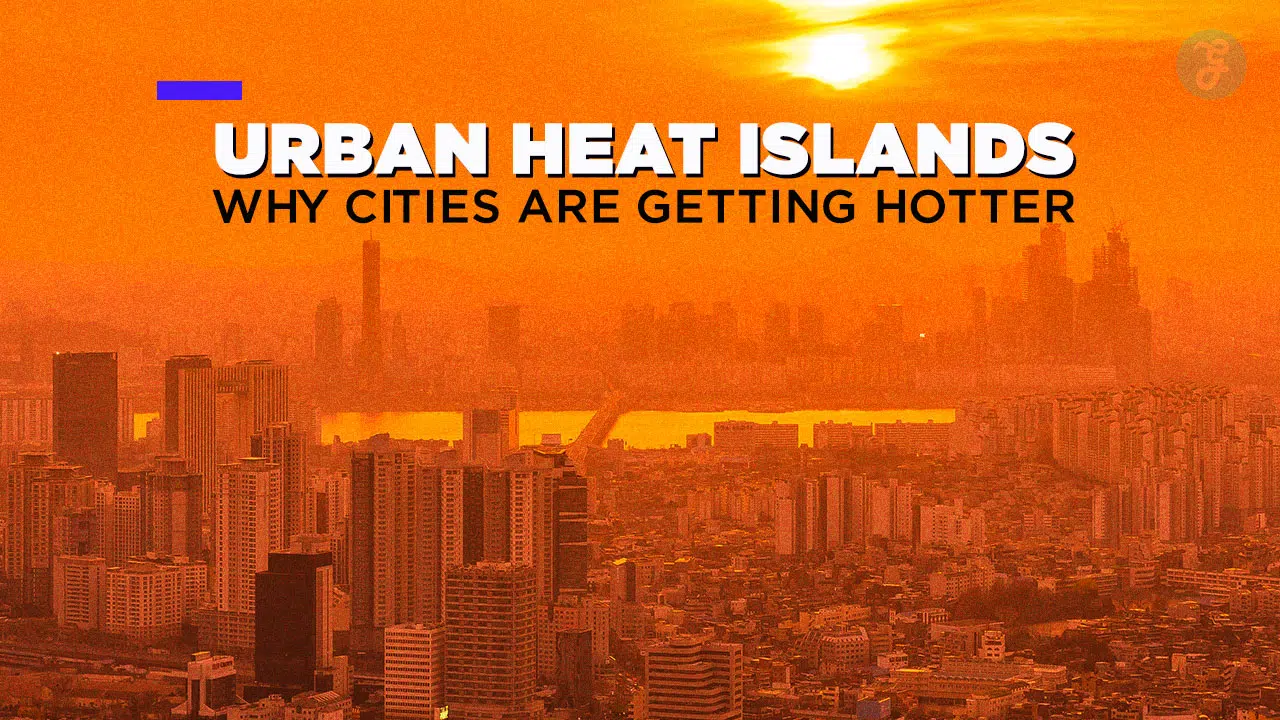
You know that feeling when you step out of your front door in July and the heat just smacks you in the face? It’s not just the summer sun. It’s the city itself. If you have ever wondered why your downtown apartment feels like a sauna while your friend’s place in the suburbs feels ten degrees cooler, you are noticing a real phenomenon. It turns out, our concrete jungles are actually trapping heat, creating invisible domes of warmth that scientists call Urban Heat Islands.
The difference is intense. In some US cities, neighborhoods can be up to 20°F hotter than rural areas just a few miles away. Walk you through exactly why this happens and, more importantly, the simple steps we can take to cool things down.
So, grab a cold drink, and let’s look at what is really going on with our city streets.
What Are Urban Heat Islands?
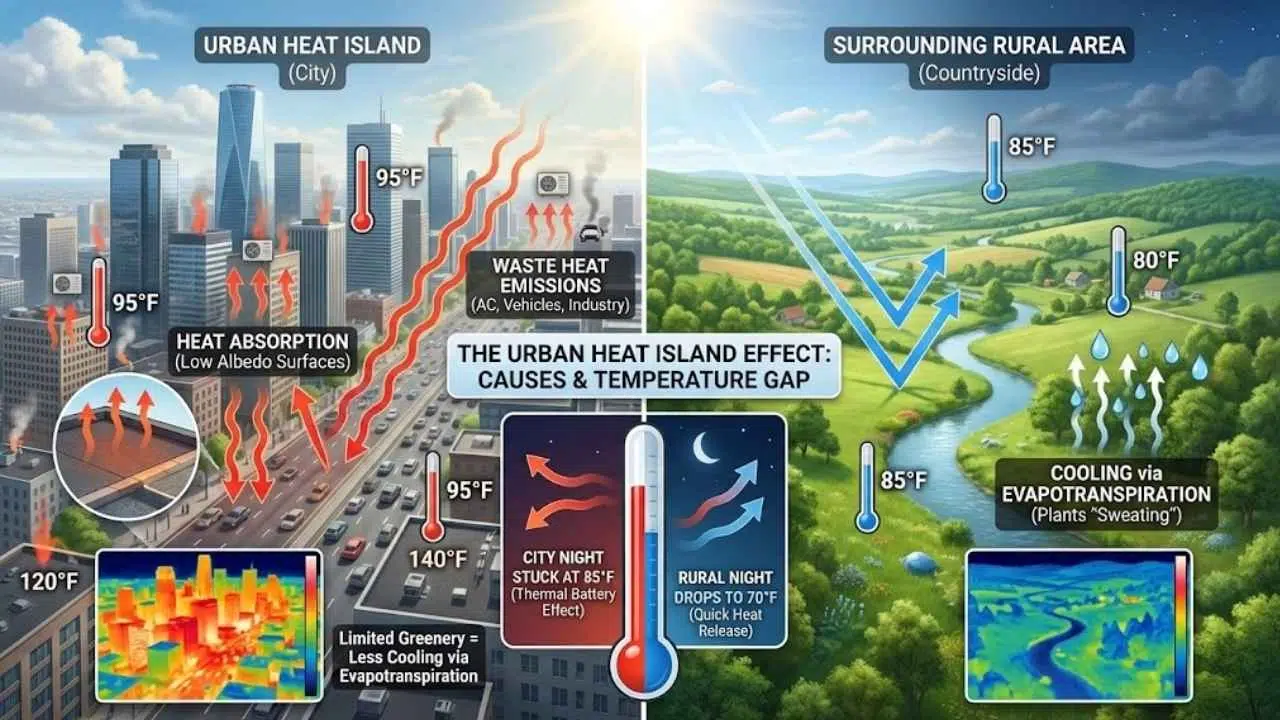
An urban heat island is essentially a metropolitan area that is significantly warmer than its surrounding rural areas due to human activity.
Think of a city like New Orleans or Newark. These places are packed with dark rooftops, paved roads, and dense buildings. These materials are experts at soaking up the sun’s energy all day long.
The Temperature Gap Explained
In the countryside, trees and grass do a great job of keeping things cool through a process called evapotranspiration—basically, plants “sweating” water vapor to cool the air. But in the city, we have replaced those plants with dry, hard surfaces.
A recent analysis by Climate Central highlighted just how extreme this gap can be. They found that in cities like New Orleans, Louisiana, and Newark, New Jersey, the heat intensity is among the highest in the nation due to the sheer density of heat-absorbing surfaces.
“Research shows that for every 10% decrease in tree canopy, land surface temperatures can increase by nearly 2°F. It’s a direct trade-off between gray concrete and green cooling.”
How they differ from surrounding rural areas
The difference isn’t just about feeling uncomfortable at noon. It changes how the whole environment works.
Rural areas cool down quickly once the sun sets. The grass and soil release heat fast. Cities, however, act like giant thermal batteries.
They store that heat all day and slowly leak it out at night. This means that while the countryside might drop to a pleasant 70°F at night, the city might stay stuck at a muggy 85°F.
This “nighttime warming” is actually one of the most dangerous parts of the heat island effect because it gives our bodies—and our buildings—no chance to recover.
Causes of Urban Heat Islands
It’s not just one thing making our cities hot; it’s a perfect storm of design choices we have made over the last century.
Heat absorption by urban structures
The main culprit is something scientists call “low albedo.” That is a fancy way of saying dark surfaces don’t reflect sunlight; they absorb it.
Think about wearing a black t-shirt on a sunny beach versus a white one. Asphalt roads and dark tar roofs cover about 30-45% of land in major US cities, acting like that black t-shirt on a massive scale.
These surfaces can reach temperatures of 120°F to 150°F on a hot afternoon. That heat doesn’t just disappear; it radiates back up at you, making the air feel suffocating.
Limited greenery and vegetation
We have paved over our natural air conditioners. Trees provide shade, which prevents the ground from heating up in the first place, but they also cool the air directly.
Without them, we lose that protection. You can see this clearly in satellite thermal data: neighborhoods with mature oak or maple trees are often visible as “cool islands” within the hotter city map.
Heat emissions from vehicles and buildings
Here is a factor many people overlook: waste heat.
- Air Conditioners: Every AC unit cooling a room is pumping hot air out into the street. It’s a vicious cycle where cooling our insides heats up our outsides.
- Traffic: Thousands of combustion engines idling in traffic release massive amounts of heat.
- Industry: Factories and large commercial buildings vent heat continuously.
In dense areas like Manhattan, this waste heat alone can raise the local temperature by several degrees.
Characteristics of Urban Heat Islands
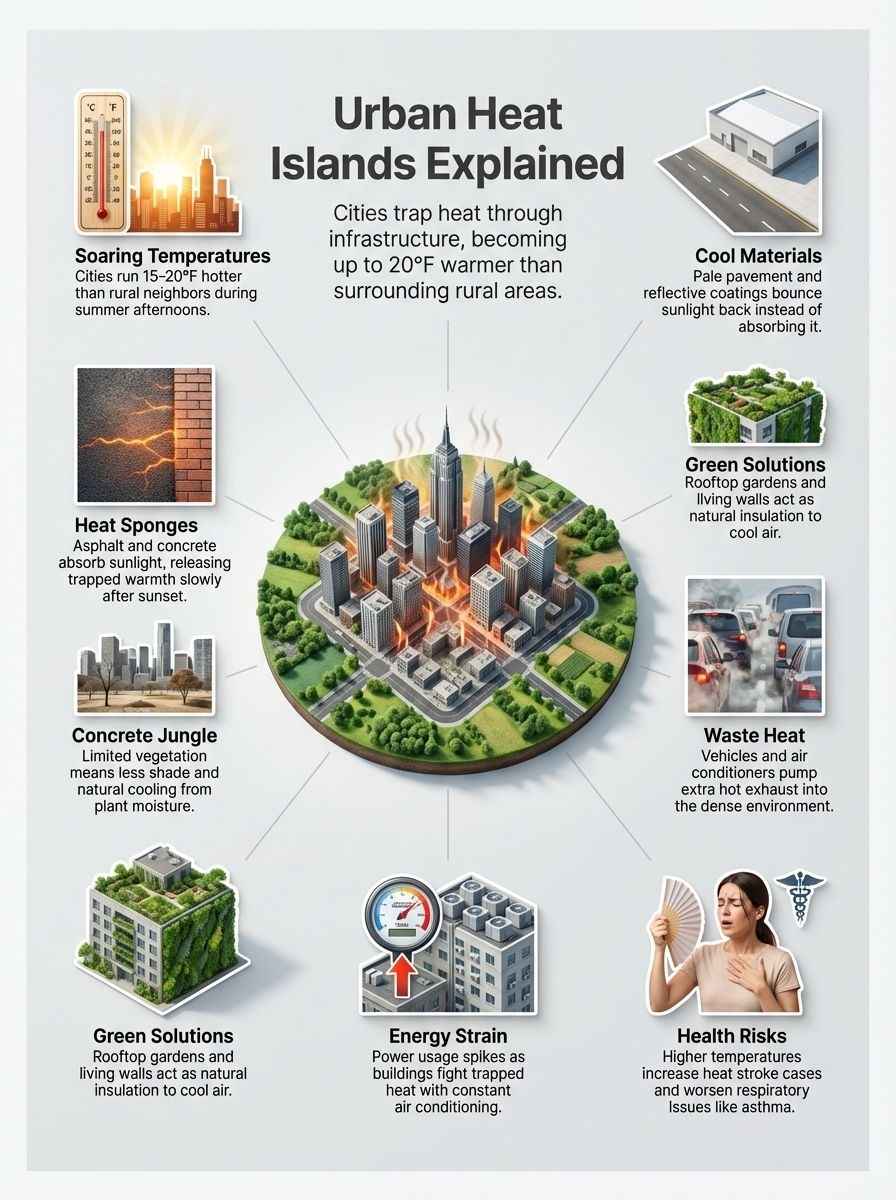
You can identify a heat island by looking for a few specific symptoms. It’s not just “it’s hot”; it’s how it stays hot.
Higher daytime and nighttime temperatures
The hallmark of a heat island is that the temperature doesn’t drop when it should. During the day, the sun bakes the pavement. But the real trouble starts after sunset.
In a phenomenon documented by NASA and NOAA, urban areas often see their minimum nighttime temperatures rising much faster than their daytime highs. This leads to sticky, sleepless nights where the thermometer simply refuses to budge.
| Surface Type | Typical Noon Temp (°F) | Effect on Air Temp |
|---|---|---|
| Green Grass | 85°F | Cools the air via evaporation |
| Asphalt Road | 140°F | Heats the air via radiation |
| White Roof | 100°F | Reflects heat away |
| Black Roof | 170°F | Absorbs and holds heat |
Variation in intensity across cities
Not all cities burn the same way. The intensity depends on how the city is laid out.
Cities with wide, treeless boulevards and sprawling parking lots, like Phoenix or Houston, experience heat differently than taller, denser cities like Chicago.
Even within the same city, the difference is stark. A 2024 study showed that formerly redlined neighborhoods—areas that historically received less investment—often have fewer trees and more pavement, making them significantly hotter than wealthier, greener neighborhoods just a few blocks away.
Impacts of Urban Heat Islands
This extra heat does real damage to our wallets and our health.
Increased energy consumption
When it gets hot, we crank up the AC. This reaction hits our bank accounts hard.
According to the Department of Energy, electricity demand climbs by about 1.5% to 2% for every 1°F increase in temperature. With the U.S. Energy Information Administration forecasting average summer electric bills hitting around $178 per month in 2025, that extra heat island effect is costing you real money every single month.
This surge in demand puts massive strain on the power grid, leading to brownouts right when we need cooling the most.
Negative effects on public health
Heat is the number one weather-related killer in the United States, surpassing hurricanes and tornadoes combined.
The CDC reported a substantial increase in heat-related emergency room visits in 2024 and 2025. The danger is that in a heat island, the body never gets a break.
When nights stay above 80°F, people without air conditioning—especially seniors and those with heart conditions—cannot cool down, leading to heat exhaustion and stroke. It’s a quiet crisis that happens behind closed doors.
Strain on urban ecosystems
It’s not just humans who suffer. The heat changes the local water cycle.
Hot pavement heats up storm water runoff. When that hot water flows into local streams or lakes, it can shock aquatic life and reduce the water’s ability to hold oxygen.
Trees in these hot zones also struggle. They need more water to survive the intense heat, and if they don’t get it, they die, leaving the neighborhood even hotter than before.
Addressing the Urban Heat Island Effect
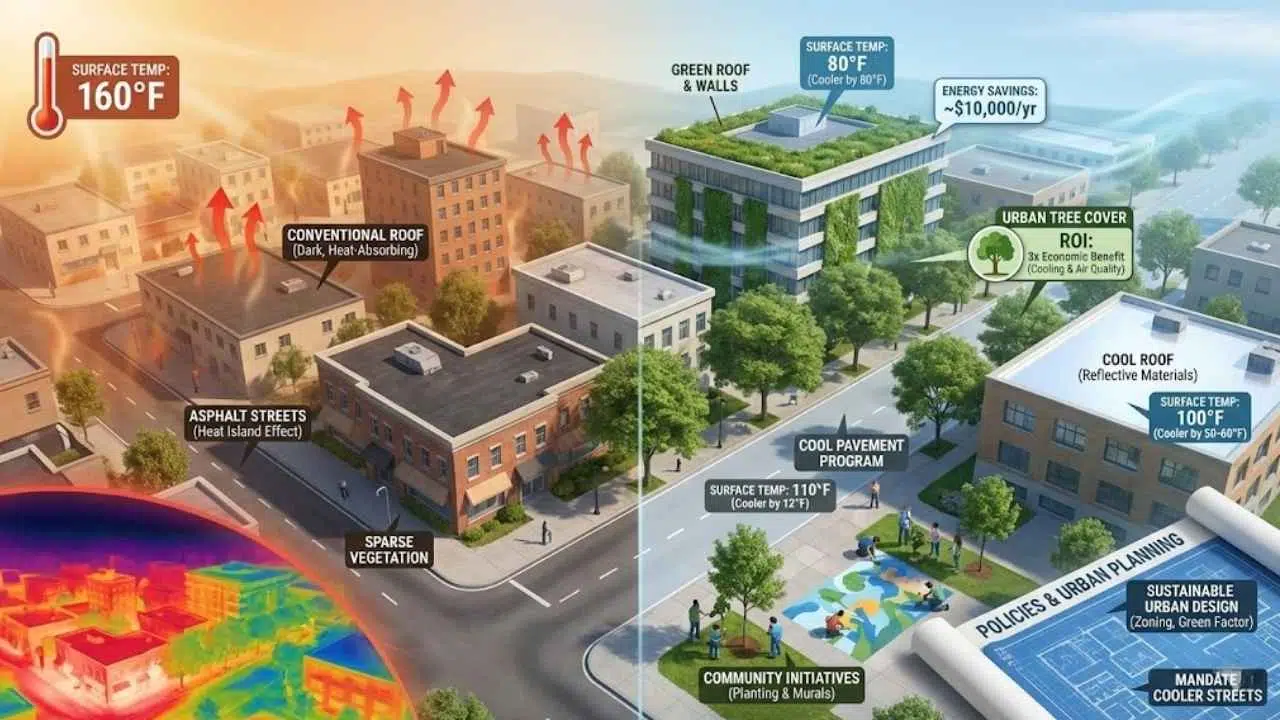
The good news is that we know exactly how to fix this. We just need to change the surfaces we build with.
Incorporating green roofs and walls
One of the most effective solutions is to turn black roofs into green gardens. A famous example is Chicago City Hall. The city installed a massive rooftop garden, and the results were incredible. On a hot summer day, the green roof surface temperature was found to be up to 80°F cooler than the black tar roof next door.
This doesn’t just cool the air; it saves the building owners about $10,000 a year in energy costs.
Expanding urban tree cover
Planting trees is the low-tech, high-impact solution. But you have to plant the right trees in the right places.
- Shade Factor: Large canopy trees like Oaks or Maples are best because they shade the street, preventing the asphalt from soaking up heat.
- Placement: Planting trees on the west and south sides of a building provides the most protection from the intense afternoon sun.
- ROI: The US Forest Service estimates that a healthy street tree generates three times more economic benefit (in cooling and air quality) than it costs to maintain.
Using reflective and cool building materials
If you can’t plant a garden on your roof, you can simply paint it white. Cool roofs use highly reflective paint or tiles to bounce sunlight back into space. The Cool Roof Rating Council rates these products, and using a certified cool roof can lower the roof’s surface temperature by 50-60°F.
This simple switch is becoming standard in building codes across California and other hot states because it is one of the cheapest ways to drop the temperature instantly.
The Role of Policies and Urban Planning
Individual actions help, but city-wide problems need city-wide plans.
Importance of sustainable urban design
Cities are rewriting their rulebooks to mandate cooler streets. It’s about being smarter with our infrastructure. For example, Portland, Oregon, has implemented zoning codes that include a “green factor,” requiring new developments to include a certain amount of vegetation or green roofing.
This ensures that as the city grows, it doesn’t just become a solid block of concrete. It integrates nature into the blueprint of the city itself.
Community-level initiatives to reduce heat
Some of the most exciting work is happening right on the pavement. The city of Phoenix has been piloting a “Cool Pavement” program. They apply a lighter-colored, reflective coating to existing asphalt streets. Results from their 2024 and 2025 reports showed that these treated streets were up to 12°F cooler on the surface than untreated roads.
While the air temperature reduction is more modest, that surface cooling helps preventing the neighborhood from baking all night long. Local groups in many cities are now applying for grants—funded by federal initiatives like the Inflation Reduction Act—to plant community gardens and paint murals on hot intersections.
Final Thoughts
Urban heat islands are a man-made problem, which means they have a man-made solution. We know that swapping dark asphalt for cool pavement, planting more shade trees, and turning rooftops into gardens can drop temperatures dramatically.
Why not take a look at your own home or apartment building? Even something as simple as adding potted plants to your balcony or choosing a lighter color for your next roof repair can help. If we all chip in, we can turn the temperature down and make our cities comfortable again.