
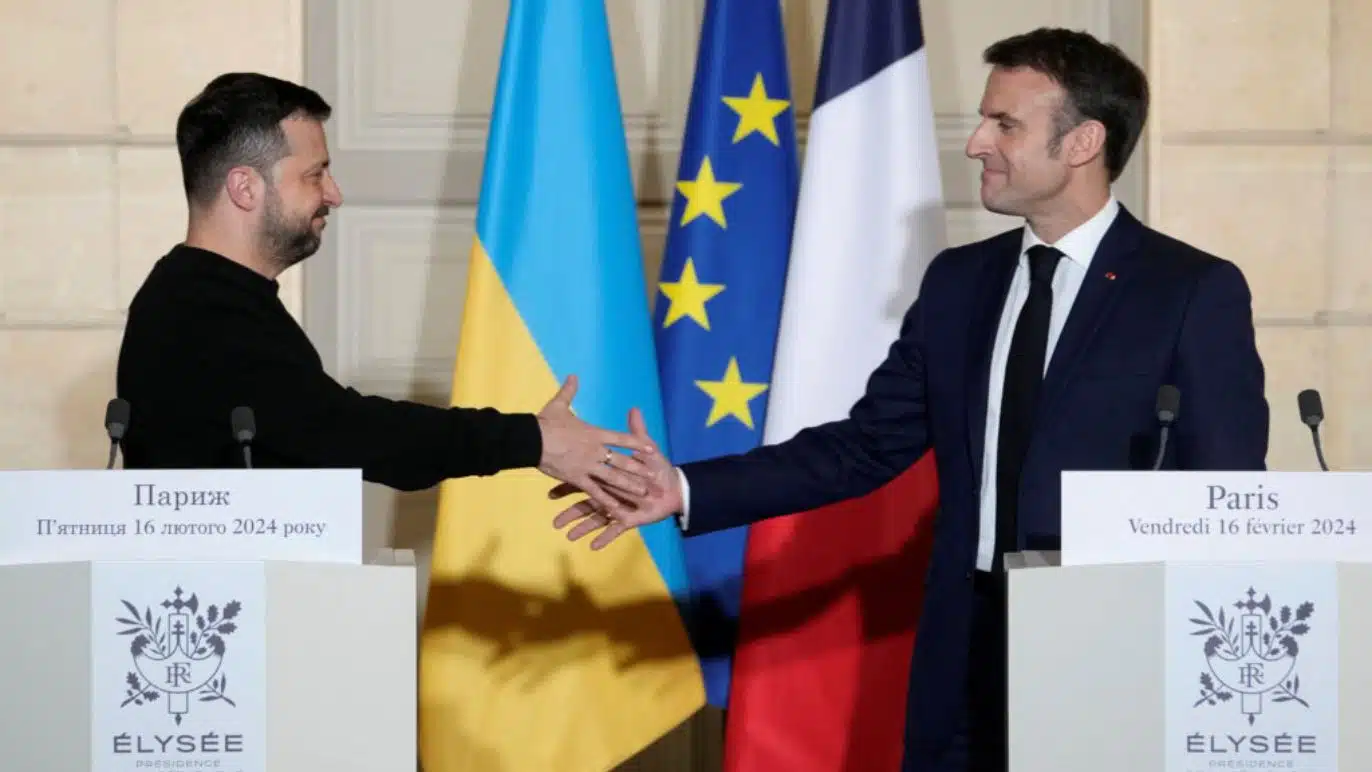
Ukrainian President Volodymyr Zelensky has drawn a firm line in the sand, declaring that any security guarantees forming part of a peace package with Russia must include boots on the ground from the United Kingdom and France. Speaking in Kyiv on January 3, 2026, after consultations with Western security advisers, Zelensky emphasized this as a non-negotiable minimum, amid ongoing efforts to finalize a framework amid fragile ceasefire talks. The demand underscores Kyiv’s deep-seated fears of Russian revanchism, positioning European military presence as the cornerstone of lasting stability.
Zelensky’s Kyiv Briefing: Laying Down the Law
President Zelensky’s remarks came at the end of a high-stakes meeting in Kyiv with national security advisers from Ukraine’s key allies, part of the “Coalition of the Willing” led by France and the UK. He made it crystal clear: no final security guarantees agreement exists yet, but physical military presence from partner nations is “mandatory” and “one of the important factors.” “The UK and France are the chairs of the Coalition of the Willing. Their military presence is mandatory,” Zelensky stated bluntly, acknowledging that not all coalition members may commit troops but stressing minimum requirements.
This isn’t a casual ask; Zelensky highlighted the parliamentary hurdles in Europe, noting that even willing leaders need legislative approval under their constitutions. The final roster of troop-contributing countries will only solidify post-ratification, a process Kyiv can’t control. The briefing followed Zelensky’s recent Mar-a-Lago sit-down with U.S. President Donald Trump, where a draft 20-point peace plan was discussed—down from an initial U.S.-proposed 28 points that leaned heavily toward Russian demands. Trump called talks “final stages” on December 28, 2025, but no breakthroughs emerged, prompting Zelensky’s pivot to European backers.
The Coalition of the Willing: Europe’s Backbone for Ukraine
The Coalition of the Willing, comprising up to 35 nations, has evolved from a loose alliance providing arms into a vanguard for post-war security. Co-chaired by French President Emmanuel Macron and UK Prime Minister Keir Starmer, it pledges deployments on land, sea, and air to deter Russian aggression once a ceasefire holds. By late 2025, 26 countries had committed to some form of presence, with France and the UK dispatching joint teams to scout “strategic locations” in Ukraine as early as March 2025.
This builds on Paris summits where Macron touted a “reassurance force”—not frontline fighters or Ukrainian army substitutes, but a deterrent shield. The UK hosted over 200 planners from 30 nations, hashing out logistics, command structures, and contributions ranging from air defense to naval patrols. Zelensky has eyed up to 200,000 European peacekeepers, citing Russia’s 1.5 million-strong army as the benchmark for credible deterrence. Recent Paris meetings finalized a security document for Trump talks, focusing on multinational support with U.S. strategic backing.
Germany shows tentative support, with politicians warming to Bundeswehr involvement, while Baltics and Nordics eye participation. Yet consensus falters—not all Europeans agree, as Macron admitted in March 2025, vowing to press ahead without unanimity. The coalition’s mandate emphasizes training, infrastructure protection, and air defense, ensuring no direct combat roles that could escalate to NATO-Russia clash.
Historical Push for Troops: From Davos to Paris Summits
Ukraine’s troop demand didn’t spring up overnight. As early as January 2025 at Davos, Zelensky floated 200,000 peacekeepers to enforce guarantees. By March, Macron and Starmer announced the reassurance force post-Paris talks, sending defense chiefs to Kyiv within weeks. August saw UK offers to guard Ukrainian skies and ports, sans frontline deployment.
September 2025 Paris meetings under the coalition banner advanced “precise plans,” despite German hesitance and Russian rebuffs. November reinforced multinational force commitments, with Macron insisting on “robust” non-paper guarantees. December’s “critical moment” ramp-up pressured Russia, as Europeans pledged billions in aid alongside troop prep. Zelensky’s New Year’s address claimed a peace deal “90% ready,” tying security to territorial integrity—no Donbas cessions.
This trajectory reflects Kyiv’s evolution from aid pleas to ironclad demands, learning Budapest Memorandum’s 1994 lesson: paper promises failed against 2022 invasion.
Reactions from London and Paris: Cautious Commitment
UK and French leaders have long co-piloted this initiative, but Zelensky’s mandate sharpens the spotlight. Starmer’s government hosted planning sessions and pledged non-frontline roles, aligning with deterrence goals. Macron, post-Paris, committed €2 billion in missiles and jets, signaling resolve despite domestic pushback. Both nations’ chiefs of staff scoped Ukraine in 2025, identifying bases for rapid deployment.
No fresh rebuffs emerged post-Zelensky’s January 3 words; instead, coalition advisers converged in Kyiv, suggesting alignment. France views it as weaning Europe off U.S. dependency under Trump, boosting EU defense spends. Britain emphasizes “over 200 military planners,” firming contributions across domains. Parliamentary ratification looms as the crux—London and Paris parliaments must greenlight amid public war fatigue.
Moscow’s Fury: ‘Legitimate Targets’ and Red Lines
Russia’s response is predictably volcanic. Putin labeled pre-peace troops “legitimate targets” in September 2025, warning of direct confrontation. Foreign Ministry spokesperson Maria Zakharova deems foreign peacekeepers “unacceptable,” a NATO intervention ploy. Post-peace, Putin claims no need for troops if Moscow honors deals—but demands reciprocal Russian guarantees.
Kremlin insists on legally binding pacts sans NATO boots, rejecting UN-mandated forces without veto power. Lavrov calls it “foreign military intervention,” tying it to maximalist demands like sanctions relief on Rosselkhozbank. Analysts see this as stalling, isolating Putin by forcing rejection of “good peace.”
Strategic Stakes: Deterrence vs. Escalation Risks
These troops aim to plug Ukraine’s deterrence gap post-ceasefire. Zelensky argues half Russia’s army size needed; coalition eyes air, sea, EW integration for viability. Non-combat roles—training, patrols, infrastructure guard—minimize escalation, per Macron. Yet perils abound: without U.S. buy-in, Europe’s force lacks punch; Russian strikes could spark NATO Article 5 debates.
Ukraine rejects frontline withdrawals or occupation recognition sans guarantees. Trump’s 15-year U.S. pact hints support, but details fuzzy. Economically, reconstruction ties in, with coalition eyeing damages commission.
| Aspect | Pro-Troops Argument | Risks/Challenges |
|---|---|---|
| Deterrence | Physical presence counters Russia’s 1.5M army; multi-domain coverage (land/sea/air) | Putin vows targeting pre-deal; no UN mandate |
| Coalition Buy-In | 26 nations pledged; UK/France lead | Parliaments may balk; Germany hesitant |
| U.S. Role | Strategic backstop possible | Trump prioritizes quick deal over Europe |
| Mission Scope | Reassurance, not combat; training/infra | Escalation if attacked; public fatigue |
Broader Geopolitical Ripples
This demand reshapes transatlantic dynamics. Trump’s Mar-a-Lago talks pressured Kyiv but spurred European autonomy. EU ramps defense, eyeing €5B ammo pledges. Turkey eyes training roles; Nordics bolster flanks. Globally, China watches warily, as troop plans sideline U.S.-Russia bilateralism.
For Ukraine’s economy—ravaged by strikes—guarantees unlock reconstruction, vital for Thakurgaon-like exporters eyeing post-war markets. Zelensky ties elections to ceasefire security, eyeing stability.
Path Forward: Paris Finalization and Trump Talks
Upcoming Paris summit finalizes the guarantees doc for Trump handover. Zelensky eyes “week or 10 days” for clarity, per late 2025. Success hinges on ratification races and Russian concessions. Failure risks frozen conflict, emboldening Putin.
Kyiv’s gambit elevates stakes: troops or no deal. As Zelensky put it, presence defines the coalition’s existence. Europe stands at crossroads—deliver or dilute deterrence. The world watches.