

In a sweeping move that underscored his administration’s aggressive stance on immigration, former President Donald Trump issued a presidential memorandum directing the U.S. military to take control of a stretch of federal land along the southern border, spanning parts of California, Arizona, and New Mexico. The action, aimed at bolstering border security, invoked the military’s authority to establish National Defense Areas within a long-standing federal zone known as the Roosevelt Reservation.
This decision marked one of the most direct efforts by the Trump administration to integrate military resources into immigration enforcement—an issue that was central to Trump’s political platform from his 2016 campaign through his presidency.
Presidential Memo: Military Mission to ‘Repel Invasions’
The memorandum, signed and issued by Trump on a Friday during his term in office, was titled “Military Mission for Sealing the Southern Border of the United States and Repelling Invasions.” In it, Trump ordered the secretaries of Defense, Homeland Security, Interior, and Agriculture to coordinate the transfer of jurisdiction over specific federal lands to the Department of Defense (DoD).
According to the directive, the Department of Defense would gain operational control over the specified areas, with authority to carry out a wide array of military functions, including but not limited to:
-
Construction of border barriers and fences
-
Deployment of surveillance and detection equipment
-
Establishment of defensive infrastructure
-
Direct monitoring and security patrols
Trump’s memo emphasized the severity of the situation, calling the southern border “under attack” from “a variety of threats,” which he did not specify but has in the past included illegal immigration, drug trafficking, and cartel activity.
“The complexity of the current situation requires that our military take a more direct role in securing our southern border than in the recent past,” Trump wrote.
What is the Roosevelt Reservation?
At the heart of this decision is the Roosevelt Reservation, a 60-foot-wide strip of federal land that runs along the southern edge of the United States, originally set aside by President Theodore Roosevelt in 1907. The reservation was created to maintain a clear and enforceable line between the U.S. and Mexico.
The reservation spans three border states:
-
California
-
Arizona
-
New Mexico
This area was originally established to prevent encroachments and enable easier enforcement of border laws. Over the decades, it has played various roles in environmental conservation, public land management, and homeland security. However, Trump’s memo reclassified this area as a military installation, designating parts of it as National Defense Areas under the control of the U.S. military.
Exclusion of Tribal Lands and Native Reservations
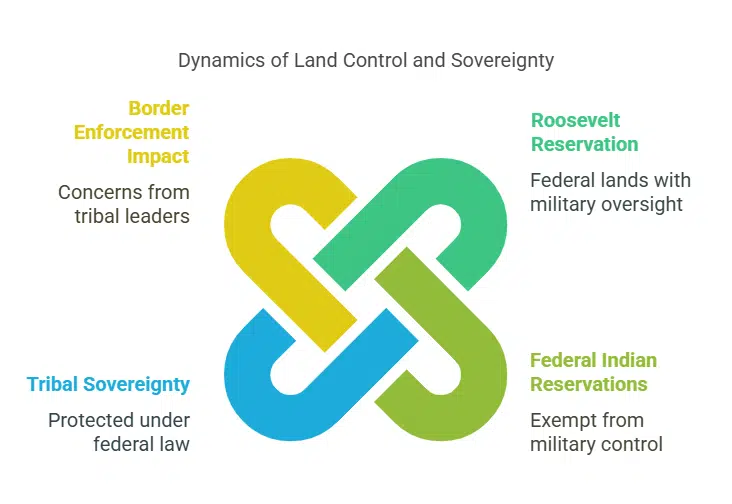
While the order grants sweeping powers over the Roosevelt Reservation and surrounding federal lands, the memo explicitly excludes all Federal Indian Reservations from military control. This clause was likely included to avoid infringing upon tribal sovereignty, which is protected under federal law.
Still, concerns have been raised in the past by tribal leaders and advocacy organizations regarding the impact of border enforcement on Native American lands, particularly in Arizona, where the Tohono O’odham Nation holds significant territory that lies directly on the U.S.–Mexico border.
Expanding the Military’s Role in Border Security
While the U.S. military has been previously deployed to the southern border in support roles, such as engineering, logistics, and surveillance (e.g., during Operation Faithful Patriot in 2018), Trump’s directive elevated the military’s involvement to an operational level, potentially allowing for direct enforcement actions.
The memorandum gives the Secretary of Defense the authority to determine what constitutes “reasonably necessary and appropriate” military activities. This language is notably broad, leaving room for interpretation and raising concerns about the scope and legality of military actions on U.S. soil.
According to the memo, activities could include:
-
Building and reinforcing physical barriers
-
Monitoring border crossings using drones and ground sensors
-
Using mobile units for rapid response along the land strip
-
Establishing forward operating bases and command posts
The lack of specific limitations raised alarms among civil liberties organizations and legal experts, particularly in light of the Posse Comitatus Act, which restricts the use of federal military forces in domestic law enforcement.
A Key Step in Trump’s Broader Border Strategy
Trump’s presidency was defined in many ways by a hardline approach to immigration. He ran on a promise to build a “big, beautiful wall” and enforce mass deportations of undocumented immigrants. Early in his administration, he issued multiple executive orders that:
-
Drastically expanded the criteria for deportation
-
Boosted funding for Immigration and Customs Enforcement (ICE)
-
Ended the Deferred Action for Childhood Arrivals (DACA) program (later restored by court orders)
-
Reallocated military funds for border wall construction
The Roosevelt Reservation order followed these earlier steps and sought to bypass legal delays and opposition by declaring the military’s need for control as a national security issue.
Legal, Environmental, and Human Rights Concerns
The militarization of the border raised legal questions and criticism from environmentalists, civil liberties groups, and border communities. Activists have warned about the consequences of military control over public lands, which often contain:
-
Protected ecosystems and wildlife corridors
-
Historic landmarks and archeological sites
-
Communities that rely on land access for agriculture and transport
Environmental impact studies have shown that border wall construction disrupts habitats for endangered species such as the jaguar, ocelot, and Mexican gray wolf. Additionally, communities near the Roosevelt Reservation expressed concerns over restricted access, noise, light pollution, and surveillance.
Legal scholars and advocacy organizations also argued that the vague nature of “repelling invasions” and the militarization of domestic land could blur the line between national defense and civilian law enforcement, potentially violating constitutional protections.
A Legacy That Shaped the National Debate
Though portions of Trump’s immigration agenda were rolled back or revised under the Biden administration, the memorandum to transfer jurisdiction of border lands to the military remains a defining moment in U.S. immigration and defense policy. It symbolized the intersection of federal land use, military authority, and domestic immigration control, setting a precedent that future administrations may revisit.
This move illustrated the extent to which a sitting president could reshape border policy through executive action—bypassing Congress in the process—and demonstrated the Trump administration’s willingness to use national defense tools for domestic political goals.
Trump’s order to designate parts of the southern border as military-controlled zones under the Roosevelt Reservation was a bold and controversial step in his border enforcement campaign. By militarizing public lands and giving broad powers to the Department of Defense, the Trump administration redefined how the U.S. could approach border security—raising profound questions about federal power, constitutional limits, and the balance between safety and civil rights.
Whether this action ultimately improved border security or created more legal and humanitarian complications remains a subject of ongoing debate among lawmakers, experts, and the communities directly affected.






















