When you suffer an injury due to someone else’s negligence, it’s crucial to gather evidence to support your case. Personal injury claims can be challenging, and the evidence you collect is often the determining factor in whether your claim succeeds.
In this article, we will dive deep into 8 tips for gathering evidence in personal injury cases in Australia, providing you with practical, actionable advice to help you build a strong case.
From documenting the accident scene to securing expert opinions, each tip is designed to help you gather evidence that strengthens your claim and maximizes your chances of receiving fair compensation.
Why Evidence Matters in Personal Injury Cases
Before delving into the tips, let’s take a moment to understand why evidence is so critical in personal injury cases. In Australia, personal injury claims rely heavily on evidence to:
- Establish liability: Evidence helps demonstrate that the defendant is responsible for the injury. Whether it’s a driver in a car accident or a property owner in a slip and fall, evidence proves who was at fault.
- Prove the severity of the injury: Medical records, witness statements, and photos show how serious your injury is, impacting your claim for compensation.
- Document damages and long-term impact: Your injuries might not only affect you physically but also have emotional and financial consequences. Gathering the right evidence shows how your life has been altered.
Now, let’s explore the 8 tips to gather the best possible evidence for your personal injury case.
Tip 1 – Document the Scene of the Incident
The first tip for gathering evidence in personal injury cases is documenting the scene of the accident. This can make a huge difference in the success of your claim, as it preserves essential details that may be lost over time. Immediate documentation helps you recall the accident’s circumstances while the memory is still fresh.
Importance of Immediate Documentation
Accident scenes can change rapidly. Whether it’s the removal of damaged vehicles, changes in the weather, or modifications to the environment [e.g., construction sites being cleaned up], timely documentation captures the moment as it was. Waiting too long to document the scene may mean missing out on crucial details that could strengthen your case.
Tools to Use for Scene Documentation
In today’s digital age, smartphones make documentation quick and easy. You don’t need specialized equipment — a few essential tools can go a long way in ensuring you collect all necessary information.
| Tool | Purpose |
| Smartphone Camera | Capture clear photos and videos of the scene. |
| Voice Recorder | Record your thoughts or witness statements when you can’t write them down. |
| Pen and Notebook | Jot down key details like time, location, or witness contact information when a camera or phone isn’t available. |
What to Capture at the Scene
Thorough documentation is essential for building your case. Here’s what you should focus on:
- Wide-angle photos: Take photos of the entire scene, showing the layout of the area, including vehicles, traffic signs, and the surrounding environment.
- Close-up shots of damage: Document any visible damage to vehicles, property, or any other objects involved in the accident.
- Road conditions: If the accident occurred on a road, capture any road conditions that might have contributed to the incident, such as potholes, wet or icy surfaces, or construction zones.
- Weather conditions: Photos of rain, fog, or excessive sunlight can prove environmental factors contributed to the accident.
- Visible injuries: If it’s safe and appropriate, take photos of any injuries to yourself or others, such as cuts, bruises, or swollen body parts.
- Witnesses and their contact information: Record the names, phone numbers, and emails of anyone who witnessed the accident, as their testimony may be valuable later on.
Example Checklist for Scene Documentation:
- Date and time of the incident.
- Exact location of the incident [e.g., address or nearby landmarks].
- Photos of visible injuries [e.g., bruises, cuts].
- Clear images of any damage to vehicles or property.
- Road conditions and any environmental factors contributing to the accident.
- Witness details [name, phone number, email address].
Tip 2 – Collect Witness Statements and Contact Information

Witnesses can provide critical evidence in personal injury claims. Eyewitness testimony can support your version of events and add credibility to your claim.
How Witness Testimonies Support Your Case
An eyewitness can provide an objective perspective of the incident, helping to corroborate your account. For example, if a driver ran a red light, a witness could confirm whether the signal was indeed red or green. In cases where you and the other party have conflicting accounts of the accident, witness testimonies can be the deciding factor.
Witness statements can also support your claims about the severity of injuries. A bystander might have seen how you struggled to stand or how the other party acted, adding weight to your argument about the impact of the accident on your health.
How to Approach and Request Statements from Witnesses
When requesting a statement from a witness, make sure to do so politely and respectfully. A friendly approach will likely encourage witnesses to help. Here’s how you can do it:
- Ask open-ended questions: Instead of asking leading questions [e.g., “Did you see the driver run the red light?”], ask questions like “What did you see?” or “Can you describe what happened?”
- Be courteous: Always thank the witness for their time and effort.
- Collect contact details: Make sure you get the name, phone number, and email address of every witness. You may need to follow up later.
Case Study: Eyewitness Impact
In a car accident case in Sydney, a cyclist witnessed a collision at a busy intersection. The cyclist’s statement, along with dashcam footage, provided an objective account that helped the injured party prove that the driver was at fault. The statement confirmed that the driver ran a red light, which would have been disputed by the driver otherwise.
Tip 3 – Obtain Medical Records and Expert Opinions
Medical records serve as some of the most vital pieces of evidence in personal injury cases. They not only document the extent of your injuries but also provide a clear link between the accident and the injury you sustained. Furthermore, expert medical opinions can enhance the credibility of your claim by providing professional analysis of your injuries and their long-term effects.
The Role of Medical Documentation in Injury Cases
Medical documentation proves that you sought medical attention immediately after the accident and received the necessary treatment. This is particularly important for establishing that your injuries are directly linked to the accident.
- Emergency room visit: Initial medical records from the hospital show immediate treatment for the injuries sustained.
- Follow-up care: Ongoing medical records, including physical therapy or specialists’ notes, provide further evidence of the injury’s persistence.
- Medical bills: These bills demonstrate the financial burden the injury has placed on you.
Seeking Expert Medical Opinions
In more complex cases, seeking an expert medical opinion can significantly strengthen your claim. For instance, in cases of spinal cord injury, a neurologist or orthopedic surgeon can explain the full extent of the injury and predict its long-term effects. This expert testimony can prove critical when determining compensation.
| Type of Medical Record | Why It’s Important |
| Emergency Room Reports | Establishes immediate injuries and treatment received. |
| Specialist Reports | Shows ongoing treatment and recovery progress. |
| Medical Bills | Proves financial costs incurred due to the injury. |
Tip 4 – Preserve Physical Evidence
Physical evidence is often overlooked but can be one of the most effective ways to prove your case. Whether it’s damaged property, injury-related clothing, or defective products, preserving physical evidence ensures it is available when needed.
Preserving Evidence for the Long Term
Some types of physical evidence may deteriorate over time. For example, damaged vehicles or clothing may be discarded or repaired. It’s important to keep these items secure and prevent them from being altered, especially if they are integral to your case.
Common Types of Physical Evidence in Personal Injury Cases
- Damaged vehicles: After a car accident, your vehicle may be a critical piece of evidence in proving the cause of the accident. Be sure to document damage with photographs, and if necessary, keep the vehicle in its damaged state for inspection by experts.
- Defective products: If a defective product caused your injury [e.g., a faulty ladder or electrical appliance], keeping the item in its original condition can support your claim. Consult with an expert to verify the defect.
- Clothing and footwear: If your clothing was torn, bloodied, or stained during the accident, preserve it. It may serve as evidence to demonstrate the severity of the injury.
Tip 5 – Utilize Surveillance and CCTV Footage
In today’s world, video footage can serve as invaluable evidence in a personal injury case. CCTV footage, dashcam recordings, or even social media videos can help verify what happened during the incident and provide an objective account of the events.
Accessing Video Surveillance from Nearby Locations
Many accidents occur in areas where cameras are present. If the incident occurred near a store, restaurant, or intersection with traffic cameras, obtaining the footage quickly can strengthen your case. Be sure to request footage as soon as possible because CCTV footage may be overwritten within days or even hours.
Legal Considerations When Using Surveillance Footage
Video evidence must be legally obtained to be used in court. Ensure that the footage hasn’t been altered or tampered with. Your lawyer can assist in ensuring that the evidence meets legal requirements.
| Source of Footage | Purpose |
| CCTV Cameras | Captures accidents in public spaces or stores. |
| Dashcams | Provides footage from vehicles involved in accidents. |
| Social Media | Videos shared by bystanders can corroborate the story. |
Tip 6 – Maintain a Personal Injury Journal
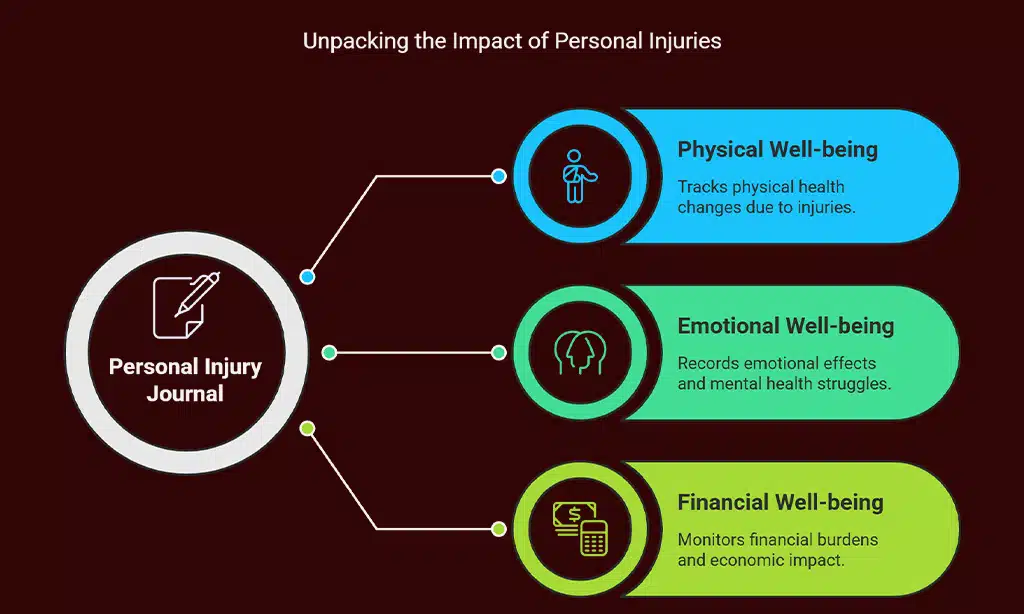
A personal injury journal is one of the simplest yet most effective tools in documenting the impact of your injuries on your daily life. This journal can provide detailed evidence of how the injury has affected your physical, emotional, and financial well-being.
Why a Journal is Critical for Personal Injury Claims
Keeping a daily journal offers a chronological account of your injury, recovery process, and its impact on your life. This documentation can add a personal, human element to your case, illustrating the suffering you’ve endured beyond what medical records and witness statements can show.
What to Include in Your Personal Injury Journal
- Pain levels: Write down your pain on a scale from 1 to 10 each day, describing how it affects your ability to perform daily tasks.
- Doctor’s visits and treatments: Document all medical appointments, treatments, and therapies.
- Impact on life: Record how the injury has affected your work, social life, and general daily activities. Has it limited your mobility, forced you to take time off work, or prevented you from engaging in hobbies?
| Journal Entry | Importance |
| Pain Levels | Helps track the ongoing impact of the injury over time. |
| Treatment Notes | Ensures you have a detailed record of the medical care you’ve received. |
| Lifestyle Impact | Demonstrates how the injury has interfered with daily life. |
Tip 7 – Work with Experienced Legal Professionals
A personal injury lawyer with experience in Australian law can be invaluable when gathering evidence. Legal professionals know what types of evidence are necessary for your case and can help you secure the right documentation.
How Lawyers Help with Evidence Collection
Experienced lawyers are skilled at coordinating expert witnesses, collecting medical records, and ensuring your evidence is legally sound. They can also guide you in obtaining surveillance footage, contacting witnesses, and organizing all your materials effectively.
Tip 8 – Organize and Present Evidence Effectively
Lastly, organizing and presenting your evidence in a clear, coherent manner is essential. In personal injury claims, how you present your evidence can be just as important as the evidence itself. Disorganized or incomplete evidence can lead to delays, confusion, and potentially a weaker case.
Importance of Evidence Organization
Proper organization ensures your lawyer and the court can easily evaluate the information you’ve gathered. Keep records sorted and accessible, whether digitally or physically, to avoid confusion during the legal process.
Takeaways
Gathering evidence in personal injury cases is the key to a successful claim. By following these 8 tips for gathering evidence in personal injury cases in Australia, you can ensure that your case is supported by strong, irrefutable proof.
From documenting the scene to preserving physical evidence and seeking expert medical opinions, each step plays a critical role in building a compelling case.
The more diligent and organized you are with your evidence, the better your chances of securing the compensation you deserve.