
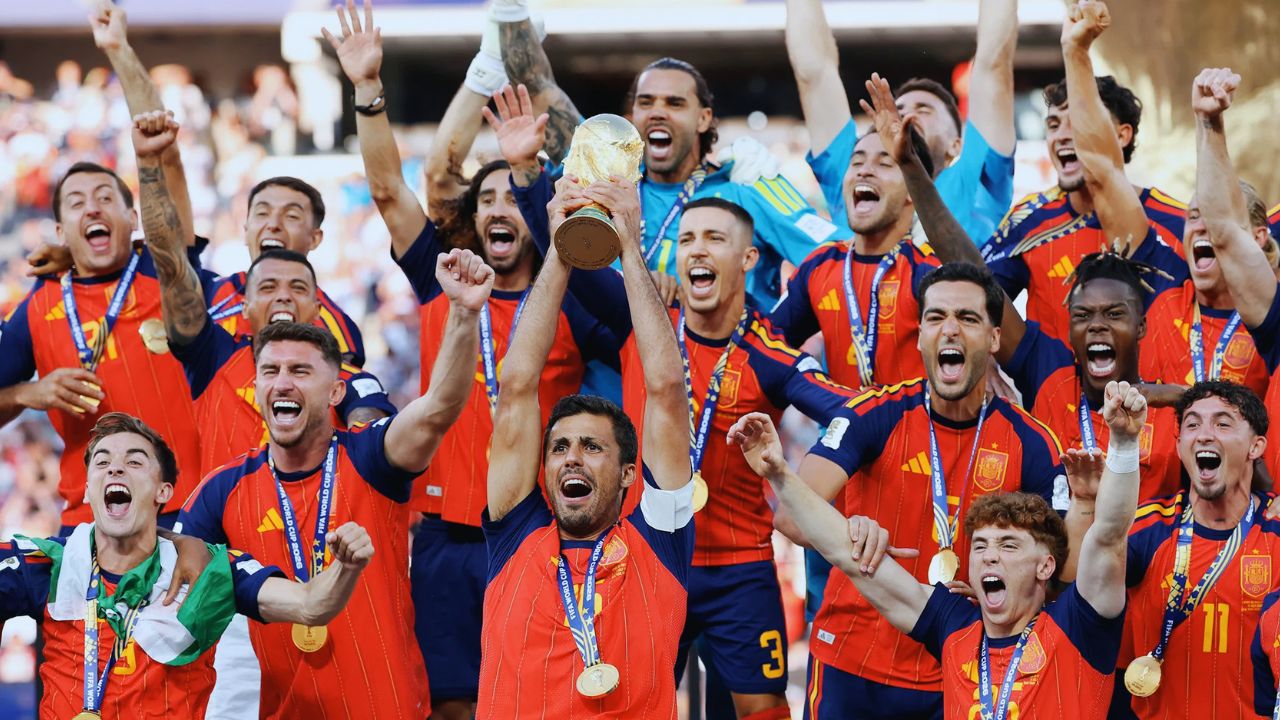
Red and yellow flags filled one end of the stadium. Across the ground, Argentina supporters remained in their seats, many covering their faces with blue-and-white shirts.
Spain’s players were gathering around the World Cup trophy. Lionel Messi stood several yards away with a runners-up medal around his neck and tears in his eyes. The Argentina supporters continued singing his name as the Spanish celebrations grew louder.
The scene summed up the conflicting emotions of the final. The Spain World Cup Win 2026 delivered another title to a team entering its strongest years. For Messi, the defeat may have closed his World Cup career.
Spain beat Argentina 1–0 after extra time at MetLife Stadium in East Rutherford, New Jersey, on July 19, 2026. Ferran Torres scored the only goal in the 106th minute, giving Spain their second men’s World Cup title and their first since 2010. Argentina’s attempt to retain the trophy ended one match short.
The final placed two very different stages of football life on the same pitch. Messi was 39 and playing in his sixth World Cup. Lamine Yamal was 19 and celebrating the biggest title of his young career.
That contrast gave the match much of its emotional force, but Spain did not win because the story demanded a generational change. They won because they controlled the game more effectively.
Spain World Cup Win 2026: How the Final Was Won
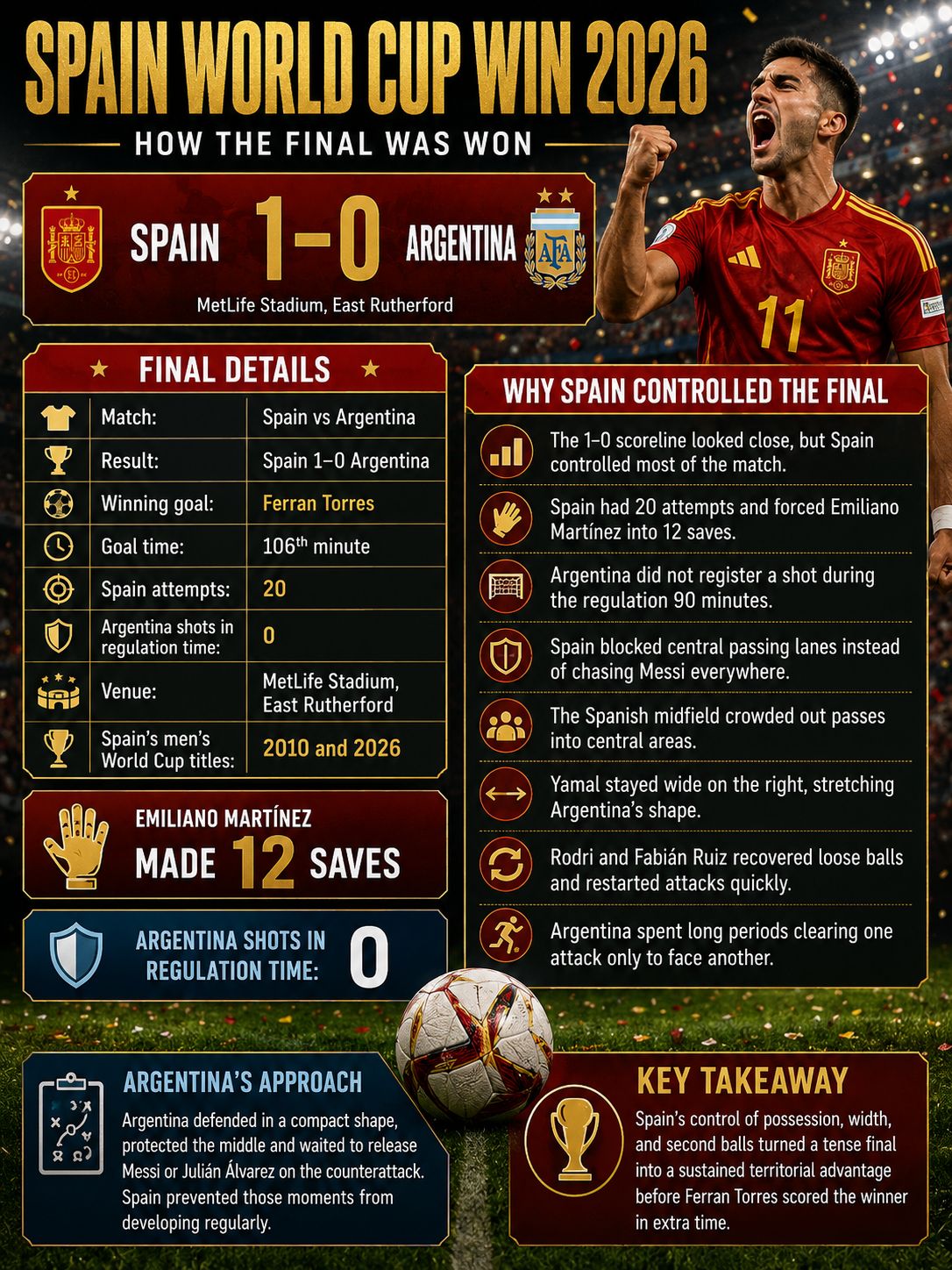
The 1–0 scoreline suggests a close contest. In practical terms, Spain spent most of the match in control.
They had 20 attempts and forced Emiliano Martínez into 12 saves. Argentina failed to register a shot during the regulation 90 minutes, an unwanted first in a men’s World Cup final.
Lionel Scaloni’s approach was cautious. Argentina defended in a compact shape, protected the middle of the pitch and waited for a chance to release Messi or Julián Álvarez on the counterattack.
Spain prevented those situations from developing regularly.
Rather than following Messi wherever he moved, the Spanish midfield closed the routes through which the ball might reach him. Argentina’s deeper players were pressured before they could turn, and passes into central areas were quickly crowded out.
Messi remained capable of producing a decisive moment, but he spent too much of the final away from the areas where he could influence it.
Spain also used the width of the pitch well. Yamal stayed wide on the right, while movement on the opposite side forced Argentina’s defenders to shift repeatedly. Rodri and Fabián Ruiz collected loose balls and helped Spain begin another attack before Argentina could reorganise.
The game settled into a frustrating rhythm for the defending champions. They cleared one attack only to face another.
| Final detail | Information |
| Match | Spain vs Argentina |
| Result | Spain 1–0 Argentina |
| Winning goal | Ferran Torres |
| Goal time | 106th minute |
| Spain attempts | 20 |
| Argentina shots in regulation time | 0 |
| Venue | MetLife Stadium, East Rutherford |
| Spain’s men’s World Cup titles | 2010 and 2026 |
Ferran Torres Changed the Match from the Bench
Ferran Torres did not start the final. His role became important as the match moved into its later stages.
Argentina’s defenders had spent more than 90 minutes shifting across the pitch and dealing with repeated Spanish attacks. Torres entered with fresher legs and a striker’s instinct for finding space inside the penalty area.
The winning move developed in the 106th minute. After the ball reached the box, Torres reacted first and finished with his left foot. His first goal of the tournament became the goal that decided the title.
The finish also showed why squad depth matters in a long World Cup. Spain did not need every match to be decided by Yamal, Rodri or another regular starter. A substitute who had waited for his opportunity delivered the most important touch of the tournament.
That made the goal feel consistent with Spain’s wider campaign. Their strength came from the squad rather than one player carrying the entire attacking burden.
Messi’s Tears Carried the Weight of a Long Journey
Messi had walked away from a World Cup final in pain before.
In 2014, he passed the trophy after Argentina lost to Germany. The photograph of his expression became one of the enduring images of that tournament.
The circumstances in 2026 were different. By then, Messi had already won the World Cup, the Copa América, the Champions League, domestic titles and multiple Ballon d’Or awards. His place in football history did not depend on the result in New Jersey.
What remained was the chance to achieve something rare.
Argentina were trying to become the first team since Brazil in 1962 to retain the men’s World Cup. They reached the final and stayed level for more than 100 minutes, but Spain denied them the final step.
Messi’s reaction reflected more than the loss of one match. At 39, he knew another World Cup appearance was unlikely. AP described the final as his likely last appearance in the tournament, although no assumption about his future was needed to understand the emotion of the moment.
He remained on the pitch after the final whistle, embraced teammates and acknowledged the supporters. Argentina had lost, yet the crowd continued to sing his name.
There was no need to treat the scene as a failure. Messi had returned to the final four years after lifting the trophy in Qatar. Few players have sustained that level of influence for so long.
| Messi’s World Cup journey | Outcome |
| 2006 | Debut as an 18-year-old |
| 2014 | Reached the final |
| 2018 | Eliminated in the round of 16 |
| 2022 | Won the World Cup |
| 2026 | Reached a third final |
| Total appearances | Six World Cups |
A Possible Farewell Without a Perfect Ending
Sports rarely provide the ending supporters imagine.
A second consecutive World Cup would have given Messi a final international triumph of almost impossible scale. Instead, his last image from the final was one of disappointment.
That does not undo 2022 or diminish the career that came before it. It gives the ending a more recognisable human shape.
Great players do not always leave after scoring the winning goal. Sometimes they leave after a match in which the opponent controls the ball, blocks their space and refuses to cooperate with the preferred script.
Messi’s tears mattered because the result still mattered to him. All the trophies he had already won did not make the defeat painless.
Yamal’s Rise Should Not Be Reduced to a Messi Comparison
The post-match image of Yamal approaching Messi quickly attracted attention. They shook hands and embraced while Spain’s celebrations continued around them.
It was easy to present the photograph as a formal passing of responsibility from one star to another. That reading is too simple.
Yamal and Messi share obvious connections. Both are left-footed attackers associated with Barcelona. Both reached the highest level at a remarkably young age. Their age difference of 20 years made the photograph especially striking.
Their roles in football history, however, cannot be compared yet.
Messi’s reputation was built over two decades of elite performances. Yamal is at the beginning of his career. Winning a World Cup at 19 gives him an extraordinary starting point, but it does not require him to become a copy of anyone else.
Spain do not need that from him either.
Yamal is part of a team containing Rodri, Nico Williams, Pau Cubarsí, Dani Olmo, Fabián Ruiz and several other players with significant responsibilities. Their system gives talented individuals room to attack without making the whole team dependent on one of them.
The photograph with Messi therefore works best as a record of the evening: an established legend acknowledging a young champion after a difficult final.
Rodri Gave Spain Control Without Slowing Them Down
The Spain side that won between 2008 and 2012 remains an unavoidable reference point. Xavi, Andrés Iniesta and Sergio Busquets controlled matches through long passing sequences and positional discipline.
The 2026 team kept much of that technical confidence but played with more speed in wide areas.
They were willing to attack directly when space appeared. After losing the ball, they pressed quickly rather than dropping back and waiting. Their wide players stretched the opposition, while the midfield made sure the team did not become divided.
Rodri was crucial to that balance.
He decided when Spain needed a longer spell of possession and when a quicker forward pass was available. His positioning protected the defence and allowed Spain’s other midfielders to move higher.
Spain also defended by keeping the ball. Argentina could not build momentum while chasing possession, and every extended passing sequence took more energy from their forwards and midfielders.
This did not always produce exciting football. Reuters described the final as tense and low in quality for long periods. Spain nevertheless remained the side more likely to create the decisive chance.
Luis de la Fuente Trusted the System
Luis de la Fuente’s work was less about tactical surprise and more about giving players clear responsibilities.
Spain entered the final with an established way of playing. They did not abandon it when Argentina remained level through normal time. De la Fuente used his substitutes while keeping the overall shape intact, and the decision to introduce Torres eventually produced the winner.
Spain’s success also continued a strong recent period under him. The team had won the 2024 European Championship and entered the World Cup final on a long unbeaten run.
The age of the squad gives Spain a realistic chance of remaining among the strongest international teams. That future will depend on injuries, form and the development of younger players, but the foundation is already visible.
Argentina’s Attack Needed More Than Defensive Patience
Argentina’s defensive effort deserved credit.
They kept Spain scoreless for 105 minutes, despite spending long periods without the ball. Martínez’s saves kept them in the game, and the defenders remained focused under sustained pressure.
The attack offered far less.
Argentina’s plan depended heavily on finding Messi in positions where he could turn and connect with Álvarez. Once those passing routes were closed, the team struggled to create another route towards goal.
The midfield did not carry the ball through Spain’s press often enough. The wide areas produced little penetration, and Álvarez was frequently isolated against Spain’s centre-backs.
The absence of a shot in regulation time was the clearest sign of the problem. Argentina were competitive because of their defending, not because they posed a consistent threat.
| Argentina’s difficulty | Effect |
| Messi received limited service | Main creative route was blocked |
| Midfield struggled under pressure | Few controlled transitions |
| Limited threat from wide areas | Spain could protect central spaces |
| Álvarez became isolated | Little support near the penalty area |
| No shots in regulation time | Spain were rarely placed under pressure |
Preparing for Life After Messi
Argentina’s next phase cannot be built around finding another Messi. No direct replacement is available.
The responsibility will have to be shared.
Julián Álvarez, Alexis Mac Allister, Enzo Fernández and other younger players must take larger roles in progressing the ball and creating chances. Argentina will need different attacking combinations so that closing one passing route does not stop the whole team.
That process can begin even if Messi continues playing internationally. Reducing dependence on him would help the team and allow him to operate more selectively.
The final exposed a practical problem rather than a philosophical one. When Spain prevented Messi from receiving the ball in useful positions, Argentina did not create enough elsewhere.
That is the issue Scaloni must solve.
Spain’s Second World Cup Was Years in the Making
The Spain World Cup Win 2026 grew out of a long development system.
After their first World Cup title in 2010, Spain endured a difficult period. They were eliminated in the group stage in 2014, and later teams sometimes kept possession without creating enough danger.
Spain did not discard their technical identity. They adjusted it.
Youth development remained central, but the senior side became faster and less predictable. Wide attackers were encouraged to run directly at defenders. Pressing became more aggressive. Young players were trusted earlier.
The result was a team that could control possession without relying on slow circulation alone.
Spain’s second title also created a notable first: they became the first country to hold the men’s and women’s World Cups at the same time, following the women’s triumph in 2023. Their men’s team conceded only one goal across eight matches, according to AP.
Those numbers point to a team built on more than attacking talent. Spain’s defence and midfield control made them difficult to unsettle throughout the tournament.
Development, Experience and a Strong Bench
Spain’s squad combined players at different career stages.
Young talents brought pace and confidence. Experienced players understood how to manage difficult periods. The bench offered alternatives when the starting attack could not find a breakthrough.
That balance was visible in the final. Yamal remained a threat, Rodri controlled the middle, Martínez made Spain work for every chance, and Torres eventually supplied the finish.
No single idea explains the victory. Spain succeeded because several parts of the team functioned together.
Did the Final Mark a Generational Change?
The temptation to describe the match as the end of Messi’s era and the beginning of Yamal’s is understandable.
The evidence is less tidy.
Messi’s generation did not disappear when the final whistle sounded. Established players will continue to influence international football, while Yamal and Spain’s younger group still have to prove they can sustain their success.
The tactics, however, showed how the game is developing.
Teams at the highest level increasingly distribute creative responsibility across several positions. Wide players must press. Midfielders must protect space and build attacks. Defenders are expected to pass through pressure.
Argentina remained heavily connected to one exceptional creator. Spain produced attacks through several players and recovered the ball as a group.
That difference influenced the final more than any symbolic storyline.
The match may eventually be remembered as a turning point, especially if Messi does not play another World Cup and Spain continue winning. For now, it is enough to say that one team looked better prepared for what comes next.
The 48-Team World Cup Changed the Scale, Not the Demands
The 2026 tournament was the first men’s World Cup to feature 48 teams and 104 matches. It was jointly hosted by the United States, Canada and Mexico, making it the first edition staged across three countries.
The larger format gave more nations access to the tournament and introduced a round of 32. It also increased the physical and logistical demands on teams.
Longer travel, more matches and changing conditions made squad management particularly important.
The expansion produced new stories and brought unfamiliar teams onto the global stage. By the final stages, though, the traditional powers had again moved to the front.
Spain’s victory showed that the basic requirements for winning remained familiar: a deep squad, tactical flexibility, strong player development and the ability to manage pressure over several weeks.
Beyond the Entertainment, Four Images Remained
The final came with a large entertainment programme and the commercial scale expected of a World Cup staged in North America.
Most viewers will remember simpler moments.
Torres striking the ball with his left foot.
Martínez making save after save.
Messi standing in tears after collecting his medal.
Yamal walking towards him as Spain celebrated.
Those scenes gave the evening its emotional shape. The surrounding show made the final larger, but the players produced the memories that will last.
Final Thoughts: Spain Won the Match and Looked Ready for the Future
The Spain World Cup Win 2026 was built on control, defensive discipline and greater attacking depth.
Spain created more chances, restricted Messi’s influence and remained patient when Argentina’s defence refused to break. Torres’ goal rewarded the pressure they had applied for most of the match.
Argentina left with disappointment but not disgrace. They defended with determination and stayed within one goal of retaining the trophy. Their inability to create chances, however, showed how much work lies ahead.
Messi’s tears gave the final its most emotional image. Yamal’s celebration provided another. Their meeting after the game added to the sense that international football is changing, even if no career or era can be reduced to one photograph.
Spain lifted their second World Cup. Messi left the pitch to the sound of Argentina supporters singing his name.
Both images belonged to the same night, and neither needed exaggeration.