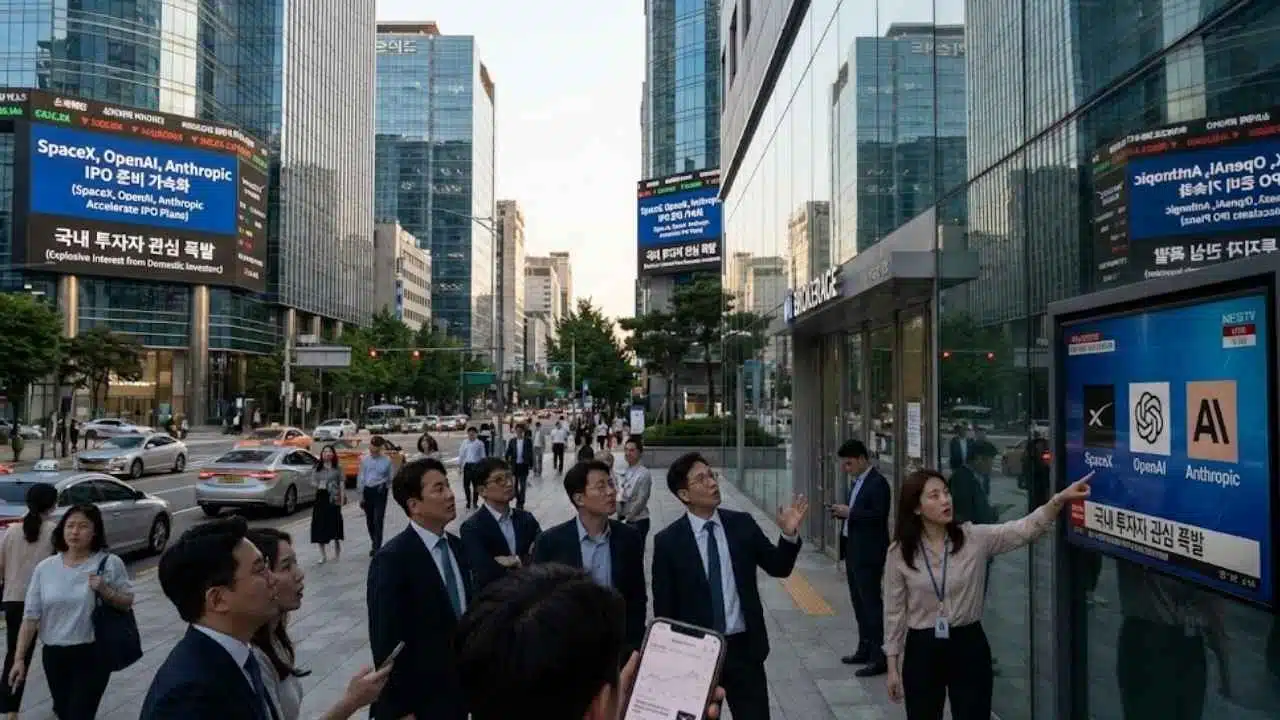
SpaceX, OpenAI, and Anthropic IPOs are back in focus for Korean retail investors as fresh signals—from SpaceX’s internal memo to OpenAI’s new corporate structure—revive expectations of blockbuster U.S. listings in 2026–2027.
Why Korean investors are watching these “dream stocks” again
Korea’s “Seohak ants” (retail investors buying foreign stocks) have already shown a strong appetite for U.S. tech leaders and high-volatility themes. Now, attention is shifting to late-stage private companies that could define the next IPO cycle—especially those tied to space infrastructure and generative AI.
The renewed buzz is not only about potential first-day price swings. It is also about long-term exposure to platforms that sit on scarce assets: launch capacity and satellite networks in SpaceX’s case, and foundational AI models plus compute partnerships for OpenAI and Anthropic.
SpaceX: internal share sale and a memo pointing to 2026 IPO readiness
Recent reporting indicates SpaceX approved a large secondary share sale priced at $421 per share, implying an around $800 billion valuation, and discussed preparing the company for a possible IPO in 2026—while emphasizing that timing and valuation remain uncertain and dependent on execution and market conditions.
The same messaging has tied potential IPO capital needs to aggressive spending plans, including increasing launch cadence, pursuing “space-based AI data centers,” and longer-horizon programs linked to Moon and Mars ambitions.
What’s driving the valuation narrative
Investors often point to two core engines:
- Starlink: recurring connectivity revenues and expansion plans (including direct-to-mobile ambitions referenced in recent coverage).
- Launch dominance and Starship optionality: a pipeline of commercial, defense, and exploration missions, plus upside if Starship reaches higher reliability and cadence.
Even with a memo-driven IPO discussion, it is important to treat “IPO next year” as conditional rather than guaranteed, because SpaceX has historically used private liquidity events to delay listing pressure.
OpenAI: restructure into a Public Benefit Corporation strengthens IPO pathways
OpenAI has already taken a concrete step that markets associate with future listing readiness: it confirmed its for-profit arm is now a public benefit corporation (OpenAI Group PBC) under mission-focused oversight.
Microsoft also publicly described a recapitalization framework in which it holds an approximately 27% stake on an as-converted basis (valued around $135 billion in Microsoft’s description), reflecting a clearer ownership picture that investors often want before any IPO filing.
Meanwhile, separate recent reporting suggests OpenAI has been discussing very large fundraising and IPO scenarios that could put a filing window as early as the second half of 2026, with listing expectations extending into 2027 depending on structure and readiness.
Why this matters to public-market investors
OpenAI’s costs are unusually high because the product race in AI is also a compute race. The ability to raise capital—through private rounds first and eventually public markets—can be a competitive moat.
Anthropic: a disclosed $183B round—and the IPO conversation starts sooner
Anthropic confirmed it completed a $13 billion Series F that valued the company at $183 billion post-money (a rare, highly transparent datapoint in private AI financing).
Since then, market chatter has included much higher implied valuations and the possibility of a nearer-term IPO discussion, driven by the same force shaping the whole sector: the need to fund compute, research, and enterprise scale.
what we know today (and what remains unconfirmed)
| Company | Latest widely reported / confirmed valuation signal | Most discussed IPO window (not guaranteed) | Key catalyst investors cite |
| SpaceX | $421/share internal transaction; ~ $800B implied value | “Possible” 2026 (conditional) | Starlink scale + launch cadence + capital intensity |
| OpenAI | PBC restructure confirmed; Microsoft ~27% stake described | Filing talk as early as 2H 2026; listing often framed 2027 | Compute funding needs + platform dominance |
| Anthropic | Series F: $13B raised at $183B post-money (confirmed) | IPO discussions emerging; timing unclear | Enterprise demand + escalating compute spend |
How big could a SpaceX IPO be—and why comparisons to Aramco keep showing up
When IPO watchers compare “largest offerings,” they often reference Saudi Aramco, which raised $29.4 billion after the over-allotment option was exercised (the “greenshoe”), a commonly cited benchmark for record size.
Whether SpaceX could surpass that depends on final float, pricing, and market conditions. The important point for investors is that a listing of that scale would likely reshape global IPO allocations—tilting access heavily toward institutions and large brokers.
Korea angle: why local financial groups are also part of the story
Korean investors are not only watching U.S. listings directly. They are also scanning local firms with meaningful exposure through private holdings, funds, or venture investments.
One widely circulated example is Mirae Asset’s reported SpaceX investment totaling $278 million across 2022–2023, frequently cited as an early bet that may look stronger as secondary prices rise.
This “indirect exposure” theme can affect Korean-listed prices even before any U.S. IPO happens—because local investors may treat the holding as a proxy trade when the underlying private shares are inaccessible.
How can Korean retail investors buy U.S. IPO shares?
1. Direct IPO allocation is hard for individuals—everywhere
In the U.S., IPO allocations are typically dominated by institutions and preferred clients. Even when individuals can access IPO “participation” through a broker, allocations can be small or unavailable in heavily oversubscribed deals.
2. The most realistic path: buy after listing
For most Korean retail investors, the practical path is purchasing shares after the stock starts trading on the NYSE or Nasdaq via a Korean broker’s U.S. trading service—accepting market price and volatility rather than IPO price.
3. “IPO subscription agency” and cross-border partnerships
Some Korean securities firms have pursued partnerships to strengthen cross-border IPO access and advisory capabilities, reflecting demand for U.S.-market participation. Even with agency-style services, the core constraint remains: if the U.S. allocation partners cannot secure shares, investors still end up buying in the open market.
What retail investors should watch (practical checklist)
| What to check | Why it matters |
| Exchange + ticker confirmation | Prevents confusion with look-alike names or unofficial “pre-IPO” products |
| Lock-up periods and insider selling rules | Large unlocks can pressure prices weeks/months after IPO |
| Risk disclosures for “pre-IPO” funds/notes | These can carry fees, liquidity limits, or structure risk |
| Valuation vs. revenue/trajectory | Big narratives can detach from fundamentals early |
What comes next
For Korean investors, the coming year is likely to be shaped by three moving parts:
- Verification of timelines: SpaceX’s IPO language is “possible,” not promised, and OpenAI’s path still depends on structure, fundraising, and regulatory readiness.
- AI-capex reality: the winners may be those that can fund compute at scale without damaging unit economics.
- Access mechanics: for most individuals, the real decision will be whether to buy immediately post-listing or wait for price discovery after lock-ups and early volatility.
SpaceX, OpenAI, and Anthropic sit at the intersection of frontier tech and massive capital needs—exactly the mix that tends to pull global liquidity back into the IPO market when conditions improve. For “Seohak ants,” the opportunity is real, but so are the access limits: the biggest deals often reward those with allocation power, while most retail investors will meet these stocks in the secondary market—where timing, risk control, and discipline matter more than hype.