Shahid Qadri’s name shines brightly in the history of Bengali poetry, but his story carries an unusual paradox. Here was a poet who emerged in the 1960s as a dazzling new voice—urban, bold, cosmopolitan—and then suddenly fell into a silence that lasted for nearly three decades. For a man who was once hailed as the next great modernist after Jibanananda Das, this long gap between poems remains one of the most striking mysteries of Bengali literature.
But silence, as Qadri’s life reminds us, is not always emptiness. Sometimes it is a form of survival, a rebellion against relentless expectations, or even a quiet recharging of creative energy. In today’s world, where creators are constantly pressured to produce more—blog posts, songs, videos, designs—his 30-year absence resonates deeply. It becomes a lens to explore the modern epidemic of creative burnout.
On his 9th death anniversary, reflecting on Shahid Qadri’s poetic journey invites us to reconsider what it means to create, to pause, and to endure. His silence is not just a biographical detail—it is a lesson for anyone who has ever felt overwhelmed by the demands of creation.
Shahid Qadri—The Urban Voice of Modern Bengali Poetry
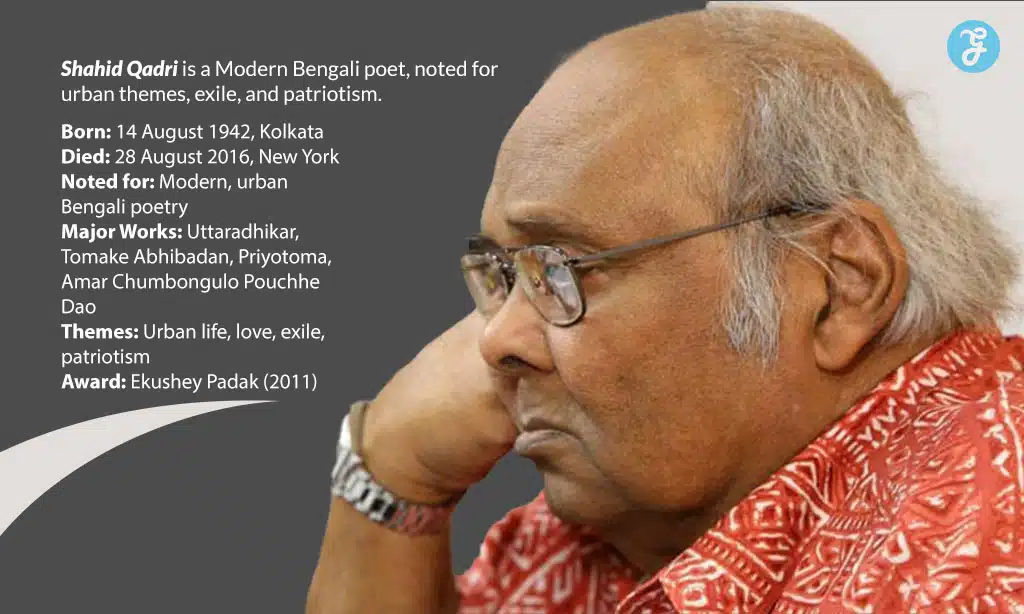
Born in 1942 in Kolkata and later moving to Dhaka, Shahid Qadri belonged to the first generation of Bengali poets writing after the Partition of India. The world he inherited was fractured: politically unstable, socially unsettled, and rapidly urbanizing. Unlike many of his predecessors who drew inspiration from pastoral Bengal, Qadri’s muse was the city itself.
When his debut collection Uttaradhikar (Inheritance) was published in 1967, it marked a clear break from tradition. His poems carried the noise of traffic, the anonymity of crowds, and the alienation of urban life. He captured the mood of Dhaka with a modernist sensibility that spoke to young people who felt both patriotic and restless.
By the 1970s, with collections like Tomake Abhibadon Priyatama (Salute to You, Dearest), he was celebrated as a poet who could merge the lyrical with the political. He received the Bangla Academy Award in 1973, cementing his position as one of the leading voices of his time. Yet, just as his fame peaked, Qadri did something few could imagine—he disappeared from the literary scene.
The 30-Year Silence—Exile, Distance, and Withdrawal
After publishing Kothao Kono Krondon Nei (Weeping Nowhere) in 1978, Qadri stopped releasing new poetry. For the next thirty years, there was no new book, no public readings, and no sign of his once-unstoppable creative flow. Instead, he moved abroad, living in London and Germany and eventually settling in Boston.
Why did he retreat? Several factors converged.
-
Disillusionment with politics and society: Bangladesh in the late 1970s was turbulent, and Qadri, always sensitive to urban chaos and corruption, may have found little inspiration in the instability.
-
Exile and alienation: Living abroad distanced him from the Bengali literary world, but it also distanced him from the cultural soil that nourished his early poetry.
-
Personal struggles: Health issues and the loss of his second wife added to his isolation.
For many admirers, his silence was painful. Yet, looking back, we can see that this silence itself became a profound part of his creative identity. It was a pause, a gap, but not an erasure. It forces us to ask: was this silence a tragedy—or was it a necessary form of healing?
A Modern Lens to Understand His Silence
Today we use the word “burnout” freely. It describes the exhaustion that comes from overwork, constant pressure, and the inability to replenish ourselves. But in the 1970s, such language was not available. Qadri’s sudden withdrawal, however, can easily be read through this modern lens.
Imagine being a young poet in your twenties, hailed as the voice of a new generation. Every poem you publish is dissected, every absence questioned. The pressure of being “the future of Bengali poetry” could weigh heavily on anyone. For Qadri, the solution was radical—he walked away.
| Creator | Field | Known For | Period of Silence | Key Lesson from Silence |
|---|---|---|---|---|
| Shahid Qadri | Poetry (Bengali) | Urban modernism, Uttaradhikar, Kothao Kono Krondon Nei | 30 years (1978–2009) | Silence can be self-preservation and a new form of creativity. |
| J.D. Salinger | Literature | The Catcher in the Rye | 45 years (1965–2010) | Protecting art from overexposure can make it timeless. |
| Kate Bush | Music | Wuthering Heights, Running Up That Hill | 12 years (1993–2005) | Creative withdrawal can lead to bold reinvention. |
| Arthur Rimbaud | Poetry (French) | Symbolist visionary, Illuminations | Quit writing at 21, never returned | Silence itself can become part of an enduring myth. |
| Harper Lee | Literature | To Kill a Mockingbird | 55 years (1960–2015) | One book can define a lifetime—silence can amplify legacy. |
Table: Shahid Qadri and Other Silent Creators
His silence reminds us of something essential: burnout is not only about exhaustion but also about losing joy in creation. Many writers, musicians, and artists today echo the same sentiment.
Taylor Swift has spoken about her creative fatigue, Ed Sheeran about stepping away, and countless YouTubers announce “burnout breaks.” In this sense, Shahid Qadri was ahead of his time. His silence was his way of protecting himself from being consumed by expectations.
Lessons from Qadri’s Hiatus—What Silence Can Teach Us
1. Silence as Rest, Not Failure
We often equate silence with failure. But Qadri’s story challenges that. His absence was not the end of his creativity—it was a long pause that allowed him to preserve himself. For creators, silence can be a form of rest, a refusal to burn out completely.
2. Distance Creates Perspective
Exile gave Qadri a different lens. His later poems carried a more global outlook, infused with the experience of being a migrant in Boston and Germany. Distance, though painful, enriched his vision.
3. Returning Doesn’t Need to Be Loud
In 2009, Qadri published Amar Chumbongulo Pouchhaya Dao (Please, Convey My Kisses). It wasn’t a grand comeback but a quiet offering. This reminds us that returning to creativity doesn’t need fanfare. Sometimes a whisper carries more weight than a shout.
4. Legacy Is Measured by Depth, Not Volume
Shahid Qadri left behind only four collections. Yet his place in Bengali literature is secure. Quality, not quantity, defines legacy. For today’s creators drowning in deadlines and content calendars, this is a liberating lesson.
Shahid Qadri in the Age of Hustle Culture
We live in a world where hustle is glorified. “No days off,” “rise and grind,” and “publish daily” are modern mantras. Against this backdrop, Shahid Qadri’s 30-year silence feels revolutionary.
His choice challenges the idea that worth is tied to constant output. Instead, his career suggests that sometimes, the most radical act is to pause, to refuse the machinery of endless production. In many ways, Qadri anticipated our debates about mental health and the toxicity of hustle culture.
The Personal Side of Silence—Grief, Love, and Loss
It is important not to romanticize Qadri’s silence entirely. Behind it were real struggles: the loneliness of exile, the death of his beloved wife, and his own health problems. These human experiences remind us that silence often carries deep personal costs.
Yet, when he did return to poetry, it was not about regaining fame. It was about reconciling with his own experiences. His later poems, though fewer, are filled with tenderness, maturity, and acceptance. They read less like cries of a young urban rebel and more like meditations of a man who has lived through storms.
Can Silence Be Creative?
Silence, paradoxically, can be fertile. For Qadri, three decades of silence did not erase his creativity—it reshaped it. The absence itself became part of his artistic identity.
Other creators have done the same. J.D. Salinger stopped publishing after The Catcher in the Rye. Kate Bush disappeared from the music scene for years before her quiet return. In each case, silence became part of the myth but also part of the art. Qadri belongs in this lineage of artists who show that sometimes silence can be as powerful as words.
What Creators Today Can Learn from Shahid Qadri
-
Take breaks before breakdowns: Don’t wait until you’re drained to step away.
-
Absence can amplify presence: a pause can make your return more powerful.
-
Guard your creativity: Don’t let expectations dictate your art.
-
Impact beats volume: Four books can be more powerful than forty.
-
Silence is part of your story: even what you don’t create shapes your legacy.
Takeaways
Shahid Qadri’s life is proof that silence is not the opposite of creativity—it is part of it. His 30-year gap between poems was not wasted time but a different kind of poem, written in absence rather than words.
On his 9th death anniversary, we should remember him not just as the poet of urban modernism but also as the poet who dared to be silent. In a world that pressures us to create endlessly, his silence still echoes with meaning: sometimes the bravest thing an artist can do is to stop, breathe, and wait until the words return.