

In a major biotech development, pharmaceutical giant Regeneron has agreed to acquire the once-prominent genetic testing firm 23andMe for $256 million after the latter filed for Chapter 11 bankruptcy earlier this year. The acquisition, subject to approval by the U.S. Bankruptcy Court for the Eastern District of Missouri, is expected to be finalized by the end of the third quarter of 2025.
The deal, executed through a bankruptcy auction, marks the end of an era for the Silicon Valley-based startup that once promised to revolutionize personalized medicine but ultimately struggled with profitability and privacy controversies.
Regeneron’s Plan: Preserve 23andMe’s Legacy While Advancing Genetic Research
Regeneron Pharmaceuticals, known for its cutting-edge work in genetics and drug development, aims to integrate 23andMe’s extensive consumer DNA database into its own research pipeline. According to the company, the acquisition will allow it to continue 23andMe’s services without interruption while advancing Regeneron’s mission to develop genetic-based medical treatments.
“We assure 23andMe customers that we are committed to protecting the 23andMe dataset with our high standards of data privacy, security, and ethical oversight,” said Aris Baras, Senior Vice President and Head of the Regeneron Genetics Center.
Regeneron currently operates its own database with genetic data from around 3 million individuals. The inclusion of 23andMe’s genetic trove—comprising data from more than 15 million users worldwide—will significantly enhance Regeneron’s ability to conduct population-wide genetic studies, develop personalized treatments, and identify biomarkers for diseases.
23andMe’s Rise and Fall: From Billion-Dollar Darling to Bankruptcy
Founded in 2006 by Anne Wojcicki, 23andMe made headlines by offering direct-to-consumer DNA testing kits, enabling individuals to discover their ancestry and potential genetic health risks from the comfort of their homes. Its accessible testing model and early focus on empowering consumers with personal genetic information helped it grow rapidly.
The company’s ambitions expanded beyond ancestry to health reports and pharmaceutical partnerships. In 2018, it announced a major collaboration with GlaxoSmithKline (GSK) for drug development based on consumer genetic data. Then, in 2021, 23andMe went public via a special-purpose acquisition company (SPAC), reaching a valuation of nearly $6 billion.
However, cracks in the business model soon appeared. The company struggled to build a sustainable revenue stream. Its once-revolutionary product proved to be a “one-and-done” service, generating limited repeat business. Attempts to enter telehealth and therapeutics—including the acquisition of Lemonaid Health—failed to deliver expected growth. In 2023, the company also suffered a major data breach, which compromised the personal data of millions of users, further shaking consumer confidence and prompting regulatory scrutiny.
In September 2024, all seven independent board directors resigned following strategic disagreements with CEO Anne Wojcicki. She stepped down in March 2025, coinciding with the company’s Chapter 11 bankruptcy filing.
Data Privacy Concerns Remain Front and Center
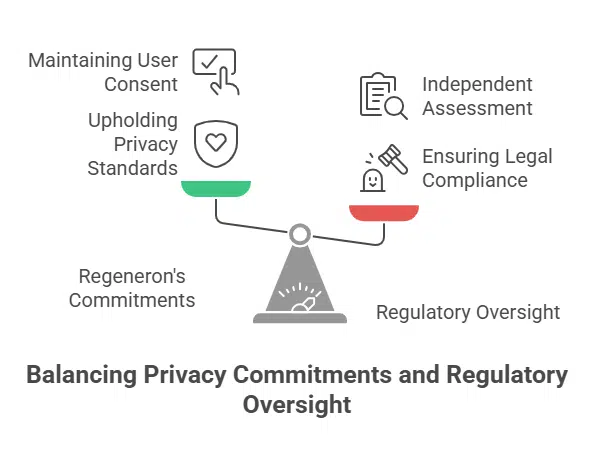
As part of the acquisition deal, Regeneron has been vocal about its commitment to upholding privacy standards. The company has promised that it will adhere to 23andMe’s existing privacy policies, ensure user consent remains intact, and apply high-level ethical oversight to any research conducted using the data.
This reassurance comes amid widespread consumer, regulatory, and political concerns over the security of sensitive genetic information. In March 2025, California Attorney General Rob Bonta issued a public advisory urging Californians to delete their genetic data from 23andMe, citing the company’s financial instability and uncertainty surrounding its future.
Additionally, the Federal Trade Commission (FTC) intervened to emphasize that any new owner of 23andMe must legally agree to be bound by the original terms of the company’s privacy agreement with users. A consumer privacy ombudsman has been appointed by the bankruptcy court to independently assess whether Regeneron’s acquisition terms meet federal privacy standards. A formal court hearing is scheduled for June 17, 2025, and the ombudsman’s findings are due by June 10.
Regeneron Will Discontinue Lemonaid Health but Retain Core Operations
While the acquisition includes 23andMe’s consumer DNA testing business, biobank, and research data, it excludes the firm’s telehealth arm, Lemonaid Health, which will be shut down. Regeneron stated it intends to focus on integrating 23andMe’s core assets—primarily its genetic insights and infrastructure—into its Regeneron Genetics Center (RGC) to accelerate precision medicine development.
“Regeneron is uniquely positioned to transform this wealth of genetic information into life-saving therapeutics,” said Mark Jensen, Chair of 23andMe’s Special Board Committee. “The acquisition enables the mission of 23andMe to live on, while maintaining critical protections around customer privacy, choice, and consent.”
Consumers Have Options: Data Deletion and Sample Destruction
For concerned customers, 23andMe continues to offer self-service tools to manage their data. Users can:
-
Log in to their accounts to delete genetic reports and raw data.
-
Revoke consent for research participation.
-
Request physical destruction of stored saliva samples.
These features were already available before the acquisition and will remain in place under Regeneron, in line with federal privacy requirements.
What This Means for the Genetic Testing Industry
The acquisition signals a major consolidation in the consumer genetics and biotechnology industry. Regeneron’s move is seen as a strategic play to gain access to one of the world’s largest genomic datasets, allowing for breakthroughs in drug discovery, rare disease treatment, and predictive health modeling.
However, critics argue that it also sets a worrisome precedent regarding how sensitive health data is handled during corporate bankruptcies and buyouts. “Consumers should not have to worry that their DNA could be sold off like furniture,” said a privacy watchdog quoted in a Washington Post investigation.
As genetic data becomes an increasingly valuable asset, how it’s collected, stored, and transferred will continue to face intense legal and ethical scrutiny.
























