


Petropolitics Realignment is the defining doctrine of the new American era, violently inaugurated in the early hours of January 2026. When the United States launched Operation Absolute Resolve, it did not merely execute a regime decapitation; it fundamentally rewrote the rules of hemispheric power and resource acquisition. The sudden military strike that extracted Venezuelan President Nicolás Maduro from Caracas signaled an unapologetic pivot from global policing to regional hegemony.
Driven by the Trump administration’s mandate to secure the Western Hemisphere’s vast resources, Washington has traded diplomatic nuance for blunt transactional dominance. This aggressive maneuver forces a radical rethink of trade alliances, energy security, and national sovereignty across the Americas.
By leveraging overwhelming military force to unlock the world’s largest proven oil reserves, the U.S. has ignited a fierce new Great Game right in its own backyard.
The Shock and Awe of Petropolitics: Operation Absolute Resolve
The transition from diplomatic pressure to overwhelming kinetic force fundamentally altered the geopolitical baseline of South America, demonstrating that Washington’s new approach to the region relies on immediate, hard-power consequences.
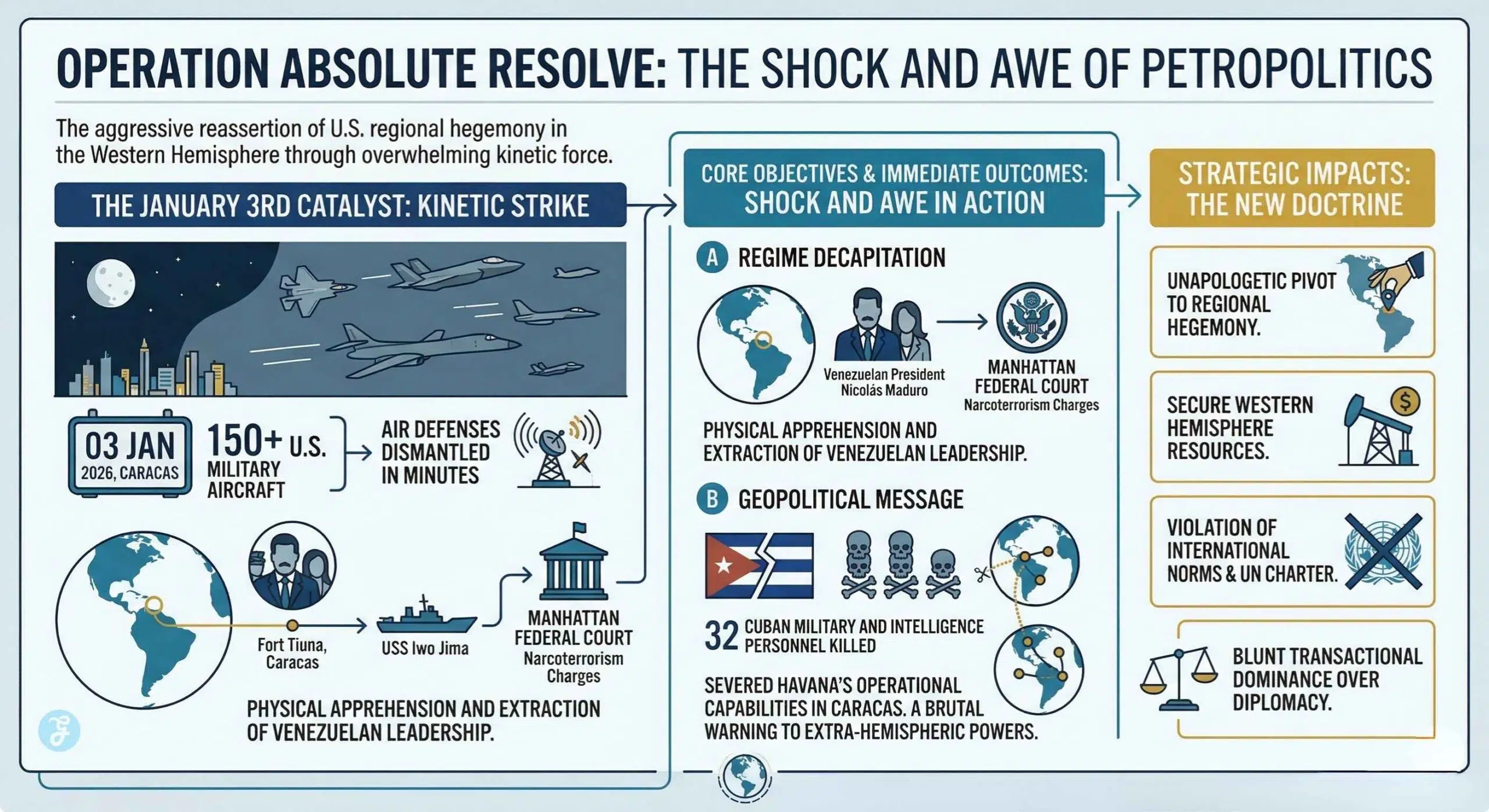
The January 3rd Catalyst
In the dead of night on January 3, 2026, the skies over Caracas were overwhelmed by the deafening roar of over 150 U.S. military aircraft. Operation Absolute Resolve was a terrifying masterclass in modern, synchronized warfare. Leveraging an armada that included F-35 stealth fighters, B-1B Lancers, and advanced electronic warfare planes, the United States systematically dismantled Venezuelan air defenses in a matter of minutes.
By the time the specialized apprehension force descended upon the Fort Tiuna military installation, the message to the rest of the hemisphere was irrevocably delivered: the era of U.S. tolerance for hostile actors in the Americas had abruptly and violently ended.
The physical extraction of Nicolás Maduro and his wife, Cilia Flores, to the USS Iwo Jima, and eventually to a Manhattan federal court to face narcoterrorism charges, was the sensational headline. However, the operational realities on the ground revealed a much deeper, more ruthless strategy.
The airstrikes systematically neutralized embedded foreign assets, most notably resulting in the deaths of 32 Cuban military and intelligence personnel.
This deliberate severing of Havana’s operational capabilities in Caracas served as a brutal, unmistakable warning to any extra-hemispheric powers attempting to maintain a security footprint in the region.
The Trump administration, guided by figures like Secretary of War Pete Hegseth and Secretary of State Marco Rubio, proved it was willing to violate international norms and the UN Charter to forcefully evict rival influences.
This decisive military action, however, was only the kinetic mechanism designed to facilitate a much larger, highly lucrative economic objective.
The 50-Million-Barrel Handshake: Securing the Hemispheric Supply
As the smoke cleared over the Venezuelan capital, the underlying motives of this aggressive regional pivot became starkly visible, replacing the rhetoric of democratic liberation with the cold math of commodity acquisition.
The Strategic Oil Agreement
The true endgame of Operation Absolute Resolve crystallized almost immediately. Rather than occupying the country to install a democratic government from the ground up, President Donald Trump bluntly stated that the U.S. was going to “run the country” until a transition occurred, and began doing business with the remnants of the very regime he had just decapitated.
Within weeks, the administration announced a staggering 50-million-barrel oil supply deal with the remaining Venezuelan leadership, anchored by an immediate $300 million cash advance processed by January 20. Simultaneously, the United States lifted crippling sanctions and issued broad licenses allowing American energy companies to resume unhindered operations.
This transactional diplomacy represents a profound and jarring shift in U.S. foreign policy priorities. The ideological pursuit of democratic purity, which had defined Latin American policy for decades, was unceremoniously replaced by the pragmatic necessity of raw resource acquisition.
Washington demonstrated to the world that it is perfectly willing to recognize and heavily fund an authoritarian government, with Vice President Delcy Rodríguez abruptly sworn in as acting president, provided that the government guarantees a steady, uninterrupted flow of heavy crude oil to American refineries.
To satisfy Washington’s immense resource demands, however, the surviving political apparatus in Caracas was forced to execute a historic domestic capitulation.
The Caracas Compromise: Privatization Under Rodríguez
The rapid and desperate adaptation by Venezuela’s acting government illustrates the uncompromising realities of survival for smaller nations caught in this newly weaponized hemispheric hierarchy.
Dismantling the State Monopoly
Faced with the existential threat of further U.S. military strikes, a devastated economy, and the desperate need for immediate capital, Acting President Delcy Rodríguez orchestrated an unprecedented economic surrender. On January 29, 2026, she signed into law a sweeping overhaul of the nation’s hydrocarbon sector.
This legislation effectively dismantled the rigid socialist model that had defined Venezuela since Hugo Chávez’s aggressive 2006 nationalizations, permanently stripping the state-owned Petróleos de Venezuela SA (PDVSA) of its historic monopoly over oil production, pricing, and global sales.
The new hydrocarbons law is essentially a master blueprint written to appease foreign investors and secure American corporate interests. It grants private energy companies full management over operations at their own risk and expense.
Most crucially, it removes the mandate that corporate disagreements be settled exclusively in party-controlled Venezuelan courts, allowing for independent international arbitration, a non-negotiable demand for Western firms terrified of future expropriation.
By yielding this massive degree of sovereign control, Rodríguez secured her government’s immediate survival, but permanently surrendered the nation’s economic independence.
To fully understand the magnitude of this legislative surrender, one must examine the stark contrast between the previous nationalist framework and the new privatized reality.
| Policy Area | Pre-2026 Hydrocarbons Framework | 2026 Post-Intervention Reality |
| Operational Control | PDVSA maintained mandatory majority ownership and total operational control. | Private entities assume full operational management at their own risk. |
| Dispute Resolution | Conflicts strictly settled within Venezuelan courts under regime control. | Independent international arbitration permitted, securing foreign capital. |
| Sales and Distribution | PDVSA held a strict monopoly over all crude oil sales and exports. | Private operators can directly market and sell crude globally. |
| Foreign Participation | Limited strictly to heavily regulated, minority-stake joint ventures. | Direct contracts established with private, predominantly Western, energy firms. |
| Geopolitical Alignment | Exports are heavily skewed toward China, Russia, and Cuba to service regime debts. | U.S. Treasury licenses strictly prohibit sales to Russia, China, Iran, or Cuba. |
This complete rewriting of Venezuela’s economic DNA sent immediate shockwaves through global financial centers, triggering a massive corporate mobilization.
The Market Shockwave: Wall Street’s Reaction to the Caracas Compromise
The sudden availability of the world’s largest oil reserves transformed a geopolitical crisis into an unprecedented financial opportunity for Western energy conglomerates.
The Rush of the Energy Titans
The passage of the January 29 privatization law, coupled with the U.S. Treasury Department’s issuance of General License 46, triggered a modern-day gold rush. Gulf Coast refineries in the United States, which were specifically designed decades ago to process the heavy, viscous crude native to Venezuela, found themselves perfectly positioned to capitalize on the lowered feedstock costs.
Energy titans like Chevron, ExxonMobil, Shell, and Repsol immediately began maneuvering to secure highly lucrative, direct-extraction contracts under the newly capped 30% royalty rate.
However, this market opening was strictly, artificially curated by Washington to benefit American and allied interests. General License 46, while broad in its authorization of transactions with the Venezuelan government, explicitly prohibits any operations involving entities from Russia, China, Iran, North Korea, or Cuba.
This legally ensures that the immense wealth generated from the newly privatized Venezuelan oil fields will flow exclusively into Western markets, structurally preventing Eastern bloc nations from recouping their billions in stranded investments.
This sudden consolidation of American energy dominance directly correlated with the deliberate, humiliating expulsion of Eurasian influence from the Western Hemisphere.
Displacing the Eastern Bloc: Russia and China’s Strategic Setback
The aggressive reassertion of American power has fundamentally disrupted the careful, decades-long investments made by global adversaries attempting to secure a foothold in Latin America.
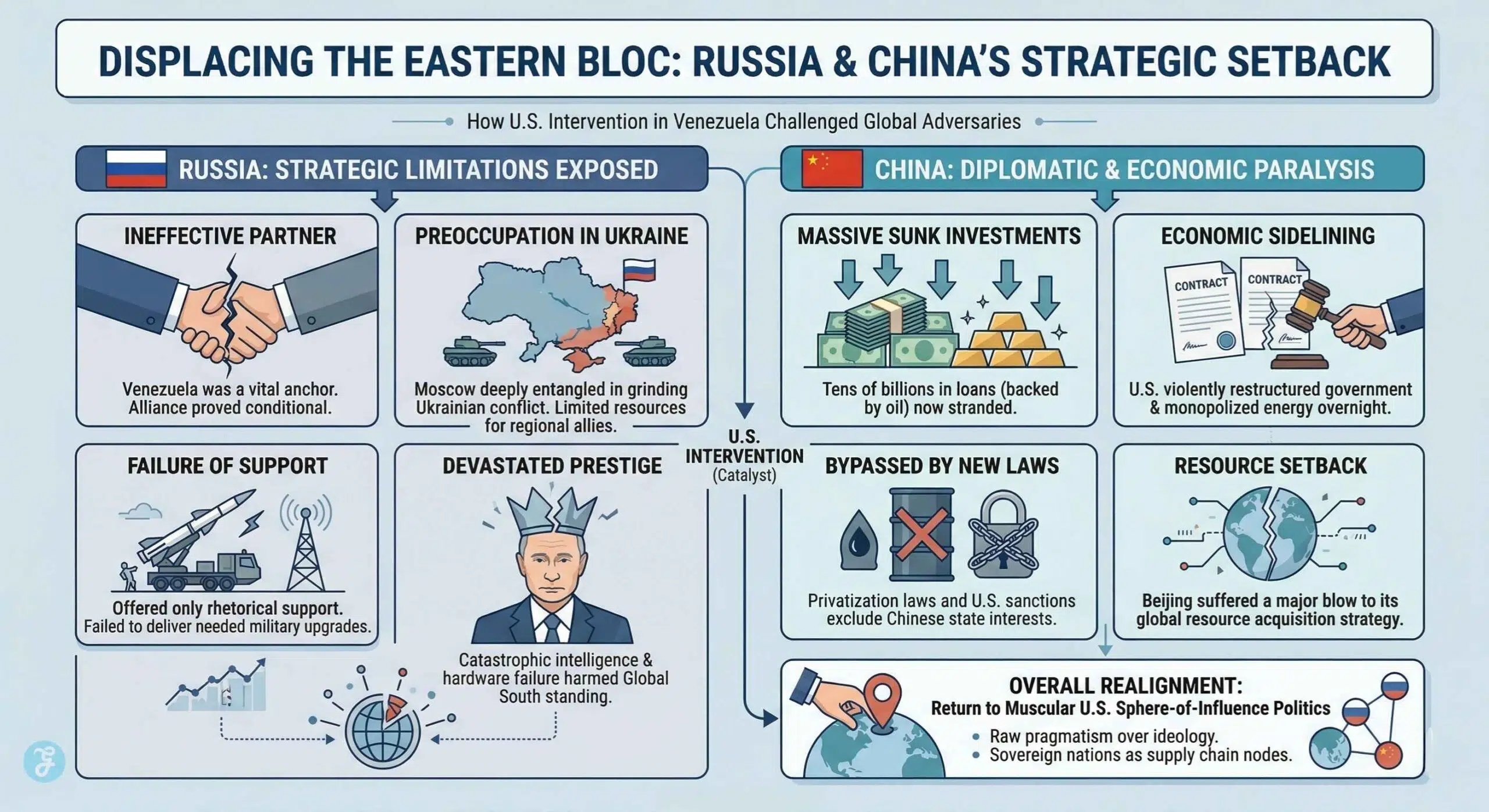
Exploiting the Eurasian Distraction
For years, Caracas served as a vital strategic anchor for Moscow and Beijing in the Americas, a defiant outpost of anti-Western sentiment. However, Operation Absolute Resolve ruthlessly exposed the glaring limitations of these alliances. Russia, deeply entangled in its grinding and economically devastating conflict in Ukraine, proved to be a completely ineffective partner.
Despite Maduro’s desperate pleas in late 2025 for updated air defense systems and aircraft repairs, Moscow could offer little more than rhetorical support when the American stealth jets arrived.
The catastrophic failure of Russian intelligence and military hardware to protect its primary regional ally delivered a devastating blow to Vladimir Putin’s prestige across the Global South. The much-touted “infinite friendship” was revealed to be entirely conditional.
Similarly, China found itself diplomatically paralyzed and economically sidelined. Having invested tens of billions of dollars in loans heavily backed by future Venezuelan oil deliveries, Beijing watched helplessly as the U.S. violently restructured the government and monopolized the energy sector overnight.
Because the new privatization laws and U.S. sanctions conveniently bypass Chinese state interests, Beijing has suffered a massive strategic setback in its global resource acquisition strategy.
This deliberate pushing out of rival superpowers represents a return to a much older, more muscular brand of American foreign policy.
The Echoes of 1823: Rebranding the Monroe Doctrine
The tactical acquisition of Venezuelan oil is merely the operational phase of a broader, unapologetic strategy to structurally wall off the Americas from outside influence.
Historical Precedent vs. Modern Execution
When President Trump publicly justified the capture of Nicolás Maduro, he explicitly invoked the Monroe Doctrine, formally resurrecting the 19th-century policy that views any foreign interference in the Americas as a potentially hostile act against the United States.
However, the 2026 iteration of this doctrine has been stripped of its historical paternalism and replaced with aggressive, resource-driven pragmatism. In the 19th and 20th centuries, the U.S. often intervened in Latin America under the guise of preventing the spread of communism or promoting democratic institutions. Today, the pretext is unapologetically transactional.
By violently asserting dominance in its own backyard while simultaneously signaling a retreat from other global conflicts, such as drawing down commitments in Eastern Europe and the Middle East, Washington is signaling a return to raw, sphere-of-influence politics.
The United States is no longer interested in being the world’s policeman; it is only interested in being the Western Hemisphere’s undisputed landlord. This modern execution of the Monroe Doctrine treats sovereign nations not as partners, but as vital supply chain nodes to be secured by any means necessary.
As Washington celebrates this strategic victory, the sheer brutality of the intervention has sent a wave of profound anxiety rippling through neighboring capitals.
The Latin American Backlash: A Continent on Edge
The immediate human and regional fallout across the continent reveals a deeply polarized hemisphere struggling to navigate the terrifying new realities of American power.
Brazil and Colombia’s Diplomatic Tightrope
For the surrounding nations of South America, the U.S. intervention in Venezuela has triggered a complex and agonizing diplomatic tightrope walk. On one hand, countries like Colombia, Brazil, and Peru have been fundamentally exhausted by the unprecedented migration crisis caused by Venezuela’s long-running economic collapse.
Over 8 million Venezuelans have fled the country over the last decade, placing an unbearable strain on the social services of neighboring states. In this regard, the sudden removal of Maduro and the potential stabilization of the Venezuelan economy through oil privatization offer a glimmer of desperately needed relief.
On the other hand, the blatant violation of international law and the UN Charter has horrified the region’s leaders. The normalization of cross-border military strikes and the abduction of a sitting head of state revives the darkest memories of 20th-century U.S. imperialism and CIA-backed coups.
Leaders in Brasilia and Bogotá are acutely aware that if Washington is willing to deploy 150 aircraft to secure oil in Caracas, no nation holding vital resources, from the lithium triangles of Chile and Bolivia to the copper mines of Peru, is truly safe from unilateral American intervention. The hemisphere is now acutely aware that national sovereignty is entirely contingent on remaining useful to Washington’s economic interests.
Finally: The True Price of Hemispheric Dominance
While the immediate tactical victories of this aggressive petropolitical strategy are undeniable, securing a vital energy supply chain, enriching domestic energy titans, and humiliating global rivals, the long-term viability of this approach remains deeply perilous. By explicitly prioritizing resource extraction over human rights and utilizing unilateral military force to reshape a sovereign government, Washington has permanently traded moral authority for heavy crude.
The Caracas Compromise is built entirely on the fragile foundation of coercion, not consensus. As regional neighbors watch the world’s preeminent military power casually dismantle and rebuild a South American nation to serve its own corporate interests, the United States risks replacing a manageable ideological rivalry with a deeply rooted, highly volatile resentment that will haunt the hemisphere for generations.





















