

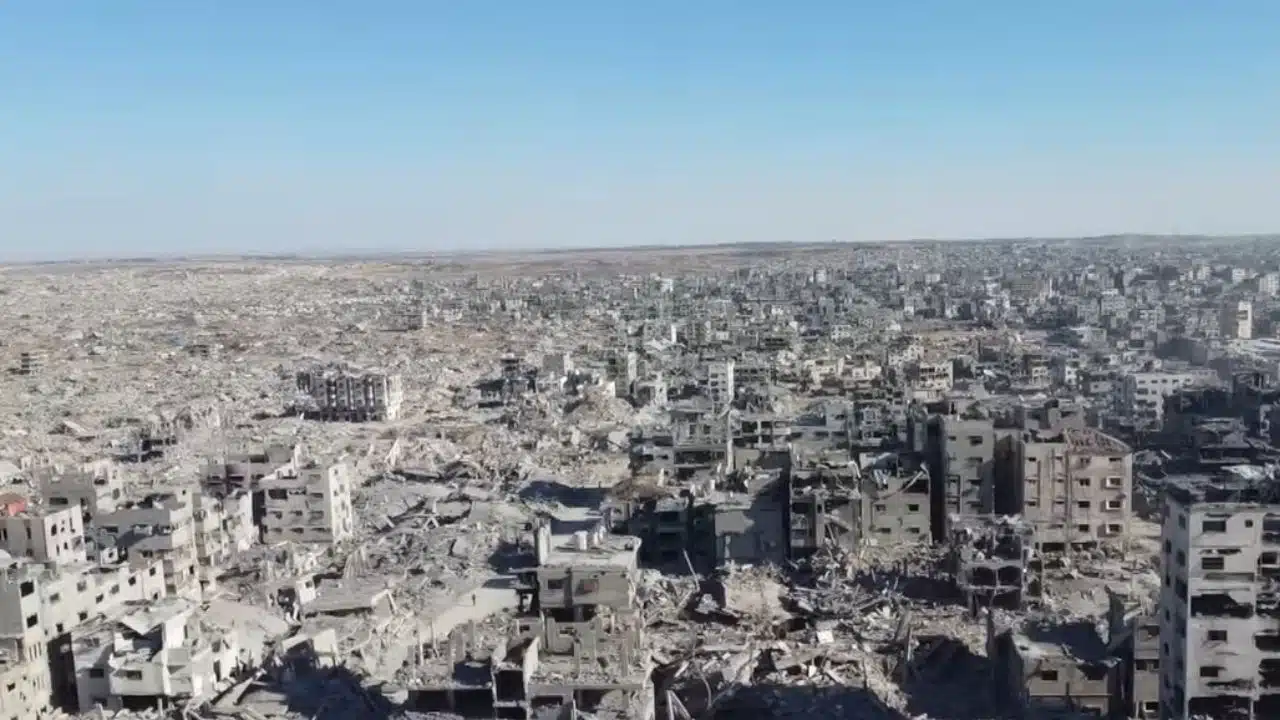
A fragile, US-brokered ceasefire in Gaza has all but collapsed following a weekend of deadly violence, with both Israel and Hamas accusing each other of critical violations. Top US mediators, including Jared Kushner, are on the ground in Israel, with Vice President JD Vance arriving today (October 21, 2025) in a high-stakes bid to rescue the agreement, even as US President Donald Trump issued a stark warning to Hamas to “behave” or be “eradicated.”
The severe escalation began Sunday after Hamas militants allegedly ambushed Israeli troops in Rafah, killing two soldiers. Israel responded with a massive bombardment that Palestinian officials report killed dozens. Israeli Prime Minister Benjamin Netanyahu confirmed the scale of the operation, stating his forces struck Gaza with “153 tons of bombs.
The State of the Truce
- Renewed Violence: The ceasefire, in effect since October 11, 2025, was shattered by an alleged Hamas ambush in Rafah on Sunday (Oct 19), killing 2 IDF soldiers.
- Israeli Retaliation: Israel responded with massive airstrikes. Prime Minister Netanyahu stated on Monday (Oct 20) that Israel dropped “153 tons of bombs” on Gaza in response.
- Palestinian Casualties: The Gaza Government Media Office reported Monday (Oct 20) that 97 Palestinians have been killed and 230 injured in 80 separate alleged Israeli violations since the truce began.
- Diplomatic Scramble: US envoys Jared Kushner and Steve Witkoff met with PM Netanyahu on Monday. US Vice President JD Vance is scheduled to arrive in Israel today (Oct 21) to “solidify the truce.
- US Warning: President Donald Trump warned Hamas on Monday, “if they’re not [good], we’re going to go and we’re going to eradicate them.”
The Collapse of a Ceasefire
Sunday’s Deadly Escalation
The 10-day-old truce, brokered by the Trump administration with support from Egypt and Qatar, unraveled dramatically on Sunday, October 19.
According to a statement from the Israel Defense Forces (IDF), the breach occurred in the southern Gaza city of Rafah. The IDF reported that its troops were targeted by anti-tank missiles and operatives emerging from a tunnel, resulting in the deaths of two soldiers. Israeli media detailed the incident as a “serious breach” involving anti-tank fire and an improvised explosive device (IED) targeting military engineering vehicles.
Israel’s response was immediate and overwhelming. On Monday, October 20, during the opening of the Knesset’s winter session, Prime Minister Benjamin Netanyahu confirmed the scale of the operation.
During the ceasefire, two soldiers fell… We struck them with 153 tons of bombs and attacked dozens of targets across the Gaza Strip,” Netanyahu stated.
Palestinian sources reported a devastating toll. The Gaza Civil Defence agency stated that at least 33 people were killed in the Israeli strikes on Sunday. The Gaza media office later updated that figure, claiming 44 Palestinians were killed in Sunday’s attacks alone.
Hamas, for its part, denied responsibility for the initial Rafah ambush. The group’s armed wing, the Izz al-Din al-Qassam Brigades, issued a statement affirming its commitment to the ceasefire and claiming it had lost communication with its units in the Rafah area, suggesting any action was from a rogue cell.
A Pattern of Alleged Breaches
While Sunday’s clash was the largest, Palestinian officials allege Israel continues deadly Gaza truce breaches as a matter of course. The Gaza Government Media Office released a statement on Monday (Oct 20) documenting what it called “80 Israeli ceasefire violations” since the agreement began on October 11.
These alleged violations, according to the statement, have resulted in:
- 97 Palestinians killed
- 230 Palestinians injured
One of the deadliest reported incidents prior to Sunday occurred on Friday, October 17. Eleven members of a single Palestinian family, including seven children and three women, were killed by Israeli forces near a demarcation line.
Mahmoud Basal, a spokesperson for the Gaza Civil Defence, described the tragedy. “They had crossed the so-called ‘yellow line’, an imaginary boundary mentioned by the Israeli army,” Basal told reporters. “I am certain the family couldn’t distinguish between the yellow and red lines because there are no actual physical markers on the ground.”
The Israeli military contended that troops opened fire in accordance with the agreement after individuals crossed the boundary line, posing a threat.
US Scrambles to Save Deal Amid “Eradication” Warning
With the ceasefire agreement in tatters, Washington has initiated a full-scale diplomatic press to prevent a return to all-out war.
On Monday, October 20, the key architects of the truce, White House senior envoy Steve Witkoff and President Trump’s son-in-law Jared Kushner, arrived in Israel. They held emergency meetings with Prime Minister Netanyahu to “mediate some of the early disputes” and find a path back to compliance.
The diplomatic push is set to intensify today, October 21, with the scheduled arrival of US Vice President JD Vance. Vance is expected to meet with Netanyahu to discuss solidifying the current truce and, crucially, moving to the more complex “Phase 2” of the plan, which includes the disarmament of Hamas and the establishment of a multinational stabilization force in Gaza.
The diplomatic effort has been paired with harsh rhetoric from the White House. Speaking to reporters on Monday, President Donald Trump placed the blame for the breakdown squarely on Hamas, issuing a direct threat.
We made a deal with Hamas that they’re going to be very good, they’re going to behave, they’re going to be nice,” President Trump said. “And if they’re not, we’re going to go and we’re going to eradicate them.”
When asked if this implied the use of US troops, the president stated, “we don’t need to.”
Analysis: Sticking Points and Humanitarian Toll
The current truce is failing over several critical points of contention that were left unresolved in the initial agreement.
- Hostage Remains: Israel accuses Hamas of dragging its feet on the return of deceased hostages. As of October 15, the UN estimates 21 bodies of Israeli hostages remain in Gaza. Hamas claims it requires specialized equipment to retrieve them from rubble.
- Rafah Crossing: A key part of the deal was the reopening of the Rafah border crossing with Egypt to allow humanitarian aid, medical evacuations, and the return of some Palestinians. Israel has kept the crossing sealed, citing Hamas’s slow cooperation.
- Yellow Lines”: The ambiguity of the ceasefire lines, as highlighted by the killing of 11 family members on Friday, creates deadly flashpoints on the ground.
- Disarmament: The core of the US plan—the eventual disarmament of Hamas—remains the largest obstacle, as Hamas has not agreed to this condition.
The diplomatic failure has immediate, dire consequences for Gaza’s population. The UN Office for the Coordination of Humanitarian Affairs (OCHA) reported that the ceasefire had allowed some aid to resume and for people to move. Since October 10, over 390,000 movements of displaced persons were recorded, mostly civilians attempting to return to northern Gaza.
This movement is now halted, and aid delivery, which remains far below pre-war levels, is again in jeopardy.
The overall toll of the war, which began in October 2023, is staggering. As of October 15, 2025, the Gaza Ministry of Health reports 67,938 Palestinians have been killed and 170,169 injured. The Israeli military reports 468 soldiers have been killed since the ground operation began.
The next 24 hours are critical. All eyes are on:
- VP JD Vance’s arrival: His meetings with Netanyahu today will determine if the US can force a de-escalation.
- The status of Rafah: Whether Israel opens the crossing as a sign of de-escalation or keeps it sealed.
- Response from Hamas: How Hamas and other militant factions in Gaza react to President Trump’s “eradication” warning.
The weekend’s violence has demonstrated that the truce was little more than a pause. With both sides trading accusations and high-explosive ordnance, the high-level US delegation faces the monumental task of pulling the region back from the brink of a full-scale war that, for the past 48 hours, has already resumed.
The Information is Collected from BBC and Aljazeera.






















