India and Pakistan, two long-standing nuclear-armed rivals, have agreed to a full and immediate ceasefire after days of escalating violence that many feared could lead to an all-out war. The surprise announcement, made on Saturday, May 10, 2025, was welcomed with cautious optimism by the global community. However, the situation remains fragile as both countries report fresh violations of the truce just hours after it was declared.
Below is a detailed breakdown of how the ceasefire came about, what led to the escalation, and the challenges that may threaten the fragile peace.
How Did the Ceasefire Come About?
At around 8 a.m. Eastern Time (5 p.m. in India and Pakistan), former U.S. President Donald Trump took to his platform, Truth Social, to announce that India and Pakistan had reached a ceasefire agreement.
“After a long night of talks mediated by the United States, I am pleased to announce that India and Pakistan have agreed to a FULL AND IMMEDIATE CEASEFIRE,” Trump wrote.
He credited the leaders of both countries for “using common sense and great intelligence.”
Shortly after, U.S. Secretary of State Marco Rubio confirmed that discussions had been underway for two days. Rubio claimed that not only had the two countries agreed to a ceasefire, but they also planned to engage in broader peace talks “at a neutral location.” According to Rubio, the talks were led in part by Vice President JD Vance, who, alongside Rubio, held urgent discussions with senior Indian and Pakistani officials to avoid a catastrophic escalation.
Contrasting Narratives: US Role Disputed
While Pakistan acknowledged and praised the U.S. for its diplomatic intervention, India downplayed any foreign involvement, asserting that the ceasefire had been arranged directly between the two nations.
“The ceasefire agreement was worked out through direct military-to-military channels,” said India’s Ministry of Information. “There is currently no decision to initiate any additional peace talks at a third-party venue.”
By contrast, Pakistani Prime Minister Shehbaz Sharif lauded President Trump and the U.S. for “playing a proactive role in establishing regional peace.”
These opposing views reflect the countries’ differing stances on foreign mediation. Analysts say India traditionally resists outside interference, especially regarding Kashmir, while Pakistan often welcomes international intervention to raise diplomatic pressure on New Delhi.
What Triggered This Round of Violence?
This latest crisis was sparked by a deadly terrorist attack on April 26, 2025, in Pahalgam, a popular hill station in Indian-administered Kashmir.
The Pahalgam Massacre
According to Indian authorities, gunmen opened fire on a group of tourists, killing 25 Indian nationals and one Nepali citizen. The attack drew immediate international condemnation. New Delhi blamed Pakistan-based militants, specifically accusing the group The Resistance Front (TRF)—believed to be backed by Lashkar-e-Taiba—of orchestrating the massacre.
Pakistan denied any role in the attack and called for a neutral international investigation, which India rejected outright.
Operation Sindoor: India’s Military Response
In retaliation, India launched “Operation Sindoor” on May 8, targeting alleged militant camps and military installations in Pakistan-administered Kashmir and even deep into Pakistani territory. The strikes, which Indian officials claimed were “precise and proportionate,” included air-to-surface missile deployments and drone surveillance operations.
Pakistan responded with its own strikes, targeting military bases in Srinagar, Jammu, and beyond. The country’s military described the response as “an eye for an eye”, claiming it had inflicted significant damage on Indian installations.
A Worsening Battlefield: What Happened on Saturday?
Despite behind-the-scenes talks, the morning of May 10 was one of the most violent in years. Pakistani officials claimed that Indian missiles struck strategic military locations near Islamabad, as well as in Pakistan-administered Kashmir.
India responded by stating that its air defense systems had intercepted multiple Pakistani drones and retaliated by targeting radar stations and launch pads used for cross-border attacks.
By afternoon, multiple explosions were reported in Indian-administered Kashmir, including the capital city Srinagar, and the border town of Jammu. Both countries maintained combat readiness throughout the day—until Trump’s ceasefire announcement shifted the tone.
Why Did the U.S. Step In?
Until recently, U.S. officials had minimized the likelihood of involvement, with Vice President JD Vance stating on Fox News that the conflict was “not America’s business.”
However, on Friday, U.S. intelligence agencies warned of an imminent risk of full-scale war between the two countries. With nuclear assets reportedly moved into readiness, the State Department urgently re-engaged with New Delhi and Islamabad.
Behind-the-Scenes Diplomacy
High-level discussions were held in Geneva and via secure satellite lines coordinated by U.S. diplomats in Doha and New York, according to sources familiar with the negotiations. By late Friday night, a draft ceasefire had been prepared and shared with both nations. The Trump administration, eager to display foreign policy influence in a tense global climate, fast-tracked the announcement.
Will the Ceasefire Hold?
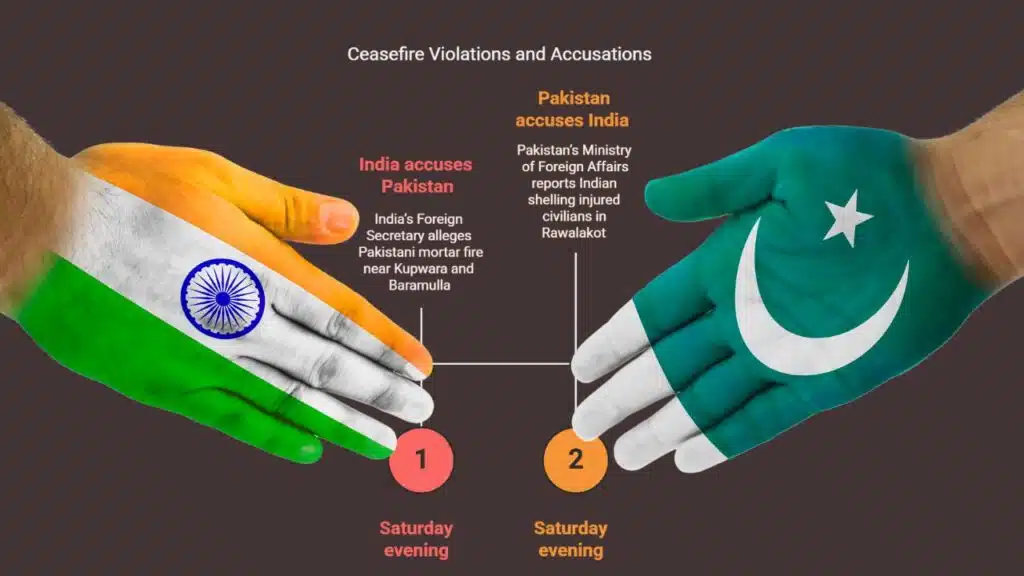
Despite the agreement, early signs are not encouraging. By Saturday evening, both sides were accusing each other of violating the ceasefire.
Accusations of Breach
- India’s Foreign Secretary Vikram Misri alleged that Pakistani mortar teams had fired shells near Kupwara and Baramulla.
- Pakistan’s Ministry of Foreign Affairs reported that Indian shelling injured four civilians in Rawalakot, and warned that it “reserves the right to respond proportionately.”
Both governments insist they are “committed” to maintaining the ceasefire, but the ongoing mistrust and volatile border dynamics present major obstacles.
Other Fallout Measures Still in Place
Even if the ceasefire technically holds, numerous other escalatory measures remain unresolved:
- India has suspended all tourist visas for Pakistani citizens.
- Pakistan has imposed a full trade embargo on Indian goods.
- India has withdrawn from the Indus Waters Treaty negotiations, a critical water-sharing agreement that has historically served as a diplomatic lifeline during crises.
- Both countries have scaled down diplomatic ties, recalling ambassadors and freezing back-channel communications.
What Happens Next?
The international community, including the G7, China, and the United Nations, has called for calm and long-term dialogue.
However, the diplomatic landscape remains deeply polarized. Without formal agreements to resume trade, restore confidence-building measures, or de-escalate military deployments along the Line of Control (LoC), analysts fear the ceasefire may simply be a pause before another cycle of violence.
“This ceasefire buys time, not peace,” said Dr. Aparna Pande of the Hudson Institute.
“Unless there’s real political will on both sides, this fragile moment could disappear just as quickly as it appeared.
India and Pakistan’s agreement to a ceasefire offers a glimmer of hope in a deeply volatile situation. But with conflicting narratives, ongoing military tensions, and unresolved territorial disputes, this truce remains on uncertain ground. Whether this is the first step toward reconciliation—or just a temporary timeout—will depend on how both nations act in the coming days.
The Information is Collected from CNN and BBC.