
Subhas Chandra Bose, popularly known as Netaji, remains one of India’s most enigmatic freedom fighters. His unwavering commitment to India’s independence and his radical approach to achieving it set him apart from other leaders of his time. His mysterious disappearance in 1945 left behind a trail of unanswered questions and speculations.
But what if Netaji had lived? How would India’s political, economic, and military landscape have evolved under his leadership? How would India be different if Netaji had lived? Would India have taken a different path in governance, foreign relations, and economic development?
In this editorial, we explore the potential trajectory of an India shaped by the leadership of Subhas Chandra Bose.
Netaji’s Vision for India
Netaji Bose envisioned a militarily strong, economically independent, and socially progressive India. Unlike Mahatma Gandhi’s non-violent struggle, Bose believed in achieving freedom through armed resistance.
His leadership of the Indian National Army (INA) demonstrated his commitment to direct action. Post-independence, Bose would have likely pursued a path distinct from the Congress-led governance under Jawaharlal Nehru.
His ideology combined nationalism with socialist principles. He admired leaders like Hitler and Mussolini for their ability to industrialize and modernize their nations rapidly, though he did not subscribe to their oppressive policies.
Bose wanted India to be self-reliant, industrially robust, and free from Western influence. His governance would have emphasized strong leadership, discipline, and economic planning.
A Militarized and Industrialized Nation
Bose was a firm believer in a strong military-backed governance model. He envisioned a disciplined and organized nation where the armed forces played a crucial role in maintaining internal security and external defense.
His leadership would have led to an India with a much stronger defense industry, capable of self-sustenance rather than relying on foreign imports for arms and ammunition.
Bose’s admiration for technologically advanced nations meant that India under his rule might have pursued rapid industrialization. Unlike the Nehruvian socialist approach that emphasized state-controlled enterprises, Bose might have promoted a blend of public and private sector participation, ensuring economic self-reliance while leveraging global expertise.
A Nationalistic and Unified Identity
Bose strongly advocated for national unity beyond religious and caste barriers. His idea of nationalism revolved around collective identity rather than regional or religious affiliations. Had he lived, India might have seen stricter policies to curb separatist tendencies, and a greater emphasis on a singular national identity through education and cultural programs.
Scientific and Educational Progress
Bose emphasized the role of science and technology in nation-building. Under his leadership, India might have invested heavily in scientific research, technological innovation, and higher education, much earlier than it did.
Institutions focusing on defense technology, space exploration, and industrial research could have emerged decades earlier, positioning India as a global leader in innovation much sooner.
Welfare and Economic Policies
Bose’s governance would likely have balanced economic growth with social welfare. He believed in fair wages, labor rights, and equal opportunities, which could have led to stronger labor laws, industrial reforms, and a more equitable economic structure.
Unlike Nehru’s reliance on heavy state control, Bose might have implemented a model similar to Japan or South Korea—one that combined state-led planning with private sector participation.
How Would India Be Different if Netaji Had Lived?
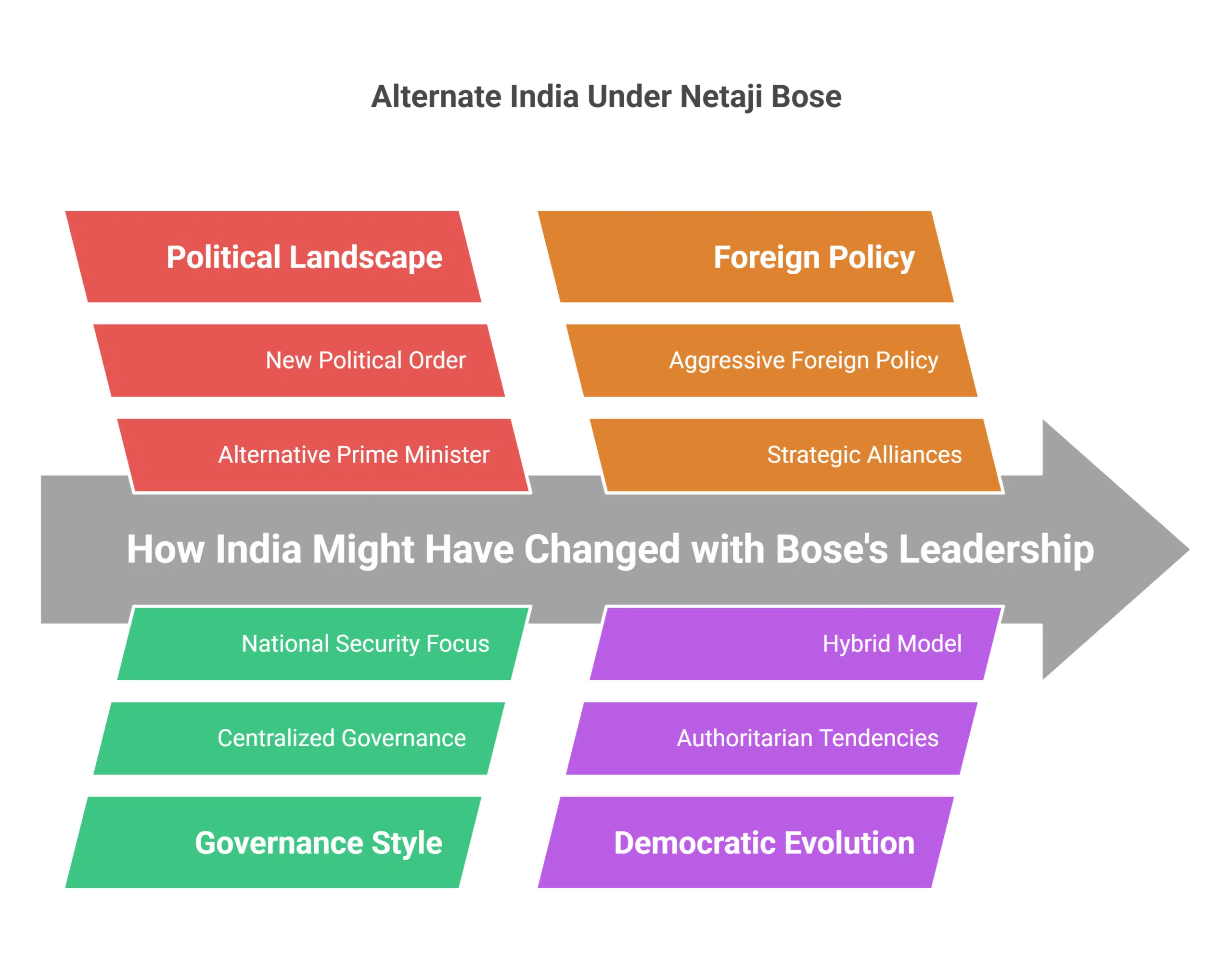
Imagine a world where Netaji Subhas Chandra Bose, the formidable leader of the Indian National Army, survived the tumultuous final years of India’s freedom struggle. What new shape might our nation have taken under his influence?
Speculating on this alternate history offers a glimpse into how India’s political, economic, and cultural landscape could have evolved differently—perhaps more boldly, with a stronger military ethos and a fresh approach to uniting diverse communities.
Would India Have Had a Different First Prime Minister?
Had Netaji survived and returned to India, he would have been a strong contender for the position of Prime Minister. Given his strained relations with the Congress leadership, he might have either challenged Nehru’s leadership or established an alternative political force.
Bose’s emphasis on nationalism and militarization could have led to a stronger executive system rather than Nehru’s parliamentary democracy. His leadership might have resulted in a single-party system, similar to what was seen in some Asian countries like China and Singapore, where strong governance and economic reforms took precedence over multiparty democracy.
Formation of a New Political Order
If Netaji had lived, he might have led to the formation of a new political movement distinct from the Congress. Given his ideological differences with Gandhi and Nehru, he could have established a nationalist, socialist-driven party that prioritized strong leadership, defense, and rapid economic development.
Such a party could have fundamentally altered India’s early political landscape and prevented the Congress Party’s long-term dominance.
Stronger Centralized Governance
Netaji was known for his belief in discipline, organization, and strong central governance. Unlike the decentralized power structures favored by Nehru and Gandhi, Bose might have established a more centralized system of governance, focusing on efficiency and swift decision-making.
This could have led to a government structure similar to modern China or Russia, where rapid industrialization and infrastructure development took precedence over bureaucratic deliberation.
Stricter National Security and Law Enforcement
Bose’s governance style would likely have emphasized national security and law enforcement, ensuring internal stability. With his emphasis on military discipline and national unity, Bose might have implemented stricter measures to curb regional insurgencies, separatist movements, and external threats. This could have resulted in a stronger, more unified India but might have also led to a more authoritarian governance structure.
An Alternative to the Non-Aligned Movement
Nehru’s foreign policy was heavily centered around the Non-Aligned Movement (NAM), where India maintained a neutral stance between the U.S. and the Soviet Union during the Cold War. In contrast, Bose’s pragmatic approach might have led to closer alliances with technologically advanced and militarily strong nations.
Instead of a neutral stance, Bose could have pursued a more aggressive foreign policy that positioned India as a strategic global power much earlier than it eventually did.
Potential Impact on Indian Democracy
One of the most debated aspects of Bose’s hypothetical leadership is whether India would have remained a democracy. His admiration for strong governance models in Germany and Italy raises questions about whether he would have leaned towards a more authoritarian style of rule.
However, given his commitment to India’s welfare, it is possible that he would have balanced strong leadership with democratic principles, creating a unique hybrid political model.
Foreign Policy Under Bose
Bose’s approach to international relations was pragmatic and strategic. Unlike Nehru’s Non-Aligned Movement (NAM), which sought to maintain a neutral stance in Cold War politics, Bose might have pursued strategic alliances based on national interests.
- India as a Global Power: With a strong military and a self-reliant economy, Bose might have positioned India as a key player in global geopolitics, influencing major international decisions.
- Alliances with Emerging Powers: Instead of maintaining a neutral stance, Bose could have strategically allied with nations that aligned with India’s vision of development and military expansion.
- Economic and Military Expansion: Bose’s foreign policy would have likely focused on securing vital resources, expanding trade partnerships, and enhancing military capabilities through international collaborations.
- Regional Leadership: India under Bose’s leadership might have played a more dominant role in South Asia, ensuring stability and fostering economic ties with neighboring countries.
Economic Model: A Different Approach?
Netaji Bose was a strong advocate of a planned economy, but unlike Nehru’s socialist model, his approach might have been more pragmatic, incorporating elements of both capitalism and socialism.
- Industrialization First: Bose understood the importance of rapid industrialization. Unlike Nehru, who placed heavy reliance on state-owned enterprises, Bose may have encouraged private entrepreneurship alongside state intervention. His economic policies would have facilitated technological advancements, infrastructure growth, and a robust manufacturing sector, making India a formidable industrial power much earlier.
- Self-Reliance and Global Trade: While Nehru was hesitant about global trade, Bose might have pursued an export-driven economy, making India a competitive manufacturing hub much earlier. His policies would have likely promoted a mix of protectionist strategies to nurture domestic industries while selectively engaging in international trade to enhance competitiveness.
- Welfare Policies and Labor Rights: Bose strongly believed in workers’ rights, fair wages, and equal opportunities. His governance could have emphasized labor reforms, better working conditions, and the establishment of a social security system for workers. A balance between industrial growth and workers’ welfare might have created a more equitable economy.
- Strategic Economic Planning: Unlike Nehru’s centralized five-year plans that relied heavily on government intervention, Bose may have preferred a more dynamic approach where state planning worked in tandem with entrepreneurial initiatives. His vision could have fostered an economic environment similar to post-war Japan or Germany, where state policies encouraged private enterprise while ensuring national interests remained a priority.
- Agricultural and Rural Development: Recognizing the importance of agriculture, Bose’s policies might have included substantial rural development programs, modernizing farming techniques, and ensuring fair market prices for farmers. This could have prevented agrarian distress and enhanced food security at a much faster rate.
- Banking and Financial Reforms: Bose’s pragmatic approach to economic growth might have led to earlier financial reforms, ensuring better access to credit for small businesses, regulated financial markets, and a stable banking system that could have spurred economic growth and innovation.
Under his leadership, India might have achieved economic growth similar to South Korea or China, where disciplined governance played a crucial role in rapid development.
With a clear emphasis on industrialization, self-reliance, and strategic economic planning, India could have positioned itself as an economic powerhouse decades before it actually did.
Military and National Security: A Stronger India?
One of Netaji’s core beliefs was the necessity of a strong defense. Unlike Nehru, who initially downplayed military expenditures, Bose would have prioritized building a formidable army, navy, and air force.
- Avoiding the 1962 China War Debacle: If Bose had been in power, India might not have suffered the humiliating defeat against China in 1962. His foresight in military preparedness would have ensured stronger border security.
- A More Assertive Foreign Policy: India, under Bose, might have adopted a more aggressive stance on regional disputes, potentially influencing the outcomes of conflicts like the Kashmir issue with Pakistan.
- Advanced Defense Infrastructure: Bose’s leadership would have likely resulted in a more advanced defense industry, focusing on domestic production of military equipment, reducing dependency on foreign imports.
- Compulsory Military Training: Given his emphasis on discipline and nationalism, Bose might have introduced a system of compulsory military training for youth, ensuring a strong reserve force ready for national defense.
- Naval and Air Force Expansion: Unlike the early Indian leadership that prioritized land forces, Bose would have understood the importance of maritime and aerial supremacy. India might have developed a formidable navy and air force much earlier, establishing itself as a dominant power in the Indian Ocean region.
- Strategic Alliances for Defense: Bose could have sought strategic military alliances with technologically advanced nations, ensuring access to cutting-edge defense technologies and fostering defense cooperation with global powers.
With these policies, India under Bose’s leadership could have become a regional military superpower, ensuring a strong defense posture and a more assertive role in global geopolitics.
Final Thoughts
The question of how India would have been different had Netaji Subhas Chandra Bose lived is a fascinating exploration of alternative history. His leadership would have certainly resulted in a stronger military, a different economic model, and possibly a more unified nation. However, whether India would have remained a democracy in its current form is debatable.
Bose’s charisma and radical approach could have propelled India into a superpower much earlier, but at what cost? Would his strong leadership have led to authoritarian tendencies, or would he have balanced his ideology with democratic principles? These are questions that remain unanswered.
Nonetheless, what is undeniable is that Netaji’s influence on India’s freedom struggle and his vision for a self-reliant, powerful India continue to inspire generations. His legacy reminds us of the possibilities that could have shaped a different India—one that was more assertive, disciplined, and economically robust.