Knowing how to teach letter sounds in order is one of the most critical decisions in early literacy. Teaching letters in traditional A-to-Z alphabetical order slows reading progress down because critical vowels and high-utility consonants are scattered across twenty-six letters.
By switching to an evidence-based sequence, children learn high-frequency letter sounds first and begin decoding real, full words within their first two weeks of practice.
Why Knowing How to Teach Letter Sounds in Order Matters
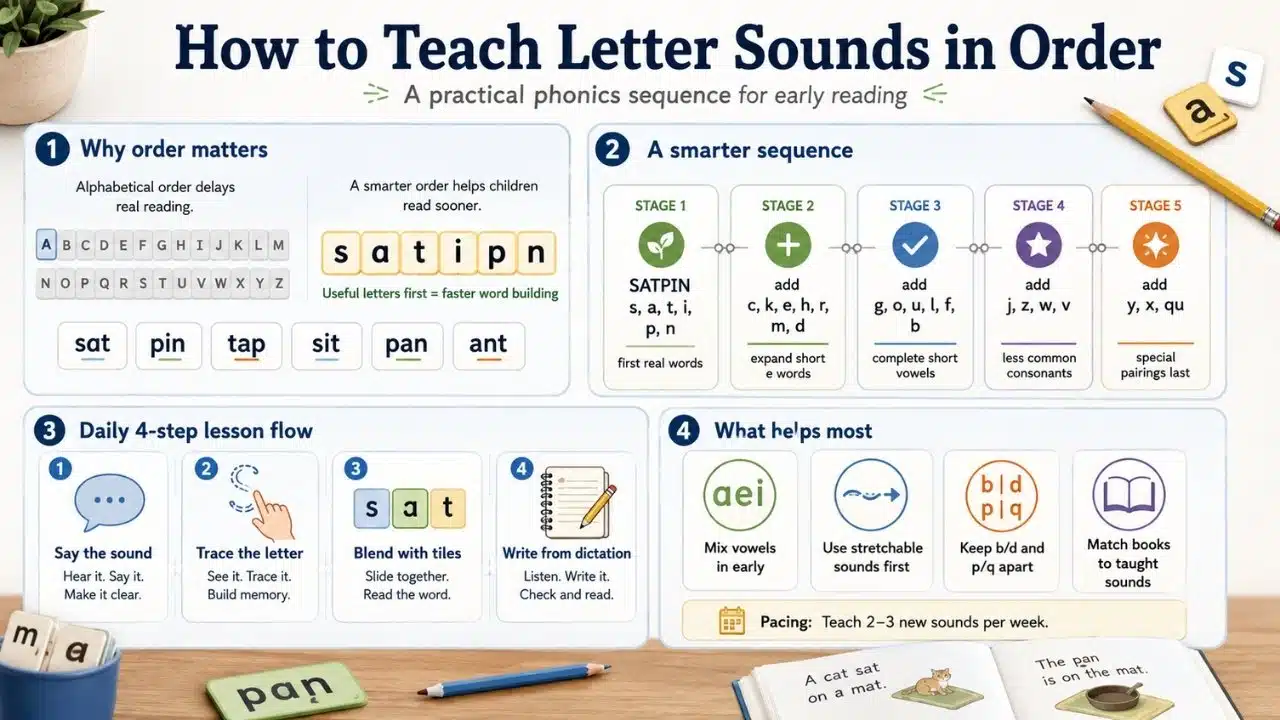
Relying on alphabetical order holds children back in isolated sound drills. Under an A-to-Z sequence, a child learns A, B, C, and D before encountering a second vowel. Without short vowels like /i/ or /o/, students lack the building blocks needed to construct simple, decodable words.
Alphabetical sequencing also places visually and auditorily confusable letters right next to each other. Teaching B and D or E and F back-to-back causes letter reversals and auditory confusion.
Understanding how to teach letter sounds in order means organizing the alphabet by utility and mouth mechanics rather than historical placement. Grouping letters strategically lets you combine a few consonants with short /a/ and short /i/ to build dozens of three-letter words right away.
The Best 5-Stage Sequence for Teaching Letter Sounds
The most practical phonics sequence introduces letters in small, functional groups designed for immediate word generation.
| Stage | Target Letters Introduced | Target Vowels | Decodable Words Students Can Read |
| Stage 1 | s, a, t, i, p, n | Short a, Short i | sat, at, it, pat, tap, pin, sit, pit, pan, tan, ant, spin |
| Stage 2 | c, k, e, h, r, m, d | Short e | cat, kid, red, hen, mad, kit, map, dad, ten, sad |
| Stage 3 | g, o, u, l, f, b | Short o, Short u | dog, log, bus, cup, fog, bat, big, sun, leg, fun |
| Stage 4 | j, z, w, v | Consolidation | jam, zip, wet, van, win, vet, cob, tub, web |
| Stage 5 | y, x, q(u) | Consolidation | fox, yes, quit, yak, box, quick, six |
Stage 1: The SATPIN Group
The letters s, a, t, i, p, and n form the foundation of early phonics. This set combines two short vowels (short /a/ and short /i/) with four high-frequency consonants. Master this single group, and students can read and spell over twenty words including sat, pin, tap, pit, and ant.
Stage 2: Adding Hard C, K, Short E, and Common Consonants
Stage 2 introduces c, k, e, h, r, m, and d. This introduces the hard /k/ sound represented by both c and k, while adding short /e/ to expand word possibilities. Students can now decode words like cat, red, hen, kit, and mad.
Stage 3: Completing the Short Vowel Set
Stage 3 brings in g, o, u, l, f, and b. Adding short /o/ and short /u/ completes the main short vowel set, opening up hundreds of new three-letter words like dog, cup, log, bus, and leg.
Stage 4: Lower-Frequency Consonants
Stage 4 focuses on j, z, w, and v. These consonants show up less often in beginner books, but teaching them here completes a child’s ability to read almost any single-syllable short-vowel word.
Stage 5: Low-Frequency Letters and Special Pairings
Stage 5 tackles low-frequency letters alongside special pairings: y, x, and the qu combination. The letter q is almost never taught alone; it pairs with u to form the /kw/ sound. The letter x comes last because it represents two blended consonant sounds (/k/ and /s/) at the end of words like box or fox.
Core Rules: How to Teach Letter Sounds in Order Effectively
Applying this sequence in daily instruction requires following four foundational reading principles:
-
Prioritize High-Utility Letters First: Focus on letters like S, A, T, P, I, N, and M early on because they build hundreds of simple CVC (Consonant-Vowel-Consonant) words. Save low-utility letters like X, Q, and Z for last.
-
Start with Continuous Sounds: Sounds you can stretch out without stopping airflow (/s/, /m/, /f/, /a/) are much easier for beginners to blend than stop sounds (/t/, /p/, /b/).
-
Separate Confusable Letters: Keep visually similar pairs (b and d) and auditorily similar short vowels (short /e/ and short /i/) several weeks apart in your teaching plan.
-
Mix Short Vowels into Week One: Never teach all 21 consonants before introducing vowels. Combine short /a/ and short /i/ with your first consonant group so children learn to blend real words immediately.
Daily 4-Step Routine for Teaching Letter Sounds
Introducing a new letter sound works best with a tight, structured daily process:
Step 1: Pronounce the Sound Short: Clip stop sounds short. Say a crisp /p/ instead of “puh” so students don’t blend “puh-a-tuh” instead of “pat.”
Step 2: Trace and Write: Have students trace the letter on paper or in the air while stating the sound out loud.
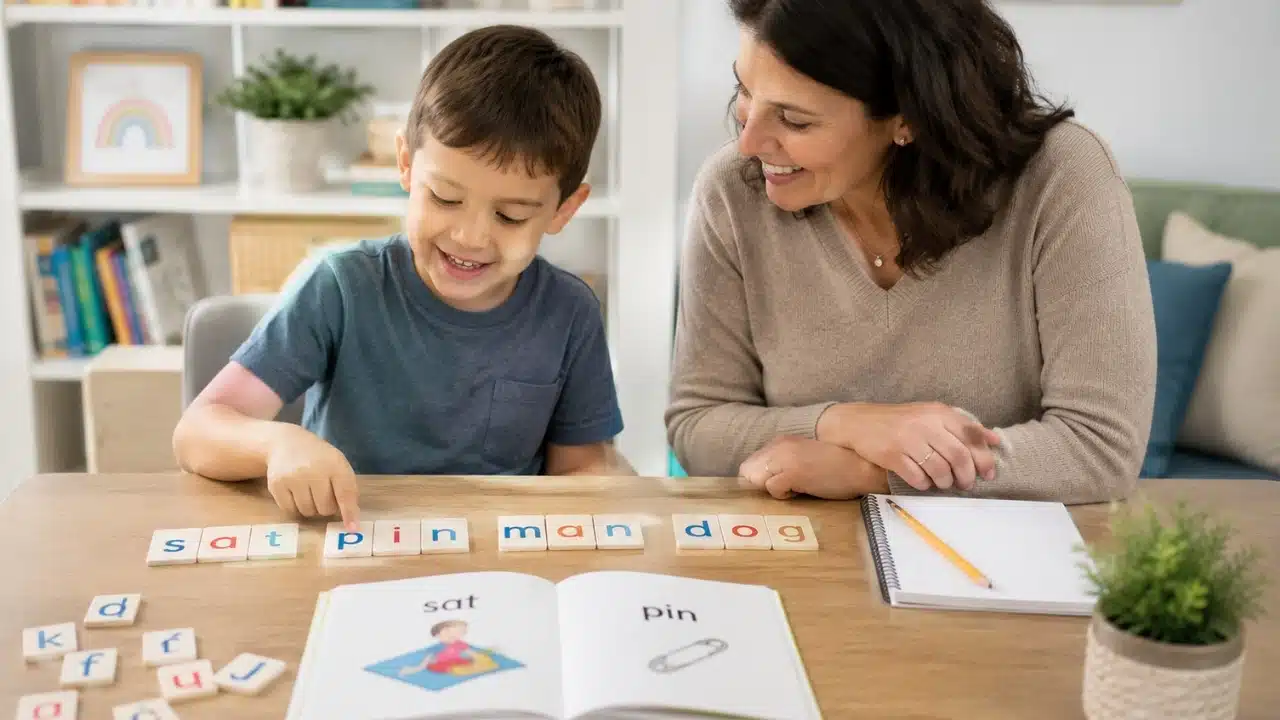
Step 3: Blend Immediately: Never teach a sound in isolation. Pull out letter tiles and blend the new sound into short words right away.
Step 4: Dictation: Say a sound out loud and have students write down the matching letter from memory.
Solving Common Classroom Challenges
Fixing b and d Reversals
Reversals are extremely common in young readers. Fix reversals by focusing on the motor strokes for writing each letter rather than relying on visual memory.
The letter b starts with a tall line down before looping around (line down, then loop). The letter d starts with a left-facing curve just like the letter c before reaching up high (curve first, then tall line). Linking each letter to a distinct handwriting motion stops confusion fast.
Setting the Right Pacing
Most effective reading programs introduce two or three letter sounds per week. This leaves plenty of time for daily review, handwriting practice, and reading decodable stories without overloading working memory.
Matching Scope to Decodable Books
Only give students books containing letter sounds they have already been taught. If a child has only learned Stage 1 sounds (s, a, t, i, p, n), give them decodable texts built strictly around those six letters. Asking children to guess at untaught sounds in complex books damages reading accuracy and encourages bad guessing habits.
How to Teach Letter Sounds in Order Using Interactive App Practice
Once you establish a high-utility sound sequence, interactive tools can provide the repetitive, multisensory practice young children need. Digital tracing applications bridge the gap between hearing a phoneme and physically writing its grapheme.
Accelerating Sound Recall with Alphabet Magic Trace and Phonics
Interactive stroke feedback prevents children from developing bad handwriting habits like forming letters from the bottom up or looping strokes in reverse. Using guided digital practice enforces correct top-to-bottom motor paths while pairing every completed stroke with its exact speech sound.
-
Guided Motor Memory: Visual prompts guide proper stroke direction, cutting down on letter reversals like b and d.
-
Instant Audio Reinforcement: Clear audio plays immediately as a child traces, locking in the link between visual shape and phonetic sound.
-
Everyday Multisensory Practice: Parents and educators can install Alphabet Magic Trace and Phonics on Android or download Alphabet Magic Trace and Phonics for iOS.
As highlighted in Editorialge’s review of Alphabet Magic Trace and Phonics, combining physical tracing motions with crisp audio feedback speeds up letter-sound recognition far better than static flashcards alone.
Actionable Takeaways for Reading Instruction
Ditching alphabetical order in favor of a high-utility phonics sequence gives beginner readers immediate traction. Starting with flexible, continuous sounds and introducing short vowels in week one lets children move directly from learning isolated letter sounds to decoding real, full words.
Keep confusable letters like b and d weeks apart, clip stop sounds short so you don’t add a “schwa” sound, and limit reading materials strictly to decodable words containing sounds you have already taught. A structured, predictable routine converts letter sound recognition into automatic reading fluency.
Frequently Asked Questions(FAQs) on How to Teach Letter Sounds in Order
Should you teach letter names or letter sounds first?
Prioritize letter sounds for reading. You can mention letter names, but decoding relies entirely on letter sounds. Saying the letter names C-A-T will not help a child blend the spoken word /k/ – /a/ – /t/.
What if a student struggles to blend sounds together?
If a student struggles with blending, switch to continuous sounds like /s/, /m/, or /f/. Have them stretch the first sound directly into the vowel without breaking their breath, guiding them through continuous blending until the skill clicks.
How do you transition from single letters to digraphs like sh and ch?
Introduce two-letter teams (digraphs like sh, ch, th, and ck) once students master single-letter short-vowel words. Treat a digraph as a single sound unit during blending practice.