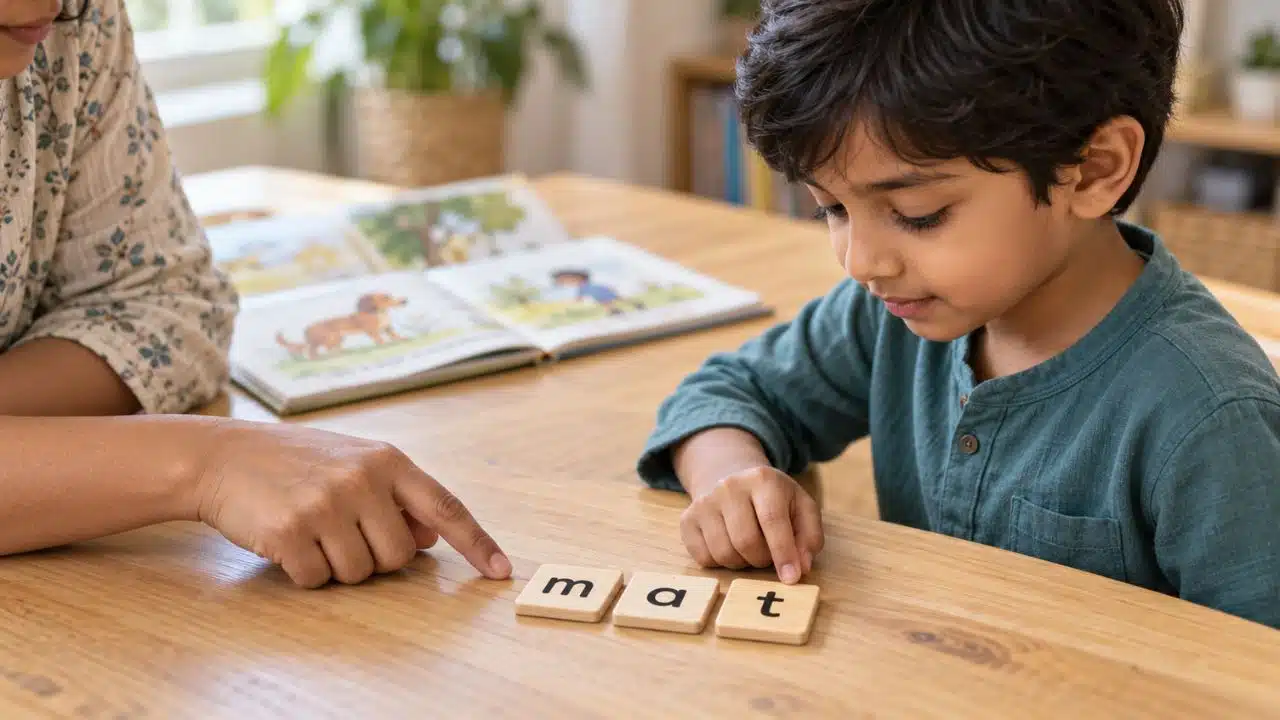
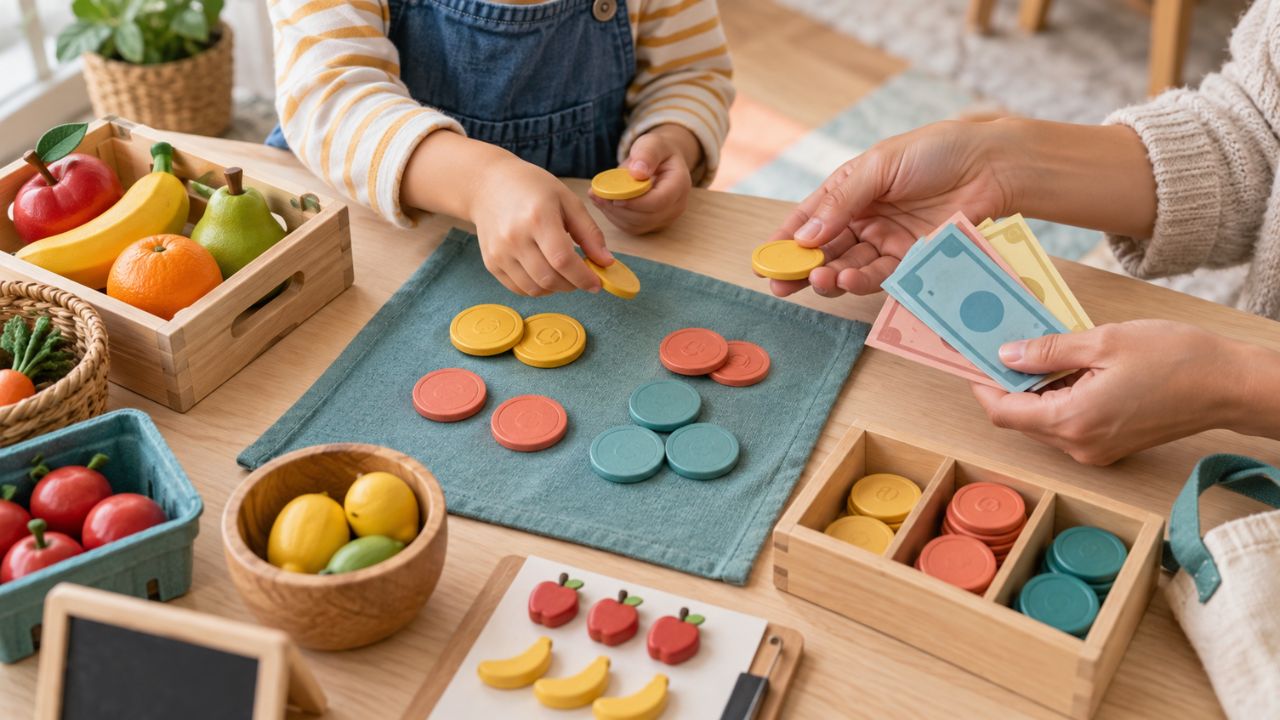
A child may be able to count to 20 and still struggle to use those numbers when making a choice. Give that child a pretend budget, a few priced objects, and a reason to buy something, and the numbers begin to do real work.
That is how money play introduces real-world math. A pretend shop or café turns addition into finding a total, subtraction into calculating what remains, and comparison into deciding which purchase is affordable.
The setup can be simple. Paper notes, oversized cardboard tokens, price labels, and a handful of household objects are enough. A toy cash register may make the game more appealing, but it does not create the learning. The decisions do.
Money Gives Numbers a Practical Job
A worksheet might ask a child to solve 3 + 2. In a pretend market, the same calculation answers a question: “The bread costs three tokens and the fruit costs two. How much do you need?”
That change of context gives early math a purpose. Depending on the child’s current skills, money play can involve:
- Counting objects accurately
- Matching quantities to written numerals
- Comparing greater and smaller amounts
- Combining prices
- Finding how much remains
- Making one amount in different ways
- Estimating a total
- Staying within a limit
- Checking whether an answer makes sense
Children also meet useful vocabulary in context: price, cost, total, more, less, enough, change, and save. These words are easier to understand when they describe an action taking place in front of the child.
Financial learning at this age should remain modest. A young child does not need a miniature lesson on investing, credit reports, or compound interest. It is more useful to understand that resources are limited, items can have different prices, and choosing one thing may mean leaving another behind.
Planning, attention, self-control, and problem-solving also support later financial capability. Money play cannot develop those skills on its own, but it provides a low-pressure place to practise them.
How Money Play Introduces Real-World Math as Children Progress
Age ranges can help adults choose a starting point, but they should not be treated as deadlines. Children of the same age may have very different experience with counting, written numerals, or local currency.
Watch what the child can already do. Then add one difficulty at a time.
Beginning With Counting and Simple Choices
For a child who is still building one-to-one counting, use one type of large token. If an object costs three, the child hands over three tokens. There is no need to explain denominations yet.
A small shop might contain:
- A block priced at one token
- A pencil priced at two
- A toy animal priced at three
- A small book priced at four
Give the child five tokens and let them choose. If they buy the toy animal, they can move three tokens to the shopkeeper and count the two left behind.
The physical action matters. It allows the child to see subtraction before being expected to interpret a written number sentence.
This stage often suits children around ages four and five, but counting ability is a better guide than age alone.
Adding Totals and Different Values
Once a child can count reliably, add two or three denominations. Keep the values simple and make them visually distinct.
The child can now buy two items, find an exact payment, or build the same amount in more than one way. A total of five might be made with five ones, two twos and a one, or another available combination.
This is where confusion often appears. A child may hold three coins and assume the total is three, even when the coins have different values. That is not carelessness. Counting objects and calculating their combined value are different tasks.
Return to one denomination if necessary. Another useful step is to place the coins beside the amount they represent before mixing them into a transaction.
Many children begin handling these ideas around ages six and seven, though some will need more concrete practice and others will move ahead sooner.
Moving Into Budgets and Change
Children who can add several amounts can take on a fixed pretend budget.
For example:
“You have 20 units. Choose one drink, one snack, and one activity without spending more than 20.”
This problem has room for judgment. The child may find a combination, discover it costs too much, replace an item, and calculate again. There can be several correct answers.
More confident learners can also:
- Estimate a total before calculating it
- Plan purchases for several people
- Work out change from a whole-number payment
- Keep a short record of pretend spending
- Save pretend earnings toward a chosen goal
- Check whether the shopkeeper’s total is correct
Decimals, taxes, percentage discounts, exchange rates, and unit prices can wait until the underlying arithmetic is secure. Tax rules and pricing customs also vary between countries. Adding complexity simply to make the game look realistic usually creates more confusion than useful learning.
A Small Shop Is Better Than an Impressive One
The most common setup mistake is offering too much.
Adults sometimes create a shop with dozens of products, several types of money, receipts, sale signs, discount labels, and a cash register. It looks convincing. It also gives the child too many details to manage at once.
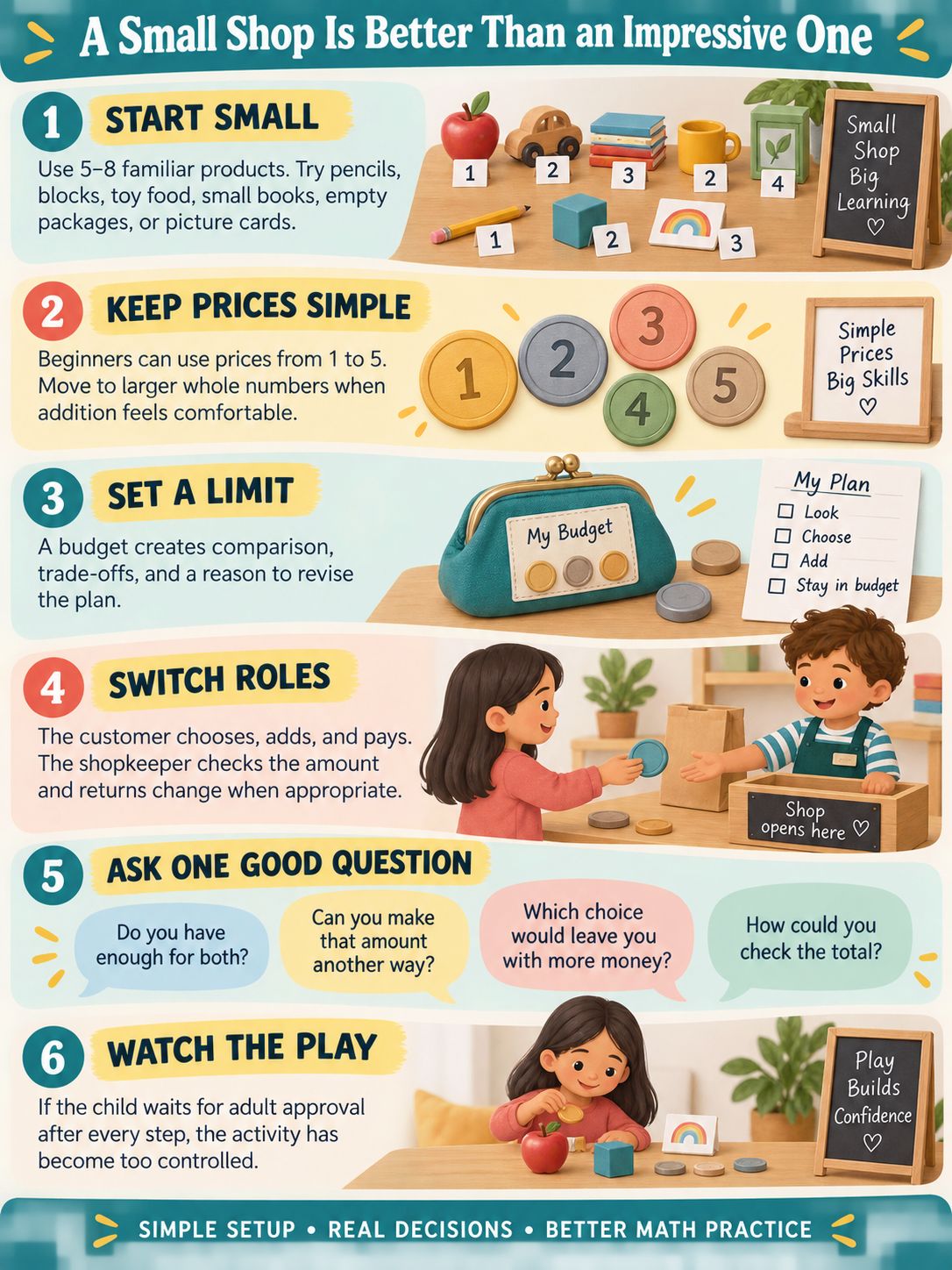
For most children, five to eight products are enough. Use pencils, blocks, toy food, small books, empty packages, or picture cards. Make the price labels large and easy to read.
A beginner’s shop might use prices from one to five. A child who is comfortable adding can work with larger whole numbers.
Most importantly, give the customer a limit. If the child can buy everything, there is no real decision to make. A budget introduces comparison, trade-offs, and the need to revise a plan.
Let the child take turns being the customer and the shopkeeper. The customer chooses, adds, and pays. The shopkeeper checks the amount and returns change when appropriate.
Resist the urge to direct every move. One useful question is better than five questions fired in quick succession:
- “Do you have enough for both?”
- “Can you make that amount another way?”
- “Which choice would leave you with more money?”
- “How could you check the total?”
If the child stops playing and starts waiting for adult approval after every step, the activity has become too controlled.
Five Money Games That Earn Their Place
1. Make the Exact Amount
This is the strongest starting activity for most children because it can be adjusted without changing the rules.
Give each object a small whole-number price. A beginner pays with identical tokens. Later, introduce different denominations and ask the child to make the amount in two ways.
A child who can name several coins may still struggle with their combined value. Exact-payment practice exposes that gap without making it feel like a test.
2. Run a Family Café
Create a short menu with several drinks and snacks. Family members place orders, and the child prepares the bill.
For a younger child, each customer can order one item. An older child can combine several orders or calculate change.
Keep the menu readable. Six clearly priced choices create better practice than 20 items squeezed onto a page. If reading the menu becomes harder than doing the math, simplify it.
3. Choose Between Spending and Waiting
Give the child a small amount of pretend income over several rounds. Offer one inexpensive item that can be bought immediately and another that requires saving.
Let the child decide. If they spend now and later wish they had waited, allow that consequence to remain within the game. The useful discussion is not “Was that a good or bad child?” It is “Did that choice match what you wanted most?”
Saving should not be presented as morally superior in every situation. Spending can also be thoughtful when it serves a clear purpose.
4. Check the Shopkeeper
Make an occasional, plausible error. State a total that is one unit too high, count a token twice, or return too little change.
Ask the child to check the transaction using the objects, a number line, or a written calculation. This turns math into a way to verify information rather than merely produce an answer.
Do not hide a mistake in every round. Constant tricks can shift the child’s attention from calculation to catching the adult.
5. Plan a Small Event
For an older child, provide a pretend budget for a picnic, family game night, or classroom celebration. List a few possible foods, supplies, and activities with prices.
The child chooses what to include and explains the decision. More than one plan can work.
This activity is valuable because it combines arithmetic with priorities. The child must decide what matters, not simply total a list chosen by someone else.
Real Currency Can Wait
Real coins and notes help children recognize the currency used in their community, but they are not always the best materials for early money play.
Coin size does not reliably indicate value. A larger coin may be worth less than a smaller one. Notes add colors, symbols, portraits, languages, and security features that can distract from the math.
Use simplified play money while the child is learning to match quantities with numerals. Introduce local currency when they are ready to distinguish the number of coins from their combined value.
Imported worksheets need similar care. An activity designed around dollars and cents may be confusing in a country with different denominations. Preserve the mathematical problem, but replace the currency with values the child is likely to encounter.
Take Small-Object Safety Seriously
Coins and other small objects can be choking or ingestion hazards, particularly for children who still put objects in their mouths. Younger siblings may also enter the play area unexpectedly.
Use oversized cardboard tokens or large paper notes when there is any concern. Supervise the use of real coins and store them securely afterward.
Button batteries and lithium coin-cell batteries must never be used as pretend money. They can cause severe internal injury if swallowed. Check that battery compartments on toys, remotes, scales, key fobs, and similar household devices remain secure.
If a child may have swallowed a button or coin-cell battery, seek emergency medical help immediately. Do not wait for symptoms to develop.
Bring the Same Ideas Into Everyday Shopping
Money play becomes more meaningful when children recognize the same decisions outside the game.
At a shop or market, a child could count several products, locate a clearly displayed price, compare two simple prices, or help check a short shopping list.
Adults can also make an invisible decision clearer by thinking aloud:
“These two packages look similar, but this one contains more.”
“This one costs less, but we need enough for four people.”
“We planned to buy one snack, so we need to choose between these.”
The cheapest item is not automatically the best choice. Quantity, quality, durability, dietary needs, availability, and the household budget can all matter. “Always buy the cheapest” is too simplistic to be a useful money lesson.
Children do not need access to private household figures. They can learn that families make choices and work within limits without being made responsible for adult financial pressure.
Explain What Happens When Adults Tap a Card or Phone
Cash makes payment visible. Cards and phones do not.
When a child sees an adult tap a device and leave with a purchase, it can appear that nothing was exchanged. A brief explanation closes that gap:
- A debit card usually takes money from a linked account.
- A prepaid card uses money previously loaded onto the card.
- A credit card uses borrowed money that must be repaid.
Young children do not need a lecture about account terms. “The card is a way of paying; it does not make the item free” may be enough.
Older children can gradually learn that borrowing through a credit card may involve interest if the balance is not repaid as required. Keep the explanation tied to what they have seen rather than introducing financial vocabulary with no practical context.
When the Game Stops Helping
Money play becomes less useful when the adult corrects every mistake immediately.
If a child pays seven tokens instead of six, give them time to compare the price and payment. Ask, “How could you check?” Recounting is part of the work.
Change can also be introduced too soon. It requires the child to understand the price, recognize the payment, subtract, and build the returned amount. If exact payment is still difficult, stay with it.
Avoid turning every pretend purchase into a judgment about behavior. A child who spends the entire budget has created a consequence to discuss, not revealed a character flaw.
There is no ideal session length. Stop when attention fades or the play becomes tense. A brief activity the child wants to repeat is more useful than a long one continued to satisfy an adult’s lesson plan.
Look Beyond Coin Names
Knowing the name of a coin is only one small part of money understanding.
A more useful check is what the child can do:
- Build an exact payment
- Compare two prices
- Make the same amount another way
- Recognize when the available money is not enough
- Check a total
- Revise a plan without abandoning the task
When the current activity becomes easy, add one new challenge. Introduce another product, a larger total, a second denomination, or a need to calculate change. Adding all four at once makes it hard to tell which idea is causing trouble.
Final Thoughts
How money play introduces real-world math becomes clear once a child has to make a decision with a limited amount. Counting has a purpose. Addition finds a total. Subtraction shows what remains. Comparison helps the child choose.
For a first activity, gather four familiar objects, give them prices from one to four, and hand the child five oversized tokens. That is enough. Let the child shop, switch roles, make a mistake, and check it.
The shop can become more complicated later. The first task is simply to make numbers useful.