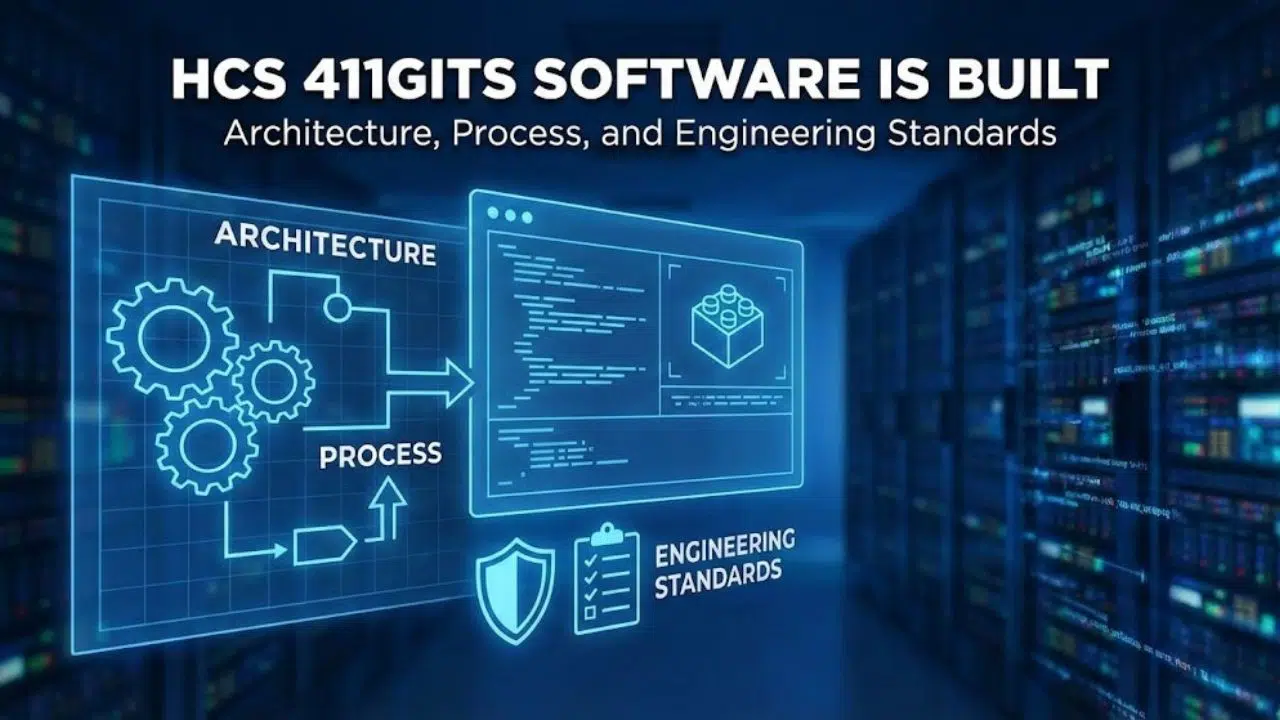
Understanding how hcs 411gits software built is essential for organizations evaluating its reliability, scalability, and long-term value. Decision-makers are no longer satisfied with feature lists alone; they want visibility into the engineering discipline, architectural logic, and development rigor behind the software they adopt.
This article provides a professional, technically grounded explanation of how HCS 411GITS software is built, from foundational architecture through development workflows, security practices, and deployment strategy. The goal is to clarify not just what the software does, but how it is engineered to perform consistently in real-world environments.
Written for a global, client-facing audience, this guide avoids assumptions, marketing language, and location bias, focusing instead on principles that align with modern enterprise software standards.
Foundational Design Philosophy
The way HCS 411GITS software is built begins with a system-first design philosophy. Rather than developing isolated features, the platform is architected as an integrated system where performance, security, and maintainability are considered from the outset.
Core design priorities include stability under load, modular expansion, and long-term maintainability. This ensures the software can evolve without introducing structural debt or operational risk. The architecture emphasizes predictability, traceability, and controlled change management, which are essential in professional and regulated environments.
Equally important is the separation of concerns. Business logic, data handling, and user interfaces are deliberately decoupled to allow independent updates, easier testing, and reduced system-wide impact during enhancements.
System Architecture and Core Components
At an architectural level, HCS 411GITS software is built using a layered model that supports both scalability and operational clarity. Each layer has a defined responsibility, allowing teams to manage complexity without compromising performance.
The application layer handles user interactions and system workflows, translating inputs into structured operations. This layer is optimized for clarity and responsiveness, ensuring consistent behavior across environments and usage patterns.
The service layer manages business rules and transactional logic. By centralizing these functions, the software maintains consistency across interfaces while enabling controlled reuse of core capabilities.
The data layer is designed with integrity and performance in mind. Data structures are normalized where accuracy is critical and optimized where read performance is essential. Access is mediated through controlled interfaces rather than direct exposure, reducing risk and improving auditability.
This architectural approach allows the software to scale horizontally or vertically depending on deployment needs, without forcing redesigns at the core level.
Development Methodology and Workflow
The development process behind HCS 411GITS software is structured around disciplined, repeatable workflows rather than ad hoc coding cycles. This ensures predictable outcomes and minimizes regression risk over time.
Development typically follows an iterative model where requirements are validated before implementation begins. Each iteration includes design review, implementation, testing, and documentation, ensuring no stage is treated as optional.
Source control plays a central role in maintaining code integrity. Changes are versioned, reviewed, and tested before being merged into production branches. This not only improves quality but also enables clear accountability and traceability across development cycles.
Code reviews are treated as a quality gate, not a formality. They focus on correctness, performance implications, security considerations, and long-term maintainability rather than stylistic preferences.
Security Engineering and Data Protection

Security is embedded into how HCS 411GITS software is built rather than added as an afterthought. The platform follows a defense-in-depth approach, ensuring that no single control is solely responsible for system protection.
Authentication and authorization mechanisms are designed to enforce least-privilege access. Users and services are granted only the permissions necessary to perform their roles, reducing exposure in the event of misuse or compromise.
Data protection is addressed both at rest and in transit. Encryption standards are applied consistently, and sensitive operations are isolated from general application logic. This reduces the attack surface and simplifies compliance with organizational security policies.
Regular security testing, including static analysis and controlled vulnerability assessments, is integrated into the development lifecycle. This allows potential issues to be identified early, when remediation is less costly and less disruptive.
Performance Optimization and Scalability
Performance considerations are integrated into how HCS 411GITS software is built, not deferred until post-deployment. System behavior under load is modeled early, allowing architectural decisions to be validated against real usage scenarios.
Caching strategies are applied selectively, based on data volatility and access frequency. This ensures performance gains without compromising data accuracy or consistency.
Scalability is achieved through stateless service design wherever possible. By minimizing dependencies on local state, the software can scale across multiple instances with predictable behavior, supporting both growth and redundancy.
Resource utilization is monitored continuously in production environments, providing feedback loops that inform future optimization efforts. This operational visibility is a direct result of deliberate engineering decisions made during development.
Testing, Validation, and Quality Assurance
Quality assurance is central to how HCS 411GITS software is built and maintained. Testing is not limited to final validation but is embedded throughout the development process.
Unit tests validate individual components in isolation, ensuring that logic behaves as expected under defined conditions. Integration tests verify that components interact correctly, particularly across service boundaries.
System-level testing evaluates real-world scenarios, including edge cases and failure conditions. This helps ensure the software behaves predictably even when dependencies are degraded or inputs are imperfect.
Documentation and test results are treated as living assets. They are updated alongside code changes, maintaining alignment between system behavior and reference materials used by technical and non-technical stakeholders.
Deployment and Environment Management
Deployment processes are designed to minimize risk and downtime. HCS 411GITS software is built to support controlled rollouts, allowing updates to be introduced incrementally rather than as disruptive system-wide changes.
Environment parity is emphasized, ensuring development, testing, and production environments behave consistently. This reduces the likelihood of environment-specific issues and simplifies troubleshooting when problems arise.
Rollback mechanisms are incorporated into deployment workflows, providing a safety net in the event of unexpected behavior. This approach reflects a professional understanding of operational risk rather than reliance on best-case assumptions.
Maintainability and Long-Term Evolution
One of the defining characteristics of how HCS 411GITS software is built is its focus on long-term maintainability. Code is written for clarity first, with performance optimizations applied only where justified by measurable need.
Clear documentation, consistent naming conventions, and modular design reduce dependency on individual contributors. This makes the software easier to support, extend, and transfer across teams over time.
Change management processes ensure enhancements are evaluated for systemic impact, not just immediate benefit. This protects the integrity of the platform as it evolves alongside business requirements.
Frequently Asked Questions
How is HCS 411GITS software built to ensure reliability?
The software is built using layered architecture, disciplined development workflows, and continuous testing, ensuring predictable behavior and controlled change management.
Is HCS 411GITS software scalable for growing organizations?
Yes. Stateless service design, modular components, and performance-aware architecture allow the system to scale without requiring fundamental redesign.
How does the software address security concerns?
Security is embedded into the development lifecycle through access control, encryption, and regular security testing rather than being added post-development.
What makes the development process professional-grade?
Structured version control, mandatory code reviews, documented testing practices, and controlled deployment processes distinguish the build methodology.
Can the software evolve without disrupting existing users?
Yes. The architecture and deployment strategy are designed to support incremental updates and backward compatibility where required.
Final Words
Understanding how hcs 411gits software built provides valuable insight into its reliability, security posture, and long-term viability. The platform’s architecture, development discipline, and operational safeguards reflect a deliberate, professional approach to software engineering.
Rather than relying on assumptions or surface-level features, organizations benefit from evaluating how software is built at a structural level. HCS 411GITS demonstrates a commitment to clarity, stability, and sustainable growth through its engineering practices.