

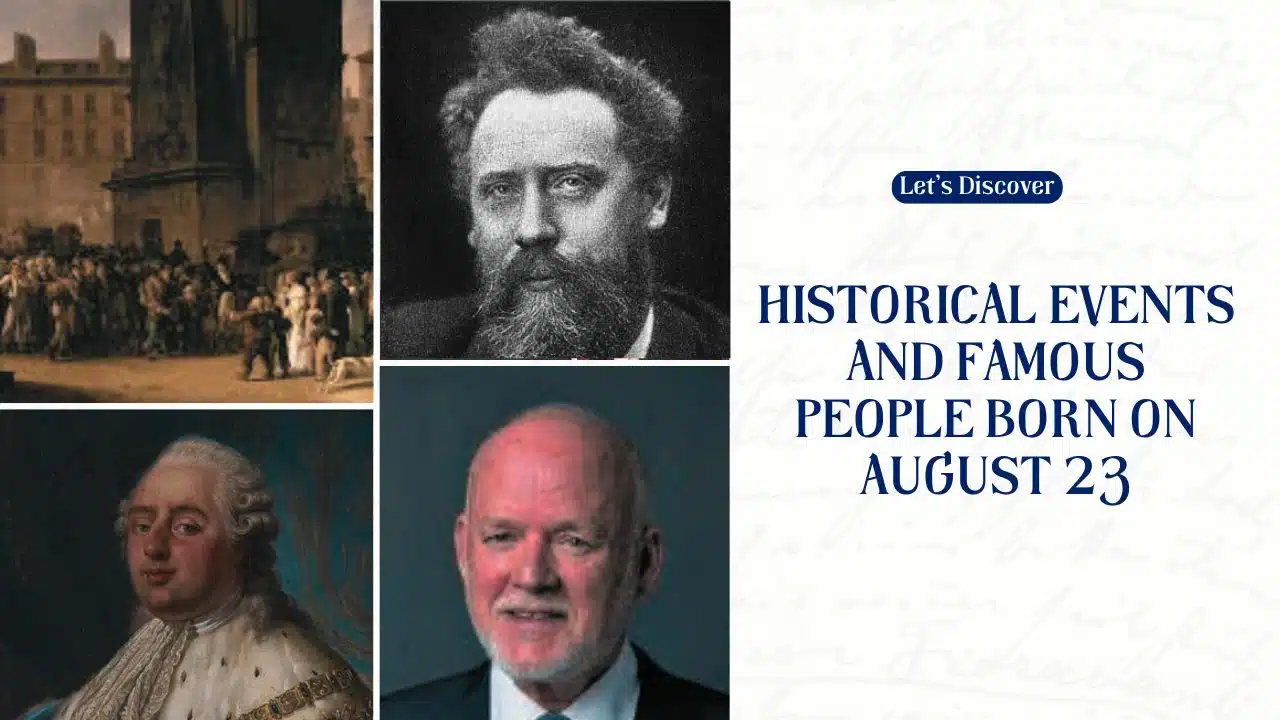
August 23 is a day filled with important events and notable birthdays. From battles that changed countries to agreements that started wars, this date has seen it all. It’s also the birthday of kings, poets, actors, and scientists who made big impacts on the world. In this article, we’ll explore five major events that happened on August 23 and learn about five famous people born on this day. By the end, you’ll see how much history is packed into just one calendar date!
Historical Events of August 23
A. William Wallace’s Execution (1305)
On August 23, 1305, William Wallace, a Scottish hero, was executed in London. Wallace fought for Scotland’s freedom from England. He led Scottish rebels against King Edward I of England, winning the Battle of Stirling Bridge in 1297. But in 1305, Wallace was caught by the English.
King Edward I wanted to make an example of Wallace. He had Wallace brought to London for a show trial. Wallace was found guilty of treason, even though he said he couldn’t be a traitor to a king he never agreed to follow. The English gave Wallace a brutal punishment. He was hanged, then cut down while still alive. Then he was cut open and his insides were burned. Finally, his body was cut into pieces and sent to different parts of Scotland as a warning.
Wallace’s death didn’t stop Scotland’s fight for freedom. Instead, it made him a martyr and national hero. His story inspired future Scottish leaders like Robert the Bruce. Today, Wallace is still remembered as a symbol of Scottish independence.
B. Levée en masse (1793)
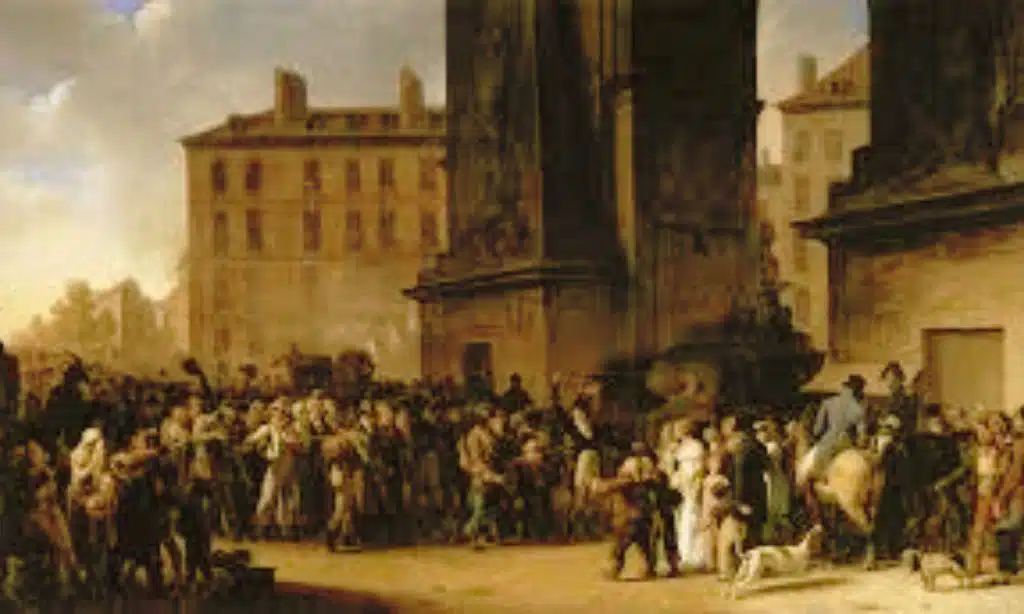
On August 23, 1793, during the French Revolution, the National Convention passed a new law called the levée en masse. This law said that all able-bodied French men between 18 and 25 had to join the army. It was the first time in modern history that a country ordered all its young men to fight.
The French Revolution had started in 1789. By 1793, France was at war with many other European countries. These countries wanted to stop the revolution and bring back the French king. France needed more soldiers to defend itself.
The levée en masse created a huge army for France. It helped France win many battles against its enemies. But it also changed how wars were fought. Before this, most armies were small and made up of professional soldiers. Now, wars would involve entire nations and much bigger armies.
This new way of fighting spread to other countries. It led to bigger and deadlier wars in the future. The levée en masse was an important step towards the idea of “total war,” where entire societies are involved in fighting wars.
C. Sixth Zionist Congress (1903)
On August 23, 1903, Theodor Herzl, the founder of modern Zionism, made a big announcement at the Sixth Zionist Congress in Basel, Switzerland. He declared that a Jewish state should be created.
Zionism is a movement that supports creating a Jewish homeland. Herzl started the Zionist Congresses in 1897 to bring together Jews from around the world to discuss this idea. By 1903, six of these meetings had been held.
At this congress, Herzl talked about the “Uganda Plan.” This was an idea to create a temporary Jewish homeland in East Africa. Many Zionists didn’t like this plan. They wanted to focus on creating a state in Palestine, the historical Jewish homeland.
Even though the Uganda Plan wasn’t accepted, Herzl’s declaration was important. It was one of the first times a leader publicly called for creating a Jewish state. This helped build support for the idea of Israel, which became a country 45 years later in 1948.
D. Molotov-Ribbentrop Pact (1939)
On August 23, 1939, Nazi Germany and the Soviet Union signed a deal called the Molotov-Ribbentrop Pact. This agreement shocked the world because Germany and the Soviet Union were supposed to be enemies. The pact said they wouldn’t attack each other.
But the pact had a secret part that wasn’t made public. In this secret agreement, Germany and the Soviet Union decided to divide up Eastern Europe between them. They agreed on how they would split Poland and other countries.
This pact had huge effects. It gave Hitler the confidence to invade Poland on September 1, 1939. When Britain and France declared war on Germany because of this invasion, World War II began. The Soviet Union invaded eastern Poland soon after, following the secret part of the pact.
The Molotov-Ribbentrop Pact didn’t last long. In 1941, Hitler broke the agreement and invaded the Soviet Union. But the pact had already helped start the deadliest war in human history.
E. Larry Hagman’s Liver Transplant (1995)
On August 23, 1995, American actor Larry Hagman got a new liver. Hagman was famous for playing J.R. Ewing on the TV show “Dallas.” He needed a new liver because years of heavy drinking had damaged his old one.
Hagman’s transplant was big news. He was one of the most famous people to get an organ transplant at that time. His experience helped raise awareness about organ donation and liver disease.
After the transplant, Hagman became a spokesperson for organ donation. He encouraged people to become organ donors and to take care of their livers. His story showed how organ transplants can save lives and give people a second chance.
Famous Birthdays on August 23
A. Louis XVI (1754-1793)
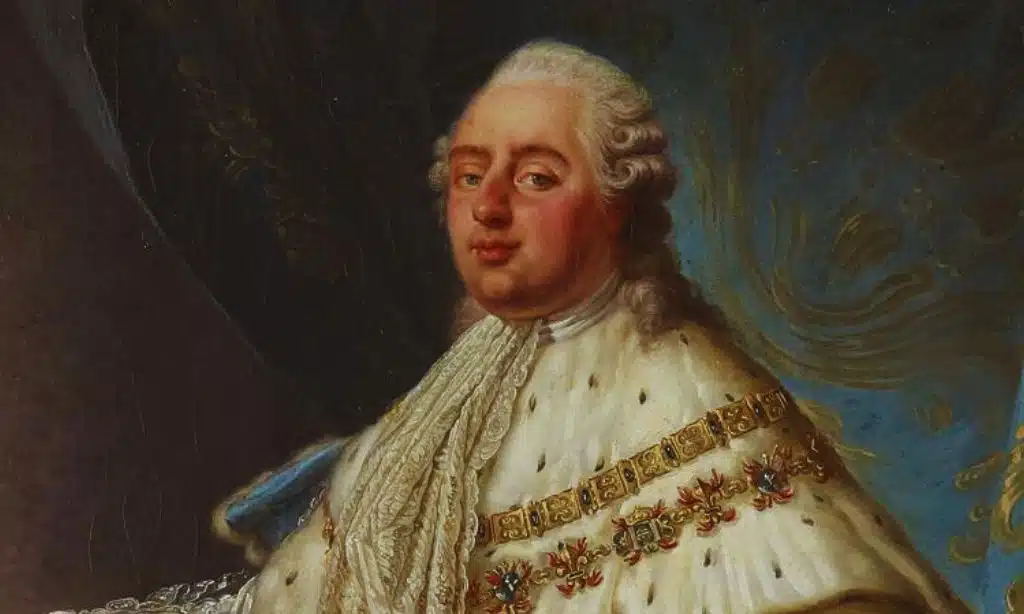
Louis XVI was born on August 23, 1754, in Versailles, France. He became King of France in 1774 when he was only 20 years old.
Biography Table:
| Key Facts | Details |
|---|---|
| Born | August 23, 1754 |
| Died | January 21, 1793 |
| Title | King of France |
| Reign | 1774-1792 |
| Spouse | Marie Antoinette |
| Famous For | Last King of France before the French Revolution |
Louis XVI’s time as king was difficult. France had money problems and many people were unhappy. In 1789, the French Revolution started. The people wanted more rights and less power for the king.
At first, Louis XVI agreed to some changes. But in 1791, he tried to escape France with his family. They were caught and brought back to Paris. This made people trust him even less.
In 1792, France became a republic and Louis was no longer king. He was put on trial for treason. On January 21, 1793, Louis XVI was executed by guillotine. His death marked the end of the monarchy in France.
B. William Ernest Henley (1849-1903)
William Ernest Henley was born on August 23, 1849, in Gloucester, England. He became a famous poet, critic, and magazine editor.
Biography Table:
| Key Facts | Details |
|---|---|
| Born | August 23, 1849 |
| Died | July 11, 1903 |
| Nationality | English |
| Occupation | Poet, critic, editor |
| Famous Work | “Invictus” |
| Other Achievements | Edited several literary magazines |
Henley had a hard life. He had tuberculosis in his bones and had to have his leg amputated when he was young. But he didn’t give up. He wrote a poem called “Invictus” about staying strong in tough times.
“Invictus” became Henley’s most famous poem. Its last lines are very well-known: “I am the master of my fate: I am the captain of my soul.” These words have inspired many people over the years.
Henley also worked as an editor for several magazines. He helped publish works by famous writers like Rudyard Kipling and H.G. Wells. Henley died in 1903, but his poems, especially “Invictus,” are still read and loved today.
C. Gene Kelly (1912-1996)
Gene Kelly was born on August 23, 1912, in Pittsburgh, Pennsylvania. He became one of the most famous dancers and actors in Hollywood history.
Biography Table:
| Key Facts | Details |
|---|---|
| Born | August 23, 1912 |
| Died | February 2, 1996 |
| Nationality | American |
| Occupation | Dancer, actor, singer, choreographer, film director |
| Famous Works | “Singin’ in the Rain,” “An American in Paris” |
| Awards | Honorary Academy Award, Kennedy Center Honors |
Kelly started dancing when he was young. He first became famous on Broadway in New York City. In the 1940s, he moved to Hollywood to make movies.
Kelly changed how dance was shown in movies. He mixed ballet with everyday movements to create a new style. He’s best known for movies like “Singin’ in the Rain” and “An American in Paris.”
In “Singin’ in the Rain,” Kelly danced and sang in the rain for a famous scene. This scene is one of the most famous in movie history. Kelly not only danced in movies, but he also directed and created the dances for many films.
Kelly kept working in movies and TV until he was older. He received many awards for his work. Today, he’s remembered as one of the greatest dancers and musical stars in film history.
D. Peter Thomson (1929-2018)
Peter Thomson was born on August 23, 1929, in Brunswick, Victoria, Australia. He became one of the greatest golfers in history.
Biography Table:
| Key Facts | Details |
|---|---|
| Born | August 23, 1929 |
| Died | June 20, 2018 |
| Nationality | Australian |
| Sport | Golf |
| Major Wins | 5 British Open Championships |
| Other Achievements | World Golf Hall of Fame member |
Thomson was best known for winning the British Open five times. He won it in 1954, 1955, 1956, 1958, and 1965. This made him one of the most successful golfers in the history of this major tournament.
Thomson didn’t just win in Britain. He won tournaments all over the world, including in Europe, Asia, and America. He won 89 professional tournaments in his career.
After he stopped playing, Thomson became a golf course designer and a writer about golf. He also helped grow the sport in Asia. In 1988, he was put in the World Golf Hall of Fame.
Thomson was known for his smooth swing and his calm attitude on the golf course. He helped make golf more popular in Australia and around the world. He died in 2018, but he’s still remembered as one of Australia’s greatest athletes.
E. Thomas A. Steitz (1940-2018)
Thomas A. Steitz was born on August 23, 1940, in Milwaukee, Wisconsin. He became a famous scientist who studied how cells work.
Biography Table:
| Key Facts | Details |
|---|---|
| Born | August 23, 1940 |
| Died | October 9, 2018 |
| Nationality | American |
| Field | Molecular Biology and Chemistry |
| Famous For | Studies of the structure and function of the ribosome |
| Awards | Nobel Prize in Chemistry (2009) |
Steitz was a molecular biologist and biochemist. He spent most of his career studying ribosomes. Ribosomes are tiny machines inside cells that make proteins. Proteins are important for almost everything cells do.
Steitz used a method called X-ray crystallography to see what ribosomes look like up close. This helped scientists understand how ribosomes work and how to make medicines that affect them.
In 2009, Steitz won the Nobel Prize in Chemistry for this work. He shared the prize with two other scientists. Their research has helped in making new antibiotics to fight infections.
Steitz taught at Yale University for many years. He helped train many new scientists and made important discoveries throughout his career. He died in 2018, but his work continues to be important in biology and medicine.
Takeaways
August 23 is a date that has seen many important events and births. From William Wallace’s execution in 1305 to Larry Hagman’s liver transplant in 1995, this day has been part of history-changing moments. It’s also the birthday of people who made big impacts in different fields, from ruling countries to making scientific discoveries.
Looking at these events and people shows us how much can happen on just one day. It reminds us that history is always being made, and that people born on any day can go on to do great things. Whether it’s through political decisions, artistic creations, athletic achievements, or scientific breakthroughs, each day holds the potential for something remarkable.
As we remember August 23, we can appreciate the rich tapestry of human history and achievement that unfolds every day on our calendar.
References:
1. “William Wallace: Scottish Hero.” BBC History.
2. “The French Revolutionary Wars.” Encyclopedia Britannica.
3. “Theodor Herzl and the Foundation of the Jewish State.” Israel Ministry of Foreign Affairs.
4. “The Nazi-Soviet Non-Aggression Pact.” United States Holocaust Memorial Museum.
5. “Larry Hagman Biography.” The Official Larry Hagman Website.
6. “Louis XVI of France.” Britannica.
7. “William Ernest Henley.” Poetry Foundation.
8. “Gene Kelly Biography.” American National Biography.
9. “Peter Thomson.” World Golf Hall of Fame.
10. “Thomas A. Steitz – Facts.” Nobel Prize Organization.






















