For many members of the global diaspora, the prospect of obtaining Irish Citizenship through Grandparents is more than just a sentimental journey; it is a practical gateway to European Union residency and mobility. As the geopolitical landscape shifts, the value of an Irish passport has surged, offering the right to live, work, and study across 27 member states. However, the process of Foreign Birth Registration (FBR) is rigorous and requires a high degree of administrative precision.
By understanding the legal frameworks and documentary requirements, you can successfully bridge the generational gap and formalise your status as an Irish citizen.
Here’s Our Selection Methodology
To identify the most efficient strategies for securing Irish Citizenship through Grandparents, we analysed the 2026 Department of Foreign Affairs (DFA) processing protocols and common application pitfalls. Our selection prioritises methods that reduce the risk of “Requests for Further Information” (RFIs) and capitalise on recent digital updates to the FBR system. Each approach is designed to ensure that your lineage is proven to a legal standard while minimising the wait times often associated with ancestral citizenship claims.
7 Effective Ways To Get Irish Citizenship Through Your Grandparents’ Heritage
Navigating the path to an Irish passport requires a structured approach to genealogy and bureaucracy. The following seven strategies provide a comprehensive roadmap for those born outside of Ireland who wish to reclaim their citizenship through a grandparent born on the island. By focusing on document integrity, family collaboration, and professional verification, you can transform a complex application into a manageable series of actionable steps.
1. Verifying Eligibility via The Foreign Births Register
The foundational step for any grandchild of an Irish-born person is confirming their placement on the Foreign Births Register (FBR). Unlike those with an Irish-born parent, your citizenship is not automatic from birth; it is only established from the date you are entered into this register. It is essential to understand that your Irish-born grandparent must have been born on the island of Ireland, which includes both the Republic and Northern Ireland.
Best for: Individuals born outside Ireland with at least one grandparent born on the island of Ireland.
Why We Chose It:
● It is the only legal mechanism to activate citizenship for the “grandchild generation”.
● It creates a permanent legal record that can facilitate citizenship for your future children.
Things to consider: Your children must be born after the date of your FBR registration for them to be eligible for citizenship through you.
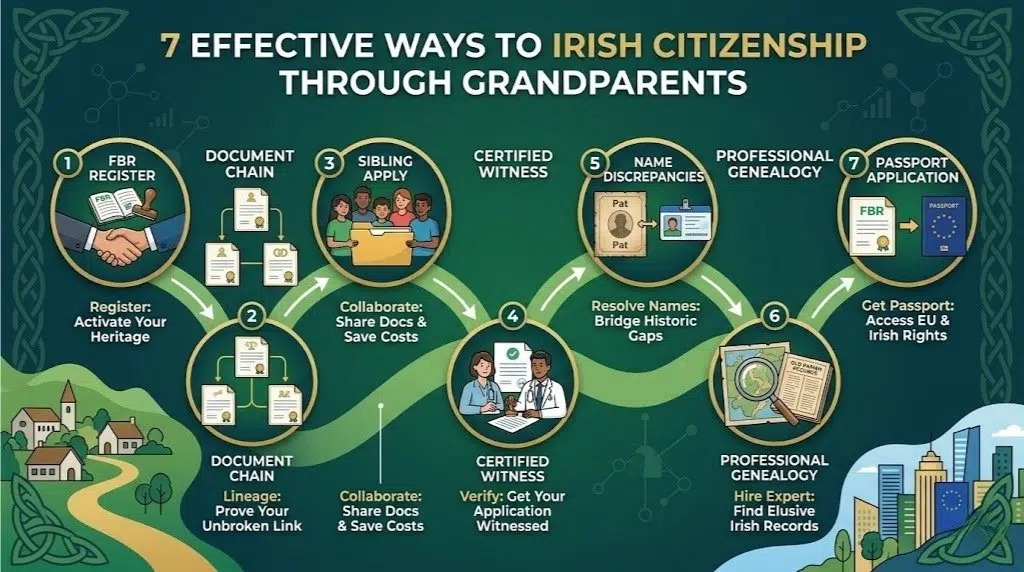
2. Sourcing Long-Form Civil Documentation
HMRC-style precision is required when gathering certificates for three generations of your family. The DFA strictly requires “long-form” or “vault” versions of birth, marriage, and death certificates. These documents must list parental details and be original copies issued by the state registry; digital scans or “short-form” abstracts that omit parent names will lead to an immediate rejection of your file.
Best for: Applicants who need to prove an unbroken legal link between themselves and their Irish ancestor.
Why We Chose It:
● It provides the primary evidence required by the Department of Foreign Affairs to verify lineage.
● It eliminates the most common reason for application delays and document returns.
Things to consider: If any certificates are not in English or Irish, they must be accompanied by a certified translation from a recognised professional.
3. Utilising Family Group Applications
One of the smartest logistical moves is to coordinate your application with siblings. When brothers and sisters apply simultaneously, they can share a single set of original documents for their common parent and Irish-born grandparent. This not only reduces the financial burden of ordering multiple sets of expensive original certificates but also ensures that the family’s shared history is reviewed consistently by the processing officer.
Best for: Families with multiple siblings looking to streamline costs and document management.
Why We Chose It:
● It reduces the total number of original documents that need to be sourced and posted.
● It ensures that the “root” documentation of the family lineage is verified once for all siblings.
Things to consider: Each sibling must still pay their own individual application fee and provide their own personal identity documents, such as their own birth certificate and passport copies.
The DFA requires a certified witness from a specific list of professions—such as solicitors, doctors, or school principals—to sign your application and photographs. In 2026, the commission has increased the frequency of “witness audits”. Ensuring your witness is currently practicing and includes their official business stamp or a business card is vital to preventing your application from being flagged as incomplete.
Best for: Validating the identity of the applicant and the authenticity of the submitted photographs.
Why We Chose It:
● It is a mandatory security measure that adds immediate credibility to your citizenship claim.
● A correctly witnessed application avoids the “verification loop” that can add months to processing times.
Things to consider: The witness must be personally known to you for at least two years but must not be related to you by blood or marriage.
5. Bridging Historical Name Discrepancies
It is common for ancestors to have variations in their names across different records—for example, a birth certificate might say “Mary” while a marriage certificate in another country lists “May”. To ensure your path to Irish Citizenship through Grandparents remains clear, you should provide a “Statutory Declaration” or supplementary evidence like baptismal records to explain these variations and prove that they refer to the same individual.
Best for: Applicants whose ancestors used nicknames or experienced spelling changes after emigration.
Why We Chose It:
● It pre-emptively addresses inconsistencies that would otherwise trigger a request for further evidence.
● It demonstrates a thorough and proactive approach to proving the family’s legal history.
Things to consider: Significant name changes, such as those made through a deed poll, must be supported by the original legal change of name document.
6. Employing Professional Genealogical Research
If you are struggling to locate your grandparent’s Irish birth record, particularly for those born before civil registration was fully centralised, a professional genealogist can be an invaluable asset. These experts have direct access to parish records and the General Register Office (GRO) in Roscommon, allowing them to find obscure entries that may not be indexed on commercial family history websites.
Best for: Individuals with limited family records or ancestors from rural parishes with complex registration histories.
Why We Chose It:
● It provides access to physical archives that are not yet digitised or available to the public online.
● It ensures that the document retrieved is the specific “legal copy” required for the FBR application.
Things to consider: Always verify that the researcher is a member of a recognised professional body, such as the Association of Professional Genealogists.
7. Completing The Digital Passport Application
Once you have received your Foreign Birth Registration certificate, the final step is applying for your first Irish passport. In 2026, the “Passport Online” service is the most efficient route, offering significantly faster turnaround times than paper-based applications. This digital platform allows you to upload a biometric photo directly from your smartphone and track the progress of your booklet through the printing phase.
Best for: Finalising your status as a dual citizen and gaining the practical benefits of EU travel.
Why We Chose It:
● It is the most modernised and user-friendly aspect of the entire citizenship journey.
● The online system provides real-time updates and automatically checks for common photo errors.
Things to consider: You must wait until you have the physical FBR certificate in your possession before you can start the passport application process.
Strategic Analysis Of The Application Process
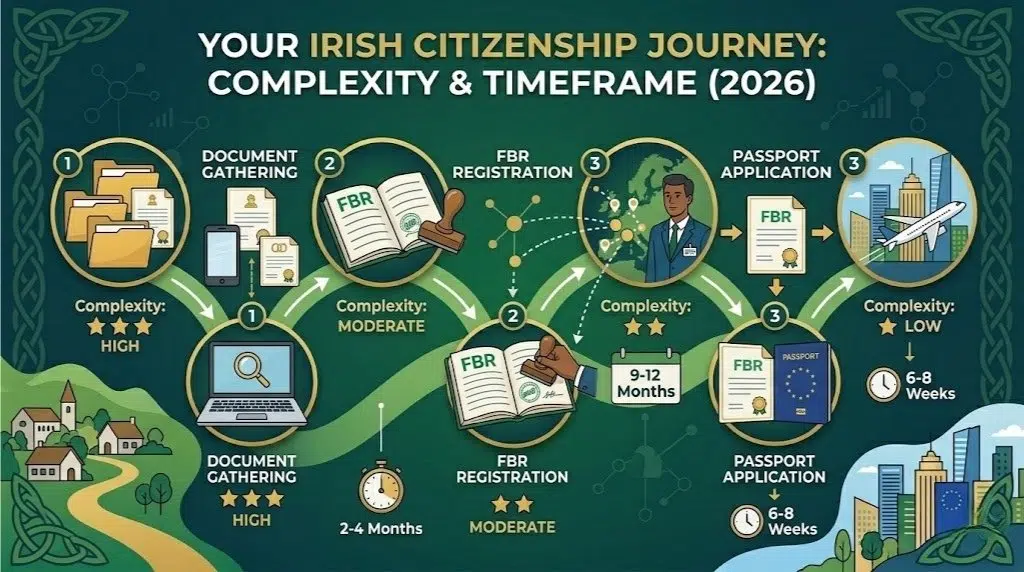
To help you manage the timeline for your citizenship journey, we have outlined the typical stages and their associated complexities as of early 2026.
Planning for these timeframes ensures that you do not book international travel or work placements before your legal status is fully confirmed.
| Application Stage | Typical Complexity | Estimated Timeframe |
| Document Sourcing | High | 2–4 Months |
| FBR Processing | Moderate | 9–12 Months |
| Passport Issuance | Low | 6–8 Weeks |
Our Top 3 Picks And Why?
While every step in the process is essential, these three strategies provide the highest impact on the success and speed of your Irish citizenship claim.
-
Sourcing Long-Form Documentation: This is the non-negotiable foundation of your case. Without original, parent-listing certificates, the DFA cannot verify your lineage.
-
Family Group Applications: This is the most efficient way to organise a family’s heritage, saving significant money on original certificates and administrative fees.
-
Passport Online Integration: Utilising the digital system for the final step ensures that once you are a citizen, you get your travel documents with minimal delay.
Essential Preparation Checklist
Before you post your application bundle to Ireland, use this checklist to ensure you meet all the 2026 requirements for ancestral citizenship.
● Original Certificates: Do you have the original, long-form birth, marriage, and death certificates for yourself, your parent, and your grandparent?
● Witness Credentials: Has your witness signed the form, two photos, and provided their professional contact details?
● Identity Proofs: Have you included a notarised copy of your current passport and two original proofs of address (e.g. a utility bill)?
● Photo Quality: Do your photos meet the biometric standards, and are they clearly signed by your witness on the reverse?
● Payment Receipt: Have you printed the confirmation page showing that your FBR application fee has been paid in full?
Securing Your Connection To Ireland
The journey to obtaining Irish citizenship is a profound way to honour your ancestors while securing a flexible and globally recognised status for your future. While the administrative requirements in 2026 are precise, they are entirely navigable with the right preparation and attention to detail. By formalising your heritage today, you are not just gaining a second passport; you are reclaiming a vital part of your identity and opening a door to a wider European future.