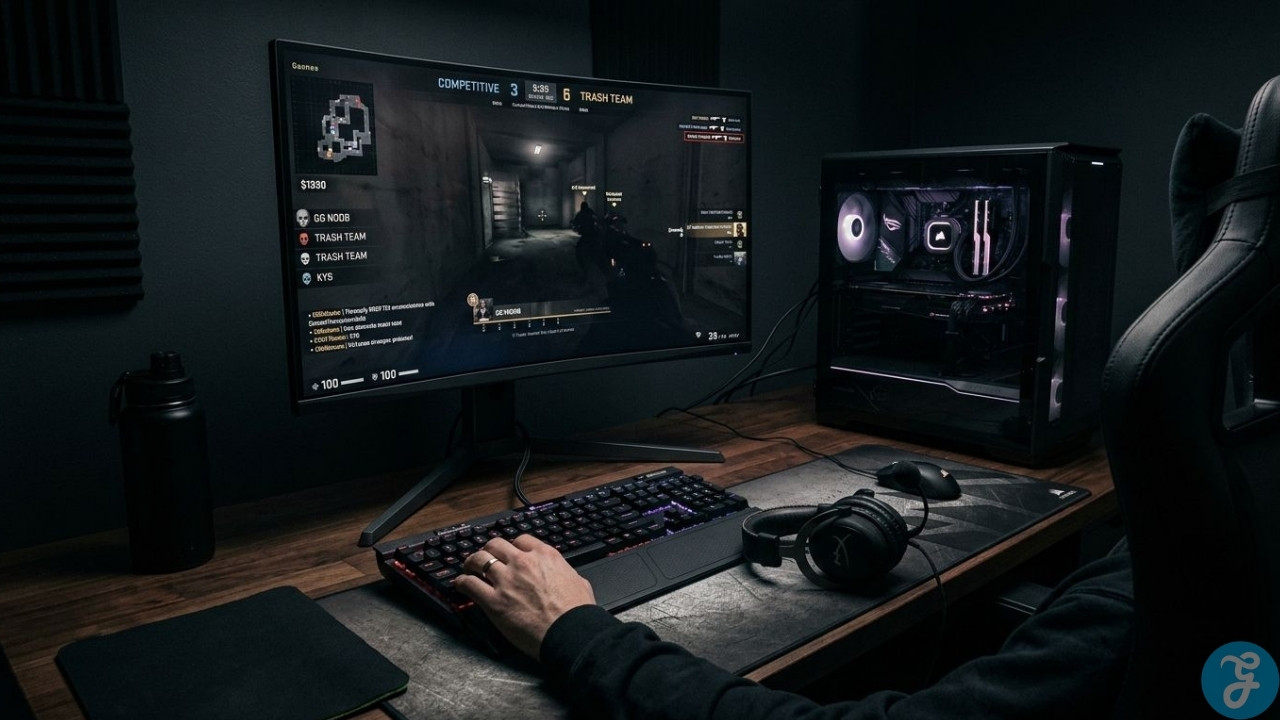
Ever finish a gaming session feeling more drained than entertained? That is the problem with gaming community toxicity. A fun match can turn ugly fast when trash talk becomes harassment, voice chat fills with slurs, or one toxic teammate decides to ruin the lobby for everyone.
In the US, this is not a small problem. Deloitte reported in 2025 that about 75% of US online multiplayer players had dealt with harassment, bullying, or other toxic behavior. That lines up with what I keep seeing in live matches, forums, and Discord servers.
I am going to walk you through the causes of toxicity, the player habits that actually help, and the tools developers can build to make online gaming healthier. If you want calmer matches and better game communities, keep reading.
What Causes Toxicity in Gaming Communities?
Toxicity in gaming communities usually grows from a few repeat triggers: anonymity, competitive pressure, weak moderation, and community norms that excuse bad behavior as “just part of the game.”
I see this most in ranked multiplayer games like League of Legends, Valorant, Rocket League, Dota 2, and Overwatch, where one bad round can turn voice chat into a pile-on.
A 2024 research paper on online game toxicity found that competitive play and anonymity still sit at the center of the problem, and toxic behavior can spread across a match once one player starts it.
How Does Anonymity Contribute to Toxic Behavior in Games?
Anonymity strips away social friction. When people hide behind cheap usernames, throwaway accounts, and mics, they often say things they would never say face to face.
The Anti-Defamation League’s gaming harms framework explains why this happens so often: anonymity can reduce empathy, encourage players to assume others are “fair game,” and make harmful behavior feel normal. In plain terms, some toxic players act worse because they do not expect real consequences.
That matters for teens and newer gamers most. A newcomer who gets mocked in voice chat during a first ranked match is far more likely to mute up, leave early, or avoid that game again.
- Fast identity masking: throwaway names and alt accounts lower accountability.
- Distance: players do not see the target’s reaction, so cruelty feels abstract.
- Group effect: once one person starts spamming insults, others often join in.
- Poor reporting faith: if players think no one reads reports, behavior gets worse.
Why Does Competitive Pressure and Elitism Increase Toxicity?
Competitive games raise the emotional temperature. When rank, streaks, clips, and public stats are on the line, frustration turns into blame fast.
A 2024 CHI study on coping with toxicity found that toxic communications hurt both wellbeing and performance. That is why one raging teammate can tank the whole match, even before the scoreboard looks bad.
Elitism adds another layer. Skilled players may treat mistakes like personal betrayal, especially in team shooters or MOBAs where one missed rotation or lost objective affects everyone.
I have seen this pattern over and over in counter-strike, Fortnite, and call of duty lobbies. The message to a newcomer becomes clear: play perfectly, or get flamed.
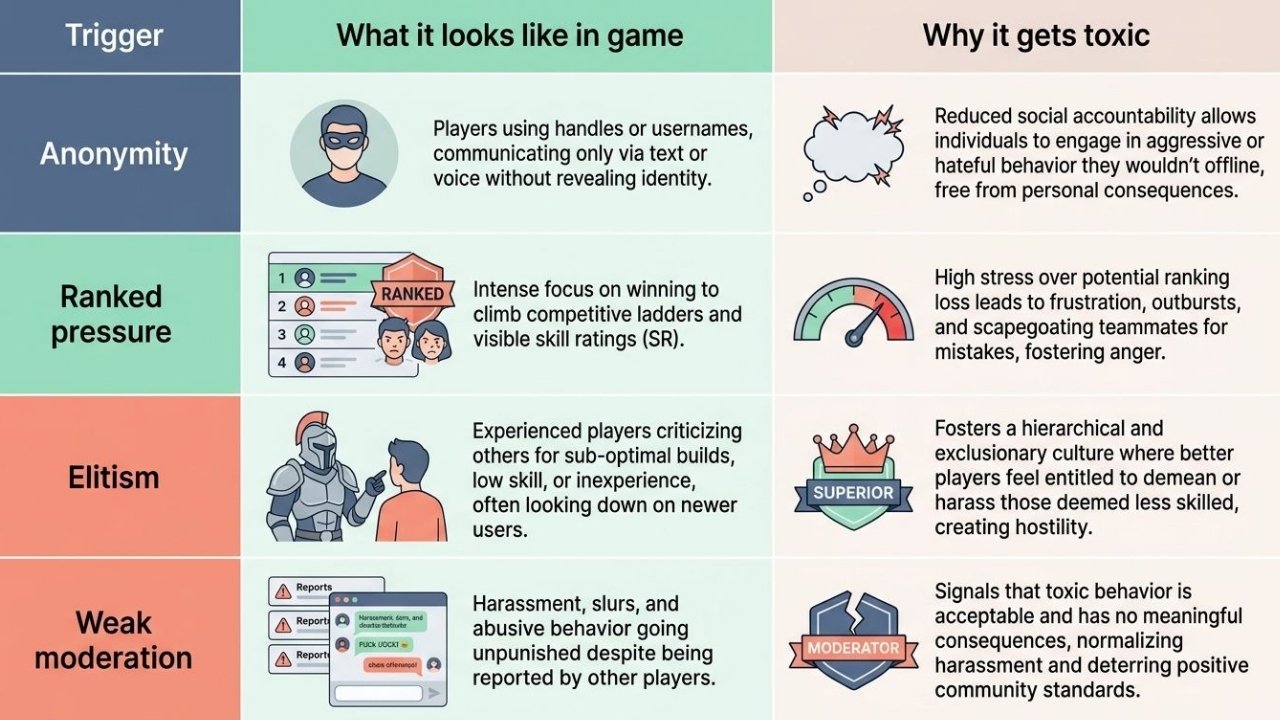
| Trigger | What it looks like in game | Why it gets toxic |
|---|---|---|
| Anonymity | Fake names, burner accounts, open mic insults | Lowers restraint and accountability |
| Ranked pressure | Rage after losses, blame in voice chat | Players treat mistakes as threats to progress |
| Elitism | Mocking casuals or newer players | Creates gatekeeping and humiliation |
| Weak moderation | Slow reports, no visible enforcement | Bad actors think they can keep going |
How Gaming Community Toxicity Disproportionately Affects Women
Women often experience a more personal and targeted form of gaming community toxicity. Once their gender becomes apparent through voice chat, usernames, or streaming, ordinary competitive criticism can quickly turn into sexist insults, unwanted comments, threats, stalking, or attempts to undermine their gaming ability.
This pressure causes some women to avoid voice chat, use gender-neutral profiles, mute teammates, or leave certain games and communities altogether. Addressing the problem requires stronger voice and text moderation, simpler reporting tools, consistent penalties, privacy controls, and visible support from teammates, moderators, developers, and influential creators.
Strategies to Foster a Healthier Gaming Environment
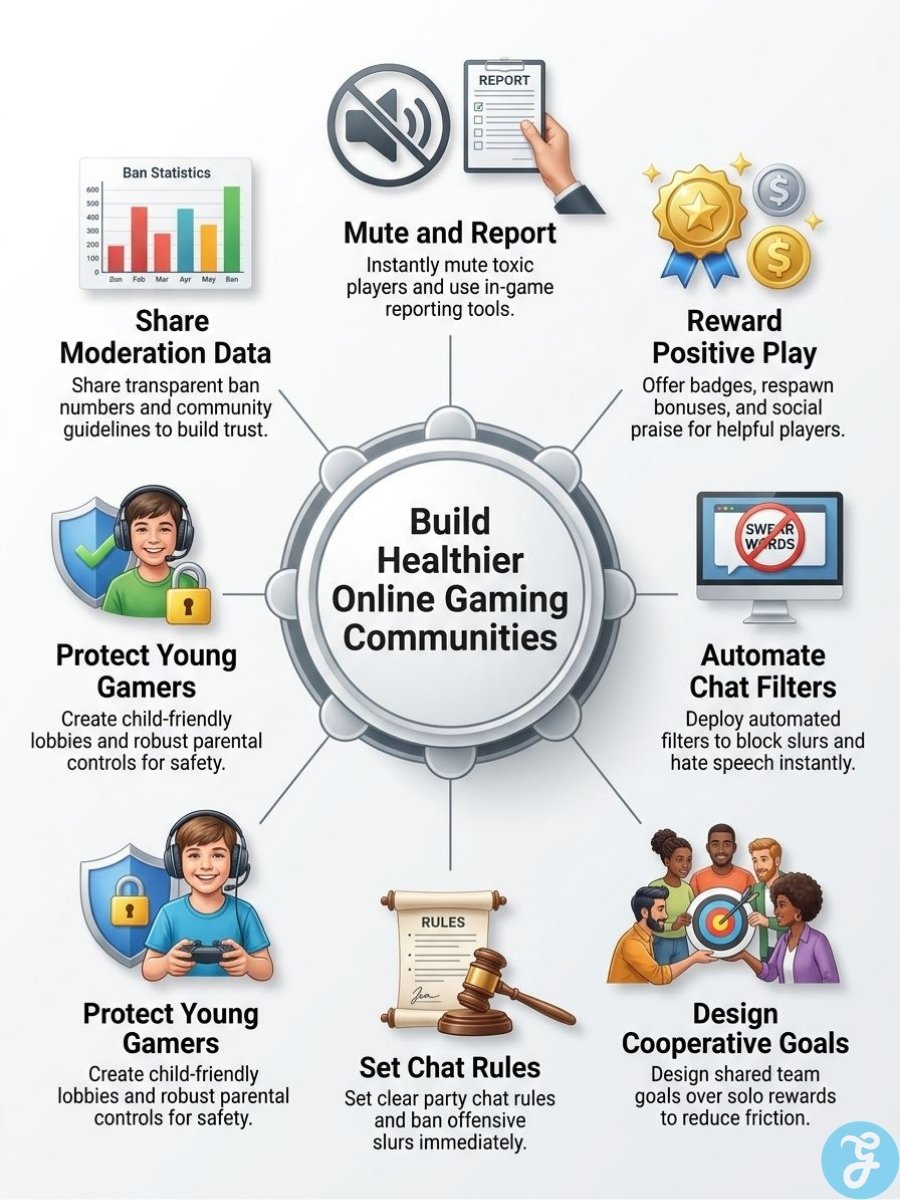
If you want to cut toxicity in the gaming community, start with the tools and habits that work in the moment. You cannot control every toxic gamer, but you can lower the damage, protect your mood, and make your lobby better for everyone else.
The biggest wins are simple: mute early, report clearly, praise useful play, and move conversations out of the spiral before a match falls apart.
How Can Players Encourage Positive Communication During Gameplay?
I aim for low-drama communication, especially in voice chat in online gaming. Short, useful callouts beat sarcasm every time.
One thing I have learned is that positive chat has to be specific. “Nice try” is fine. “Good smoke,” “great revive,” or “huge save” works better because it reinforces helpful behavior in real time.
- Mute fast: if a player starts with racist, hateful, or obscene chat, mute them before the argument grows. Waiting usually makes the match worse.
- Use short callouts: simple directions like “two left,” “rotate,” or “hold respawn” keep the team focused instead of emotional.
- Praise small wins: call out a clutch, a clean support play, or a smart revive in counter-strike 2, overwatch 2, rainbow six siege, or minecraft.
- Set party norms early: if you queue with friends, agree up front that slurs, yelling, and dogpiling are out.
- Step away after a bad match: when frustration spikes, a quick break or a switch to co-op can stop tilt from carrying into the next game.
For teens, this matters even more. Keeping your own chat calm is not about being soft. It is how you stop one toxic player from hijacking your whole night.
What Are Effective Moderation and Reporting Systems to Reduce Toxicity?
Good moderation systems reduce friction for the person reporting and increase clarity for the team reviewing the case. If either side breaks, the system fails.
Discord’s current safety guidance tells users to report the exact message and notes that lower-harm reports like harassment and hate speech may take up to a week, while higher-harm cases are prioritized faster. That is a good reminder to save the precise message, clip, or timestamp instead of sending a vague complaint.
Twitch takes a similar approach. Its moderation help pages say Safety Ops specialists review every report, and streamers can stack tools like AutoMod, verified chat requirements, slow mode, bans, and blocked terms to stop abuse before it spreads.
- Mute or block the offender right away.
- Report the exact message, whisper, username, or voice incident.
- Add the clearest category, such as harassment, hate speech, threat, or spam.
- Attach context if the platform allows it, including timestamps or clip windows.
- Leave the argument. Do not feed the offender while you wait for action.
The best systems also show players that enforcement exists. Transparency reports from platforms like Xbox help because they prove moderation is not just a promise hidden in a settings menu.
I keep coming back to the same rule: make the good behavior easier and the bad behavior more expensive. Here are some ways to reduce toxicity in online gaming
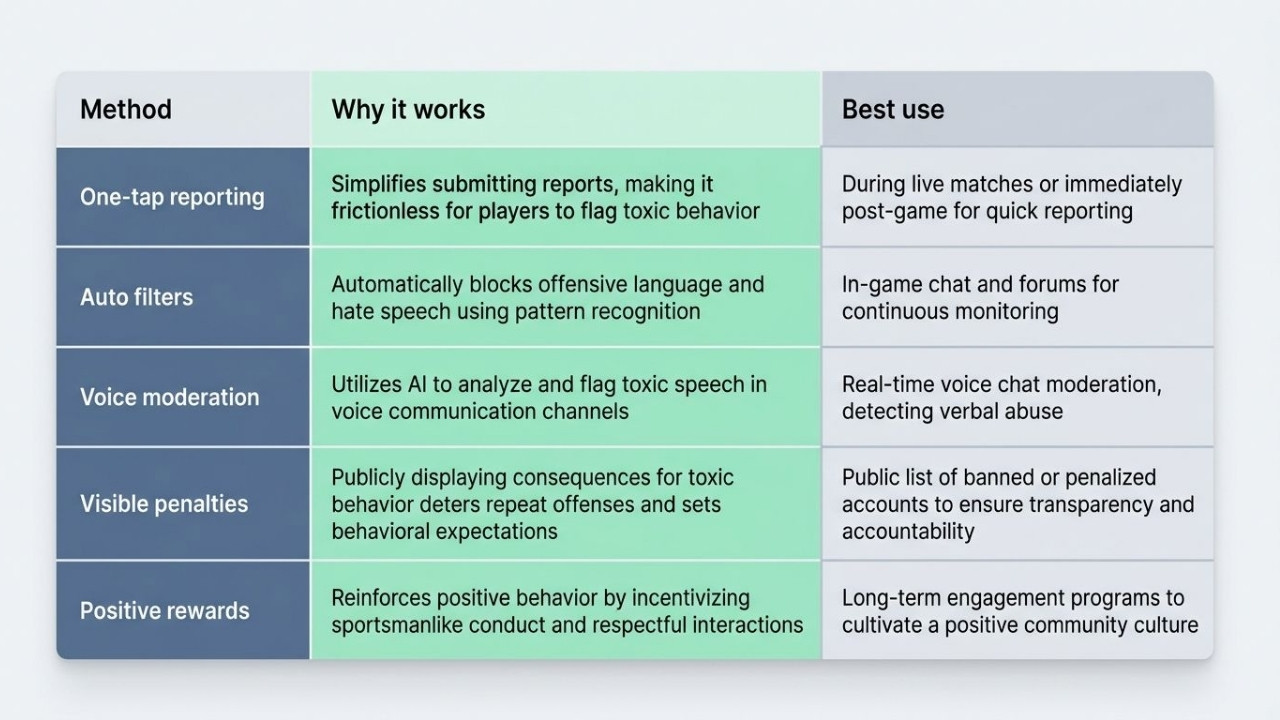
Xbox’s latest transparency materials show why this matters. The company says its reporting now covers the full year of moderation activity across Xbox and Xbox Game Studios, giving players a clearer view of what gets enforced and how platform safety works.
For younger players, protective controls matter too. Roblox’s 2026 safety updates added stronger age-based chat limits, easier in-game reporting, and linked parental controls, which is a smart model for any game with a large child and teen audience
The Role of Developers in Reducing Toxicity
Players can do a lot, but developers and publishers set the rules of the room. If the design rewards rage, hides reporting, or leaves moderation understaffed, the community pays for it.
I want developers to treat toxicity like a design problem, not just a customer support problem. Matchmaking, onboarding, role clarity, report flow, and voice tools all shape player behavior.
How Can Game Design Promote Inclusivity?
Inclusive design starts before the first match. Good onboarding teaches callout basics, shows community rules in plain language, and makes muting, blocking, and reporting easy to find.
Riot said in its 2024 Impact Report that it expanded voice moderation across almost every Riot region for English voice chat in Valorant, spanning Xbox, PlayStation, and PC. That is the kind of system-level move that changes behavior because it raises the chance that abusive voice chat will be detected.
For large youth-heavy platforms, Roblox gives another useful example. Its support materials say users can limit who chats with them, block users, and report abuse from across the app, while newer age checks help separate adult and younger-player communication more tightly.
- Clear filters: let players screen slurs and repeated offensive terms from text chat.
- Safer defaults: new accounts should start with stronger privacy and chat protections.
- Role clarity: defined jobs in team modes reduce blame and random shouting.
- Accessible reports: place the report path where players can reach it during a live match.
That kind of design does more than reduce harassment. It tells women, younger gamers, LGBTQ+ players, and anyone new to the online gaming community that they actually belong there.
Why is Cooperative and Team-Based Gameplay Important for Reducing Toxicity?
Cooperative design gives players shared goals instead of shared targets. When the objective is “win together,” players are less likely to spend the whole match hunting for someone to blame.
Research on player motivation has long linked teamwork to relatedness, which is the feeling that you matter to the group. That is why co-op modes, support roles, short team objectives, and recovery mechanics often feel less hostile than solo-carry ranked ladders.
I have seen this in games with clearer team structure, from stardew valley-style co-op to MMO raids and support-heavy shooters. A shared task lowers idle trash talk because people have something useful to do.
Developers can lean into that with a few practical design choices:
- reward assists, revives, and objective play, not just kills
- show team progress clearly so players stop guessing who “threw”
- use shorter rounds or reset points to prevent one mistake from haunting the whole match
- highlight helpful behavior in post-match screens, not just raw damage numbers
That will not erase every toxic comment. Still, it makes the game less likely to turn one missed play into a personal attack.
Ending Thoughts
I want gaming to feel fun again, not like a test of who can survive the worst lobby. Better moderation, faster reporting, smarter chat tools, and game design that rewards teamwork can cut a lot of toxicity before it spreads.
You can help right now: praise good play, mute trolls early, protect your teammate, and report abuse clearly. Small moves add up, and they make every gaming community stronger.
Frequently Asked Questions (FAQs) on Gaming Community Toxicity
1. What is gaming community toxicity?
Gaming community toxicity is harmful behavior in games, like insults, threats, or griefing, it makes play feel unsafe and drives players away.
2. What strategies help build a healthier gaming environment?
Use clear community guidelines, active moderation, and reliable reporting tools. Reward helpful players, teach good habits, and remove repeat offenders. These strategies boost healthy engagement and make play safer.
3. How can players help reduce toxicity?
Use reporting tools, be kind in chat, mentor new players, and call out bad behavior calmly.
4. When should game creators act, and what steps help most?
Act early, nip patterns of abuse in the bud, small issues grow fast. Publish rules, hire trained moderators, add strong reporting tools, and support player safety, that combo works best.