

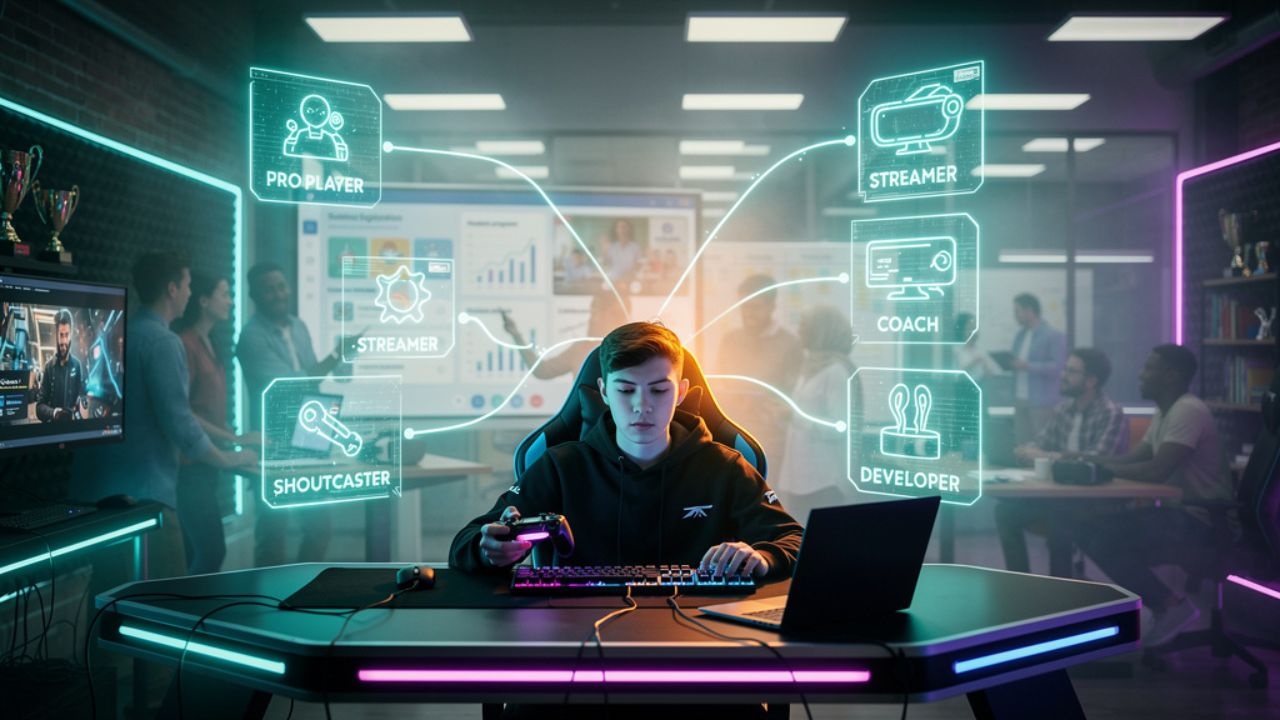
The gaming industry is no longer a niche hobby—it’s a global powerhouse driving innovation, entertainment, and employment opportunities. As technology advances, audiences expand, and games evolve beyond consoles into VR, mobile, streaming, and more, gaming career paths are increasingly diverse and in high demand. According to recent industry reports, game development, design, live-service games, e-sports, and more are among the fastest-growing sectors.
In this article, I explore 20 promising gaming career paths—from traditional development roles to new opportunities created by VR, AI, and global esports—that are set to boom in the coming years. Whether you’re a coder, artist, storyteller, gamer, or content creator, there’s likely a path that fits your skills and interests.
Why Gaming Careers Are Growing Industry Trends
Several industry-wide forces are fueling the growth of gaming career opportunities:
- Market growth & global reach: The global gaming industry is projected to grow substantially, driven by mobile gaming, cloud gaming, and expanding international audiences.
- Technological advances: VR/AR, AI-driven game logic, live-service games, and cross-platform play are opening new technical and creative roles.
- Diversification of roles: The need for writers, community managers, marketing experts, QA testers, and live-service operators has grown.
- Esports, streaming, and content creation: Competitive gaming, streaming, and game-related media have become viable career options for many.
- Global demand for localized content and new markets: As gaming spreads globally, demand for localization, regional servers, and culturally adapted content rises—creating new job niches.
Given this shifting landscape, many traditional and newly created roles are poised for growth.
20 Gaming Career Paths Set to Boom
1. Game Programmer/Software Engineer
Responsible for coding game mechanics, physics, AI, UI, and systems. Essential for building games from the ground up – especially with the rise of mobile, PC, console, and VR games.
2. Game Designer (Systems/Level/Gameplay)
Designing how a game works: its mechanics, levels, balancing, user experience, and player progression. This role shapes the “fun” and structure of the game world.
3. Narrative Designer/Game Writer
Creating storylines, dialogue, characters, and world lore. As games move toward more narrative-rich experiences, demand for skilled writers and narrative designers is rising.
4. 2D/3D Artist, Animator & Environment Artist
Visual designers who create characters, environments, textures, and animations. With high expectations for graphics, animation, and style, artistic roles remain fundamental.
5. UI/UX Designer
Design user interfaces, menus, HUDs, and overall user experience. As games become more complex and cross-platform, good UI/UX is essential to player satisfaction.
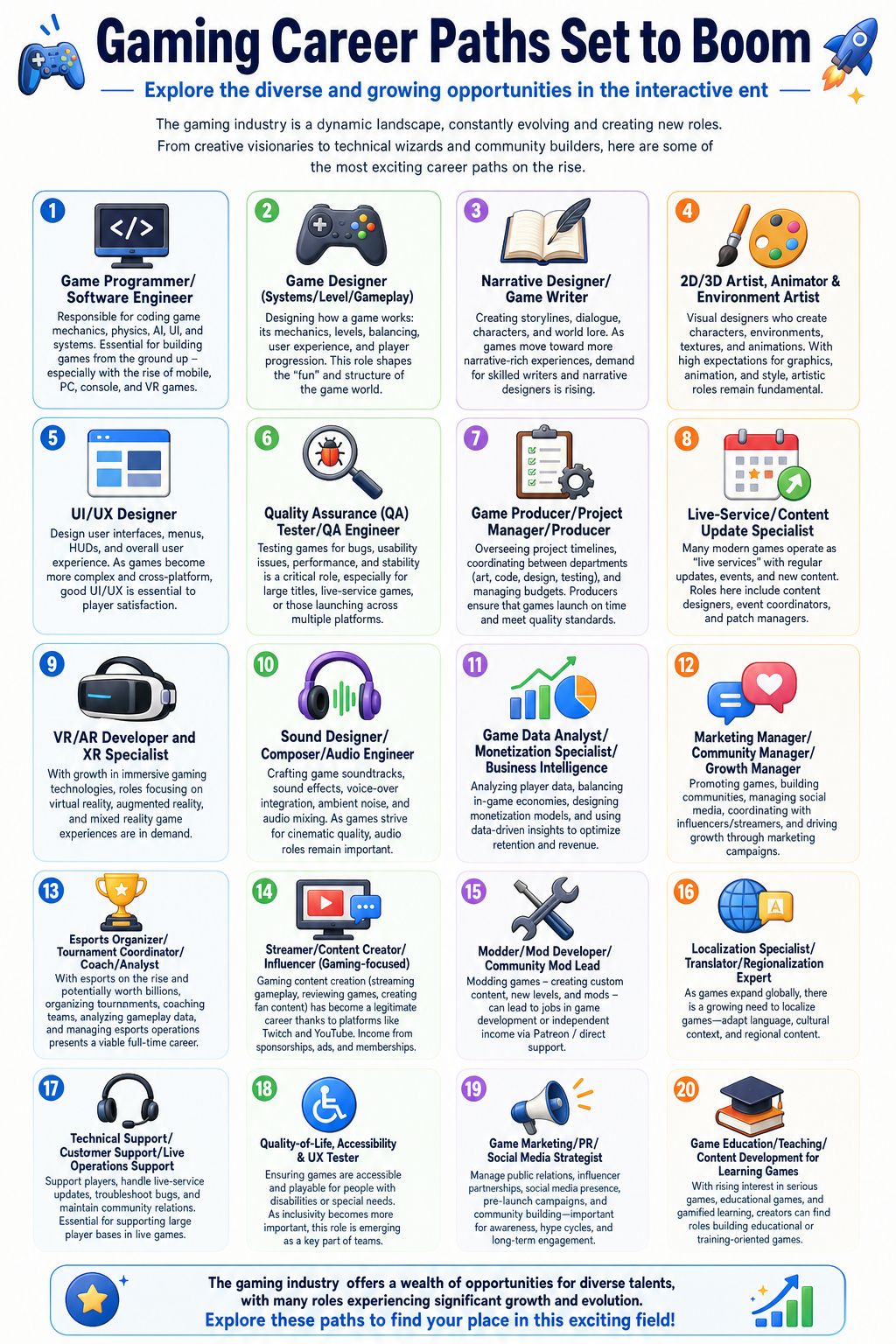
6. Quality Assurance (QA) Tester/QA Engineer
Testing games for bugs, usability issues, performance, and stability is a critical role, especially for large titles, live-service games, or those launching across multiple platforms.
7. Game Producer/Project Manager/Producer
Overseeing project timelines, coordinating between departments (art, code, design, testing), and managing budgets. Producers ensure that games launch on time and meet quality standards.
8. Live-Service/Content Update Specialist
Many modern games operate as “live services” with regular updates, events, and new content. Roles here include content designers, event coordinators, and patch managers—essential for ongoing player engagement.
9. VR/AR Developer and XR Specialist
With growth in immersive gaming technologies, roles focusing on virtual reality, augmented reality, and mixed reality game experiences are in demand. Skills in 3D modeling, VR-ready programming, and UX for VR are valuable.
10. Sound Designer/Composer/Audio Engineer
Crafting game soundtracks, sound effects, voice-over integration, ambient noise, and audio mixing. As games strive for cinematic quality, audio roles remain important.
11. Game Data Analyst/Monetization Specialist/Business Intelligence
Analyzing player data, balancing in-game economies, designing monetization models (especially for free-to-play or live-service games), and using data-driven insights to optimize retention and revenue.
12. Marketing Manager/Community Manager/Growth Manager
Promoting games, building communities, managing social media, coordinating with influencers/streamers, and driving growth through marketing campaigns. This role bridges game studios and player communities.
13. Esports Organizer/Tournament Coordinator/Coach/Analyst
With esports on the rise and potentially worth billions, organizing tournaments, coaching teams, analyzing gameplay data, and managing esports operations presents a viable full-time career.
14. Streamer/Content Creator/Influencer (Gaming-focused)
Gaming content creation (streaming gameplay, reviewing games, creating fan content) has become a legitimate career thanks to platforms like Twitch and YouTube. For successful creators, this can yield income from sponsorships, ads, and memberships.
15. Modder/Mod Developer/Community Mod Lead
Modding games – creating custom content, new levels, and mods – can lead to jobs in game development or even provide independent income via Patreon / direct support. Growing recognition of modding in mainstream gaming means this path is more viable than ever.
16. Localization Specialist/Translator/Regionalization Expert
As games expand globally, there is a growing need to localize games—adapt language, cultural context, and regional content. Translators and localization experts help games reach wider audiences.
17. Technical Support/Customer Support/Live Operations Support
Support players, handle live-service updates, troubleshoot bugs, and maintain community relations. Essential for supporting large player bases in live games.
18. Quality-of-Life, Accessibility & UX Tester
Ensuring games are accessible and playable for people with disabilities or special needs. As inclusivity becomes more important, this role is emerging as a key part of development teams.
19. Game Marketing/PR/Social Media Strategist
Manage public relations, influencer partnerships, social media presence, pre-launch campaigns, and community building—important for awareness, hype cycles, and long-term engagement.
20. Game Education/Teaching/Content Development for Learning Games
With rising interest in serious games, educational games, and gamified learning, developers, educators, instructional designers, or content creators can find roles building educational or training-oriented games.
Trends & What’s Driving Demand for These Roles
| Trend / Driver | Impact on Career Demand |
| Global growth of the gaming market & mobile/cloud gaming | More studios, more games → need for more developers, designers, testers |
| VR/AR/XR & new technologies | Creates demand for developers, 3D artists, UX designers, and VR specialists |
| Rise of live-service & ongoing content updates | Need for live-service staff, content designers, event managers, and support teams |
| Expansion of esports & streaming culture | Opens roles in esports coordination, content creation, and community building |
| Diverse player base and global audience | Growth in localization, accessibility, marketing, and cross-cultural teams |
Who These Gaming Career Paths Are For
- Tech-savvy coders and programmers — Those comfortable with coding, open to learning game engines, and eager to build gameplay mechanics.
- Creative designers and artists — People with a flair for storytelling, art, animation, UI/UX design, and world-building.
- Communicators & community-builders — Those who enjoy community management, social media, marketing, content creation, or esports organization.
- Analytical minds & data-driven thinkers — Analysts, monetization strategists, and data scientists who like numbers and optimizing performance.
- Educators or learners with broader interests—Individuals interested in educational games, localized content, or bridging gaming with other fields like learning or social causes.
What It Takes to Succeed: Key Skills & Mindset
Common traits across many gaming careers:
- Strong technical skills (programming, 3D modeling, audio design, data analysis, depending on role)
- Creativity and storytelling ability (for designers, writers, artists)
- Collaboration & teamwork — games are almost always built by diverse teams working together
- Adaptability and willingness to learn — technology, platforms, and trends shift fast
- Passion for gaming and empathy for players — helps in crafting better player experiences
- Communication and community-management skills (for marketing, live-service, support, and content)
Risks and Challenges to Be Aware Of
While opportunities are many, the gaming industry also has challenges:
- Very high competition — many people want these roles, especially popular ones like developers, artists, or content creators.
- Crunch culture and tight deadlines can lead to burnout, especially at smaller studios or during game launches.
- Job stability can vary — some companies outsource or contract workers; live-service models may fluctuate with revenue.
- Rapid technological change — work may require continuous upskilling (new engines, VR/AR, new platforms).
- Creative pressure — balancing creative vision with technical feasibility, budget constraints, and business demands.
Why Now Is a Great Time to Consider a Gaming Career
If you have a passion for games, creativity, technical interest, or community-building strengths, now is one of the best times ever to consider a gaming career. With the industry expanding, new technologies emerging, and demand for diverse skill sets rising, there’s more opportunity than ever to find a niche that fits you.
Whether you’re a coder dreaming of building your first indie game, an artist imagining new worlds, a storyteller crafting narratives, or someone who loves game communities, the gaming industry offers numerous booming career paths. As gaming continues to redefine entertainment, the opportunities will only grow.
Frequently Asked Questions (FAQs) on Gaming Career Paths
1. Is gaming really a stable career path today?
Yes, the gaming industry is growing globally, with increasing demand for developers, designers, and support roles. As games spread across platforms (mobile, console, PC, VR) and live-service models require ongoing support, career opportunities are expanding.
2. Do I need a degree to work in gaming?
Not always. Many studios and employers prioritize portfolio, experience (mods, indie games, personal projects), and demonstrated skills over formal degrees. Learning on the job or through self-study is common.
3. Can I break into gaming without coding skills?
Absolutely. Roles like game art, sound design, narrative design, community management, marketing, QA testing, or live-service support don’t always require heavy coding. There’s room for many skill sets.
4. Is esports a viable career right now?
Yes — esports and streaming have grown substantially. There is demand for players, coaches, tournament organizers, shoutcasters, content creators, and support staff.
5. What new gaming roles are expected to grow soon?
VR/AR developers, XR experience designers, live-service specialists, game data analysts, localization experts, accessibility testers, and modding-to-career paths are among those seeing rising demand.





















