On August 13, 2025, the world marks the 99th birth anniversary of Fidel Alejandro Castro Ruz—the towering figure who defined Cuba’s modern history and left a mark on global politics that remains impossible to ignore.
Born in 1926 in Birán, Cuba, Castro rose from a law student and activist to a revolutionary leader who overthrew a dictatorship, defied the world’s most powerful nation, and shaped Cuba’s destiny for nearly five decades.
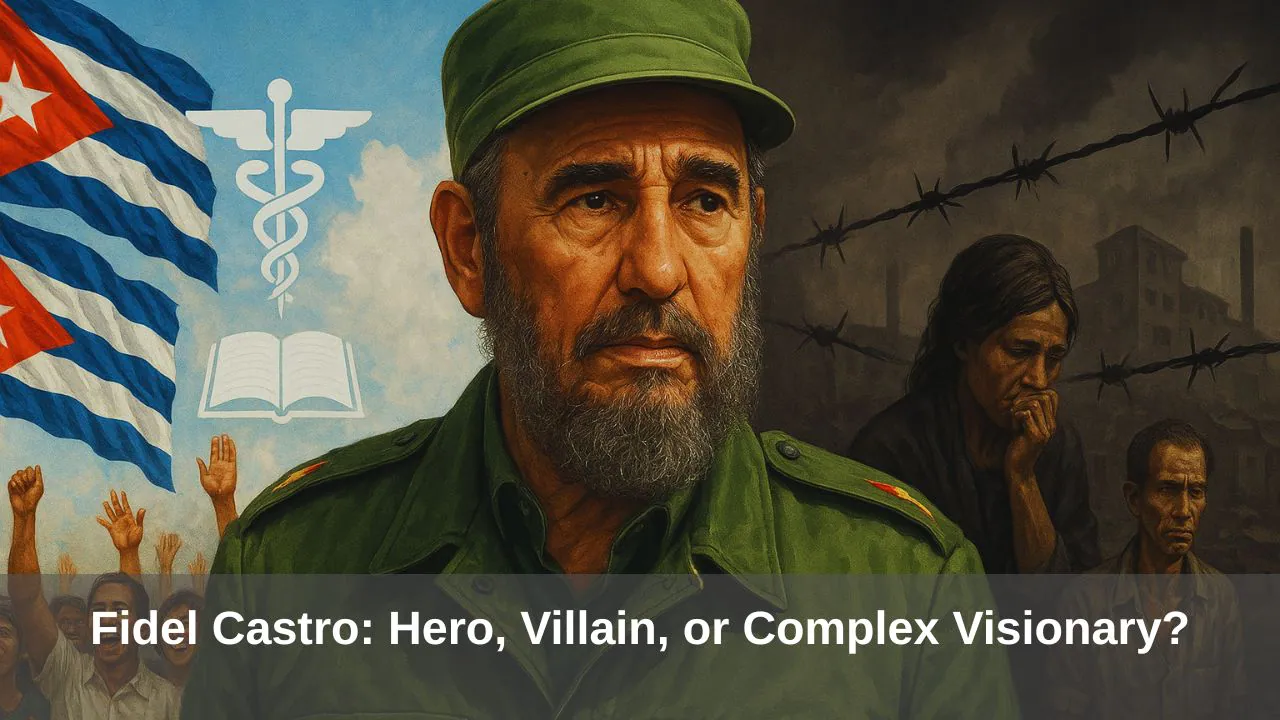
For some, Fidel Castro was a hero—a symbol of defiance against imperialism, the architect of free healthcare and education systems, and a champion of Third World solidarity. For others, he was a villain—a dictator who suppressed dissent, controlled the press, and left the Cuban people with restricted freedoms and economic hardship. And for many, he was a complex visionary—a leader who achieved remarkable social reforms while ruling with an iron grip.
As the debate continues nearly a decade after his death in 2016, Castro’s legacy remains deeply contested. This editorial explores the three lenses through which his life is viewed, revealing how the same man could inspire admiration, provoke anger, and command respect — all at once.
Early Life & Path to Power
Fidel Castro was born on August 13, 1926, to Ángel Castro, a prosperous Spanish-born sugarcane farmer, and Lina Ruz González. Growing up on his father’s estate, Castro received a privileged education, attending Jesuit schools where he developed a love for reading, debate, and sports. At the University of Havana, he studied law but also immersed himself in politics, opposing U.S. influence in Cuba and sympathizing with leftist movements abroad.
In 1953, Castro led the ill-fated Moncada Barracks attack against dictator Fulgencio Batista, an event that would define his revolutionary path. Though the attack failed and he was imprisoned, his defiant courtroom speech—later published as “History Will Absolve Me”—captured public imagination.
Released in 1955 under amnesty, Castro went into exile in Mexico, where he met Argentine revolutionary Ernesto “Che” Guevara and formed the 26th of July Movement. In 1956, they sailed back to Cuba aboard the Granma yacht, launching a guerrilla war from the Sierra Maestra mountains.
Over the next two years, their movement gained momentum, culminating in Batista’s flight from Cuba on January 1, 1959. Castro emerged not just as a revolutionary victor but as the nation’s new leader, ready to reshape Cuba’s political, economic, and social systems.
The Hero Perspective—Achievements & Ideals
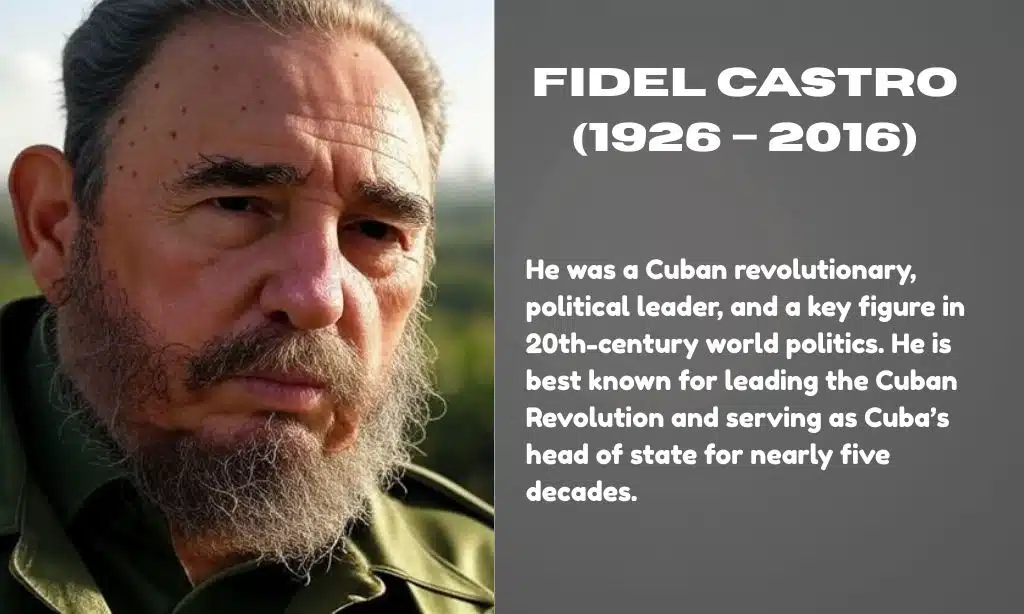
For millions around the world, Fidel Castro’s name evokes admiration, rooted in the belief that he stood as an unyielding champion of the underprivileged and the oppressed. His achievements, both within Cuba and abroad, form the foundation of his heroic image.
1. Social Reforms
Under Castro’s leadership, Cuba transformed its healthcare and education systems. Universal, free healthcare became a constitutional right, and Cuba’s medical system achieved global recognition for its reach and quality. Education also became free at all levels, with literacy campaigns reducing illiteracy from around 23% to virtually zero by the mid-1960s. These reforms became central to the narrative of Castro as a leader who prioritized human development over profit.
2. National Sovereignty
For centuries, Cuba had been shaped by foreign powers, first under Spanish colonial rule and later under strong U.S. influence. Castro’s government ended the U.S.-dominated economic order by nationalizing industries, redistributing land, and asserting political independence. This defiance—especially after surviving the Bay of Pigs Invasion in 1961—earned him admiration among nations seeking to break free from imperial control.
3. Global Solidarity
Castro positioned Cuba as a champion of internationalism, supporting leftist liberation movements in Angola, Mozambique, and Nicaragua. Cuban doctors and teachers were dispatched to dozens of countries, a practice that continues today. His readiness to assist oppressed peoples abroad reinforced his reputation as a global revolutionary.
4. Cultural Pride
Castro nurtured a strong sense of Cuban cultural identity, supporting arts, music, and sports as instruments of national pride. Under his watch, Cuba excelled in Olympic sports and developed a vibrant cultural scene that celebrated Afro-Cuban traditions and revolutionary values.
The Villain Perspective – Criticism & Failures
While Fidel Castro’s supporters praise his social reforms and defiance against imperialism, his critics point to a long record of political repression, economic mismanagement, and human rights violations. To them, Castro was not a liberator, but an authoritarian ruler who stifled freedom and kept his people under strict state control.
1. Authoritarianism
Despite his revolutionary promises, Castro established a one-party state where political opposition was not tolerated. Elections offered no real competition, and power was concentrated in his hands for decades. Critics argue that his rule betrayed democratic ideals and replaced one form of dictatorship with another.
2. Human Rights Concerns
Castro’s government was accused by international human rights organizations of suppressing dissent through censorship, imprisonment of political opponents, and harassment of dissidents. Independent media was virtually nonexistent, and freedom of speech was heavily curtailed.
3. Economic Mismanagement
While Cuba achieved impressive social indicators, its economy suffered chronic inefficiencies. Nationalization often led to low productivity and shortages. Dependence on Soviet subsidies kept the economy afloat until the USSR’s collapse in 1991, after which Cuba entered the Special Period—a time of extreme hardship marked by food scarcity, power outages, and declining living standards.
4. Mass Exodus
Economic stagnation and political repression fueled waves of emigration. The Mariel boatlift in 1980 saw over 125,000 Cubans flee to the U.S., and subsequent decades witnessed continued migration, reflecting the deep discontent among parts of the population.
The Complex Visionary—Blurred Lines
Between the polarized images of Fidel Castro as either a heroic liberator or a ruthless dictator lies a more nuanced reality—that of a complex visionary whose leadership combined idealism, pragmatism, and contradictions. To many historians, this middle ground is where the truest understanding of his legacy resides.
1. The Paradox of Leadership
Castro’s rule embodied contradictions: he was both a champion of the poor and an authoritarian, a leader who promoted education yet limited academic freedom, and a socialist who occasionally embraced market reforms when survival demanded it.
2. Cold War Chess Player
During the Cuban Missile Crisis of 1962, Castro aligned with the Soviet Union, bringing the world to the brink of nuclear war. While critics saw this as reckless, others viewed it as strategic—a way to secure Cuba’s defense against U.S. aggression.
3. Pragmatism vs. Ideology
In the 1990s, facing economic collapse, Castro cautiously allowed limited private enterprise and foreign investment. This flexibility showed that his leadership was not purely ideological but also pragmatic when necessary for survival.
4. Charisma & Symbolism
Castro’s speeches—sometimes lasting for hours—were as much theatre as politics. His bearded image in military fatigues became a global symbol of resistance, inspiring revolutionaries and provoking adversaries alike.
International Perception & Legacy
Globally, Castro’s legacy remains polarizing. In parts of Africa and Latin America, he is revered as a liberator who aided independence movements. In much of the United States and Europe, he is condemned as a tyrant. For the Global South, his defiance against the U.S. made him a symbol of self-determination.
Castro’s policies in healthcare and education still draw interest from developing nations. Cuba’s medical diplomacy—sending doctors abroad—remains one of the country’s strongest sources of soft power. Yet, his economic model is often cited as a cautionary tale about the costs of central planning and isolation.
Fidel Castro in Culture & Memory
Castro’s life has been immortalized in documentaries, biographies, and films. His image—whether on protest banners or tourist souvenirs—remains instantly recognizable. Cultural portrayals often reflect the same divide that marks his political legacy: to some, he is the romantic guerrilla; to others, the cigar-smoking autocrat.
In Cuba, his resting place in Santiago de Cuba has become a site of political pilgrimage, with visitors leaving flowers and paying homage to the man who redefined their nation’s path.
Takeaways—The Final Judgment?
At 99, Fidel Castro’s shadow still stretches across the world. He was a man of bold vision and deep flaws, a leader whose achievements in social justice cannot be separated from his failures in political freedom and economic management.
Whether hailed as a hero, condemned as a villain, or studied as a complex visionary, Castro remains one of the 20th century’s most influential—and polarizing—figures.
History’s verdict on Fidel Castro may never be unanimous. But his story stands as a reminder that revolutionary leadership is rarely pure, and its consequences are often as complex as the people who live them.