

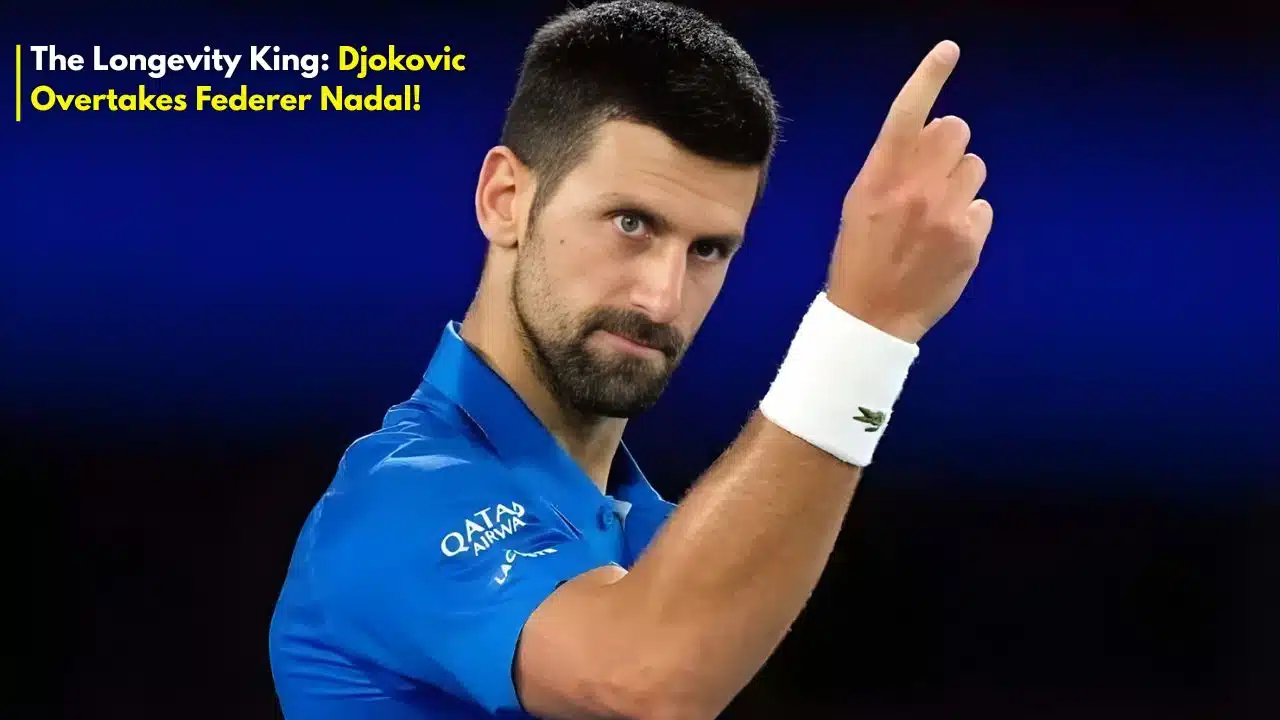
In a testament to unparalleled longevity that defies the physics of modern sport and the typical decay curve of athletic performance, Novak Djokovic has once again rewritten the history books. As the ATP Tour released its definitive year-end rankings update this morning, the 38-year-old Serbian officially secured the World No. 4 spot, making him the only player in history to finish 16 seasons ranked inside the world’s Top 4.
This latest milestone sees Djokovic break the historic three-way tie that had existed between him and his greatest rivals, Roger Federer and Rafael Nadal, who both ended their illustrious careers with 15 such finishes. While the “Big Three” era has formally transitioned into the dominance of a new generation led by Jannik Sinner and Carlos Alcaraz, Djokovic remains the last titan standing, refusing to relinquish his place at the sport’s summit.
The achievement is not merely statistical; it is a declaration of endurance. At nearly 39 years of age, Djokovic is not just competing; he is holding ground against players who were in diapers when he won his first ATP title.
Key Facts: The Longevity King
-
The New Record: Djokovic has now finished 16 seasons in the Top 4 (surpassing Federer and Nadal’s 15).
-
The Timeline: His first Top 4 finish was in 2007; his latest is 2025—a span of 18 years.
-
Current Ranking: World No. 4 (4,830 points) as of Nov 18, 2025.
-
2025 Highlights: Won career title No. 100 (Geneva) and No. 101 (Athens); Semifinalist at all 4 Grand Slams.
-
Rivals: He trails only Carlos Alcaraz (No. 1), Jannik Sinner (No. 2), and Alexander Zverev (No. 3).
-
Efficiency Rating: Played the fewest tournaments (14) of anyone in the Top 20.
The 16th Season: Strategic Brilliance Over Brute Force
The 2025 season will be remembered not as the year of Djokovic’s dominance, but as the year of his supreme efficiency. Unlike his 2011 or 2015 campaigns, where he bludgeoned the field with sheer volume, 2025 was a masterclass in “energy economics.”
Facing a field led by the explosive power of Carlos Alcaraz (22) and Jannik Sinner (24), Djokovic carefully curated his schedule, treating the ATP Tour less like a marathon and more like a series of targeted sprints. He skipped three Masters 1000 events to preserve his body, a strategy that drew criticism from some pundits but ultimately paid dividends in ranking points.
The Path to No. 4
To secure a Top 4 finish, a player must typically accrue over 4,500 points. Djokovic achieved this largely through deep runs at the Majors. By reaching the semifinals in Melbourne, Paris, London, and New York, he gathered the bulk of his points without the wear and tear of lifting the trophies.
However, the critical moment came in May. Needing to defend points to stay afloat in the Top 5, Djokovic entered the Geneva Open—a smaller ATP 250 event he usually skips. It was there he captured his 100th career title, becoming only the third man in the Open Era (after Jimmy Connors and Roger Federer) to reach triple digits in tournament wins.
“It is no trivial matter that Novak Djokovic has finished the season in the top-4 of the ATP rankings,” reported Tennis.com in their comprehensive year-end analysis. “The merit of seeing a 38-year-old player among the best in the world is enormous, almost as much as the length of time he has been among the top four.
Breaking the Tie: The “Big Three” Statistical Separation
For nearly a decade, the statistics of the “Big Three” have been inextricably linked, often requiring tie-breakers and microscopic analysis to separate their greatness. With this week’s ranking update, Djokovic has severed one of the last remaining statistical knots.
The metric of “Top 4 Finishes” is viewed by analysts as the truest measure of elite consistency. It requires a player to be a Grand Slam contender from January through November.
The All-Time Leaderboard: Top 4 Year-End Finishes
| Rank | Player | Total Years | Notable Span |
| 1 | Novak Djokovic | 16 | 2007–2025 |
| 2 | Roger Federer | 15 | 2003–2019 |
| 2 | Rafael Nadal | 15 | 2005–2022 |
| 4 | Jimmy Connors | 14 | 1973–1987 |
| 5 | Ivan Lendl | 13 | 1980–1992 |
What makes Djokovic’s record distinct is the density of his dominance. Of his 16 Top-4 finishes, a record eight were as the Year-End World No. 1. Furthermore, the gap between his first Top 4 finish (2007) and his last (2025) is 18 years—the widest gap in tennis history.
Tactical Evolution: How He Survives the “Youth Wave”
How does a 38-year-old keep up with rivals nearly two decades his junior? According to renowned tennis analyst Patrick Mouratoglou, the answer lies in Djokovic’s adaptation.
“Novak in 2025 is not the Novak of 2015,” Mouratoglou noted in a recent segment for Eurosport. “He has shortened the points. His average rally length has dropped from 6 shots to 4 shots. He is serving with more precision to set up the ‘plus-one’ forehand, reducing the amount of running he has to do.”
The “Bionic” Regimen
Sources close to the Djokovic camp indicate that his recovery protocols have become even more rigorous. Following his meniscus surgery in mid-2024, Djokovic adopted a new knee-management program that limits his practice hours on hard courts.
-
Reduced Training Load: Practice sessions are capped at 90 minutes, focusing on intensity rather than duration.
-
Serve Speed: His average first-serve speed in 2025 actually increased to 124 mph, a deliberate tactic to earn “free points.”
Hublot CEO Julien Tornare, a close partner of the Serbian star, encapsulated the sentiment after the Geneva victory: “Novak doesn’t chase time, he bends it… That he reached this moment… is incredibly meaningful.
The Financial & Legacy Impact
Beyond the rankings, Djokovic’s persistent presence at the top continues to drive the sport’s economy. By finishing in the Top 4, Djokovic triggers performance bonuses in his sponsorship contracts with Lacoste, Head, and Asics, estimated to be worth over $12 million annually.
Furthermore, his 2025 prize money earnings topped $6.5 million, extending his lead as the highest-earning tennis player in history (on-court earnings), now well past the $190 million mark.
The “Gatekeeper” Effect
Perhaps more importantly, Djokovic serves as the ultimate “gatekeeper” for the next generation. While Sinner and Alcaraz have broken through, younger prospects like Ben Shelton or Holger Rune have found themselves repeatedly stonewalled by the veteran. His presence forces the tour to maintain a higher standard; you cannot win a major tournament without likely having to go through Novak.
Comparison with Past Legends
To understand the gravity of a 38-year-old finishing No. 4, one must look at where other legends were at the same age:
-
Pete Sampras at 38: Had been retired for 6 years.
-
Bjorn Borg at 38: Had been retired for 12 years (attempting a brief, unsuccessful comeback).
-
Roger Federer at 38: Finished No. 3 in 2019 (his last great season before knee injuries).
-
Rafael Nadal at 38: Ranked outside the Top 100, battling retirement.
Djokovic is charting solitary waters. He is the only male player since Ken Rosewall in the 1970s to remain a legitimate Grand Slam threat at this age, yet Rosewall never faced the physical baseline attrition of the modern game.
What’s Next: The Obsession with “25”
Djokovic now heads into the off-season with one clear, burning objective for 2026: Grand Slam title No. 25.
Currently tied with Margaret Court for the all-time record (24) across men’s and women’s tennis, Djokovic has made it clear that the “majors” are his sole motivation. With Alcaraz and Sinner splitting the four Slams in 2025 (Alcaraz winning Wimbledon/Roland Garros; Sinner taking Australia/US Open), the window is narrowing.
“I’m happy with my level of tennis, but you know, it’s just the physicality of it,” Djokovic admitted candidly in a recent press conference in Turin. “It will be very difficult for me in the future to overcome the hurdle of Sinner, Alcaraz… but I’m not giving up. As long as I am in the Top 4, I am in the conversation.”
The 2026 Australian Open awaits. If Djokovic lifts the Norman Brookes Challenge Cup one more time, he will not only break the tie with Court but will also surpass Ken Rosewall to become the oldest Grand Slam singles champion in history.





















