

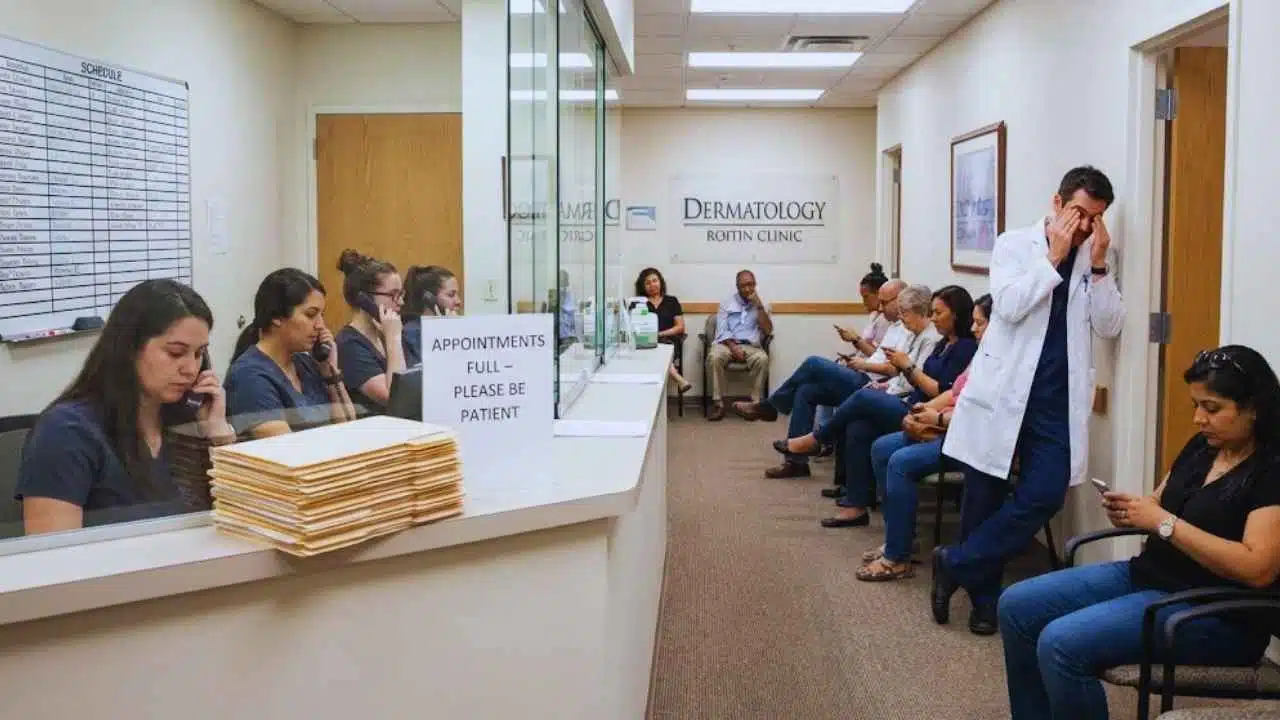
From the outside, growth looks like success. More patients. Longer waitlists. Schedules are booked weeks ahead. In dermatology, that usually feels like proof that the clinic is doing well.
Inside, it can feel very different.
Busy doesn’t always mean stable. And full schedules don’t automatically mean the clinic is working smoothly. Many dermatology clinics reach a point where adding more patients doesn’t relieve pressure — it makes everything heavier. The cracks that were easy to ignore at lower volume start spreading fast.
Most clinics don’t notice it right away. They just feel constantly behind.
When More Patients Start Creating Problems
Patient volume in dermatology often grows faster than the systems behind it. Appointments increase. Procedures stack. Follow-ups multiply. The same internal setup is expected to carry all of it.
At this stage, Dermatology Clinics and Virtual Medical Assistants become part of how clinics handle overflow, not as an idea, but as a way to keep routine work from overwhelming the core team.
More patients don’t just mean more visits. They add calls, insurance checks, photo uploads, messages, and loose ends. Without structural change, pressure builds quickly.
Full Schedules Can Hide Real Problems
A packed calendar can be misleading. It creates the feeling that things are running smoothly. Providers are booked. Revenue is steady. From the outside, the clinic looks healthy.
Underneath, small issues quietly pile up.
Messages answered late. Insurance tasks pushed to tomorrow. Charts finished after hours. Staff juggling multiple roles at once, never fully catching up. These aren’t dramatic failures. They’re slow leaks.
Slow leaks don’t demand attention until something finally breaks.
The Administrative Work That Grows With Volume
Administrative work in dermatology isn’t overwhelming because it’s difficult. It’s overwhelming because it never stops. Each task feels small on its own. Together, they take over the day.
Before clinics look for fixes, it helps to be honest about what actually increases alongside patient volume:
- Incoming calls that interrupt patient flow;
- Insurance authorizations tied to procedures;
- Photo documentation and chart updates;
- Follow-ups that don’t wait for downtime.
None of these tasks are optional. All of them pull attention away from patient care. And the more patients you add, the faster this layer grows.
Ignoring it doesn’t make the clinic more efficient. It just forces people to absorb the pressure personally.
Why Hiring More Staff Doesn’t Always Fix the Issue
The first instinct is usually to hire. Another front desk person. Another assistant. Someone to “help with admin.”
Sometimes that helps. Often, it creates new friction.
More people mean more coordination, more training, more handoffs, and more chances for things to fall through the cracks. Without a clear structure, additional staff can increase noise instead of reducing it.
Growth built entirely on hiring becomes fragile. Every sick day hurts. Every turnover causes disruption. The system depends on people compensating instead of processes carrying the load.
Where Time Disappears in Busy Clinics
One of the strangest things in dermatology clinics is how much time disappears even when everyone is working nonstop.
Not because people aren’t trying. Because attention is constantly interrupted.
Providers answer questions mid-chart. Staff stop intake to take calls. Tasks get switched every few minutes. Nothing feels finished. Everything feels urgent.
Over time, this creates a workday that feels full but unproductive.
Structure Before Volume
This is the part most clinics skip. Not because it isn’t important. Because there’s never time to stop and look at it directly.
Before adding more patients, clinics need to understand how work actually moves through a normal day — not how it looks on a schedule, but how it unfolds in reality.
Where Bottlenecks Form
Bottlenecks rarely show up as obvious failures. They form quietly. Messages waiting too long. Authorizations sitting untouched. Charts pushed to the end of the day. None of it stops the clinic outright. It just slows everything down enough to be exhausting.
What Actually Needs Clinical Attention
Not every task connected to patient care requires a clinician’s judgment. But without structure, everything ends up in the same queue. Providers become the default solution for problems that don’t need them, simply because no other lane exists.
How Interruptions Shape the Day
Interruptions feel small when they happen. One question. One call. One “quick thing.” Over a full schedule, they reshape the entire day. Fewer interruptions don’t just save minutes. They protect focus, decision-making, and patience.
Capacity and Control Are Not the Same Thing
Capacity is how many patients a clinic can see. Control is how smoothly everything moves.
Clinics often increase capacity without improving control. The result is stress, longer days, shorter patience, and more mistakes. Patients notice it, even if they can’t explain why.
Control comes from defined roles, clear workflows, and boundaries around attention. Not everything needs to be handled on-site. Not everything needs to be handled by a clinician.
Why Delegation Still Feels Risky
Delegation in healthcare carries weight. Privacy laws. Liability. Trust. Letting go doesn’t feel neutral. It feels risky. That fear isn’t irrational.
Patient data matters. Errors matter. Handing tasks off without clarity feels like adding uncertainty to an already demanding environment. Many clinics respond by keeping everything in-house, even when it’s unsustainable.
Clear structure changes that. Defined responsibilities. Limited access. Oversight without micromanagement.
Common Beliefs That Keep Clinics Chasing Volume
Certain ideas quietly push clinics toward more patients instead of better systems:
- “We’ll fix it once things slow down”
- “Being busy means we’re doing well”
- “This is just how dermatology clinics operate”
These beliefs stick because they’re familiar. They don’t require change. They only require endurance.
Things rarely slow down on their own.
What Changes When Systems Come First
When clinics focus on structure before adding volume, the shift isn’t dramatic. It’s subtle.
Phones get answered on time. Messages stop piling up. Charts close closer to visits. Evenings feel less crowded with unfinished work.
Clinicians notice something else, too. They think more clearly. Not faster. Clearer.
Less mental clutter leaves room for judgment, patience, and focus — the parts of care that actually matter.
This Isn’t About Getting Bigger
Not every dermatology clinic wants to grow. Many just want things to feel manageable again.
Sustainability isn’t about squeezing more appointments into the day. It’s about keeping work from spilling into every corner of life.
Burnout doesn’t come from caring too much. It comes from carrying too much that shouldn’t be there.
Letting the Clinic Catch Up to Its Own Demand
Dermatology has changed fast. Patient expectations. Documentation. Technology. None of it slowed down.
Many clinics are still running on systems built for a simpler version of the job. Adding more patients to that setup doesn’t strengthen it. It exposes its limits.
More patients aren’t always the answer.
Sometimes the answer is giving the clinic enough structure to actually support the work — before asking it to do more.























