

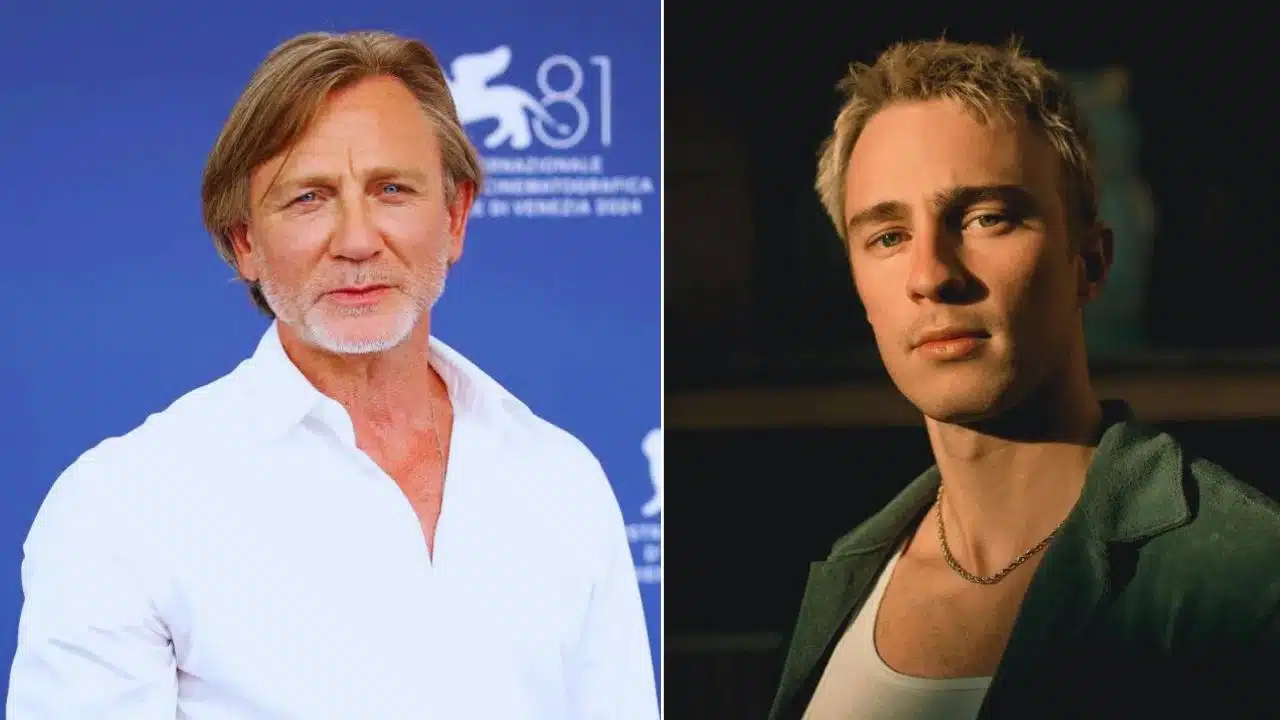
In his highly anticipated new film Queer, Daniel Craig takes a dramatic departure from the polished, sophisticated character of James Bond that he portrayed for over 15 years. This time, Craig immerses himself in the role of William Lee, a drug-addicted gay man navigating the shadows of 1940s Mexico City. Based on the semi-autobiographical novel by Beat Generation writer William S. Burroughs, Queer is a raw and poignant story of unrequited love, emotional turbulence, and the complexities of sexual identity. Craig, in a candid press conference ahead of the film’s world premiere at the Venice Film Festival, described Queer as delivering an “emotional thump,” a phrase that encapsulates the powerful impact the film is expected to have on its audience.
Directed by acclaimed Italian filmmaker Luca Guadagnino, the movie is one of 21 films competing for the prestigious Golden Lion award at the Venice Film Festival, with the winner to be announced on September 7. This gritty, emotionally charged narrative positions Craig at the heart of a vulnerable and tragic love story, offering audiences a side of him they haven’t seen before—a far cry from the invincible Bond persona that has become synonymous with his name.
From Bond to Broken: Craig’s Transformation on the Red Carpet
Daniel Craig’s appearance at the Venice Film Festival red carpet ahead of the screening was as much a statement as the film itself. Known for his sleek, sharply dressed 007 image, Craig’s look at the premiere couldn’t have been more different. With tousled, shaggy hair and wearing a relaxed cream-colored suit paired with aviator sunglasses, Craig looked nothing like the secret agent fans had grown accustomed to. This transformation reflected the depth of his shift from Bond to the emotionally fragile character of William Lee.
The first reviews of the film were overwhelmingly positive. IndieWire, a respected voice in the film industry, praised Craig’s portrayal of William Lee, describing it as “all inner torment he wears on the outside, as a deeply lonely man doomed to an unrequited all-consuming love.” The intensity of Craig’s performance, which showcases a man trapped in the anguish of desire, loss, and addiction, sets the tone for the film’s exploration of human vulnerability.
An Exploration of Love, Loss, and Longing in Queer
At the press conference, Craig spoke passionately about the emotional gravity of the story. “Queer is this emotional thump, a tiny book but an emotional thump,” he said, emphasizing the depth and resonance of Burroughs’ novel, despite its brevity. Craig further elaborated on the film’s key themes: love, loss, loneliness, yearning, and the human condition. These universal experiences are central to the narrative, which traces William Lee’s obsession with a younger man, Eugene Allerton, played by rising star Drew Starkey.
The film delves into the life of Lee, a fading writer in post-war Mexico City, whose days are filled with drinking, drugs, and fleeting encounters with men. His world turns upside down when he meets Eugene, a handsome, younger man with whom he becomes infatuated. Lee’s passion for Eugene is one-sided and all-consuming, driving him into deeper emotional turmoil as he chases a love that can never truly be his.
For Craig, this role allowed him to explore uncharted emotional territory. He confessed that the part had everything he had ever wanted as an actor. “If I was writing myself a part and wanted to tick off the things I wanted to do, this would fulfil all of them,” Craig admitted to the press. His excitement for the complexity and intensity of the role shines through in his performance, which some are already calling one of his best.
Making Intimacy Real: The Challenge of Filming Sex Scenes
One of the most talked-about aspects of Queer is its portrayal of intimacy between men. Craig, who has had his share of romantic and intimate scenes as James Bond, approached these moments in Queer with a different mindset. He wanted to ensure that the sex scenes were not only realistic but also emotionally resonant and integral to the story.
“There is nothing intimate about filming a sex scene on a movie set—there’s a room full of people watching you,” Craig revealed during the press conference, offering insight into the challenges of shooting such scenes. He and co-star Drew Starkey spent months rehearsing, working to make the intimacy between their characters feel natural, poignant, and real. Craig explained that both he and Starkey wanted the scenes to reflect the emotional weight of the characters’ relationship, rather than just physicality.
“We just wanted to make it as touching and as real and as natural as we possibly could,” Craig said, adding that they aimed to strip away any artifice and focus on the vulnerability of the characters. Starkey, too, shared his thoughts on the unique bonding experience of shooting these scenes. “When you’re rolling around on the floor with someone the second day of knowing each other, that’s a good way to get to know someone,” Starkey joked, highlighting the unusual, yet effective way their on-screen chemistry developed.
William Burroughs’ Novel: A Long Road to the Screen
The road to bringing Queer to the screen has been a long one. William S. Burroughs, the iconic Beat Generation novelist whose work often explored themes of sexuality and addiction, wrote Queer in the early 1950s. However, he chose not to publish it for decades, shelving the manuscript until 1985. According to Guadagnino, Burroughs found the novel too personal, too close to his own life, and wasn’t ready to share it with the world at the time.
“There was a very strong element of modesty in Burroughs,” Guadagnino explained. “It was too close to home that book, he couldn’t even deal with that, he had to put it aside.” This reluctance makes Queer an even more significant work, as it offers a deeply personal window into Burroughs’ own experiences with unrequited love, homosexuality, and addiction.
For Guadagnino, the story’s raw humanity was what drew him to the project. He wanted to create a film that didn’t judge its characters, but rather explored their complexities with empathy. “The idea of seeing people and not judging them… of making sure that even the worst person is the person you identify with,” the director said, reflecting on his approach to the material. “It’s so purely profoundly human and that’s what should be the task of the filmmaker, to find humanity in the dark recesses and in the most bright ones.”
A Dark, Emotional, and Visually Stunning Journey
Queer opens on a visually arresting note, with a dingy mattress set against the strains of Kurt Cobain’s haunting song “Everyone is Gay.” Scattered across the bed are manuscripts, eyeglasses, books, maps, and a revolver—objects that symbolize the chaotic and broken world of William Lee. These opening visuals, paired with the somber soundtrack, immediately set the tone for a film that delves into the darkest recesses of love, desire, and addiction.
One of the film’s central themes is William Lee’s struggle with his homosexuality, which he refers to as a “curse.” In a pivotal scene, Lee tells Eugene, “The Lees have always been perverts,” highlighting the internalized shame and self-loathing that he carries with him.
Visually, the film is a masterpiece, with Guadagnino’s Mexico City evoking the loneliness and alienation of its central character. The city’s streets and shadows are reminiscent of an Edward Hopper painting, with space and isolation serving as metaphors for Lee’s internal struggles. Guadagnino uses light and darkness to highlight the emotional distance between the characters, reinforcing the themes of longing and unattainable love.
The Descent into Obsession: A Trip to South America
As William Lee’s obsession with Eugene deepens, the two men embark on a journey to South America, in search of “yage” or ayahuasca, a hallucinogenic drug that Lee believes will bring him closer to Eugene. The film takes a darker turn here, venturing into territory reminiscent of Heart of Darkness, as the men travel deeper into the jungle in pursuit of the drug.
Their journey brings them to a remote camp, run by a reclusive American scientist played by Lesley Manville. The camp, shrouded in mystery, is the site of experiments on the properties of ayahuasca, and danger lurks at every corner, with a poisonous snake being set upon intruders. This descent into a hallucinatory world reflects Lee’s growing desperation, as he chases not only a high but also a connection with Eugene that remains elusive.
Craig’s Vulnerability Shines Through
One of the most remarkable aspects of Queer is the vulnerability that Daniel Craig brings to the role of William Lee. According to Guadagnino, Craig’s willingness to show fragility on screen is what sets him apart from other legendary actors. “Very few iconic actors allow that fragility to be seen,” the director said, praising Craig for his commitment to portraying Lee’s emotional turmoil in such an honest and raw way.
This isn’t the first time Guadagnino has brought out profound performances from his actors. His 2017 film Call Me by Your Name catapulted Timothée Chalamet into stardom, and his recent film Bones and All earned him the Silver Lion directing prize at Venice. With Queer, Guadagnino once again proves his ability to create emotionally charged, visually stunning films that resonate with audiences.
A Film to Watch at the Venice Film Festival
With its world premiere at the Venice Film Festival, Queer has already started generating significant buzz. Daniel Craig’s portrayal of William Lee, combined with Guadagnino’s direction, promises to make Queer one of the standout films of the festival. Its exploration of love, loneliness, and addiction, set against the backdrop of 1940s Mexico City, offers a raw and emotional experience that is sure to leave a lasting impact on audiences.
As the film competes for the Golden Lion, all eyes will be on Craig’s performance, which could very well redefine how audiences see him after years of playing James Bond. Queer is more than just a departure from his 007 persona—it is a deep, vulnerable, and powerful portrayal of a man wrestling with his desires and his demons.
























