
Since 2017, the growing interest from both retail and institutional investors has caused notable movements in the cryptocurrency markets. At first glance, these movements suggest that cryptocurrencies like Bitcoin and Ethereum are behaving in tandem with traditional equity markets.
But dig a little deeper, and it becomes clear that this is not a true correlation in the technical sense. Rather, the resemblance emerges because investors, both seasoned and new, are approaching cryptocurrencies using the same framework they’ve long applied to stocks and commodities. The market is not responding to intrinsic similarities between the asset classes, but rather to the habits and expectations of those participating in it.
The rise of crypto from 2009 to 2025
From its inception in 2009 through the mid-2010s, mainstream investors largely ignored Bitcoin. Prices were low, volumes were thin, and awareness was minimal. It was largely a niche experiment in financial technology. But as knowledge spread, so did investor interest. People treated crypto in the only way they knew how, like an investment opportunity. And just like equities, cryptocurrencies began to respond to macroeconomic factors, regulatory shifts, sentiment swings, and speculative behavior.
In 2025, investors can even find the next 1000x crypto, a very explosive kind of coin that can return their investment by a thousand times. Is that even a wonder, knowing that Bitcoin is soaring to 110K dollars this month? Even altcoins are riding 2025’s bull wave. The race to uncover the next token with explosive potential is very much real.
Factors that have historically influenced stock prices, such as supply and demand dynamics, investor sentiment, economic cycles, monetary policy changes, geopolitical events, and regulation, are also moving cryptocurrency markets. This doesn’t mean these assets are inherently connected, but rather that they are reacting similarly because they’re being treated similarly.
Supply, demand, and speculative dynamics
One of the clearest examples of how traditional investment principles shape crypto prices is supply and demand. The finite nature of Bitcoin (only 21 million coins will ever exist) is frequently compared to scarce commodities like gold. As demand rises and supply growth slows, prices respond accordingly. This was evident in previous Bitcoin halving events and continues to influence investor behavior.
When Bitcoin undergoes a halving, like the one expected in April 2024, which reduced the block reward from 6.25 BTC to 3.125 BTC, investors often anticipate a supply shock that could drive up prices. Historically, such events have led to price increases, although there’s no guarantee this will always be the case. The expectation alone is often enough to drive significant market activity, which shows how investor sentiment can move prices as much as actual fundamentals.
The power of expectations
Investor sentiment is perhaps one of the most powerful forces in both crypto and equities markets. In the world of traditional finance, market psychology is a well-known driver of short-term price action. Crypto markets, despite their technological foundation, are no different.
Take the October 2023 incident when a media employee mistakenly reported that the U.S. Securities and Exchange Commission had approved a Spot Bitcoin ETF. The report was false, but Bitcoin’s price surged nearly $2,000 within hours, only to fall back after the truth emerged. The rally wasn’t based on any change in the asset’s fundamentals but was instead fueled entirely by investor expectations.
This behavior is magnified in crypto markets due to the relative youth of the asset class and the speed with which information spreads. When the SEC actually approved the first Bitcoin Spot ETPs on January 11, 2024, Bitcoin responded as many had hoped. Its price, which closed around $50,000 the day before, climbed past $75,000 on Poland’s Exmo exchange by mid-March. A combination of investor excitement, institutional inflows, and media coverage drove this growth.
Macroeconomics and market behavior
Cryptocurrencies do not exist in a vacuum. They are affected by broader economic conditions just like any other asset. During the 2020 COVID-19 pandemic, global markets plummeted. The S&P 500 lost more than 110 points, and the U.S. fell into a brief but sharp recession. Bitcoin, too, felt the tremors. Prices dipped as investors fled riskier assets.
But as the economy recovered, Bitcoin showed resilience and even outperformed many traditional assets. This performance earned it a reputation as a potential hedge or alternative asset, attracting institutional money and reinforcing its role as a speculative investment with high upside potential.
Then, in May 2022, the Federal Reserve raised its target federal funds rate to 0.75%–1%. Bitcoin’s price dropped to around $31,000 the following day. The Nasdaq 100 lost roughly 1,400 points, while the S&P 500 shed 150. These simultaneous declines gave the illusion of correlation, but they were better interpreted as synchronized reactions to macroeconomic tightening.
Geopolitical and regulatory shockwaves
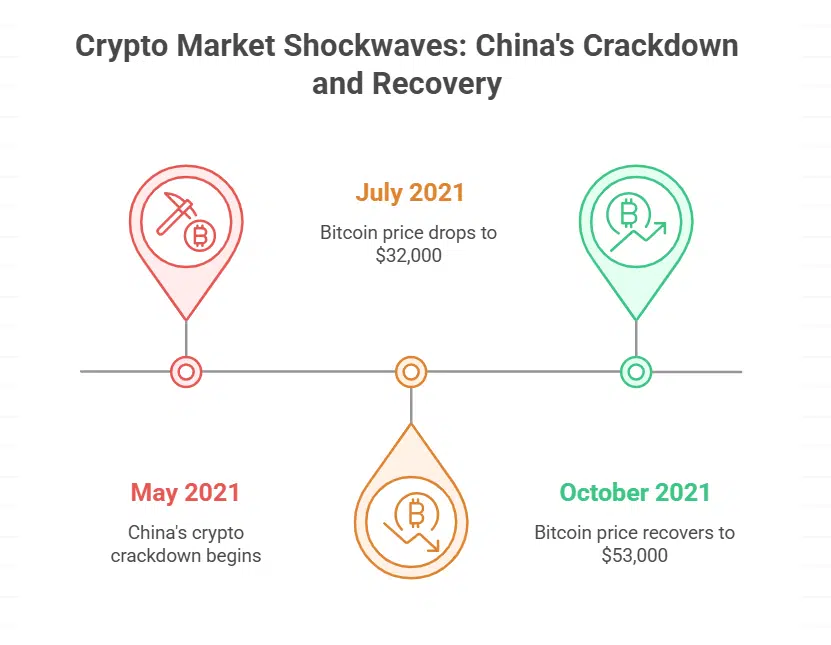
Events like China’s crackdown on crypto in 2021 show how regulation and geopolitics can reshape the market. When Chinese authorities forced mining farms to shut down, Bitcoin’s price plunged from $53,000 to $32,000 between May and July. It took until October for prices to recover.
Similar regulatory developments continue to shape investor behavior. As the ecosystem matures, traders and institutions increasingly price in changes from lawmakers, courts, and regulators, just as they do with stocks. These shared responses to outside events add another layer to the illusion of correlation between the two asset classes.
Software development and network disruptions
Unique to cryptocurrency is the role of development disputes and network changes. These rarely affect stocks in the same way. For example, the 2017 Bitcoin Cash hard fork, when developers disagreed and split the Bitcoin blockchain, caused significant investor concern. Bitcoin’s price dropped by nearly $600. Events like this highlight the experimental nature of cryptocurrencies and the importance of decentralized governance structures in price movements.
Is the correlation real?
Between 2022 and 2023, Bitcoin’s price patterns increasingly mirrored those of major stock indices like the S&P 500 and Nasdaq Composite. From November 2022 to November 2023, the rise-and-fall rhythms of these markets showed similarities. But where stock indices moved steadily, Bitcoin continued to exhibit significantly higher volatility.
This visual similarity in charts led many analysts to claim correlation, but the reality is more nuanced. The behaviors of traders and investors, rather than any intrinsic link, are largely responsible. People treat Bitcoin like a tech stock or commodity because that’s what they’re used to, creating artificial correlations through behavior.
The key takeaway for investors is not to assume correlation equals causation. Cryptocurrencies might move in ways that resemble equities, but this is more about how they’re being treated than what they are.