

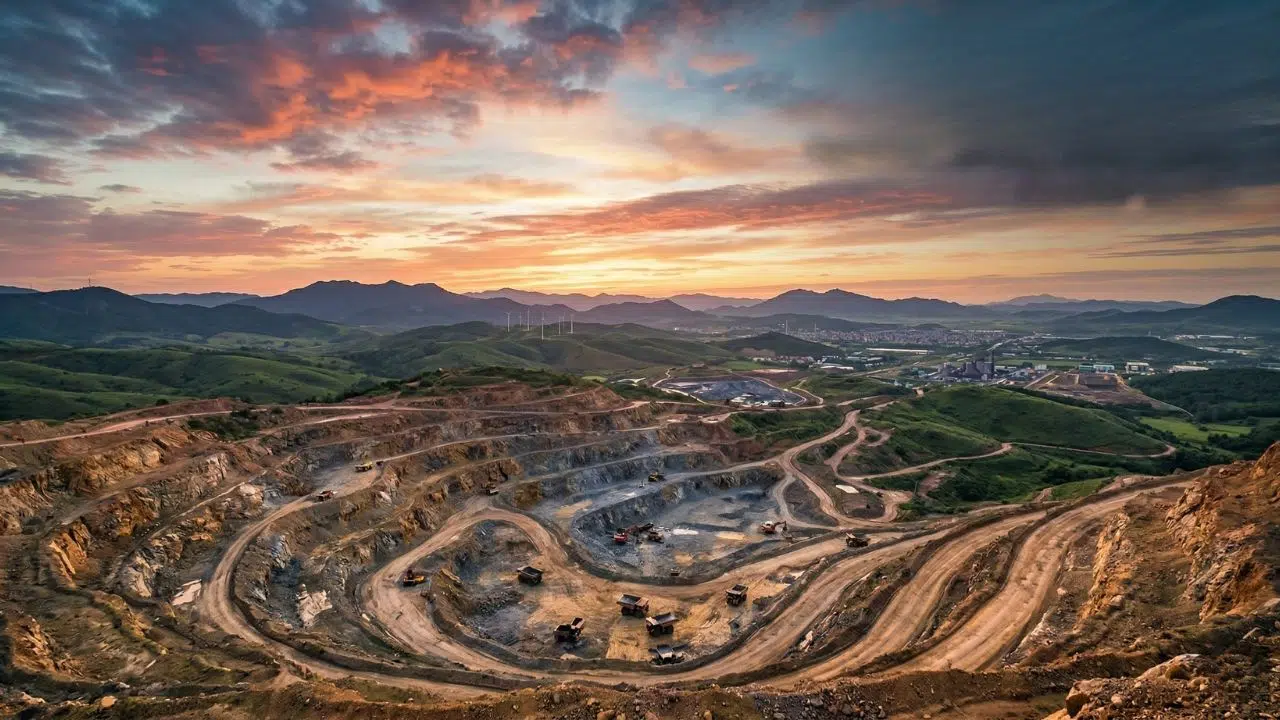
China’s dominance over critical minerals is a challenge, yes. But for South Asia and the Global South, it is also the most significant economic and strategic opening in a generation if we have the vision to seize it.
In 1992, as China was embarking on its era of economic reform, Deng Xiaoping made an observation that was largely ignored by the rest of the world: “The Middle East has oil,” he said. “China has rare earth elements.” Three decades later, that quiet declaration has become the most consequential geopolitical reality of our time.
Rare earth elements, a group of seventeen metals with names like dysprosium, terbium, and samarium, are embedded in virtually every technology that defines modern life. They sit inside the motor of your electric vehicle, the screen of your smartphone, the guidance systems of a military drone, and the magnets of a wind turbine. Alone, they are obscure. Together, they are irreplaceable. And China controls nearly all of them.
But here is what I want to argue: for the developing world, for South Asia, for Africa, for Southeast Asia, the current disruption in the critical minerals developing nations order represents something rare in geopolitics: a genuine window of opportunity.
Understanding What is Actually at Stake
Critical minerals, lithium, cobalt, graphite, dysprosium, terbium, and sixteen other rare earth elements, are the foundational inputs of modern technology. China currently controls approximately 70% of global mining and 90% of global processing for these materials.
In 2025, when Beijing imposed export controls on several of these minerals in retaliation for U.S. tariffs, it sent shockwaves through the automotive, defense, and technology industries. Manufacturers warned of production halts within weeks. Stock markets dropped. Governments scrambled.
| 2×
projected growth in global demand for critical minerals by 2030 |
47+
strategic mineral projects backed by the EU’s Critical Raw Materials Act |
$12B
U.S. strategic mineral stockpile is signalling how urgent the race has become |
But here is what that moment also did: it permanently ended the comfortable assumption that the current supply chain arrangement could continue unchanged. The race to build alternative sources of critical minerals is now fully underway, and that race will require new partners, new investment, and new supply chains in places that have, until now, been overlooked.
Where the Developing World Sits in this Picture
The critical minerals that China processes do not all originate in China. Much of the world’s lithium lies in the “lithium triangle” of Chile, Argentina, and Bolivia. Cobalt is concentrated in the Democratic Republic of Congo. Nickel reserves are spread across Indonesia, the Philippines, and Brazil. Several South Asian nations hold meaningful deposits of graphite, titanium, and rare earths that remain largely underdeveloped.
For decades, these resource-rich nations have been positioned primarily as raw material exporters, shipping unprocessed ore to China for refining, capturing only a fraction of the final value. That model is now being challenged from every direction simultaneously. Western governments are desperate to diversify. Private capital is searching for new projects. Geopolitical pressure is creating room for new partnerships that simply did not exist five years ago.
| WHAT THE DEVELOPING WORLD HAS THAT THE WORLD NOW NEEDS
● Significant untapped mineral deposits across South Asia, Africa, and Southeast Asia ● Young, growing workforces suited to building new processing industries ● Geographic position along key shipping routes for global supply chains ● Enormous domestic demand for green technologies—a built-in market ● Political leverage, for the first time, as indispensable partners in supply chain diversification |
Four Opportunities No Developing Nation Should Miss
| 01
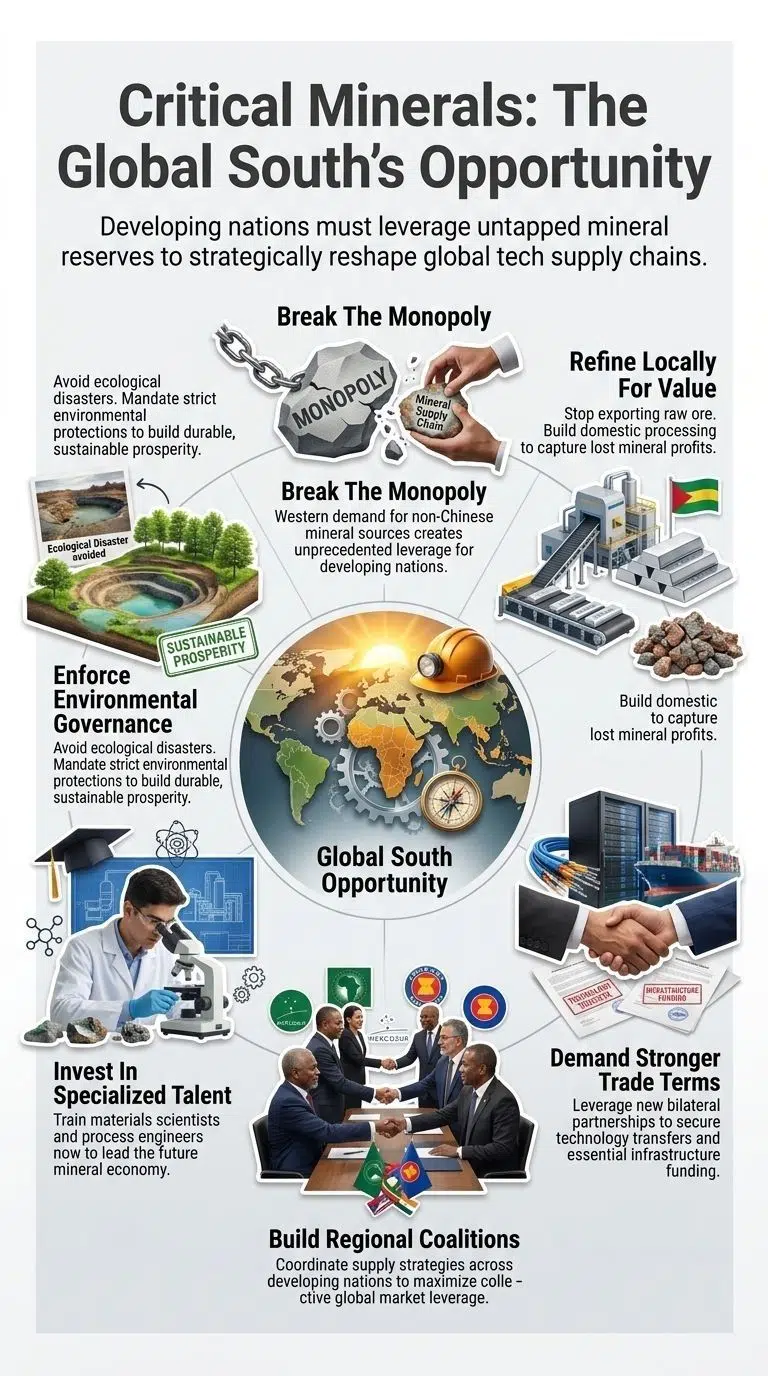
Move up the value chain Stop exporting raw ore. Invest in domestic processing capacity and capture the 80% of value currently extracted by Chinese refiners. Western governments are willing to co-finance this transition. |
02
Negotiate from a new strength The U.S., EU, and allies are signing bilateral mineral partnerships with producing nations. Now is the moment to extract concessions—technology transfer, infrastructure, and favorable terms. |
| 03
Build a regional coalition South and Southeast Asia combined represent an enormous demand for green tech. Coordinating procurement and supply strategy as a bloc creates leverage no individual nation can achieve alone. |
04
Invest in the next generation The new minerals economy requires materials scientists, process engineers, and environmental specialists. Nations that build this talent pipeline now will lead the industry in ten years. |
The Bangladesh Angle—And Why It Matters
Bangladesh stands at a particularly interesting intersection of these forces. As a nation with serious green energy ambitions, solar expansion, an emerging EV ecosystem, and a technology sector growing faster than most regional peers, Bangladesh is both a significant future consumer of critical mineral-dependent products and a nation with untapped geological potential that has barely been surveyed by modern standards.
More importantly, Bangladesh has demonstrated, through its garment industry, an ability to insert itself into global supply chains with remarkable speed when the conditions are right. The critical minerals economy offers a second such moment, not in raw mining, necessarily, but in processing, component manufacturing, and the assembly of green technology products that the whole world will need in increasing quantities over the next decade.
The window for this kind of strategic repositioning does not stay open indefinitely. But it is open right now.
| Bangladesh did not build the world’s second-largest garment industry by waiting for perfect conditions. It identified a global shift, moved quickly, and built expertise. The critical minerals economy is asking for the same instinct. |
A Note of Caution and a Call to Seriousness
Optimism, to be responsible, must be paired with honesty. The environmental and social costs of mineral extraction are real, and developing nations must not repeat the mistakes that China made in Inner Mongolia, sacrificing communities and ecosystems for short-term industrial gains. Any strategy for participating in the critical minerals economy must be built on strong environmental governance, genuine community benefit, and the kind of long-term planning that creates durable prosperity rather than a resource curse.
There is also the question of political will. The opportunities described here require governments to act strategically and coherently across trade policy, industrial policy, education, and diplomacy simultaneously. That is not easy. But it has been done before, and the nations that figure it out will find themselves in a structurally stronger position for the rest of this century.
Final Words
The critical minerals story is most often told as a story of danger: China’s chokehold, America’s scramble, Europe’s dependency. That framing is not wrong. But it is incomplete.
For the developing world, this is simultaneously a story of agency, of nations that have long been passive actors in global supply chains now holding something that great powers genuinely need, at a moment when those powers are willing to pay, partner, and negotiate in ways they never were before.
The new economy is being built. The question is not whether the developing world will be part of it. The question is whether we will show up as raw material exporters once again, or as architects of something more. I believe we can be the latter. But only if we choose to be.





















