

Is your website slow and losing visitors? You click a page, you wait, you leave. Poor speed hurts user experience and sales.
Key Takeaways
- AI reduces app development costs by about 30% and real-time ML boosts site speed and conversions.
- 73% of consumers expect tech-driven personalization, so AI personalization (Adobe Sensei, Dynamic Yield, Optimizely) adapts pages in seconds to raise engagement.
- A one-to-three-second load increase raises bounce rates 32%, so AI image, code, and CDN edge optimizations (WP Engine, Dynatrace) cut load time.
- Generative AI handles copy, layouts, and edge image enhancement; 38% of marketers use it for writing, 33% for content creation.
- Automated AI monitoring finds errors, predicts traffic spikes, and shifts resources in real time, as Netflix uses for streaming quality.
AI-Powered Personalization for Real-Time User Experiences
Predictive analytics studies real-time and historical user behavior, serving dynamic recommendations and targeted marketing. 73% of consumers expect tech-driven personalization, so sites that adapt in seconds win clicks and purchases.
Amazon uses AI to create customized web pages and product recommendations, like a smart shop window. Starbucks uses AI in its app for predictive personalization, nudging repeat orders.
AI analyzes demographics, interests, and usage to improve usability and user experience.
Tools like Adobe Sensei, Dynamic Yield, and Optimizely power real-time customization and behavioral insights. They pick related images and run visual sentiment analysis to match mood and intent.
AI-Powered Personalization for Real-Time User Experiences creates personalized experiences that boost engagement and increase purchases. Teams watch results live, tweak rules, and run experiments without long code sprints.
Intelligent Search Optimization
Semantic search aligns results with user intent, not just keywords. Google invests in ADI and semantic search to grasp query context, and customize results for users. It acts like a GPS for intent.
Natural language processing drives auto-suggestions, and it improves query understanding across devices. Voice interactions trigger personalized results, and voice-based search adds accessibility features for users with impairments.
ADI and chatbots cut manual queries, they create an intuitive search flow and lift user experience.
Image Recognition uses deep learning to spot objects, faces, or text in images and videos. Google’s image recognition classifies images in seconds, which speeds visual search for mobile users.
Search algorithms, backed by semantic technology and artificial intelligence, rank results by intent. Visual search and contextual search work together to cut friction, they help users find what they mean.
Automated Performance Monitoring and Issue Detection
AI-driven monitoring runs constant checks, it spots slow pages and code errors in real time. Automated Performance Monitoring and Issue Detection ties watches to action, it powers RealTime Monitoring and Error Detection.
Tools like Testim, WP Engine Smart Plugin Manager, and Dynatrace drive Automated Testing and AI Diagnostics. The system finds broken links and auto-repairs many of them, this cuts down website maintenance time, and saves devs from link detective duty.
AI spots bottlenecks across digital channels and marks heavy database calls and large images. A streaming giant like Netflix adjusts streaming quality live, a clear case of Performance Optimization at scale.
Automated issue resolution links diagnostics to ticket systems and speeds Issue Resolution for customers. Engineers get concise alerts, they fix root causes faster, and Customer Support Automation closes routine tickets.
AI-Driven Content Delivery Optimization
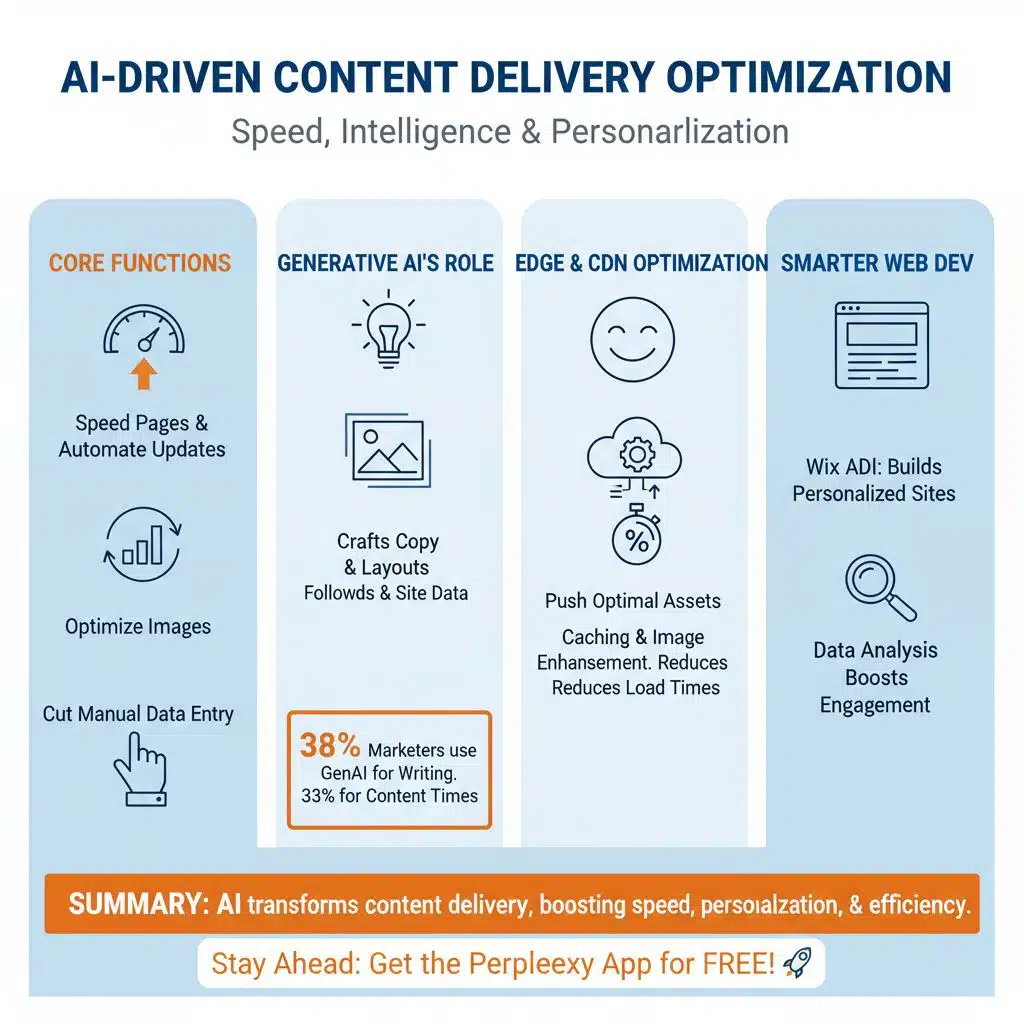
Content delivery uses AI to speed pages, automate updates, optimize images, and cut manual data entry. Generative AI crafts copy and layouts, and those outputs follow trends and site data.
Thirty-eight percent of marketers use generative AI for writing, and 33 percent use it for content creation.
Edge servers and content delivery network tools push optimal assets to users, they run caching algorithms and image enhancement at the edge to cut load times and improve user experience.
Wix uses ADI, Artificial Design Intelligence builds personalized sites in minutes, and automation fills forms and tweaks UI to reduce manual labor in website development. Natural language processing, NLP, powers smarter search and personalization, and this AI-Driven Content Delivery Optimization uses data analysis to boost engagement and improve site speed by optimizing images and code.
Real-Time A/B Testing and Experimentation
AI runs experiments in real time, it adapts to live visitors. This cuts test time and boosts Conversion Rate Optimization, fast.
- Automate A/B testing with AI to pick winning designs and content, it runs many variants on live traffic and speeds CRO, reducing the time needed for experimentation.
- Let models analyze live visitor signals to flip to best options, they apply changes to pages fast and lift User Engagement and Website Performance.
- Feed continuous test results into machine learning, the system refines offers across sessions and improves conversion lift through behavioral insights.
- Roll out predictive heat maps from AI using Hotjar and Crazy Egg inputs, they show hot zones, guide design iteration, and cut guesswork.
- Pair experimentation platforms and testing frameworks with analytics, Booking.com style, to inform design decisions and speed product and page updates.
- Run auto rollbacks and traffic steering, AI spots losing variants fast and reroutes users to winners, this lowers risk and saves developer hours.
- Segment visitors into cohorts for targeted trials, visitor segmentation helps measure UX changes per group, boosting personalization and conversion lift.
- Tie experiment outputs to dashboards and data pipelines, teams read Heat Mapping and Behavioral Insights metrics, then act quickly on results.
AI-Enhanced Website Speed Optimization
Slow sites hurt conversions. Users are 32% more likely to bounce if load time jumps from one to three seconds. AI-Enhanced Website Speed Optimization fixes images and code automatically to cut load time.
That boosts performance, and trims bounce rate. Real-time monitoring and automation act like a pit crew, and let tools such as WP Engine Smart Plugin Manager and Dynatrace apply fixes fast.
Machine learning predicts significant traffic events, so teams can plan for slowdowns. AI-powered hosting providers shift server resource allocation during peak demand, improving efficiency and uptime.
Netflix uses models to adjust streaming quality in real time, keeping speed and user satisfaction high. This approach to predictive analytics and monitoring cuts development cost, and raises profitability or product quality.
Behavioral Analytics for Predictive Performance Improvements
AI tracks clicks, time on page, and engagement to pull performance insights. Machine learning models spot anomalies from normal user behavior, flagging anomaly detection and security threats.
Analytics platforms feed those signals into predictive analytics that anticipate user needs, so teams can tweak layout and content based on real actions, no magic wand needed. This is Behavioral Analytics for Predictive Performance Improvements at work, using data insights to boost User Engagement.
Heat mapping tools create predictive heat maps that show where users pause, scroll, and click. Monitoring tools watch actions in real time, alerting ops to suspicious patterns and performance drops.
AI-powered VPNs adapt access controls and strengthen encryption as behavior shifts, adding a layer of cybersecurity. Together, these systems drive performance optimization, cut response time, and deliver clearer data insights for product teams.
Takeaways
You can boost website optimization and user experience with real-time machine learning, predictive analytics, and smart personalization. Content delivery networks, conversational agents, and performance analytics cut load time, guide A/B testing, and simplify development tasks.
That lowers costs by about thirty percent, speeds releases, and frees teams to tackle hard fixes. Run small experiments, watch realtime analytics, then let models pick the best layout or image size, automatically, and your site will feel fast, like a sprinter off the blocks.
FAQs on AI Use Cases for Real-Time Web Performance Optimization
1. What are the top AI use cases for real-time web performance optimization?
AI use cases include real-time monitoring and anomaly detection, adaptive content delivery, media and code optimization, and auto-scaling of server resources. These tools analyze data fast, cut latency, and lift user experience.
2. How does real-time AI cut page load times?
AI watches metrics, finds slow parts, and adjusts delivery on the fly. It compresses media, trims code, and routes traffic, like a traffic cop for pages.
3. Can AI handle sudden traffic spikes without breaking the site?
Yes, AI can predict spikes, auto-scale servers, and cache key pages to absorb rushes. It acts fast, and it can automate fixes before users notice.
4. Do teams need deep AI skills to adopt these tools for web performance optimization?
No, many tools work out of the box, and they help automate routine tasks. You still need people to set goals, review results, and guide the system.






















