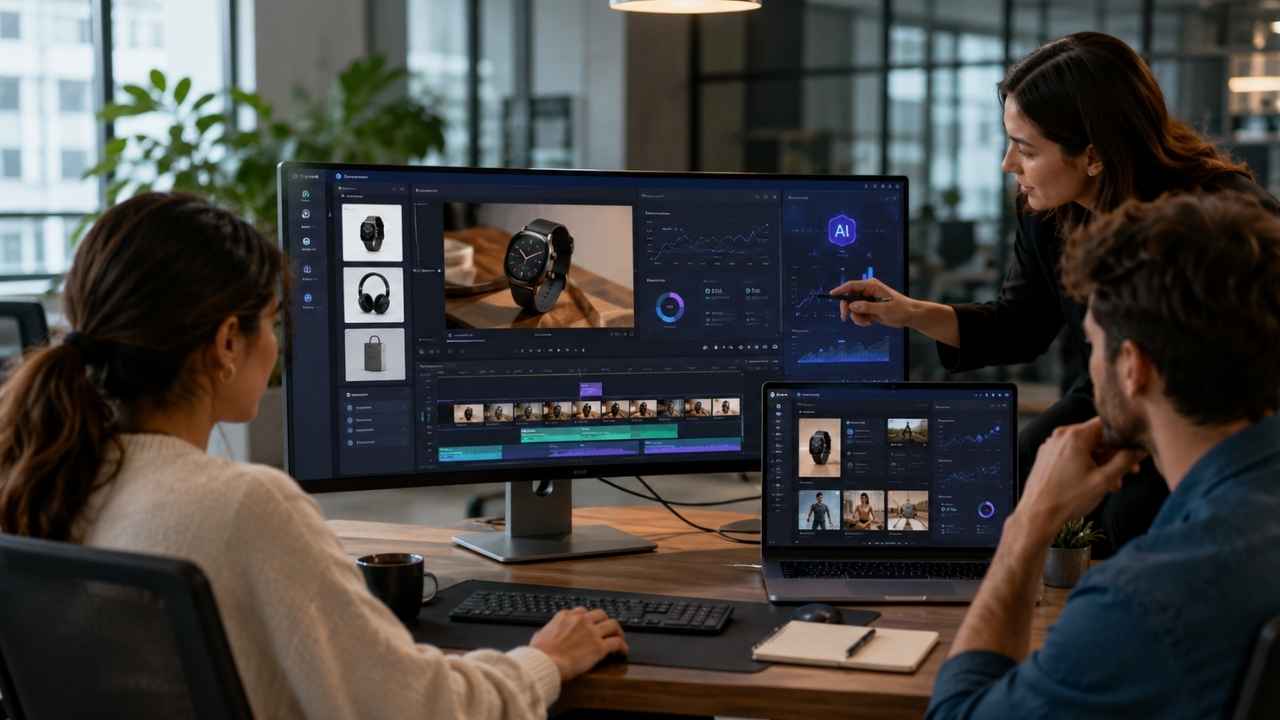
An AI marketing studio sounds like a solved problem until you realise that most workflows still involve five to eight separate tools, three browser tabs for analytics, and a spreadsheet that nobody updates. I have worked inside this fragmented setup for years, and the real cost is not money. It is context-switching, lost insights, and creative decisions made without data.
The idea behind an AI marketing studio is simple: put video creation, image generation, performance analytics, and campaign reporting inside one workspace so that creative output and business results are connected. But in practice, most tools only solve one piece. You generate a video here, check analytics there, build a report somewhere else, and hope the insights travel between systems.
In this guide, I am sharing my practical workflow for using an AI marketing studio that actually connects creation to performance — how I plan content, generate videos across multiple AI models, track e-commerce data from platforms like TikTok and Amazon, and produce shareable reports without leaving a single workspace. The specific tool I have been testing is Topview AI’s Marketing Studio, which combines multi-model video generation with cross-platform analytics and a modular skills system. But the workflow principles apply broadly.
At Editorialge Media LLC, we work across media, SaaS, e-learning, and AI-powered creative tools, so every workflow has to survive real production pressure. That is the lens I apply here.
Why Most AI Video Workflows Break At The Analytics Step
The typical AI marketing workflow looks like this:
- Create video content using an AI tool
- Export and upload to social platforms or ad accounts
- Wait for results
- Open a separate analytics dashboard
- Try to figure out which video drove which results
- Manually compile a report
- Make creative decisions based on incomplete data
- Repeat
The problem is step 4 through 7. The connection between “what I created” and “what happened commercially” is broken. When your video creation tool and your analytics dashboard do not talk to each other, every optimisation decision requires manual reconstruction.
I have seen teams spend more time building performance reports than creating new content. That is a workflow failure, not a resource problem.
| Traditional Workflow | Integrated Studio Workflow |
| Video creation in one tool | Video creation inside the same workspace |
| Analytics in separate dashboards | Platform data pulled into the creative environment |
| Reports built manually | HTML reports auto-generated |
| Creative decisions based on memory | Creative decisions connected to live data |
| New skills require new tools | New capabilities install modularly |
| A/B testing requires manual tracking | Variations tested and measured in one place |
What An AI Marketing Studio Should Actually Do
Based on my experience, a true AI marketing studio needs to solve these four problems simultaneously:
Problem 1: Content Creation At Volume
A single product might need 20-30 video variations for proper A/B testing across platforms. Traditional production cannot support that volume. The studio needs to offer multiple AI models so you can match the right generation approach to the right content type.
Problem 2: Platform-Native Formatting
Different platforms need different formats, aspect ratios, pacing, and styles. Creating once and cropping is not enough. The studio should let you generate platform-ready content from the start.
Problem 3: Performance Visibility
After content goes live, you need to know what is actually driving revenue — not just views or likes, but real sales, real conversions, real revenue. The studio should integrate with your selling platforms.
Problem 4: Actionable Reporting
Data is useless if it lives in a dashboard nobody checks. The studio should produce shareable reports that make the insights portable — to your team, your clients, your investors, or your own future reference.
Marketing Studio addresses all four of these. Here is how I use it in practice.
My Practical Workflow Inside Marketing Studio
Step 1: Start With The Commercial Question, Not The Creative Brief
Before I open any video generation tool, I ask one question: what am I trying to sell, and where am I trying to sell it?
This sounds basic, but it prevents the most common workflow mistake: creating beautiful content that does not connect to any measurable outcome.
For example:
| Scenario | Platform | Content Goal | Success Metric |
| New product launch on Amazon | Amazon + TikTok | Product demo videos | Sales velocity, conversion rate |
| Seasonal promotion | Instagram + TikTok | UGC-style ads | ROAS, click-through rate |
| Brand awareness campaign | YouTube + Instagram | Cinematic brand story | View-through rate, saves |
| TikTok Shop product page | TikTok | Short product explainers | Add-to-cart rate |
| Cross-border expansion | Multiple | Multilingual product videos | Revenue by market |
Once the commercial question is clear, the creative decisions become much easier.
Step 2: Generate Video Content Using Multiple AI Models
This is where Marketing Studio’s multi-model approach becomes practically useful. Different AI video models have different strengths. A model that excels at cinematic scenes might produce awkward results for a product close-up. A model great at talking heads might not handle abstract brand storytelling well.
Marketing Studio aggregates over 10 AI video models, including:
- Seedance 2.5 — Strong for fluid motion, product showcase, and realistic movement
- Sora 2 — Good for cinematic storytelling and complex scene composition
- Kling 3 — Effective for character-driven content and consistent subjects
- Veo 3.1 — Solid for photorealistic environments and commercial aesthetics
- Vidu Q3 — Useful for quick generation and iterative drafting
In my workflow, I usually start with 2-3 models for the same prompt and compare outputs before committing to a direction. This comparative approach saves time because you are evaluating real results, not guessing which model will work best.
Beyond video, Marketing Studio also supports:
- AI image generation — text-to-image across multiple models (GPT Image 2, Seedream 5.0, and others)
- AI talking avatars — upload a photo and script to create presenter-style videos with lip-sync
- Voice synthesis and cloning — 100+ voices, multi-language TTS, voice cloning from a single sample
- Background removal and product shots — useful for clean e-commerce visuals
All of these live in the same workspace, which means I do not need to export from one tool and import into another.
Step 3: Build Variations For A/B Testing
One video is never enough. For any serious marketing campaign, I create multiple variations:
- Hook variations — Different opening 2-3 seconds with different angles
- CTA variations — Different endings with different calls to action
- Format variations — Same content adapted for 9:16, 4:5, 1:1, 16:9
- Style variations — Same message delivered via UGC avatar, cinematic product shot, and animated explainer
- Language variations — Same video dubbed or regenerated in different languages using AI voice
Marketing Studio makes this fast because the generation, editing, and organisation happen on the same canvas. I keep all variations on a shared Board workspace where my team can review, comment, and select winners before publishing.
Step 4: Connect E-Commerce Analytics
This is the step that most AI creative tools skip entirely, and it is the step that matters most for marketing ROI.
Marketing Studio integrates directly with:
- TikTok — Ad performance, TikTok Shop data, audience insights
- Amazon — Sales data, product performance, BSR tracking
- Shopify — Store analytics, conversion funnels, revenue attribution
Once connected, I can see which specific video creative is driving which commercial outcomes. Not “this campaign performed well,” but “Version B of the product demo generated 3.2x more add-to-carts than Version A on TikTok Shop.”
This feedback loop is what transforms AI video creation from a content production task into a commercial optimisation process.
| Without Analytics Integration | With Analytics Integration |
| “We posted 12 videos this week” | “Video #7 drove 68% of this week’s TikTok Shop revenue” |
| “Engagement is up” | “UGC-style avatars convert 2.4x better than cinematic for this product” |
| “We need more content” | “We need more variations of the hook style from Video #3” |
| “The campaign did okay” | “ROAS improved 41% after switching to faster-paced intros” |
The difference is specificity. Specific insights lead to better creative decisions.
Step 5: Use The Self-Installing Skills System
This is one of the features I did not expect to use heavily, but it has become central to my workflow.
Marketing Studio has a modular skills system that lets the platform install new analytical and creative capabilities on the fly. Instead of waiting for a feature update or subscribing to another tool, you can extend the platform’s capabilities based on what your current project needs.
In practical terms, this means:
- If I need a specific type of competitor analysis, the platform can install that skill
- If a new data visualisation approach would help a client report, it gets added
- If my workflow requires a specialised content format, the skill adapts
Think of it less like a fixed software product and more like an adaptable workspace that learns what you need. For someone managing campaigns across multiple product categories or markets, this flexibility matters because no two campaigns have identical analytical needs.
Step 6: Generate HTML Reports
This is the step where most workflows collapse into screenshot-pasting and slide-deck building. Marketing Studio automates this by generating professional HTML reports directly from the campaign data.
These reports include:
- Performance visualisations and trend charts
- Platform-by-platform breakdowns
- Creative asset performance rankings
- Audience insights and demographic data
- Period-over-period comparisons
- Actionable recommendations
The reports are shareable via link, which means I can send a live report to a client, a team member, or a stakeholder without exporting PDFs or building slides.
Why this matters practically:
| Report Method | Time Required | Update Frequency | Shareability |
| Manual spreadsheet + slides | 4-8 hours | Weekly at best | Attachment-based |
| Screenshot-based reports | 2-3 hours | Ad hoc | Poor formatting |
| Dashboard-only | 0 hours | Real-time | Requires login access |
| Auto-generated HTML reports | Minutes | On-demand | Link-based, portable |
The auto-generated HTML approach hits the practical sweet spot: it is fast to produce, professional in appearance, and easy to share with people who do not have access to your analytics dashboards.
Use Cases I Have Tested
E-Commerce Product Launch
For a product launch on Amazon and TikTok Shop simultaneously, I used Marketing Studio to:
- Generate 25 video variations across 3 AI models
- Create UGC-style talking avatar testimonials in English and Spanish
- Produce product demonstration videos showing features in use
- Track sales performance across both platforms in real-time
- Identify the top 3 performing creatives within the first 72 hours
- Scale budget toward winning variations
- Generate a week-one performance report for the brand team
The entire workflow — from first video generation to final report — happened inside one workspace. No exports, no imports, no manual data reconciliation.
Social Media Content Calendar
For ongoing social media management, I use the Board Canvas feature to organise content by week, platform, and campaign. All generated assets live on the board, making it easy to:
- Drag and drop content into a publishing schedule
- Review variations side-by-side
- Share the board with team members for approval
- Track which published content connects to which performance data
Multilingual Campaign
For a brand selling across English, French, and Portuguese markets, I used the voice cloning and multilingual TTS features to produce localised versions of the same campaign videos. The AI dubbing preserved the original pacing and emotional tone while adapting language, which saved approximately 80% of the cost compared to traditional localisation workflows.
Common Mistakes When Using An AI Marketing Studio
Mistake 1: Treating It As Just A Video Generator
If you only use Marketing Studio for content creation, you are using 30% of the platform. The real value is in the analytics integration and reporting cycle.
Fix: Connect your e-commerce accounts on day one. Let data inform your creative decisions from the start.
Mistake 2: Generating One Version Of Everything
A single video cannot tell you what works. You need variations to test hooks, CTAs, formats, and styles.
Fix: Generate at least 3-5 variations for any piece of content you plan to advertise. Use the A/B testing data to guide future creation.
Mistake 3: Ignoring The Skills System
Many users never explore the modular skills system because the default features already feel comprehensive. But the skills system is where you find workflow-specific advantages.
Fix: When you encounter a workflow gap, check whether a skill can address it before looking for an external tool.
Mistake 4: Building Reports Manually
If you are still copy-pasting screenshots into slide decks, you are spending hours on work that the platform can automate in minutes.
Fix: Use the HTML report generation for recurring reports. Save manual analysis for strategic interpretation.
Mistake 5: Creating Content Without A Commercial Goal
Beautiful content that does not connect to a business outcome is a hobby, not a marketing strategy.
Fix: Define the commercial question before opening the creative workspace.
My Practical AI Marketing Studio Checklist
Before launching any campaign through an AI marketing studio, I run through this checklist:
| Checkpoint | Done? |
| Commercial goal defined before creative work begins | ☐ |
| Target platform and format selected first | ☐ |
| Multiple AI models tested for the content type | ☐ |
| At least 3-5 creative variations generated | ☐ |
| Videos formatted correctly for each platform (9:16, 4:5, 16:9) | ☐ |
| E-commerce accounts connected for performance tracking | ☐ |
| Captions and voiceover reviewed for accuracy | ☐ |
| AI avatar lip-sync checked if used | ☐ |
| Team review completed on shared Board workspace | ☐ |
| Campaign launched with variation tracking enabled | ☐ |
| Performance data monitored within first 48-72 hours | ☐ |
| Winning variations identified and scaled | ☐ |
| HTML performance report generated and shared | ☐ |
| Learnings documented for next campaign cycle | ☐ |
This checklist looks long, but once the workflow is established inside Marketing Studio, most of these steps happen naturally within the same workspace.
How This Compares To A Fragmented Tool Stack
To illustrate the practical difference, here is what the same workflow looks like with separate tools versus an integrated marketing studio:
| Task | Fragmented Stack | Integrated Studio |
| Video creation | Runway, Pika, or standalone generators | Built-in multi-model generation |
| Image creation | Midjourney, DALL-E, or separate tools | Built-in multi-model image suite |
| Avatar videos | Separate avatar platform | Built-in talking avatar creation |
| Voice and TTS | ElevenLabs or separate TTS tool | Built-in voice synthesis and cloning |
| Asset organisation | Google Drive, Dropbox, or Notion | Built-in Board Canvas |
| TikTok analytics | TikTok Business Centre | Integrated within workspace |
| Amazon analytics | Amazon Seller Central | Integrated within workspace |
| Reporting | Google Slides, PowerPoint, or manual | Auto-generated HTML reports |
| New capabilities | Find, evaluate, and subscribe to new tools | Self-installing skills system |
| Team collaboration | Slack, email, shared drives | Built-in shared workspace |
The fragmented stack can work, but the overhead of moving between tools, reconciling data, and maintaining multiple subscriptions adds up. An integrated studio reduces that friction.
Who Benefits Most From An AI Marketing Studio
Based on my experience, these are the profiles that benefit most:
- E-commerce sellers who need to produce video content at volume and directly connect creative performance to sales data across Amazon, TikTok Shop, or Shopify.
- Marketing agencies managing multiple clients who need a centralised workspace for creation, analytics, and reporting without building custom data pipelines.
- DTC brands that operate lean marketing teams and cannot afford separate subscriptions for video creation, image generation, analytics, and reporting.
- Cross-border sellers who need multilingual content production with automated dubbing and localisation alongside market-specific analytics.
- Content creators who want to understand the commercial impact of their content beyond vanity metrics like views and likes.
Final Thoughts: The Workflow Matters More Than The Tool
The biggest lesson I have learned working with AI marketing studios is that the tool does not fix a broken workflow. If you do not have clear commercial goals, platform-specific formatting habits, a testing discipline, and a reporting cycle, no tool will make your marketing effective.
But when the workflow is right, an integrated studio like Marketing Studio removes an enormous amount of friction. The time I used to spend exporting, importing, reconciling, screenshot-pasting, and tab-switching now goes into creative strategy and data interpretation — which is where the actual value lives.
AI makes content creation faster. Analytics makes it smarter. The studio approach makes the connection between them practical.
That is the real point.