
Artificial Intelligence (AI) is revolutionizing industries worldwide, and journalism is no exception. AI in journalism is transforming how news is reported, analyzed, and consumed.
From automated content generation to AI-powered fact-checking and personalized news recommendations, the impact of AI on journalism is profound. But while AI brings efficiency and innovation, it also raises ethical and practical concerns.
This guide explores ten essential things you should know about AI in journalism, from its applications to its challenges and future prospects. Whether you’re a journalist, media professional, or an avid news consumer, this article provides valuable insights into the evolving landscape of AI-driven journalism.
AI is not just an assistant but a disruptive force shaping the future of news media, making it imperative to understand its role and impact.
1. How AI is Transforming Journalism
AI in journalism has evolved rapidly over the past decade. Newsrooms have started leveraging AI to streamline operations, improve efficiency, and enhance content distribution. Some notable transformations include:
- Automated Reporting: AI-driven software can generate news reports on topics such as sports scores, financial updates, and weather reports, significantly reducing turnaround time.
- Content Curation: AI tools help journalists sift through vast amounts of data, identifying relevant stories and trends, ensuring audiences receive timely and relevant news.
- Speech-to-Text Transcription: AI-powered tools convert interviews and speeches into written text, saving journalists significant time and enabling faster content production.
Key AI Tools Used in Journalism
| Tool | Function |
| Wordsmith | AI-driven news writing |
| Heliograf (Washington Post) | Automated article generation |
| Trint | AI-powered transcription |
| NewsGuard | AI-based fact-checking |
Real-World Applications of AI in Journalism
AI is already making an impact in media companies worldwide. Some leading examples include:
- The Associated Press (AP): Uses AI to generate earnings reports and minor league sports coverage, allowing human journalists to focus on investigative work.
- Bloomberg: Employs its AI system, Cyborg, to assist in financial reporting by analyzing stock market fluctuations.
- The Washington Post: Utilizes AI-driven content generation tools to cover local elections, sports events, and breaking news more efficiently.
2. AI and Automated News Writing

AI-powered writing tools, such as OpenAI’s GPT models and automated journalism platforms like Wordsmith and Heliograf, use Natural Language Processing (NLP) to create written content. Here’s how they work:
- Data Input: The AI collects and analyzes structured data, such as financial reports or sports scores.
- Pattern Recognition: It identifies trends and insights from the dataset, recognizing recurring patterns and relationships.
- Content Generation: Using predefined templates and deep learning models, AI constructs a coherent article with readable language and logical flow.
Comparison of Human vs AI-Generated News Writing
| Feature | Human Journalist | AI-Generated Content |
| Creativity | High | Limited |
| Speed | Moderate | Extremely fast |
| Accuracy | High (with verification) | Requires oversight |
| Cost | Higher | Lower |
Limitations of AI-Generated Content
Despite its advantages, AI-generated journalism has limitations:
- Lack of Creativity: AI can report facts but struggles with investigative storytelling and opinion pieces, which require deeper analysis.
- Accuracy Concerns: AI may misinterpret data, leading to misinformation if not carefully monitored.
- Ethical Issues: Automated content raises concerns about transparency and bias in news reporting, potentially impacting media trustworthiness.
3. AI’s Role in Fact-Checking and Misinformation Detection
AI in journalism plays a crucial role in verifying facts and detecting misinformation. AI-powered tools like Google’s Fact Check Explorer and Full Fact use machine learning to:
- Cross-check sources against trusted databases.
- Identify misleading or manipulated images using AI-based forensic analysis.
- Detect deepfake videos and AI-generated audio manipulations.
Top AI Fact-Checking Tools
| Tool | Function |
| Fact Check Explorer | Google’s AI-based misinformation detector |
| Full Fact | AI-driven claim verification |
| Snopes | AI-assisted fake news debunking |
Challenges in AI-Driven Fact-Checking
While AI enhances fact-checking, challenges remain:
- Context Understanding: AI struggles to grasp nuances, satire, and regional dialects, which can lead to misinterpretation.
- Bias in Training Data: AI systems can inherit biases from datasets, leading to unreliable fact-checking.
- Over-Reliance on Automation: Human oversight is necessary to verify AI’s conclusions and ensure accountability in reporting.
6. Ethical Considerations in AI Journalism
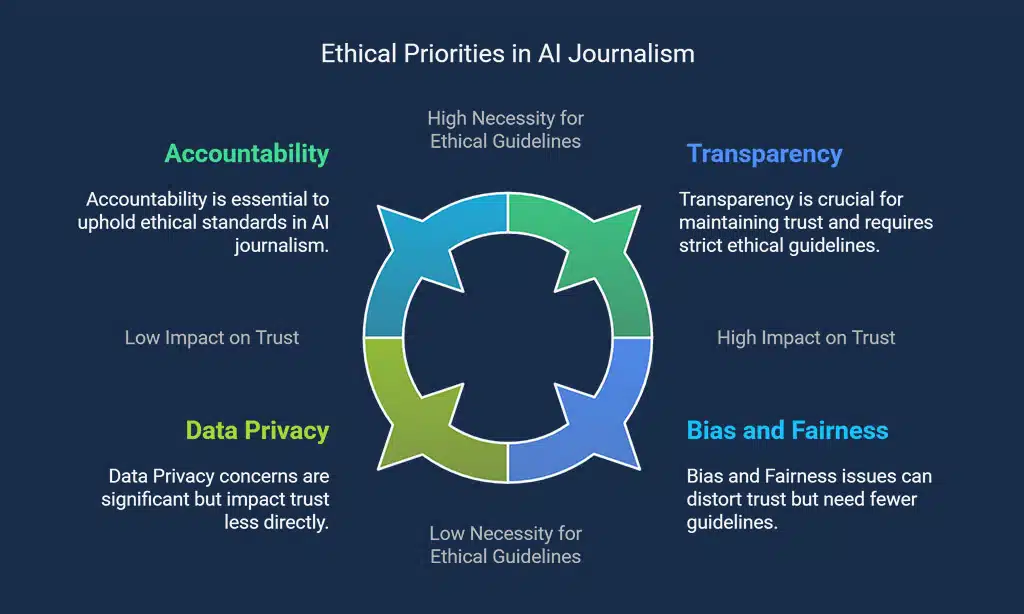
AI in journalism introduces several ethical concerns that require careful management to maintain trust and credibility in the media industry. As AI-generated content becomes more prevalent, ensuring ethical standards is essential to prevent misinformation and bias. The following are some of the most pressing ethical considerations:
- Transparency: AI-generated content should be clearly labeled to ensure readers are aware of non-human contributions. Transparency about AI’s role in content creation helps maintain credibility and prevents misleading the audience.
- Bias and Fairness: AI models may reflect and reinforce existing biases present in training data, leading to skewed reporting. Addressing bias in AI algorithms is critical to ensuring fair and impartial journalism.
- Accountability: Establishing who is responsible for AI-driven errors in journalism is crucial. AI should complement human oversight rather than replace it, ensuring ethical responsibility remains with publishers and editors.
- Data Privacy: AI tools rely on vast amounts of data, which raises concerns about user privacy. Ethical AI journalism should prioritize the protection of user information and adhere to data privacy laws.
- Deepfake and Misinformation Risks: AI-generated deepfake videos and manipulated content pose a significant threat to journalism. Ethical guidelines must be implemented to prevent AI from being misused for deceptive purposes.
Examples of AI Ethics in Journalism
| Organization | Ethical Approach |
| Reuters | Implements AI transparency reports to disclose AI involvement in news production |
| BBC | Uses AI to detect deepfake videos and prevent misinformation |
| New York Times | Explores ethical AI editorial policies to ensure fair reporting |
| Associated Press | Implements AI-driven fact-checking tools to verify news accuracy |
7. AI and Investigative Journalism
AI has become an indispensable tool in investigative journalism, enabling reporters to uncover hidden patterns, analyze extensive datasets, and enhance fact-checking processes. AI-driven investigative tools help journalists tackle complex issues with greater efficiency.
- Analyzing Leaked Documents: AI assists in scanning and analyzing large volumes of leaked documents, making it easier to identify critical information in investigations like the Panama Papers.
- Tracking Financial Fraud: AI can detect anomalies in financial transactions, helping journalists uncover corruption and illicit activities.
- Identifying Misinformation Networks: AI-driven analytics tools monitor social media and digital platforms to track the spread of fake news and coordinated misinformation campaigns.
- Automating Public Record Searches: AI enhances journalists’ ability to sift through vast public records and legal documents to uncover crucial case details.
Investigative Journalism AI Tools
| Tool | Use Case |
| Palantir | Analyzes large datasets for investigative reporting |
| CrowdTangle | Tracks social media misinformation and identifies disinformation trends |
| IBM Watson | Assists in financial investigations and fraud detection |
| Google Pinpoint | Helps journalists analyze thousands of documents quickly |
The future of investigative journalism will see AI and human expertise working together to uncover critical stories, ensuring that the truth prevails in an era of data-driven journalism.
8. Job Opportunities and Threats
AI in journalism is creating new career opportunities while simultaneously disrupting traditional roles. As AI technology continues to evolve, new job roles are emerging to complement AI-driven workflows, ensuring responsible use and ethical implementation. However, the increasing reliance on AI tools also presents risks, including job displacement and a shift in skill requirements for media professionals.
Emerging Roles
With AI playing an increasingly important role in news production, new specialized positions are arising:
- AI Content Editors – Professionals who refine AI-generated content to ensure clarity, accuracy, and readability.
- AI Data Analysts – Experts who analyze large datasets to extract meaningful insights for investigative journalism.
- Ethics Consultants for AI Journalism – Specialists who ensure AI applications in journalism adhere to ethical guidelines and prevent misinformation.
Comparison of Traditional vs AI-Driven Journalism Jobs
| Role | Traditional Journalism | AI-Driven Journalism |
| Reporters | On-site news coverage | AI-assisted news summaries |
| Editors | Manual fact-checking | AI-aided content refinement |
| Investigative Journalists | Deep research & interviews | AI-assisted data analysis |
| Fact-Checkers | Manual verification | AI-powered misinformation detection |
Potential Threats
While AI is creating new job opportunities, it is also disrupting the journalism workforce:
- Reduction of Entry-Level Journalism Jobs – Automated content generation tools may replace junior writers and reporters.
- Over-Reliance on AI for Content Creation – Media houses may prioritize AI-driven efficiency over human insight and creativity.
- Skill Shift Requirements – Journalists must adapt to new technologies, requiring upskilling in AI literacy and data analytics.
9. Challenges of AI Integration
Integrating AI into journalism is not without its challenges. From ethical concerns to financial constraints, the transition to AI-driven journalism requires careful planning, oversight, and regulatory frameworks.
Key Challenges
- Cost of AI Implementation – Developing and maintaining AI-powered journalism tools requires significant investment.
- Data Privacy Concerns – AI systems rely on vast amounts of data, raising concerns about user privacy and data security.
- Legal and Compliance Issues – AI-generated content blurs legal responsibility in cases of misinformation or defamation.
Key Challenges in AI Integration
| Challenge | Impact |
| High Implementation Costs | Limits AI adoption in smaller media outlets |
| Ethical Bias in AI Algorithms | Can influence news credibility and audience trust |
| Regulatory Uncertainty | Lack of clear legal frameworks for AI-generated content |
| Workforce Disruptions | May lead to layoffs and industry restructuring |
10. Future Trends in AI Journalism
As AI technology continues to evolve, journalism is likely to witness further innovation and transformation. Future trends indicate increased collaboration between AI and human journalists, improved news verification techniques, and greater use of AI in multimedia storytelling.
What’s Next?
- Increased AI-Human Collaboration – AI will assist rather than replace journalists, streamlining research and fact-checking processes.
- AI-Powered Video Journalism – AI will generate video news reports, reducing production costs and enabling real-time updates.
- Enhanced Real-Time News Analytics – AI-driven analytics will help news organizations track breaking stories and audience engagement more effectively.
- Immersive Storytelling with AI – AI will enhance virtual reality (VR) and augmented reality (AR) experiences for immersive news consumption.
Upcoming AI Innovations in Journalism
| Trend | Expected Impact |
| AI-Assisted Investigative Journalism | Faster data analysis for in-depth reporting |
| AI-Generated Visual Content | Automated video and image creation for news stories |
| Blockchain-Based News Verification | Ensures authenticity and prevents misinformation |
| AI-Powered Real-Time Translations | Expands global reach of journalism |
Takeaways
AI in journalism is evolving rapidly, bringing new opportunities and challenges. The future lies in a balanced approach where AI supports journalists without replacing the human touch essential for ethical and investigative reporting.
Ensuring transparency, accountability, and continued ethical oversight will be crucial in shaping the next era of AI-driven journalism.