Choosing the right way to bill your clients is not just about covering your costs; it is about building a foundation for sustainable growth. In 2026, the landscape has shifted significantly as AI and automation change how we deliver work. Many firms are finding that old-school methods are no longer enough to keep up with rising overhead and client expectations for high ROI. If you want to scale effectively, you need to understand the various agency pricing models available and how they align with your specific goals.
Choosing the right structure helps you avoid burnout and ensures you are actually getting paid for the value you bring to the table. Whether you are a small creative shop or a large-scale digital firm, the strategy you pick will dictate your profit margins and your relationship with your clients.
| Feature | Hourly Rate | Project-Based | Monthly Retainer | Value-Based |
| Revenue Predictability | Low | Medium | High | Variable |
| Ease of Sales | High | High | Medium | Low |
| Scalability | Low | Medium | High | Very High |
| Client Risk | High | Low | Medium | Low |
1. The Hourly Rate Model
Charging by the hour remains one of the most common agency pricing models, especially for teams just starting out. It is a simple “time for money” trade where you set a fixed rate for every sixty minutes of work performed.
Best for: New agencies, consultants, and projects with a very loose or undefined scope.
Why We Chose It: It is incredibly transparent and easy for a client to understand exactly what they are paying for.
Things to consider: You are essentially punished for being fast and efficient, which limits your long-term growth.
How Hourly Billing Works in 2026
In the current market, hourly rates typically range from $100 to $250 for specialized experts. While it feels safe, this model creates a “ceiling” on your income because there are only so many billable hours in a day. It also tends to lead to clients micromanaging your time sheets instead of looking at the results you produce.
| Factor | Description |
| Average Rate | $100–$250 per hour (Expert level) |
| Tracking | Requires strict time-tracking software for accuracy |
| Client Benefit | Low commitment and pay-as-you-go flexibility |
| Agency Risk | Revenue stops the moment the work stops |
2. Project-Based Fixed Pricing
This strategy involves giving the client one flat fee for a specific deliverable with a clear beginning and end. It is a staple for creative work where the goal is a finished product rather than ongoing management.
Best for: Website redesigns, branding packages, and one-off audits.
Why We Chose It: It provides a “guaranteed” cost for the client, which makes budget approval much faster.
Things to consider: If you underestimate how long a task takes, your hourly profit can drop below minimum wage.
The Reality of Fixed Fees
A project-based approach allows you to focus on the quality of the final deliverable. However, “scope creep” is the biggest enemy here. Without a solid contract that defines exactly what is included, you might find yourself doing ten rounds of revisions for free. In 2026, standard website projects often range from $5,000 to $50,000 depending on complexity.
| Project Type | Typical Price Range |
| SEO Audit | $1,500 – $5,000 |
| Brand Identity | $10,000 – $30,000 |
| Custom Website | $20,000 – $50,000+ |
| Strategy Deck | $5,000 – $15,000 |
3. Monthly Retainer Agreements
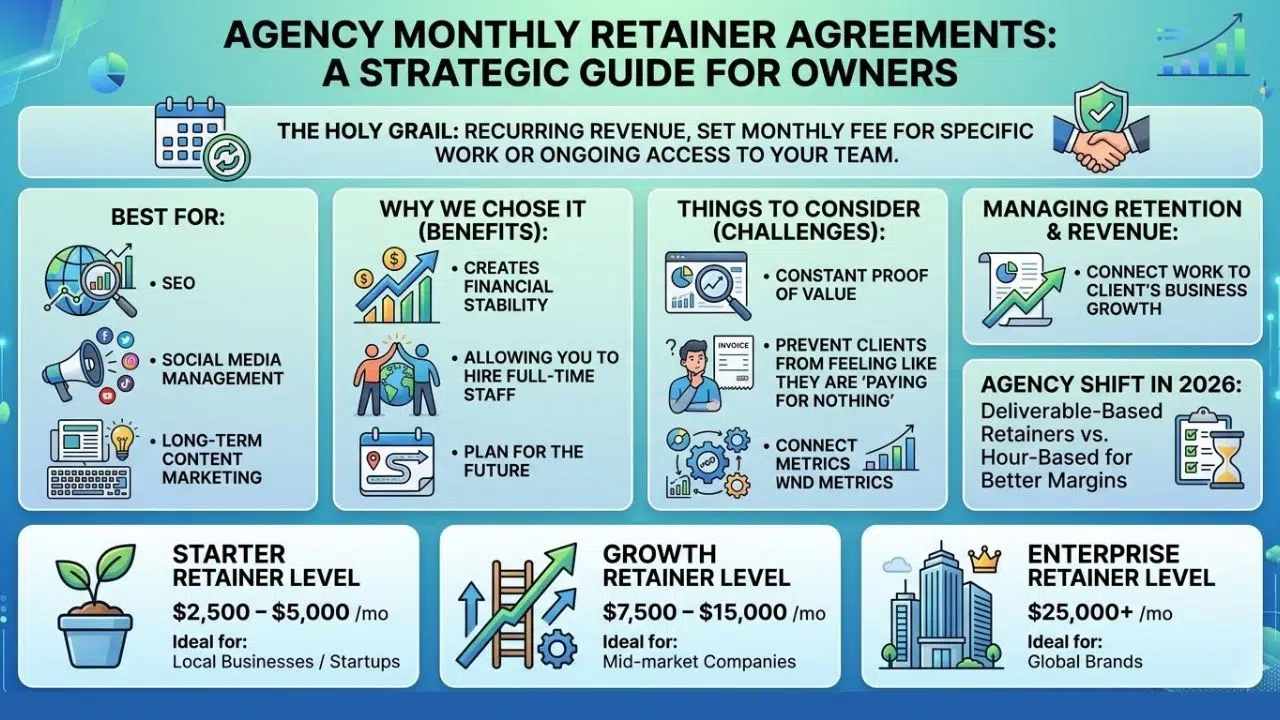
Retainers are the holy grail for many owners because they provide recurring revenue. The client pays a set fee every month for a specific amount of work or ongoing access to your team.
Best for: SEO, social media management, and long-term content marketing.
Why We Chose It: It creates financial stability, allowing you to hire full-time staff and plan for the future.
Things to consider: It requires constant proof of value to prevent the client from feeling like they are “paying for nothing.”
Managing Retention and Revenue
Successful retainers usually start at around $2,500 per month for small businesses and can exceed $20,000 for enterprise clients. The key is to provide regular reporting that connects your work to the client’s business growth. In 2026, many agencies are moving away from “hour-based” retainers and toward “deliverable-based” retainers to maintain better margins.
| Retainer Level | Monthly Cost | Ideal Client |
| Starter | $2,500 – $5,000 | Local businesses / Startups |
| Growth | $7,500 – $15,000 | Mid-market companies |
| Enterprise | $25,000+ | Global brands |
4. Value-Based Pricing Strategy
Value-based pricing is one of the most sophisticated agency pricing models. Instead of looking at your costs, you look at the financial impact your work will have on the client’s bottom line and charge a percentage of that value.
Best for: High-level strategy, conversion rate optimization (CRO), and specialized consulting.
Why We Chose It: It offers the highest possible profit margins and aligns your success directly with the client’s.
Things to consider: It is much harder to sell because you must prove the “future value” of your work before it happens.
The Math Behind the Value
If your work helps a client generate an extra $1,000,000 in sales, charging them $100,000 for that work is a bargain for them but a massive win for you. This model requires you to have deep data on the client’s current performance and a proven track record of delivering high-tier results.
| Step | Action |
| 1. Discovery | Identify the client’s current revenue and bottlenecks. |
| 2. Projection | Estimate the financial gain your solution will provide. |
| 3. Pricing | Quote 10–20% of that total projected value. |
| 4. Proof | Use case studies to validate your ability to hit those numbers. |
5. Performance-Based Pay
In this model, you only get paid when you achieve a specific result, such as a lead generated or a sale made. It is a high-risk, high-reward strategy that is becoming more popular in the e-commerce and lead-gen space.
Best for: Lead generation, e-commerce growth, and affiliate marketing.
Why We Chose It: It is an “easy yes” for clients because they don’t lose money unless they make money.
Things to consider: You have no control over the client’s sales team, which can lead to you doing work without getting paid.
Aligning Incentives with Results
Performance deals often use a “Cost Per Lead” (CPL) or “Cost Per Acquisition” (CPA) structure. For example, a B2B agency might charge $250 per qualified meeting booked. In 2026, advanced tracking tools make it easier to attribute these results accurately, but you must ensure your data is perfectly synced with the client’s CRM.
| Metric | Typical Performance Fee |
| Qualified Lead | $50 – $400 |
| Closed Sale | 5% – 15% of revenue |
| Qualified Meeting | $150 – $300 |
| App Install | $2 – $10 |
6. Percentage of Ad Spend
This is the standard model for agencies managing paid advertising. You charge a flat management fee plus a percentage of the total budget spent on platforms like Google, Meta, or TikTok.
Best for: PPC, social media advertising, and media buying firms.
Why We Chose It: As the client spends more to grow their business, your agency’s revenue grows automatically.
Things to consider: Clients may eventually feel that you are encouraging them to spend more just to line your own pockets.
Balancing Management Fees
Most agencies charge between 10% and 20% of the monthly ad spend. To protect your bottom line, it is common to have a “minimum management fee” (e.g., $1,500/month or 15%, whichever is higher). This ensures you get paid for your work even if the client decides to pause their ads for a week.
| Ad Spend Band | Management Percentage |
| Under $10k | 20% (or flat fee) |
| $10k – $50k | 15% |
| $50k – $250k | 12% |
| $250k+ | 10% or custom |
7. Tiered Package Pricing
Presenting three distinct levels of service—often called “Good, Better, Best”—allows clients to choose the package that fits their budget and needs.
Best for: Standardized services like content writing, local SEO, and basic social management.
Why We Chose It: It uses consumer psychology to nudge clients toward the middle (and usually most profitable) tier.
Things to consider: It can feel rigid for clients who have unique needs that don’t fit perfectly into a box.
The Power of Options
Tiered pricing reduces the “paralysis by analysis” that happens during a sales pitch. By giving the client three clear choices, you shift the conversation from “Should we hire them?” to “Which package is right for us?” In 2026, the trend is toward “outcome-based” tiers rather than just listing the number of tasks performed.
| Tier Name | Typical Monthly Cost | Primary Focus |
| Essential | $1,500 | Basic visibility and maintenance |
| Professional | $3,500 | Consistent growth and lead gen |
| Ultimate | $7,000+ | Market dominance and scaling |
8. Hybrid Pricing Models
A hybrid model combines two or more strategies to create a balanced fee structure. A common example is a base monthly retainer plus a performance bonus for hitting certain KPIs.
Best for: Full-service agencies that want stability but also want a share of the upside.
Why We Chose It: It protects your agency from losses while keeping the team motivated to exceed goals.
Things to consider: Invoicing can become a nightmare if you don’t have clear systems to track the different components.
Customizing the Hybrid Approach
Hybrids are becoming the standard for agency pricing models in 2026 because they offer the best of both worlds. A $3,000 base retainer ensures your staff’s salaries are covered, while a $500 bonus for every “Top 3” keyword ranking achieved gives you a major profit boost.
| Component | Purpose |
| Base Fee | Covers overhead, salaries, and basic tools. |
| Variable Fee | Adjusts based on workload or spend. |
| Success Fee | Rewards the agency for high-level results. |
| Setup Fee | One-time charge for the initial heavy lifting. |
9. Productized Service Model
Productizing your services means turning what you do into a “buy it now” product with a fixed scope, fixed price, and fixed turnaround time.
Best for: Specific audits, logo design, landing page builds, and video editing.
Why We Chose It: It eliminates the need for long sales calls and custom proposals, making your sales cycle instant.
Things to consider: It is very difficult to handle custom requests once you have committed to a productized workflow.
Selling Services Like Software
In this model, your website looks more like an e-commerce store than a traditional agency site. A client can click “Buy Now” for a $2,500 SEO Audit. This forces you to be incredibly efficient with your internal processes, which often leads to much higher profit margins than custom consulting work.
| Product Example | Fixed Price | Delivery Time |
| SEO Content Bundle | $2,000 | 7 Days |
| PPC Campaign Setup | $1,500 | 5 Days |
| Brand Style Guide | $3,500 | 10 Days |
| Video Sales Letter | $5,000 | 14 Days |
10. Points-Based Pricing
Instead of selling hours or specific tasks, you sell “points” that a client can spend on various services each month.
Best for: Agile agencies working with clients whose priorities change weekly.
Why We Chose It: It is the most flexible model, allowing clients to swap tasks without needing a new contract.
Things to consider: It requires significant education for the client to understand the “value” of a point.
The Agility of Point Systems
A client might buy 100 points per month. A blog post might cost 10 points, while a complex landing page costs 40 points. If the client decides to skip the blogs this month to focus on a big launch, they just reallocate their points. This solves the “scope creep” problem because anything outside the original plan just costs more points.
| Activity | Point Cost |
| Short Blog Post | 5 Points |
| Technical SEO Fix | 15 Points |
| Email Campaign | 20 Points |
| Full Sales Page | 45 Points |
Final Thoughts on Agency Pricing Models
Selecting the right strategy is not a “set it and forget it” task. As your team gains more expertise and your internal tools become more efficient, you must revisit your agency pricing models to ensure you aren’t leaving money on the table. The goal of a growing agency should be to move away from hourly billing and toward models like value-based or productized services that reward expertise and results rather than just labor.
By 2026 standards, the most successful firms are those that provide transparency while protecting their own margins. Whether you choose a monthly retainer for stability or a performance model for high-growth potential, make sure your pricing reflects the real-world impact you have on your clients’ success.
Frequently Asked Questions (FAQs)
1. What is the most profitable pricing model for a small agency?
Value-based pricing usually offers the highest profit margins because it is based on results rather than time. However, many small agencies find tiered packages or monthly retainers more manageable for steady cash flow.
2. How often should an agency raise its prices?
Most successful agencies review their pricing annually. A common approach is a 5–10% increase each year to account for inflation, increased tool costs, and your team’s growing expertise.
3. Is hourly billing dead in 2026?
Not entirely, but it is becoming less popular. While it is still used for one-off consultations, most agencies prefer retainers or project-based fees to avoid the pitfalls of trading time for money.
4. How do I choose between a retainer and a project fee?
If the work is ongoing and requires regular optimization (like SEO), use a retainer. If the work has a clear endpoint and a fixed deliverable (like a website build), a project fee is usually better.