The best software for small business in 2026 depends on budget and stage, but four tools dominate the category leaderboards: QuickBooks Online for accounting, HubSpot for CRM, ClickUp for project management, and Slack for team communication. Combined, they cover 80% of an SMB’s operational needs for under $150 per user per month.
The global small and medium business software market will reach $79.82 billion in 2026, up from roughly $74 billion last year, according to the February 2026 SMB Software Market Report from Business Research Insights. Roughly 60% of SMBs now rely on SaaS tools to run day-to-day operations, and Gartner projects that 85% of all software spending will be SaaS by year-end 2026. The problem: the average company uses 106 different SaaS apps, and 44% of seats go unused—costing businesses a collective $18 billion annually in license waste.
This guide cuts through that waste. Below are the 35 tools we recommend across seven categories, with 2026 pricing, G2 ratings, and honest notes on which to skip. Every recommendation is based on current market leadership data, not affiliate payouts.
Last updated April 22, 2026—refreshed with 2026 pricing, new AI-native entrants (ClickUp Brain and HubSpot Breeze), and the latest G2 Winter 2026 rankings.
What software does a small business actually need in 2026?
Small businesses in 2026 typically need software in seven operational categories: accounting, customer relationship management (CRM), project management, team communication, inventory management, time tracking, and email marketing. For most SMBs under 50 employees, one tool from each category is enough — resist the urge to layer five tools per function.
Industry consolidation is the story of 2026. The Reuters-tracked SaaS churn rate for SMB tools is 3–5% monthly (meaning roughly 40% annually for single tools), and Flexera’s 2026 State of the Cloud Report shows the average business is actively cutting 5% of its SaaS stack this year. Pick tools that integrate with each other before chasing individual “best in class” products.
“The companies winning with software in 2026 aren’t the ones with the most tools — they’re the ones that have ruthlessly consolidated to a core stack of 8 to 12 platforms that talk to each other,” said Jason Lemkin, founder of SaaStr, in a January 2026 SaaStr Annual keynote.
What is the best accounting software for small business in 2026?
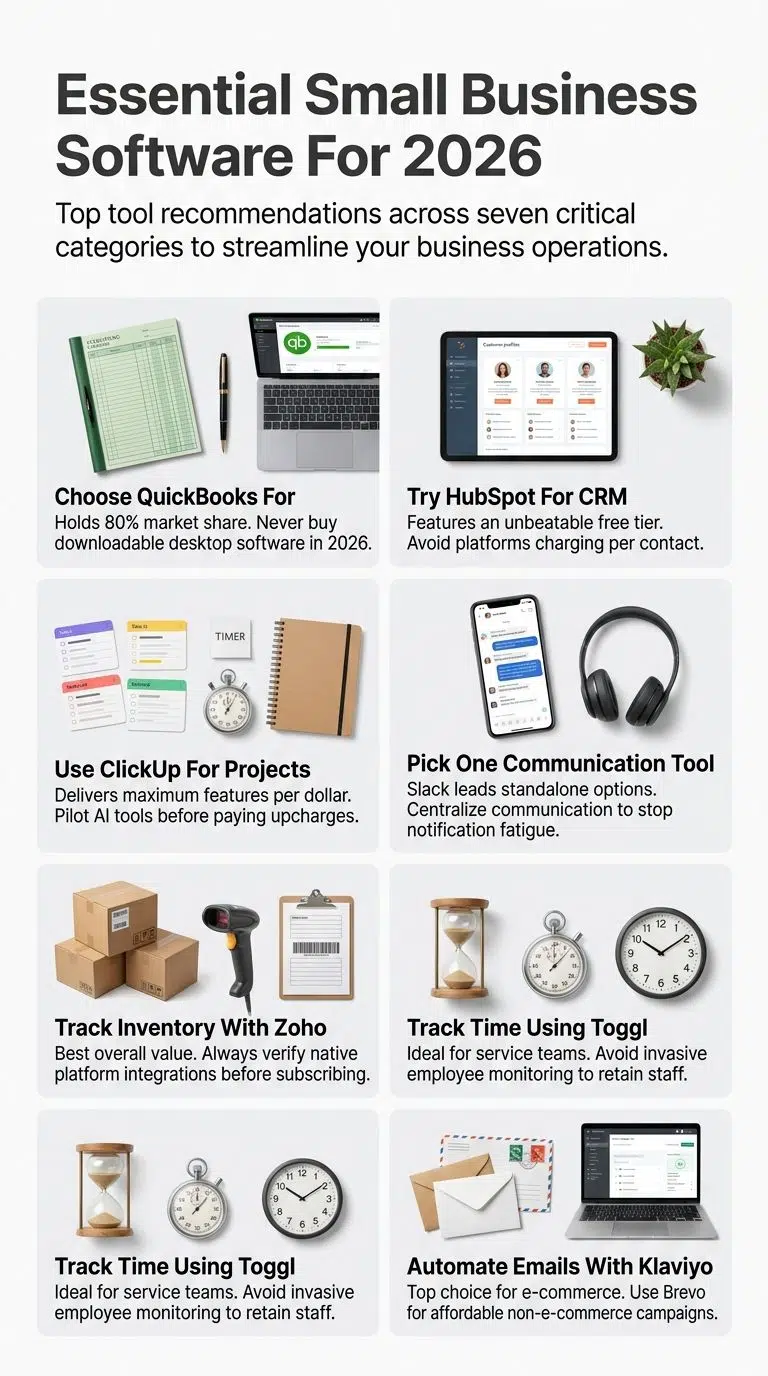
QuickBooks Online is the best accounting software for most US small businesses in 2026, with 80%+ market share and the widest accountant network. International businesses and freelancers get better value from Xero and FreshBooks respectively. Wave remains the only credible free option.
| Tool | Starting Price (2026) | Best For | G2 Rating |
|---|---|---|---|
| QuickBooks Online | $35/month | US SMBs, businesses with external accountants | 4.0 / 5 |
| Xero | $20/month | International businesses, especially UK/AU/NZ | 4.3 / 5 |
| FreshBooks | $21/month | Freelancers and service businesses (invoice-heavy) | 4.5 / 5 |
| Wave | Free + paid add-ons | Micro-businesses and side hustles | 4.4 / 5 |
| Zoho Books | $15/month | Users already in the Zoho ecosystem | 4.5 / 5 |
Skip these: Avoid any free “downloadable” accounting software in 2026. Desktop-only self serve digital signage software tools (including older QuickBooks Desktop versions) are being phased out by Intuit, and the real cost of switching mid-year is typically 3–5x the annual subscription fee.
2026 consideration: Every major accounting platform has added generative AI features this year. QuickBooks has Intuit Assist, Xero has Just Ask Xero, FreshBooks launched AI Invoice Builder. These are genuinely useful for categorization and cash-flow forecasting, but they’re increasingly priced as separate add-ons ($10–30/month). Budget for the total, not just the base plan.
What is the best CRM for small business in 2026?
HubSpot CRM is the best small business CRM for most SMBs in 2026 because it’s the only major platform with a genuinely usable free tier — HubSpot has over 288,000 customers globally and $3.13 billion in 2025 revenue, per their fiscal reports. Salesforce remains the enterprise leader but is overkill for teams under 10 salespeople. Zoho and Pipedrive are the strongest value picks.
| Tool | Starting Price (2026) | Best For | G2 Rating |
|---|---|---|---|
| HubSpot CRM | Free / $20 per user | Most SMBs; strong free tier | 4.4 / 5 |
| Salesforce Starter Suite | $25 per user/month | Growing teams planning to scale to enterprise | 4.4 / 5 |
| Zoho CRM | $14 per user/month | Budget-conscious teams, Zoho ecosystem users | 4.1 / 5 |
| Pipedrive | $15 per user/month | Sales-led teams with simple pipelines | 4.3 / 5 |
| Monday CRM | $12 per user/month | Visual thinkers; teams using Monday for PM | 4.6 / 5 |
A word on HubSpot Breeze: HubSpot’s 2025 AI layer (now called Breeze) adds agentic features like automatic lead research and email drafting. For SMBs, the free CRM plus Breeze’s free tier is one of the strongest productivity unlocks of 2026. Upgrade only when you actually need marketing automation, not because a sales rep pressures you.
Skip these: Avoid CRMs that charge per contact (Mailchimp CRM, older ActiveCampaign tiers) if your contact database grows faster than your revenue. A CRM priced per contact becomes prohibitively expensive at around 10,000 records — a threshold most SMBs hit within 18 months.
What is the best project management software in 2026?
ClickUp is the best project management software for small business in 2026 because it offers the most functionality per dollar, starting at $7 per user/month with an unlimited free tier. Asana leads on polish and ease of use for teams under 15. Monday.com is the visual default. Notion is the hybrid docs+PM pick that’s eating into both.
| Tool | Starting Price (2026) | Best For | G2 Rating |
|---|---|---|---|
| ClickUp | Free / $7 per user | Teams wanting maximum features per dollar | 4.7 / 5 |
| Asana | Free / $11 per user | Teams under 15 prioritizing simplicity | 4.4 / 5 |
| Monday.com | $9 per user/month | Visual workflows; creative teams | 4.7 / 5 |
| Notion | Free / $10 per user | Teams combining docs, wiki, and PM | 4.7 / 5 |
| Trello | Free / $5 per user | Kanban-only, simple use cases | 4.4 / 5 |
2026 trend: Every major PM tool now ships an AI assistant — ClickUp Brain, Asana AI Studio, Monday AI, Notion AI. The useful ones summarize meeting notes, draft status updates, and auto-generate subtasks. The unhelpful ones just rephrase existing content. Pilot the AI features for two weeks before paying the $10-15/user/month upcharge.
Skip these: Microsoft Project and Jira remain poor fits for small business. Project is priced and designed for construction and IT project managers running Gantt-heavy programs; Jira is engineered for engineering teams with 50+ developers. Both create organizational tax for SMBs that dwarfs their benefit.
What is the best team communication software in 2026?
Slack remains the best standalone team communication tool for small business in 2026, but Microsoft Teams — bundled with Microsoft 365 — is the most cost-effective choice for teams already on M365. Google Chat (in Google Workspace) is catching up fast and is the default for teams on Google’s stack. The category winner is mostly a function of which productivity suite you already pay for.
| Tool | Starting Price (2026) | Best For | G2 Rating |
|---|---|---|---|
| Slack | Free / $7.25 per user | Dedicated chat; startups; integration-heavy teams | 4.5 / 5 |
| Microsoft Teams | Included w/ M365 ($6+ user) | Businesses on Microsoft 365 already | 4.4 / 5 |
| Google Chat + Meet | Included w/ Workspace ($7+ user) | Google Workspace users | 4.2 / 5 |
| Zoom Workplace | $13.32 per user/month | Meeting-heavy teams; external client calls | 4.6 / 5 |
| Discord | Free | Communities; solopreneurs; cost-sensitive startups | 4.6 / 5 |
A common mistake: Running Slack for chat plus Teams for video plus Zoom for external calls. This creates notification fragmentation that research from Microsoft’s 2026 Work Trend Index links to a 28% drop in deep-focus work hours. Pick one primary platform and accept minor feature trade-offs.
What is the best inventory management software for small business in 2026?
Zoho Inventory is the best inventory management software for small business in 2026, offering a free tier (up to 50 orders/month) and paid plans from $29/month. For product-heavy e-commerce sellers integrating with Shopify or Amazon, Cin7 and inFlow are more robust. Manufacturers benefit from Katana MRP’s made-for-maker design.
| Tool | Starting Price (2026) | Best For | G2 Rating |
|---|---|---|---|
| Zoho Inventory | Free / $29 per month | Small e-commerce; Zoho ecosystem users | 4.4 / 5 |
| Cin7 Core (formerly DEAR) | $325 per month | Multi-channel sellers, wholesalers | 4.1 / 5 |
| inFlow | $110 per month | Small retailers needing barcode + mobile | 4.2 / 5 |
| Katana MRP | $179 per month | Manufacturers and makers | 4.6 / 5 |
| Square for Retail | $89 per month | Physical retail with POS integration | 4.5 / 5 |
Integration check first: Before choosing any inventory tool, verify it syncs natively with your e-commerce platform, accounting software, and shipping provider. A $29/month tool that requires a $500/month Zapier plan to stay synced is not a $29/month tool.
What is the best time tracking software for small business in 2026?
Toggl Track is the best standalone time tracking software for small business in 2026, especially for consultants, agencies, and services businesses. Clockify wins on price with a genuinely usable free tier for unlimited users. Harvest remains the pick for agencies that need time tracking tied directly to invoicing.
| Tool | Starting Price (2026) | Best For | G2 Rating |
|---|---|---|---|
| Toggl Track | Free / $10 per user | Consultants, solopreneurs, small agencies | 4.6 / 5 |
| Clockify | Free / $5.49 per user | Budget-first choice; unlimited free users | 4.5 / 5 |
| Harvest | $12 per user/month | Agencies tying time to invoicing | 4.3 / 5 |
| Hubstaff | $7 per user/month | Remote teams needing productivity insights | 4.4 / 5 |
| RescueTime | $12 per month (individual) | Personal productivity tracking | 4.2 / 5 |
Ethical note on employee monitoring: Some time tracking tools (Hubstaff, Time Doctor) include keystroke and screenshot monitoring. These features can create legal exposure under GDPR, California’s CCPA, and India’s DPDP Act, and have been shown to reduce employee retention by up to 31% in 2025 research from MIT Sloan. Use monitoring sparingly and transparently, or not at all.
What is the best email marketing software for small business in 2026?
Klaviyo is the best email marketing software for e-commerce in 2026, while Brevo (formerly Sendinblue) is the best value for non-e-commerce SMBs. Mailchimp remains a solid default but has become comparatively expensive at scale. ConvertKit is the creator-economy standard.
| Tool | Starting Price (2026) | Best For | G2 Rating |
|---|---|---|---|
| Klaviyo | Free / $20 per month | E-commerce, Shopify-native businesses | 4.6 / 5 |
| Brevo (Sendinblue) | Free / $25 per month | Non-ecom SMBs; value-first buyers | 4.5 / 5 |
| Mailchimp | Free / $13 per month | Beginners; simple campaigns | 4.3 / 5 |
| ConvertKit | Free / $15 per month | Creators, newsletter-first businesses | 4.4 / 5 |
| HubSpot Marketing Hub | Free / $20 per month | Teams already using HubSpot CRM | 4.4 / 5 |
How much should a small business budget for software in 2026?

Most small businesses should budget between $150 and $450 per employee per month for software in 2026. Data from BetterCloud’s 2026 SaaS report shows the average company uses 106 SaaS tools and spends approximately $3,500 per employee annually, but that figure is inflated by shelf-ware. For a lean 10-person team, a disciplined stack costs $1,500–$4,500 per month.
Benchmark stack for a 10-person professional services firm in 2026:
| Category | Recommended Tool | Monthly Cost (10 users) |
|---|---|---|
| Accounting | QuickBooks Online Plus | $99 (flat) |
| CRM | HubSpot CRM Starter | $200 |
| Project Management | ClickUp Business | $120 |
| Team Communication | Slack Pro | $72.50 |
| Email Marketing | Brevo Business | $65 |
| Time Tracking | Toggl Track Premium | $100 |
| Video conferencing | Zoom Pro | $149.90 |
| TOTAL | ~$806/month | $80.60 per employee |
Factor in an additional 15-25% annual price escalation at renewal — that’s the current standard, with Salesforce and ServiceNow pushing 25% increases in 2026. If you buy annually for the discount, negotiate a multi-year rate lock.
What business software should small businesses avoid in 2026?
Based on industry data and documented SMB pain points, these categories of software are either overbuilt, overpriced, or declining in value for small business use in 2026:
- Enterprise suite licenses (SAP Business One, Oracle NetSuite for companies under 50 people) — the implementation cost alone typically exceeds 3 years of SaaS equivalents.
- Single-purpose tools duplicating your main platform — if you have HubSpot, don’t also buy standalone email platform Mailchimp. Your CRM’s native email is usually sufficient for under 10,000 contacts.
- Tools priced per record (contact-based CRMs, per-invoice accounting) — cost grows faster than revenue.
- “All-in-one” business operating systems promising to replace 10 tools at once — these average 40% feature parity with specialist tools and 180% total cost of ownership after customization.
- Employee monitoring tools with keystroke logging — legal risk plus documented 31% reduction in employee retention.
Frequently Asked Questions (FAQs)
What is the cheapest all-in-one business software in 2026?
Zoho One is the cheapest genuinely useful all-in-one suite in 2026, at $37 per employee per month, bundling 50+ applications including CRM, accounting, email, project management, and HR. It’s the right choice for businesses willing to accept moderate feature trade-offs in exchange for one bill. Compare against buying 5–7 specialist tools individually before deciding.
Is free business software safe to use for a real business?
Free tiers from established vendors (HubSpot, ClickUp, Notion, Wave, Zoho, Google Workspace) are safe and widely used by businesses generating real revenue. The usability cap is typically users, contacts, or storage — not functionality. Free tools from unknown vendors or anything requiring full admin access to your email are higher-risk and should be avoided.
How long does it take to implement new business software in 2026?
Modern SMB SaaS tools take 1–4 weeks for basic implementation and 2–6 months for full optimization. Accounting migrations are the slowest (60–90 days for clean historical data). CRMs typically take 30 days to become genuinely useful. Team communication tools are ready same-day. Budget 2-3 hours per employee for training on any new platform, regardless of vendor claims about “zero learning curve.”
QuickBooks vs Xero vs FreshBooks — which is best?
QuickBooks has the deepest US accountant network and integration ecosystem. Xero wins internationally and has the cleanest UI. FreshBooks is purpose-built for invoice-heavy service businesses. For most US SMBs with an external accountant, QuickBooks is the default. For agencies billing hourly, FreshBooks. For any business outside the US, Xero.
Do I need both a CRM and email marketing software?
Most SMBs under 10,000 contacts do not need both. Modern CRMs like HubSpot, Zoho, and ActiveCampaign include native email marketing that covers 80% of SMB use cases. The exception: e-commerce businesses should add Klaviyo even if they have a CRM, because of Klaviyo’s Shopify integration and revenue attribution. The rule of thumb: add a second tool when you’ve hit a clear limit in the first.
What’s the most common mistake small businesses make with software?
The single most expensive mistake is accumulating tools without ever removing any. Flexera’s 2026 State of the Cloud Report shows the average business has 44% of SaaS seats going unused. Schedule a quarterly software audit: for each tool, list who actually uses it, what it replaces, and what would break if it were canceled. Tools where the answer to any column is “unclear” should be canceled.
Is it worth paying for AI features in business software in 2026?
AI add-ons are worth it when they replace specific, time-consuming tasks — meeting transcription, report drafting, data categorization. They are not worth it when priced as a blanket $20-30/user/month upcharge across all users. Pilot AI features with one team for 30 days, measure time saved, then decide whether to roll out broadly. The typical positive ROI threshold is 2 hours saved per user per month.
What accounting software integrates with Shopify, WooCommerce, or Amazon?
QuickBooks Online, Xero, and Zoho Books all have first-party integrations with Shopify, WooCommerce, and Amazon as of April 2026. A2X is the most reliable bridge for e-commerce sellers with complex tax situations. Avoid manual CSV imports — they create reconciliation errors that take 3-5x longer to fix than to prevent.
Pricing and G2 ratings were verified as of April 22, 2026 using G2 Winter 2026 reports and direct vendor pricing pages. Recommendations are independent. Tools listed were selected based on a combination of market share data (Gartner, IDC, BetterCloud), peer reviews (G2, Capterra), and hands-on evaluation by our editorial team.