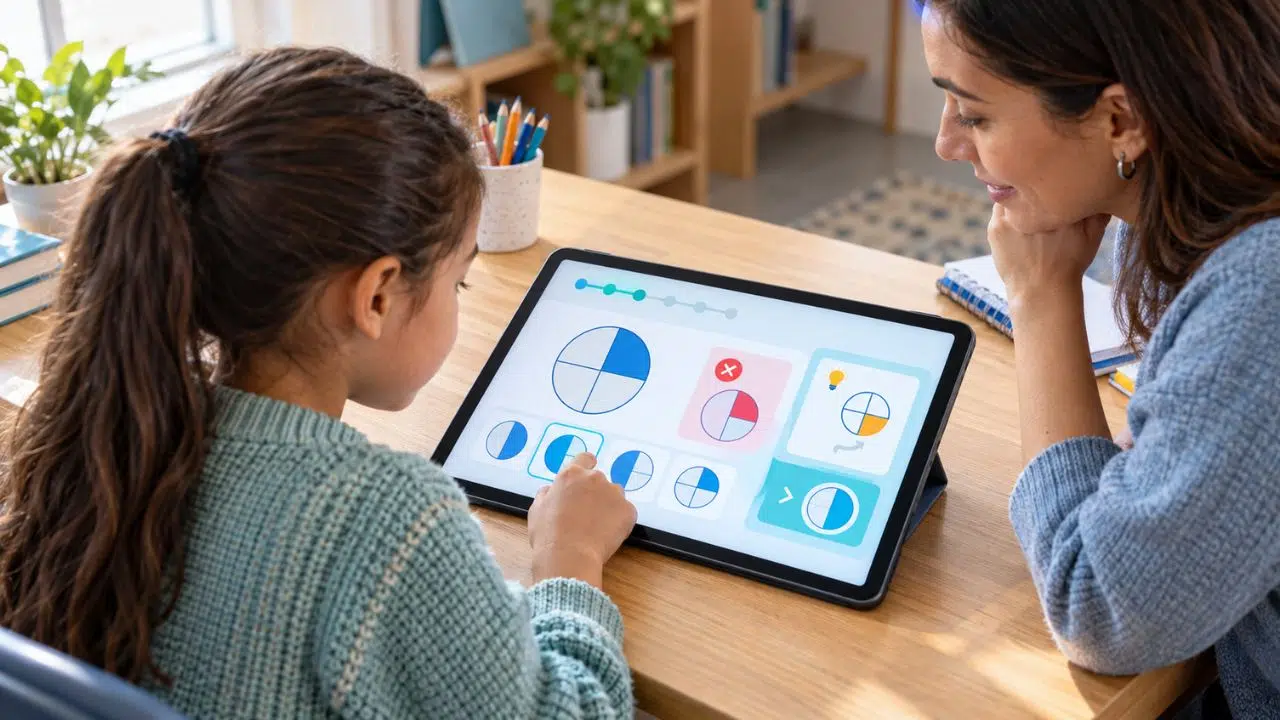
In late 2020 or early 2021, I began exploring AI through OpenAI’s tools. At the time, I did not know how quickly the technology would become part of ordinary working life. What stayed with me was a simple question: if a machine can help us write, research, create, and organize, how should we decide what to trust—and what should remain firmly in human hands?
As founder and CEO of Editorialge Media LLC, ImagineLab.art, Edutorial Gaming Technologies, and HappinessFit LLC, I think about that question across media, creative technology, education, and wellness. These fields have different responsibilities, but they share a challenge: a faster output is only useful when it helps someone achieve a better result.
This essay combines my own experience of discovering AI with published research. The studies I discuss were conducted by other researchers, not by my companies. I find that distinction necessary: a personal observation can help us ask better questions, but it does not turn an external finding into a result we measured ourselves.
My First Encounter With AI Came Before ChatGPT
Through work, I met a software engineer from Gujarat, India, who introduced me to AI tools. He now leads an international writing technology company. I am grateful for that early introduction; I will leave his name out to respect his privacy.
I remember exploring OpenAI Playground and seeing what a prompt could produce. Around that period, I also encountered WordPress automation systems. Together, those experiences changed how I looked at a publishing workflow: a task could be broken into steps, some assisted by software, while a person remained responsible for checking what came out.
I do not have records that establish the exact model version I used at the start, so I would rather leave that detail open than guess. What the public timeline does establish is that OpenAI introduced its API in 2020, using models in the GPT-3 family. Playground was a place to experiment with models, not itself a model version.
ChatGPT arrived on November 30, 2022. OpenAI says the initial system was fine-tuned from a model in its GPT-3.5 series. It did not begin as GPT-2 or GPT-2.5, and Playground did not simply become ChatGPT. To me, the important change was practical: an experience that had felt like experimenting with prompts became a conversational tool that many more people could approach. By 2023, that shift was much easier to see.
What Changed in the Way We Work?
Consider an article. Someone still needs to decide what matters to readers, locate credible evidence, speak to sources where necessary, challenge assumptions, and take responsibility for the finished piece. AI can help frame questions, suggest an outline, summarize a document, or offer another way to explain an idea. Each suggestion is the beginning of work, not proof that the work is correct.
That shift reaches well beyond publishing. A teacher can use AI to draft exercises at different levels. A small-business owner can explore ways to respond to common customer questions. A developer can ask for help understanding code. A creative team can use a draft storyboard to discuss an idea sooner.
Yet the last mile can be demanding. A fluent response can contain an invented reference or a misleading statistic. A beautiful image can contain visual errors, including a face that does not accurately resemble the person it is supposed to depict. A useful first draft may still require substantial revision. Those are costs of the workflow, even if they do not appear in the time it took to generate the draft.
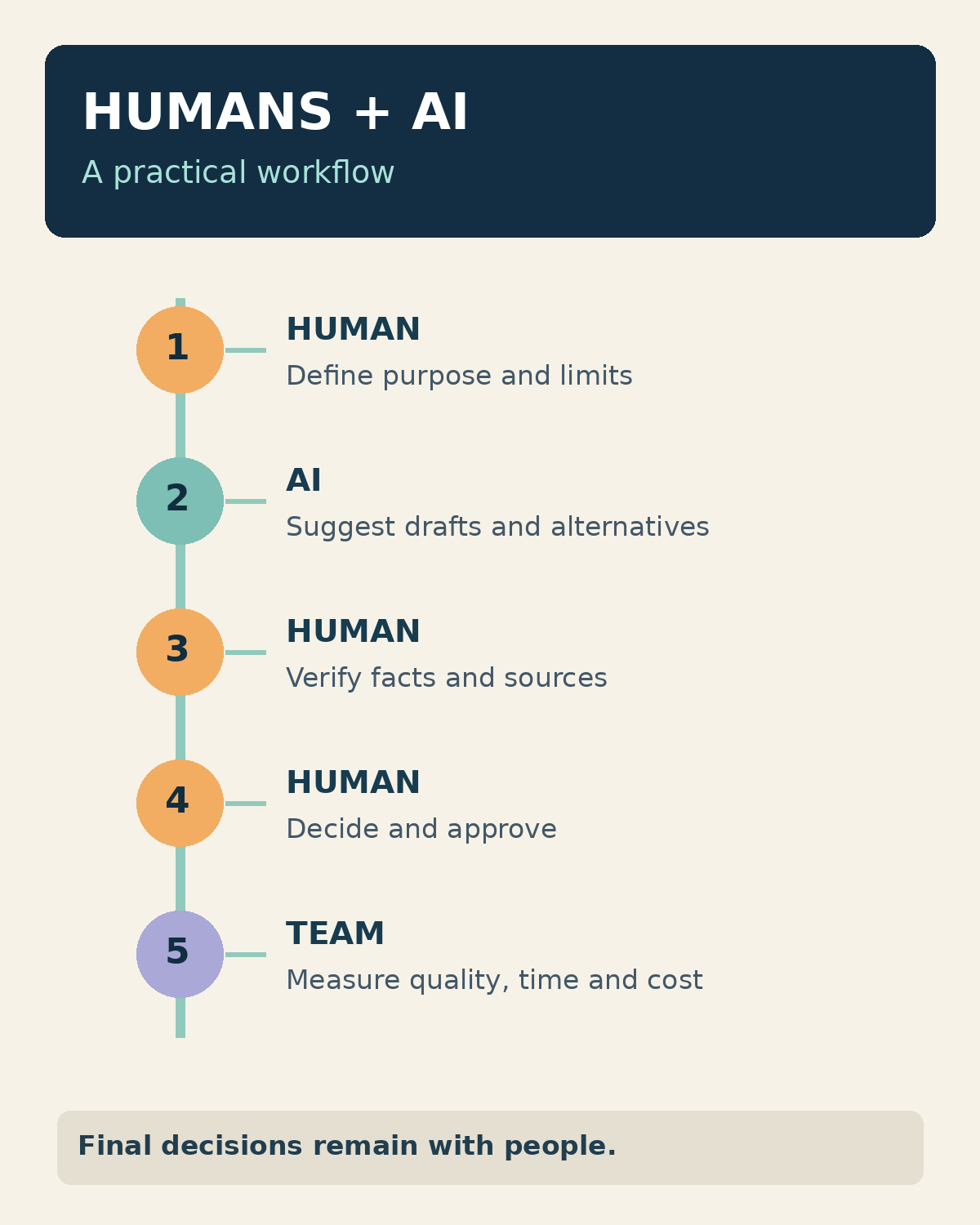
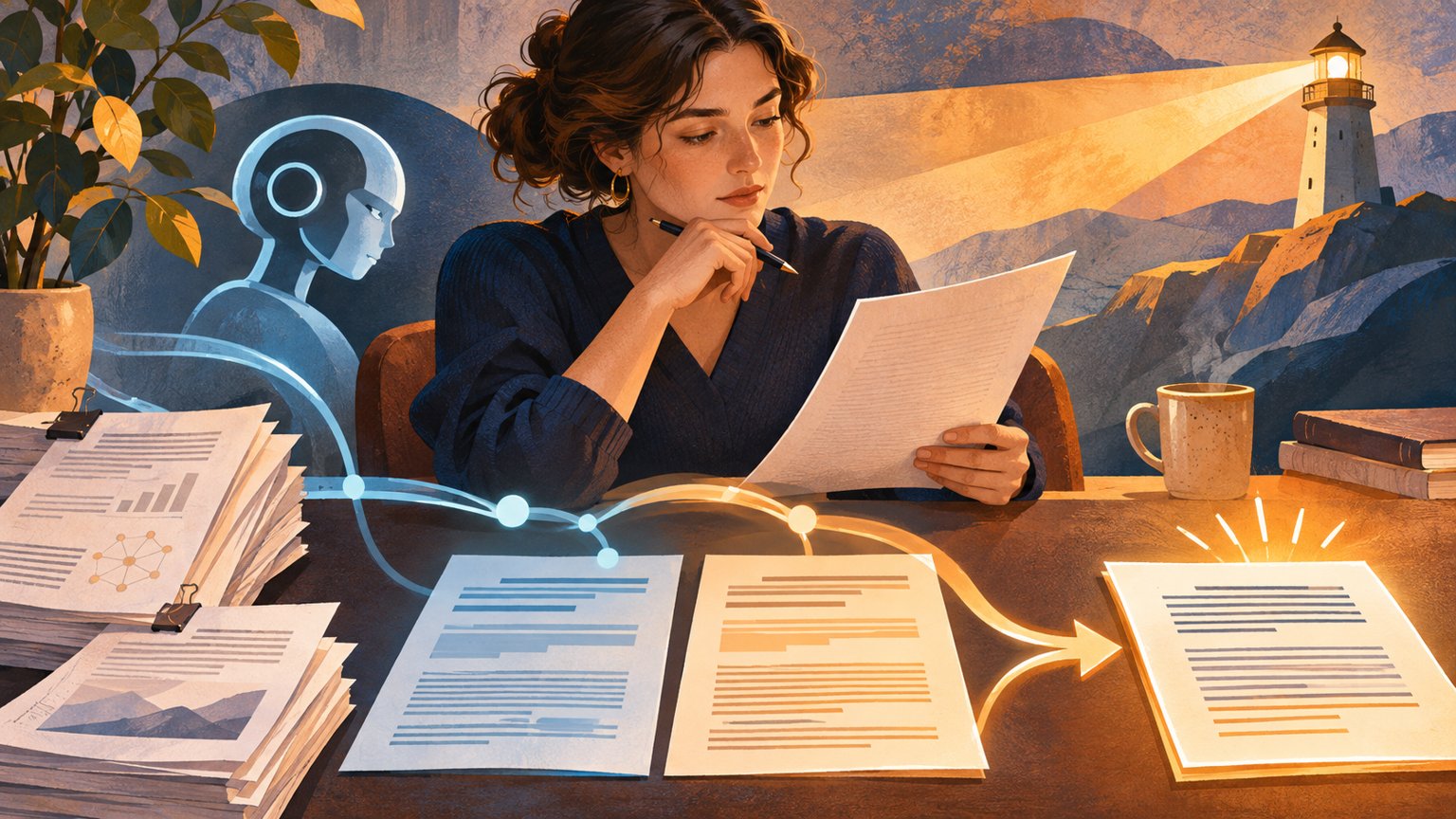
In the workflow above, people set the objective and limits; AI proposes a draft; people verify sources; a responsible person makes the decision; and the team measures quality, time, and cost. It is a practical framework, not a claim that any one company has achieved a measured result.
Four Studies That Made Me Think Differently
1. Consultants gained ground on some tasks
A Harvard-led study involving 758 Boston Consulting Group consultants examined work that included creative and analytical tasks. For tasks within the system’s capabilities, researchers reported improvements in speed, completed tasks, and evaluated quality. Their description of a “jagged technological frontier” matters to me: a system can perform well on one task and fail at another that looks deceptively similar.
For an editor, that means a useful outline does not prove that the supporting facts are sound. For a business leader, it means the right question is not simply whether a team has AI access. It is which part of the work benefits, and who checks the result.
2. AI changed how people approached product ideas
A 2025 working paper involving 776 Procter & Gamble professionals compared people working individually or in pairs, with and without AI, on real product-innovation challenges. In that experiment, individuals with AI achieved evaluated performance comparable to teams without AI. The result is interesting, but it does not prove that software can replace every benefit of a team, including accountability, disagreement, context, and trust.
My takeaway is that an additional perspective can be valuable when shaping an idea. It is still necessary to talk to real users and assess whether a proposed product solves a real problem.
3. Experienced developers were not always faster
In a small randomized METR study, 16 experienced open-source developers completed 246 tasks in projects they knew well. With the early-2025 AI tools studied, tasks took 19% longer on average when developers were allowed to use AI. The sample was small, the work was specific, and tools continue to change. This is not a verdict on every developer or every AI coding tool.
It is a useful warning against treating generated code as the measure of success. Testing, integration, security review, and fixing unsuitable suggestions are part of the job too.
4. Customer support showed gains that varied by experience
An NBER study of 5,179 customer-support agents found that access to an AI assistant increased issues resolved per hour by 14% on average. Newer and less-skilled agents saw larger gains; experienced agents saw little change. The result concerns a particular workplace and measure. It does not guarantee the same increase in another company.
The contrast between these studies is exactly why I resist a single sweeping number for “AI productivity.” It matters what people are doing, what they already know, how the tool is integrated, and how success is measured.
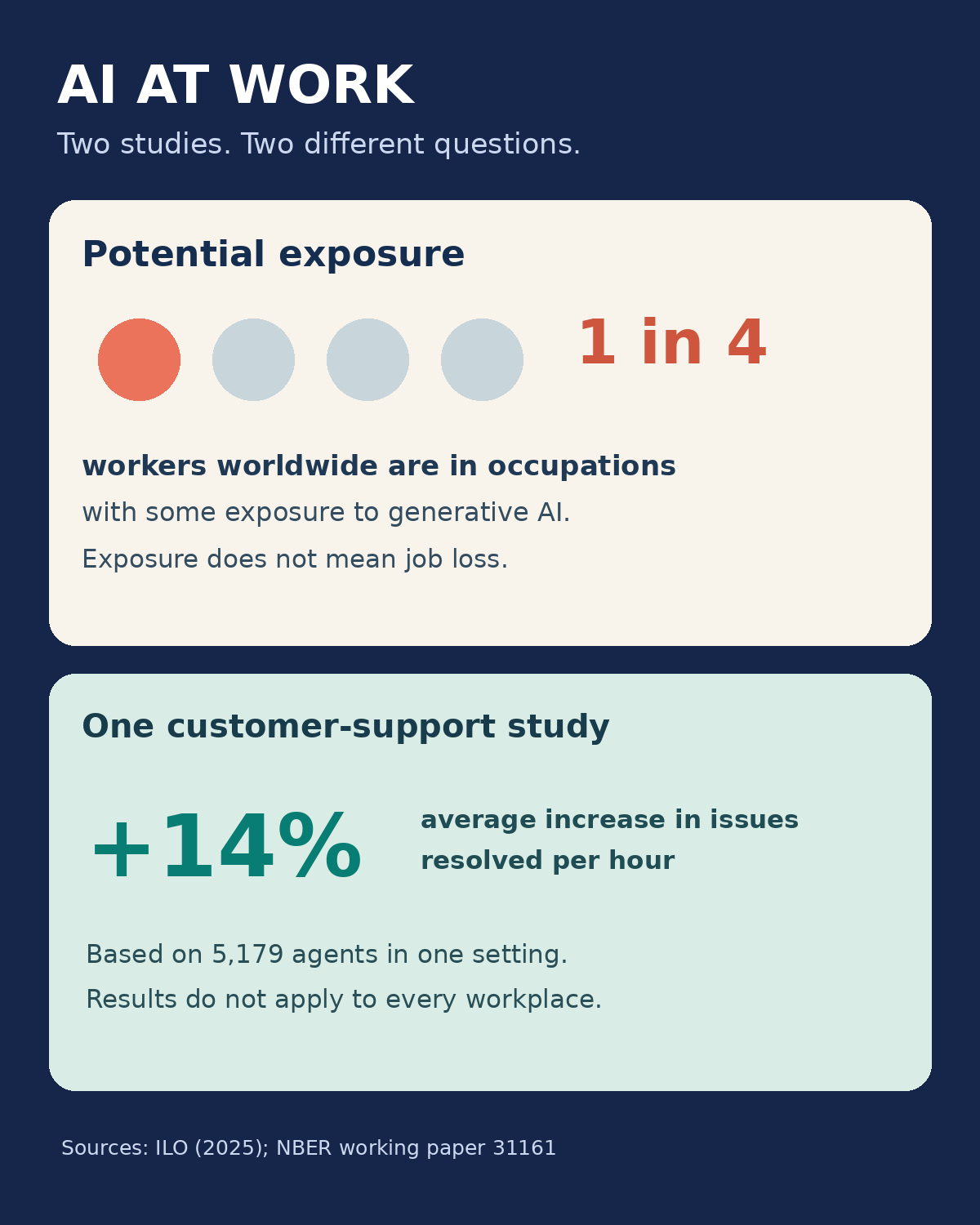
The International Labour Organization’s 2025 estimate places about one in four workers globally in an occupation with some exposure to generative AI. Exposure is not the same as job loss. The customer-support finding, by contrast, measured resolved issues per hour in one study. The two figures answer different questions and should not be added together or treated as predictions for an individual business.
Where Opportunity Meets Responsibility
In media, AI can help organize background material, but it cannot take responsibility for a published claim. A reporter or editor still needs to open the source, check its context, contact relevant people when appropriate, and correct mistakes. When a generated image is used to illustrate an idea, readers should not be led to believe it documents an event that actually happened.
In creative work, AI can make it easier to explore variations of an image, script, or storyboard. But I have also seen, in the process of preparing visuals for this article, how difficult it can be to reproduce a person’s face faithfully. That makes review more than an aesthetic preference: accuracy and the person’s consent matter.
In education, a customized explanation or exercise may help a learner find another route into a topic. A teacher still needs to check accuracy and age suitability, and students need opportunities to reason rather than merely copy an answer. In health and wellness, AI can help someone prepare questions, but personal diagnosis and treatment require qualified professionals. Sensitive information deserves particular care.
For small businesses, a draft response may save effort, but a person should verify prices, promises, policy exceptions, and unresolved complaints. I would measure the quality of the resolution, repeat contacts, and the time needed for review—not just the number of answers produced.
Bangladesh and the Uneven Opportunity
For students, freelancers, and entrepreneurs in Bangladesh, AI can make information and certain capabilities more accessible. It can help someone explore a question in Bengali or prepare a first English-language draft. But access to reliable internet, devices, training, and paid tools is not equal. Nor do models consistently understand every local expression, name, or cultural context.
There is also a labor-market question. World Bank analysis of a collected online job-postings dataset found that the share of AI-related postings in South Asia rose from 2.9% in January 2023 to 6.5% in March 2025. Online postings are not the whole labor market. Even so, they suggest that technical fluency and the ability to use AI thoughtfully are becoming more relevant in some occupations.
I want us to invest in local-language knowledge, digital skills, and products designed around local needs. A genuine opportunity should reach beyond those who already have the fastest connection or the largest budget.
Six Questions I Would Ask Before Adopting AI
- What specific problem are we trying to solve?
- What happens if the output is wrong, and who checks it?
- Do we have permission to share the information involved?
- Can important claims be traced to their original sources?
- Have we measured the entire task, including review and corrections?
- Are we protecting opportunities for people to learn, question, and improve their work?
Those questions help me connect the promise of a tool with the reality of the people who use it. They are also useful when a tool does not deliver the savings we expected.
The Future Is Still a Human Decision
My interest began with curiosity about an unfamiliar tool. Years later, that curiosity remains, but the questions have grown. Who gets access? Who benefits from time saved? What happens to a new worker’s chance to learn? Who accepts responsibility when a polished answer is wrong?
I remain optimistic about AI’s ability to help people work and create. That optimism depends on keeping people involved in the decisions that matter. As an Editorialge article on AI productivity and time argues, the benefits should be felt by people doing the work. The future of work will be shaped by the choices we make about evidence, education, opportunity, and accountability—not by the technology alone.