
You sell goods in Europe, or plan to, and keep hearing that you need a “Digital Product Passport.” It is a digital record tied to a product that people open by scanning a QR code. It shows what the item is made of, where it came from, how it affects the planet, and how to fix or recycle it.
EU law makes it mandatory from February 18, 2027, starting with batteries for electric cars, e-bikes, and e-scooters, home storage batteries, and industrial batteries over 2 kWh. More product types will follow. Any company that sells those products in the EU needs one, including US exporters and small firms.
This guide helps you check whether your products are covered and who in your supply chain holds the duty. It also gives the key dates, rough costs, and what to do first.
What Is a Digital Product Passport (DPP)?
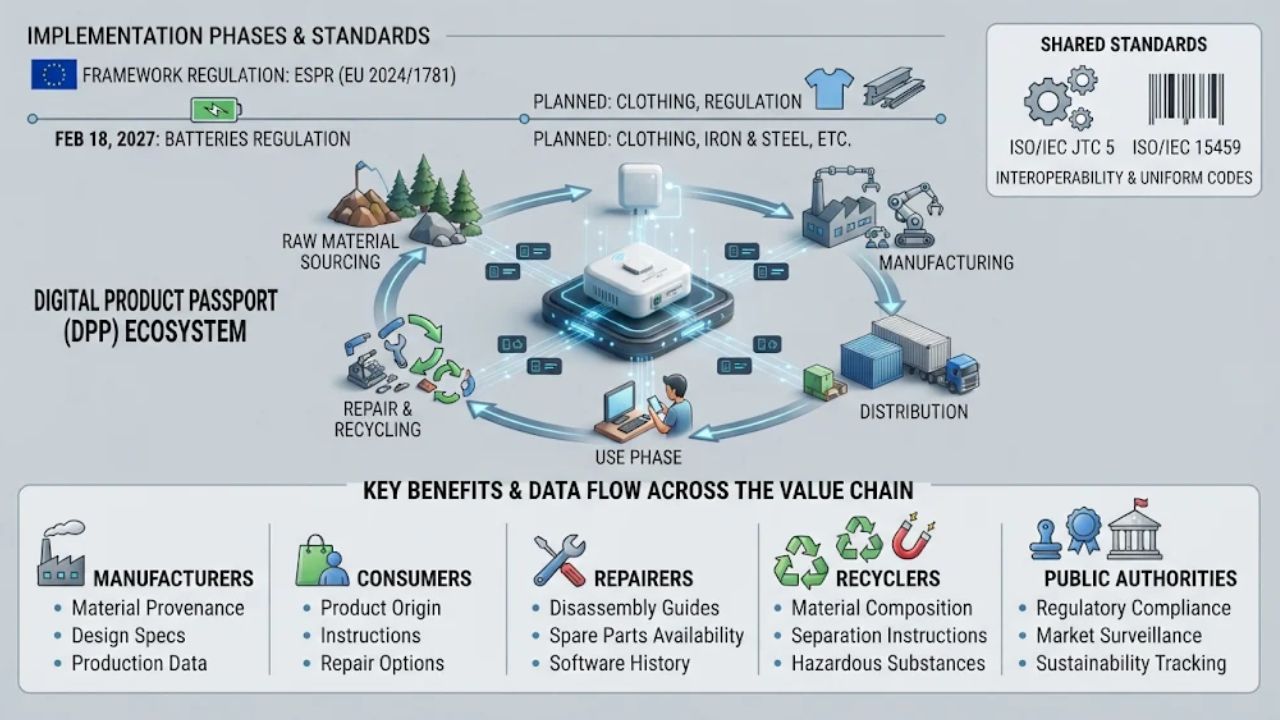
A Digital Product Passport is a digital record of facts about a product, part, or material across its whole life. It is linked to a physical product sold or used in the EU.
Its job is to put key product facts in one place so everyone in the value chain can find them. That includes “businesses, consumers, repairers and recyclers, and public authorities.” The EU also wants it to support greener products, help materials get reused, and make it easier to follow the law.
The law behind it
The passport rules sit under the Ecodesign for Sustainable Products Regulation, or ESPR, which is Regulation (EU) 2024/1781. Some product types also get passport rules from their own laws, such as the Batteries Regulation and the Construction Products Regulation.
ESPR is a key part of the EU’s push for a circular economy. In a circular economy, products last longer, get fixed, and their materials get used again instead of being thrown away.
ESPR does not switch on passports for every product at once. It works like a frame.
The EU fills in that frame one product group at a time, with separate rules called delegated acts. Each act says which products need a passport, what data goes in, and when.
Required now vs. only planned
This is the point most guides blur. As of late 2026, the first hard passport deadline is for batteries on February 18, 2027. Clothing, iron and steel, and other groups are planned, but their dates depend on rules still to come.
Work on shared standards is also still going on. Groups such as ISO/IEC JTC 5 work on shared tech rules, and ID standards like ISO/IEC 15459 help keep product codes the same across systems. These help passports work the same way across companies and borders.
How Does a Digital Product Passport Work?
A passport links a real product to its data through a unique code. Anyone allowed to see the data can scan the product and read it on a phone or computer.
Here is how the parts fit together, step by step.
- Give the product a unique ID. Each product, or each batch or model where the rules allow it, gets its own unique product identifier. The EU is setting rules for these IDs and for data carriers.
- Gather the data. The company collects facts on origin, materials, environmental impact, and repair. Much of this data comes from suppliers, so start asking early.
- Store the passport data. For batteries, the passport runs “through a decentralised system, with detailed battery information maintained by the responsible economic operator.” In plain words, the company or its service provider keeps the data, not the EU.
- Register the product. The EU DPP Registry stores “the unique identifiers for each product, alongside mandatory registration data.” Once registered, a product gets “a unique URI for the DPP,” which works like a fixed web address.
- Put a data carrier on the product. The physical item shows “a digital data carrier, such as a QR code” that links to the stored facts. QR codes are expected to be the most common carrier.
- Set who sees what. The EU is setting up access rights, so some data is open to all and some is only for groups like repairers or officials.
- Let people scan. Shoppers, repairers, recyclers, and officials scan the code and see the facts they are allowed to see.
- Let officials check. Market surveillance authorities can use the registry and the passports to check that products follow the rules.
- Keep it current. Some data changes over time. A battery passport, for example, covers state of health, which shifts as the battery ages.
One registry, many data stores
A common mix-up is that the EU keeps one big database of all product data. It does not. The registry holds IDs and core sign-up details, while the detailed battery data stays with the company that holds the duty.
The EU is also building a web portal and other tools around the registry. Its launch, along with a testing area, gives businesses a way to get ready.
What Information Goes Into a Digital Product Passport?
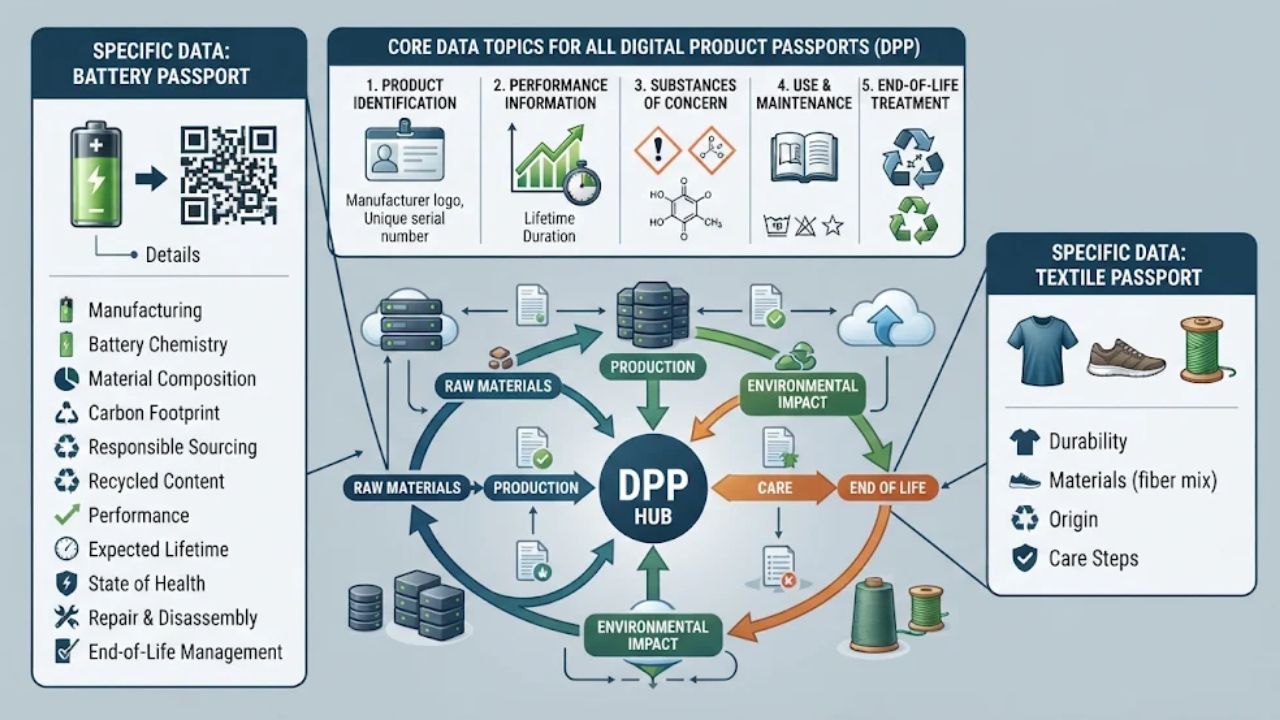
Each product group gets its own data list through its own rules. Still, most passports cover the same broad topics.
Under ESPR, a passport is expected to cover these kinds of data:
- Product identification: what the product is, who made it, and its unique ID.
- Performance information: how well it works and how long it should last.
- Substances of concern: harmful materials that matter for safety, repair, and recycling.
- Instructions for use and maintenance: how to use the product, care for it, and keep it working.
- End-of-life treatment: how to take it apart, reuse it, or recycle it.
In everyday terms, a passport tells the story of raw materials, production, environmental impact, and care.
What a battery passport holds
Batteries are first, so their list is the clearest. A battery passport is reached by QR code and covers “manufacturing, battery chemistry, material composition, carbon footprint, responsible sourcing, recycled content, performance, expected lifetime, state of health, repair and disassembly, and end-of-life management.”
Some of this data you already have, such as chemistry and capacity. Other parts, like carbon footprint and responsible sourcing, need data from deep in your supply chain.
What a textile passport is likely to hold
For clothing, shoes, and textiles, guides expect passports to show details such as durability and materials. The exact list will come in the textile rules. If you sell clothing, fiber mix, origin, and care steps are good places to start your data work.
Which Businesses Will Need a Digital Product Passport?
The short answer: any business that places a covered product on the EU market. It does not matter where the product was made or how big the company is.
The key word is “covered.” Only product groups with their own rules need a passport. The battery rules are already set in law and become mandatory on February 18, 2027, with other groups to follow.
Who holds the legal duty?
The duty does not spread across every company that touched the product. For batteries, the Commission is clear: “The obligation to create and maintain the battery passport lies with the economic operator placing the finished battery on the market, rather than suppliers of individual components or modules.”
The economic operator is the company that puts the battery on the EU market or puts it into service. Another party can act on its behalf, but the legal duty remains with that operator.
For example, say a cell maker sells cells to a firm that builds the finished e-bike battery. The cell maker does not hold the passport duty. The firm that puts the finished battery on the EU market does, though it will need data from the cell maker.
US and other non-EU exporters
There is no exception for companies outside Europe. ESPR applies to all products placed on the EU market, wherever they are made. US brands must provide a compliant passport just like EU makers and importers.
For batteries, the legal duty sits with the operator that places the finished battery on the EU market or puts it into service. A service firm may build or host the passport for that operator. Even then, the legal duty stays with the operator.
So look at how you actually sell and ship into the EU to find out who that operator is. Then write down who supplies each piece of data and who does the passport work. Do this well before the deadline.
Small businesses
Size does not get you out. Companies of all sizes are affected by ESPR and passports, unlike CSRD, which targets larger firms. One source says upwards of 1.1 million businesses could fall under passport rules over the next several years, though that figure comes from a search snippet and should be read as a rough guide.
What is exempt
ESPR leaves out food, animal feed, medicines, and motor vehicles. This means carmakers do not need an ESPR passport for the car itself.
The battery inside an electric car is a different story. EV batteries fall under the Batteries Regulation and need their own passport from February 18, 2027.
Scope check by product group
| Product Group | Status in Late 2026 | Who Holds the Duty |
| Electric vehicle batteries | Required from February 18, 2027. | The economic operator placing the finished battery on the EU market. Not cell or module suppliers. |
| Light means of transport batteries (e-bikes, e-scooters, e-mopeds) | Required from February 18, 2027. | The economic operator placing the finished battery on the EU market. |
| Home storage batteries | Required from February 18, 2027. | The economic operator placing the finished battery on the EU market. |
| Industrial batteries over 2 kWh | Required from February 18, 2027. | The economic operator placing the finished battery on the EU market. |
| Textiles, clothing, and footwear | Planned. Expected to need a passport showing details like durability and materials. Date set by future rules. | The company placing the product on the EU market, including non-EU brands. |
| Iron and steel | Planned. Estimated for 2028. | The company placing the product on the EU market. |
| Construction products | Covered by passport plans under the Construction Products Regulation. Timing set by that law’s own rules. | The company placing the product on the EU market. |
| Electronics, furniture, tires, and other goods | Expected in later delegated acts. No passport duty yet. | To be set by each future rule. |
| Food, animal feed, medicines, motor vehicles | Exempt from ESPR. | No ESPR passport duty. EV batteries still need their own passport. |
A quick self-check
Run each product you sell in the EU through these three questions. Your answers tell you whether you need to act now or just keep watch.
Is it exempt?
If it is food, feed, a medicine, or a motor vehicle, ESPR does not apply. A battery inside it may still need its own passport.
Does a passport rule cover it yet?
Right now, only the battery types in the table have a set date.
Are you the one placing the finished product on the EU market?
If yes, the duty is yours. If not, expect the operator to ask you for data.
When Do Digital Product Passport Rules Start, and What Will They Cost?
Lots of vendor timelines float around online, and some are already out of date. The table below uses official European Commission dates where they exist. Other dates are marked as estimates.
| Date | What Happens | What It Means for You |
| July 18, 2024 | ESPR enters into force. | The legal frame exists. No passport duty starts on this date. |
| April 16, 2025 | First ESPR and Energy Labelling Working Plan adopted, along with two legal acts setting general rules. | Shows which product groups the EU will work on over five years. |
| February 9, 2026 | Acts on the destruction of unsold products adopted. | A related ESPR rule, not a passport rule. |
| July 19, 2026 | Ban on destroying unsold clothes and shoes takes effect. | A separate ESPR duty for clothing sellers. Not a passport deadline. |
| July 20, 2026 | EU DPP Registry becomes operational. | You can now explore the registry and its testing area. |
| February 18, 2027 | Battery passport becomes mandatory for the covered battery types. | The first hard passport deadline. |
| February 2027 | Standard disclosure format for unsold consumer goods applies. | Related ESPR reporting, not a passport. |
| 2028 | Estimated date for iron and steel passports. Working Plan review scheduled. | Watch for new product groups and dates. |
The rules are not backward-looking
Passport rules apply to goods placed on the EU market after the compliance dates. Stock you already sold before the deadline does not need a passport after the fact.
What a passport setup may cost
Costs depend on how many products you sell, how complex they are, and how easily your suppliers can share data. The ranges below are rough published estimates. They are not quotes, and they do not promise what full compliance will cost you.
| Setup Type | Rough Cost | Best Fit |
| Entry-level software tool | About €10,000+ per year for the software. | Smaller firms with a short product list. |
| Large custom system | About €100,000 to €500,000+. The source does not say if this is yearly or one-time, or what it includes. | Big companies with many products and deep supply chains. |
Tool fees are only part of the bill. When you build your budget, list each of these costs:
- Setup: picking a tool and building your first product records.
- Integration: linking the passport tool to the systems where your product data lives.
- Supplier data: staff time to ask suppliers for data, chase gaps, and sort what comes back.
- Checks: reviewing the data before it goes live, so your claims hold up.
- Upkeep: keeping data current, since some facts change, like a battery’s state of health.
Ask each vendor which of these items its price covers. Then fill in the rest with your own staff time.
What Do Businesses Gain From a Digital Product Passport?
A passport is a legal duty first. Still, the work to build one pays off in a few ways.
- Easier compliance: The EU built the passport partly to make following the law easier. With product data in one place, you can answer officials and buyers faster.
- A clearer supply chain: Asking suppliers for real data can show gaps, such as missing material details or weak sourcing records.
- Trust you can prove: Buyers get product facts “in a more transparent and standardised digital way.” That makes green claims easier to back up and harder to fake.
- Help for repair and recycling: Key facts are easy to find for everyone in the value chain. Repairers and recyclers can see how a product comes apart and what is inside.
- A head start on the next rule: Firms that set up clean data now can reuse it when the next rule lands.
What Should Your Business Do Next?
You do not need to solve everything at once. Start with these steps.
- List what you sell in the EU: Match each product against the scope table above. Check first whether it falls under the exempt groups: food, feed, medicines, or motor vehicles.
- Find out who holds the duty: For batteries, it is the operator placing the finished battery on the EU market or putting it into service. Look at your real sales and import setup to see whether that is you or your importer.
- If you export from the US or elsewhere, plan as if you are an EU maker: Non-EU brands must provide a compliant passport just like EU producers. Agree in writing who supplies data and who builds and keeps the passport. Handing off the work does not hand off the legal duty.
- Ask suppliers for data now: Start with the hardest items, such as material origin, recycled content, and carbon footprint. Suppliers do not hold the battery passport duty, but you will need their data.
- Set a budget: Use the ranges above as a rough guide: about €10,000+ a year for entry-level software, and €100,000 to €500,000+ for large custom systems. Add setup, integration, supplier data, checks, and upkeep.
- Try the registry: The EU DPP Registry became operational on July 20, 2026. Use its testing area to learn the process before your deadline.
- Track your dates: Mark February 18, 2027, if you sell covered batteries. Keep in mind that the rules apply to goods placed on the market after the deadline, not to stock already sold.
- Watch for new rules: Follow new delegated acts and the Working Plan review set for 2028. That is where dates for textiles, iron and steel, and other groups will be confirmed.
The main point is simple. Not every product needs a Digital Product Passport yet, but covered batteries do from February 18, 2027, and more groups are coming.
Find out where your products fit today. Then you can plan the work and the budget instead of rushing at the deadline.
Frequently Asked Questions About Digital Product Passport
1. What is a digital product passport?
A digital product passport is an online record that holds key facts about a product. It shows what the item is made of, where it came from, and how to fix it or recycle it. Under the EU’s Ecodesign for Sustainable Products Regulation, shoppers, sellers, and recyclers can access it by scanning a code, such as a QR code, on the item.
2. Which businesses will need one?
Firms that make, import, or sell certain goods in the European Union will need one. The first groups include batteries, textiles, electronics, steel, and tires, with the textile sector alone expected to affect over 12,000 companies operating in the EU market.
3. When will the rules start?
The first rules apply to electric vehicle batteries and large industrial batteries in February 2027, with textiles and electronics expected to follow in phases through 2030.
4. How can a business get ready?
A business can start now by mapping its supply chain and collecting product data using Product Lifecycle Management software or sustainability platforms. Some firms also check the Gartner Magic Quadrant to compare tools that store and share this information.