Ever read a headline about quantum computing and wonder if it is a real advance or just a flashy claim? Quantum Computing Breakthroughs separate the useful signals from the noise, without burying you in physics jargon.
Quantum machines are still early, but the progress is real. Google’s 105-qubit Willow processor, new error-correction results, post-quantum security standards, and experiments that link quantum devices are all changing what researchers can test.
We’ll walk through what each breakthrough means, where the limits still are, and what you should watch next.
Understanding Quantum Computing
Quantum computing uses qubits, short for quantum bits, rather than ordinary bits. A regular bit is either 0 or 1. A qubit can exist in a blend of both states until a measurement forces an answer.
That unusual behavior is called superposition. Qubits can also share a link called quantum entanglement, which lets the state of one qubit relate to another in ways classical bits cannot copy.
- Superposition gives quantum algorithms more ways to represent a problem.
- Entanglement lets qubits work as a connected system rather than isolated switches.
- Interference helps an algorithm amplify useful answers and cancel bad ones.
- Error correction protects fragile quantum information from noise.
The catch is that qubits are delicate. Heat, electrical noise, imperfect control pulses, and measurement mistakes can all damage a calculation, so the most meaningful quantum computing research now focuses on quality as much as qubit count.
Breakthrough 1: Google’s Willow Chip and Its 105 Qubits
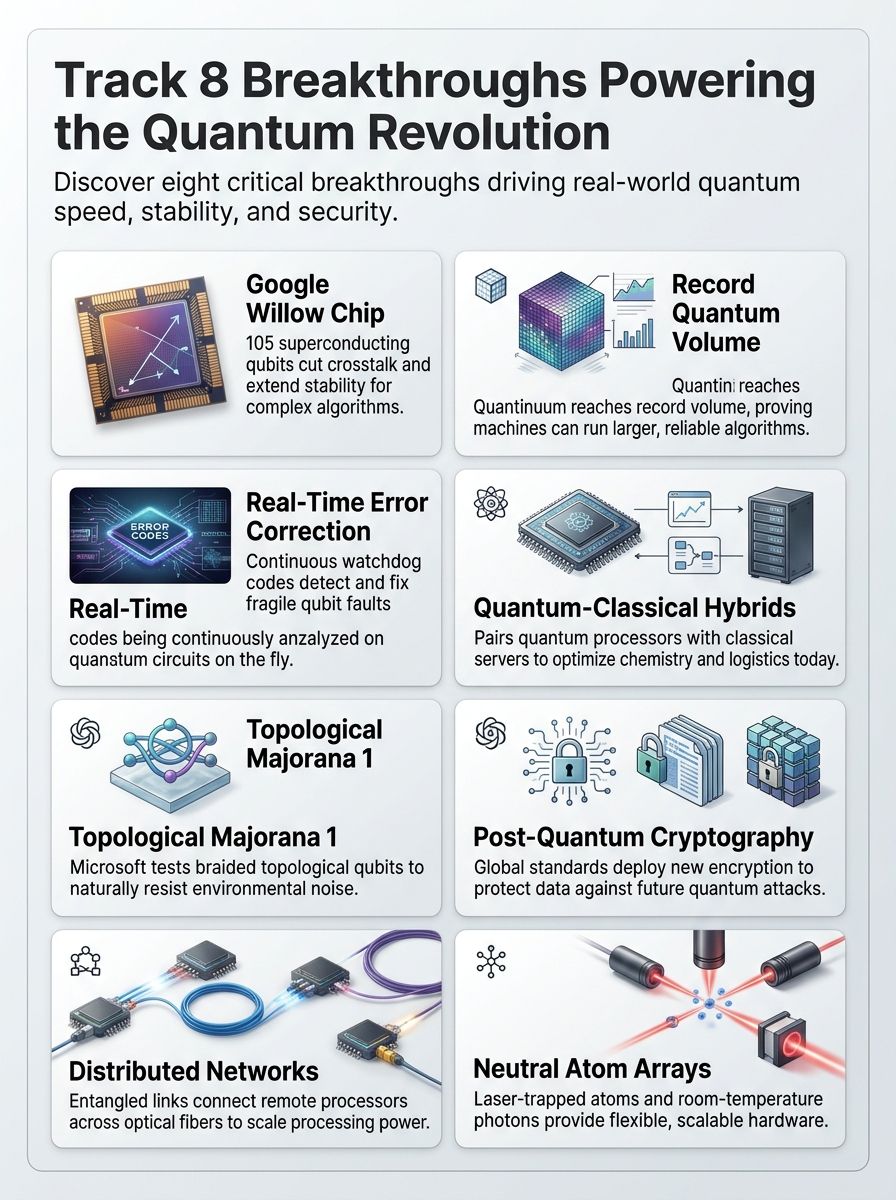
Google’s Willow chip has 105 superconducting qubits on one processor. Its bigger story is not the number alone, it is the way Google used the device to show that quantum error correction can improve as a code gets larger.
In Google’s December 2024 update, the team reported that increasing the surface-code distance from 3 to 5 to 7 lowered the logical error rate at each step. That matters because a logical qubit is built from many physical qubits, and it is the logical qubit that must stay accurate long enough to run useful quantum algorithms.
| Willow metric | What it means for readers |
|---|---|
| 105 physical qubits | Enough hardware to test larger error-correction layouts, not just isolated qubits. |
| About 0.33% average two-qubit gate error in one error-correction configuration | Two-qubit gates are where noise often grows, so lower error rates make deeper circuits more realistic. |
| 909,000 error-correction cycles per second | Fast repeated checks give engineers more chances to spot errors before they spread. |
For readers following quantum machine performance, Willow is a useful filter: ask whether a chip can improve logical-qubit behavior as it scales. A raw qubit total can sound impressive, but error-corrected performance is the harder test.
Breakthrough 2: Record Quantum Volume Achieved by Quantinuum
Quantinuum has continued to push quantum volume, a benchmark that combines usable qubit count, gate quality, connectivity, and circuit depth. It is more informative than counting qubits alone because a machine with fewer, cleaner qubits can run a more demanding circuit than a larger noisy device.
Its 56-qubit System Model H2 reached a quantum volume of 33,554,432 in September 2025. That figure is also written as 225, because each increase in quantum volume represents a doubling of the benchmarked computational space.
Quantum volume does not prove that a computer can solve every business problem. It tells you how well a system handles a demanding randomized circuit under a defined test.
If you compare quantum providers, look beyond a single headline number. Check which benchmark they ran, how many qubits were involved, whether the result came from physical or error-corrected qubits, and whether the workload resembles the task you care about.
Breakthrough 3: Milestones in Quantum Error Correction
Error correction is the bridge between today’s noisy experiments and future quantum machines that can run long calculations. Instead of trusting one physical qubit, researchers encode one logical qubit across many physical qubits and repeatedly measure error clues called syndromes.
The key result from Willow was “below threshold” behavior. Put simply, adding more physical qubits to the error-correction code reduced logical errors instead of creating more opportunities for failure.
- Physical qubits are the fragile hardware units on a chip.
- Logical qubits are protected qubits created from many physical qubits.
- Surface codes organize qubits in a grid so nearby checks can identify likely errors.
- Decoders are classical programs that interpret those checks and recommend a correction.
Researchers at Google, Quantinuum, IBM, QuEra, and university labs are testing different ways to lower logical error rates. The practical lesson is simple: treat a company’s error-correction result as more meaningful when it reports logical error rate, code size, gate quality, and how many runs produced the result.
Breakthrough 4: Development of Quantum-Classical Hybrid Systems
Most useful quantum work today is hybrid. A classical computer prepares data, chooses circuit settings, and checks results, while a quantum processor tackles the part of the calculation that involves difficult quantum behavior.
This approach is already producing serious chemistry experiments. A 2025 IBM-led study used a Heron processor and the Fugaku supercomputer to model iron-sulfur clusters with circuits of up to 77 qubits and 10,570 gates.
| Classical computer role | Quantum processor role |
|---|---|
| Prepares data, updates parameters, corrects and analyzes samples | Generates quantum measurements from the part of the problem that is hard to model directly |
| Handles large-scale storage and repeated statistical work | Represents correlated quantum states in molecules and materials |
| Checks whether the output is stable and useful | Runs the short, carefully chosen quantum circuits |
For anyone evaluating quantum technology, hybrid workflows are the realistic starting point. You do not need to wait for a million-qubit machine to test a focused research problem, but you do need a strong classical workflow around the quantum hardware.
Breakthrough 5: Advances in Topological Quantum Computing With Microsoft’s Majorana 1
Microsoft announced Majorana 1 in February 2025 as an eight-qubit processor built around its topological-qubit approach. The long-term idea is appealing: use special physical states called Majorana zero modes to store quantum information in a way that may be less exposed to local noise.
Microsoft says its Topological Core is designed with a path to a million qubits on one chip. That is an engineering target, not a finished fault-tolerant computer, and independent physicists have said the evidence will need continued testing and replication.
- Why researchers care: topological protection could reduce the amount of error correction needed per logical qubit.
- What still needs proof: stable, repeatable logical operations and error-corrected computation at useful scale.
- What readers should watch: published fidelity data, logical-qubit demonstrations, and results reproduced outside one company.
This is a high-risk, high-reward path in quantum physics. It is exciting because it could simplify scaling, but it should be judged by measured performance rather than future capacity claims.
Breakthrough 6: Expansion of Post-Quantum Cryptography Initiatives
Post-quantum cryptography is a breakthrough you can act on before large quantum computers arrive. It uses new classical encryption methods designed to resist attacks from future quantum machines.
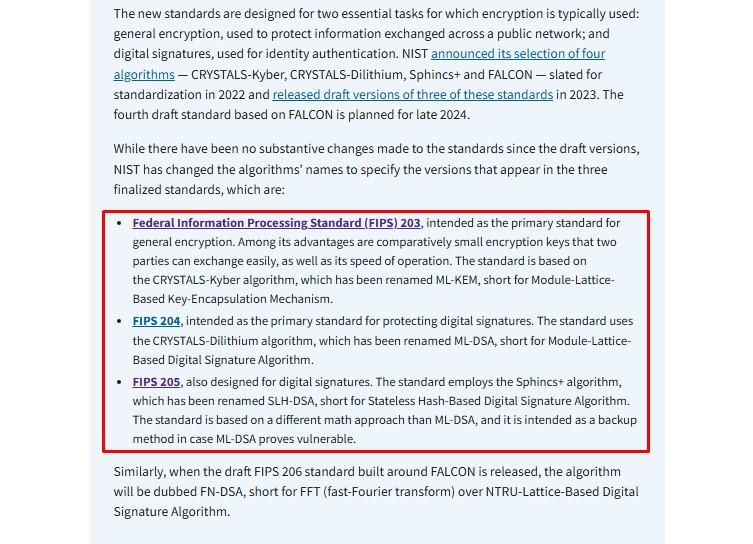
On August 13, 2024, the National Institute of Standards and Technology approved three initial U.S. post-quantum cryptography standards: FIPS 203 for ML-KEM key establishment, FIPS 204 for ML-DSA digital signatures, and FIPS 205 for SLH-DSA signatures.
| Standard | Primary use | Practical next step |
|---|---|---|
| FIPS 203, ML-KEM | Establishing shared encryption keys | Find systems that use public-key key exchange and identify where long-lived data is stored. |
| FIPS 204, ML-DSA | Digital signatures | Inventory code signing, document signing, identity systems, and software-update processes. |
| FIPS 205, SLH-DSA | Hash-based digital signatures | Review it as an additional signature option for systems that need a different security design. |
NIST’s current migration guidance highlights the “harvest now, decrypt later” risk. If your organization holds health, financial, government, or intellectual-property data that must stay confidential for years, start with a cryptography inventory rather than waiting for a quantum computer to threaten it directly.
Breakthrough 7: Progress in Quantum Networking and Distributed Quantum Computing
Quantum networks aim to distribute entanglement between separate devices. If that works at scale, several smaller quantum processors could share quantum resources instead of relying on one enormous machine.
Fiber links, free-space optical links, quantum memories, and repeaters all play a role. A repeater is a device meant to extend a quantum connection by helping entanglement survive over longer distances, much like a relay extends a weak signal.
The Department of Energy’s quantum networking roadmap makes one limitation clear: no quantum repeater had yet beaten an equivalent repeater-free light path in end-to-end efficiency. That makes repeater performance a useful reality check for networking claims.
Distributed quantum computing is still experimental, but the direction is clear. Researchers want networks that can connect computers, sensors, and secure communication systems while using entanglement as a shared resource.
Do not confuse this with a replacement for the internet. Quantum networks will rely on classical networks for control and ordinary data, and they will serve specialized jobs rather than everyday web traffic.
Breakthrough 8: Hardware Innovations in Neutral Atom and Photonic Quantum Systems
Superconducting chips are not the only way to build a quantum computer. Neutral-atom systems trap individual atoms with lasers, while photonic systems encode quantum information in particles of light.
Neutral atoms can be arranged into large, flexible arrays. In March 2026, Google Quantum AI expanded its research into neutral atoms, noting that the platform can be easier to scale in qubit count while superconducting processors can be easier to scale in circuit depth.
| Hardware approach | What it does well | Main challenge |
|---|---|---|
| Neutral atoms | Creates flexible atom arrays and can move qubits into useful patterns with optical control. | Needs highly accurate laser control, fast measurement, and dependable error correction. |
| Photonic qubits | Uses light, which is naturally suited to networking and can work without a dilution refrigerator. | Must manage photon loss, source quality, and the difficulty of making photons interact. |
| Superconducting qubits | Supports fast operations and a mature chip-fabrication path. | Requires extremely cold hardware and careful wiring and control. |
For readers watching quantum innovation, the useful question is not “Which platform will win?” It is “Which platform is showing measured progress on fidelity, logical qubits, control, and manufacturable scale?” Different hardware may fit different jobs.
Predictions for the Near Future of Quantum Computing
Over the next few years, expect more emphasis on logical qubits, error-corrected operations, and hybrid quantum-classical workflows. Raw qubit counts will still make headlines, but stronger reporting will explain the error rates and workload behind the number.
- More chemistry and materials experiments will pair quantum processors with supercomputers.
- Post-quantum cryptography migration will move from planning into system inventories, testing, and deployment.
- Neutral-atom, photonic, trapped-ion, and superconducting teams will keep pursuing different scale and reliability tradeoffs.
- Quantum networks will focus on entanglement distribution, memories, transducers, and repeaters rather than consumer internet service.
The most credible advances will show repeatable measurements, clear classical comparisons, and honest limits. That is a healthier sign of progress than a dramatic claim with no benchmark behind it.
Quantum Computing Breakthroughs: The Path Forward
The path forward for quantum computing runs through better qubits, stronger error correction, smarter quantum algorithms, and practical hybrid systems. Each piece matters because a useful machine must work as a complete system, not as a single impressive chip.
The best way to follow these Quantum Computing Breakthroughs is to watch the evidence: logical-qubit quality, verified benchmarks, useful scientific results, and real progress on post-quantum security.
Quantum computing is no longer just science fiction, but it is not magic either. The next advances will come from patient engineering, careful research, and results that hold up outside the headline.