
The next era of artificial intelligence may not have a single winner. American companies still command extraordinary capital, influential platforms, and some of the strongest frontier models. Chinese developers have shown that formidable systems can emerge under tighter constraints, while wider access to model weights can accelerate adoption far beyond their home market.
The central question is no longer whether China can participate in advanced AI. It is which country and which companies will turn research into affordable, trusted, and useful technology at scale. On that measure, the contest is still open—and the answer may differ for a research laboratory, a small business, and a writer working on a deadline.
The state of the race: A lead that can change
Stanford’s 2026 AI Index documents rapid improvements in technical performance and a narrowing gap between leading US and Chinese models in several measured areas. Such comparisons capture specific tests at specific times; they cannot establish permanent national superiority or predict every real-world outcome.
The United States retains a major financing advantage. The AI Index reports $285.9 billion in US private AI investment in 2025, compared with $12.4 billion in China. These figures concern private investment, not total national spending; they do not capture every form of government support or tell us how efficiently each dollar is used.
Leading US and Chinese models: A practical comparison
The table below is a snapshot of one independent benchmark, not Editorialge’s hands-on test. Artificial Analysis’s Intelligence Index v5.0.1 combines multiple evaluations. Scores are index points, not percentages. Models, settings and the leaderboard can change; a model shown here is not necessarily each company’s newest model when you read this article.
| Developer / model | Country | Index score / setting |
|---|---|---|
| Google — Gemini 4 Carbon (high) | United States | 60 |
| Anthropic — Claude Opus 5.5 (max) | United States | 59 |
| OpenAI — GPT-6 Astra (max) | United States | 57 |
| Google — Gemini 4 Argon (high) | United States | 50 |
| Moonshot AI — Kimi K3.1 Pro | China | 46 |
| Alibaba — Qwen3.8 Max (0902) | China | 34 |
| DeepSeek — DeepSeek V4.1 Flash 1017 (max) | China | 33 |
Source: Artificial Analysis Intelligence Index v5.0.1, observed November 6, 2026. Scores are index points, not percentages. The entries are selected model variants and settings, not the complete leaderboard or a matched-price comparison. Fallback and reasoning settings can affect a result. Scores are not a direct measure of writing quality; the chat products available to readers may use different models.
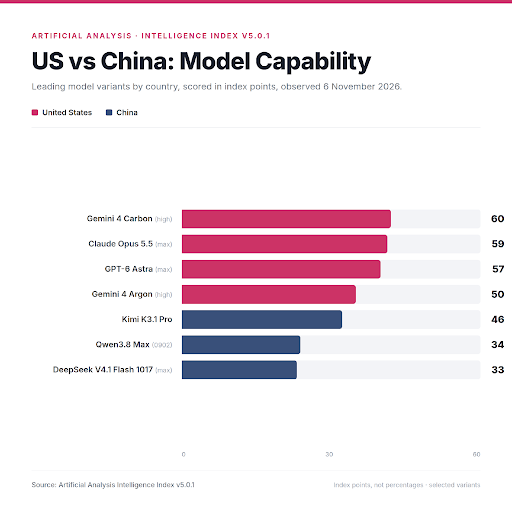
This snapshot puts Google’s Gemini 4 Carbon (high) at 60, ahead of Claude Opus 5.5 (max) at 59 and GPT-6 Astra (max) at 57. Gemini 4 Argon (high) scores 50, Kimi K3.1 Pro 46, Qwen3.8 Max (0902) 34, and DeepSeek V4.1 Flash 1017 (max) 33. These are particular versions evaluated under the index methodology—not a final ranking of each company’s entire model family.
The differences reflect the chosen models, available evaluation results, reasoning effort and the v5.0.1 scoring methodology. Older articles or other tables may use an earlier version of the index, different model variants or a different access date. Their scores should not be combined into a single ranking without checking the methodology.
Google and Alibaba deserve a place in the story. Google’s Gemini family competes at the US frontier, while Alibaba’s Qwen family broadens the Chinese field. In his October 2026 earnings remarks, Google CEO Sundar Pichai said the company was “excited to be leading at the frontier” with Argon and Carbon. That is Google’s assessment; the independently measured scores above answer a narrower benchmark question.
Check the benchmark comparisons directly: Gemini Carbon vs Qwen | Gemini Argon vs Qwen | Claude vs Kimi | GPT vs DeepSeek
Neither these benchmark scores nor the provider’s claims tell a newsroom which assistant writes the best introduction or verifies sources most reliably. That requires a separate, documented task-based comparison.
Where the United States has an advantage
American AI companies benefit from deep venture markets, cloud infrastructure, research institutions and established enterprise relationships. Companies can connect models to software used by millions of customers, making distribution as consequential as laboratory performance. The United States also has an influential position in advanced chip design and the surrounding software ecosystem, even though semiconductor supply chains are global.
Money and access, however, do not guarantee durable dominance. Frontier research is expensive, and high operating costs can limit how widely a model is used. A company that wins a difficult benchmark may still lose customers if competitors offer sufficiently good performance at a much lower total cost.
China’s strengths: Efficiency, scale and distribution
Chinese developers have brought intense competition to both model capability and deployment. Open-weight releases can let outside organizations adapt and deploy a model on their own infrastructure, subject to the applicable license. Open weights do not necessarily mean that training data, code and every other part of the system are open.
For a company in Bangladesh, Africa or Latin America, that distinction can matter more than a national rivalry. The relevant questions may be whether the model can run in a preferred environment, whether the license permits the intended use, and what the complete cost of deployment will be. Open-weight availability is not proof that any particular installation is private or secure: configuration and hosting matter.
Chips and export controls can shape, but not decide, the race
Advanced computing hardware remains a strategic constraint. US export controls affect some chip transactions involving China, while policy and license conditions continue to change. The US Commerce Department revised its review policy for certain semiconductor exports in January 2026; it should not be described as a simple, permanent ban on all AI chips.
Restrictions can increase costs and uncertainty. They can also encourage changes in model design, hardware sourcing and deployment. Neither outcome makes the eventual winner inevitable. Chip availability, energy, manufacturing capacity and research talent all interact over time.
Chinese AI vs American AI in a writer’s workflow

For writers and publishers, a useful test begins with work that resembles a real assignment. Give ChatGPT, DeepSeek, Claude, Kimi, Gemini and Qwen the same brief and source packet. For this article, three practical pairs are ChatGPT vs DeepSeek, Claude vs Kimi, and Gemini vs Qwen. Record the product, exact model when visible, plan, date, settings, browsing and uploaded materials; product names do not guarantee a particular benchmark model is selected.
Then have a human editor check factual errors, invented citations, missed context, clarity and the time needed to make the copy publishable. Repeat the test with several topics. If browsing access, paid features or model settings differ, disclose those differences. A small trial is useful editorial evidence, but it is not a scientific claim that one model is best for everyone.
Editorialge ran this test on November 6, 2026. All six assistants were given the same 100-word writing prompt as signed-in users on their respective services, and every response was captured. The prompt asked for an introduction to this article, explaining the stakes for writers and small businesses, without invented statistics, quotations or personal experience. The exact model version was not displayed in every interface; where it was visible, it is recorded in the captions below.
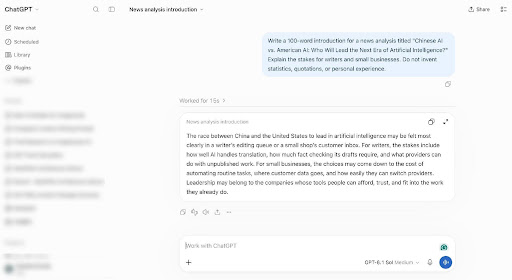
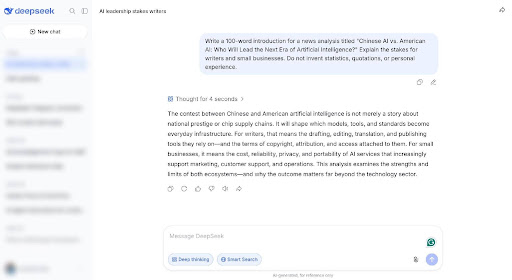
What the pair shows. Both tools answered the two audiences by name. ChatGPT’s GPT-6.1 Sol (Medium) response ran about 100 words and reached in one pass, opening on a writer’s editing queue and a small shop’s inbox, then closing on tools people can “afford, trust, and fit into the work they already do.” DeepSeek’s reply stayed inside the same word budget and leaned on the cost, reliability, privacy, and portability of AI services, preceded by a visible four-second reasoning step. Neither invented a statistic or a quotation, which was the prompt’s explicit constraint. The editor’s remaining work on both is the same: the framing is broad, and a newsroom would still want a sharper opening and any load-bearing figure to come from a checked source rather than the model’s own general knowledge.
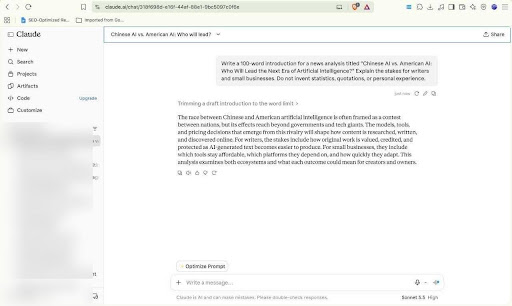
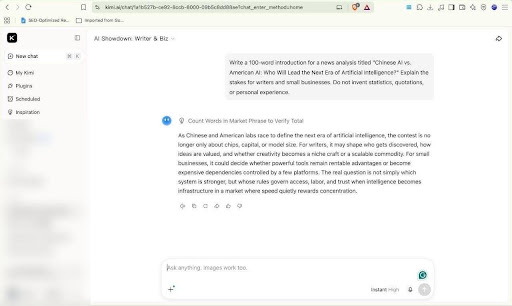
What the pair shows. Claude Sonnet 5.5 (High) produced a measured, essay-like paragraph that named the audience stakes directly—how original work is “valued, credited, and protected”—and kept the 100-word discipline. Kimi, running in its Instant High mode, wrote in the same register and pushed further into consequence, asking whose rules govern “access, labor, and trust when intelligence becomes infrastructure.” Kimi’s reply carried a visible reasoning trace and a slightly more editorial closing cadence; Claude’s stayed flatter and more explanatory. Both avoided unsupported numbers and quotations. As with the first pair, the honest editorial note is that neither answer would publish without added reporting—these are openings, not findings.
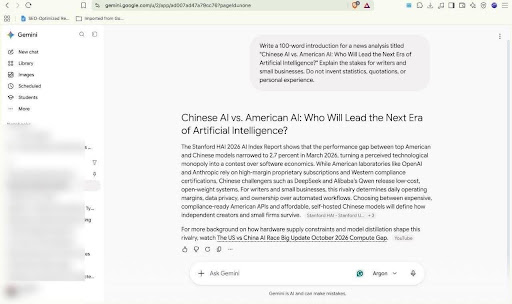
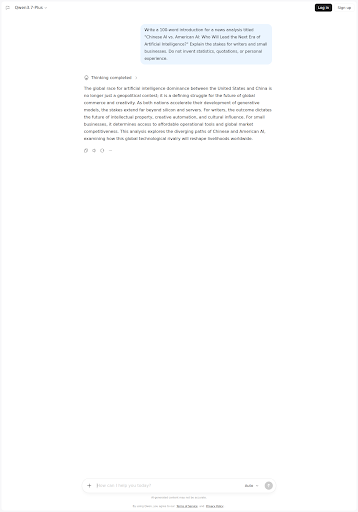
What the pair shows. Gemini answered with a two-paragraph response headed by the article title and grounded its opening in a cited figure: it stated that the performance gap between top American and Chinese models narrowed to 2.7 percent in March 2026, carrying a source chip to the Stanford HAI 2026 AI Index and a link to background video on the compute gap. This is worth flagging carefully. The prompt told every model not to invent statistics, and Gemini complied in the sense that its number was sourced rather than fabricated—but it did introduce a statistic the others left out, which shifts the editor’s work from “check for invention” to “verify an attributed claim.” Qwen, running as Qwen3.7-Plus, produced the most even-handed of the six, splitting its sentences between writers (intellectual property, creative automation, cultural influence) and small businesses (affordable tools, market competitiveness) with no numbers at all. A reviewer would still ask Qwen for a sharper thesis and Gemini for independent confirmation of its cited figure before either went to press.
The evidence above is a snapshot of all six assistants captured on one date under one prompt. It is a snapshot, not a verdict. A single prompt cannot rank writing quality across providers, and the model a reader meets in a chat window may differ from the benchmark variant in the table above.
My Experience as a Writer and AI Platform Founder
As a writer and journalist, and as the founder of ImagineLab.art, I approach AI writing tools with a practical question: do they help people produce work that deserves a reader’s trust? A polished paragraph is useful, but it is only a starting point. The editor still has to assess its facts, choose meaningful context, and make sure the language serves the audience.
My perspective comes from working across publishing and an AI platform. It makes me attentive to the decisions writers face: selecting a model for an assignment, checking its claims and deciding how much revision an answer needs. I would not choose a writing model solely because it leads a benchmark or comes from a particular country. The right choice depends on the task, access, cost, and the quality of the final, reviewed work.
For this article, the documented prompt test covers all six assistants shown above. I ran the same brief across ChatGPT, DeepSeek, Claude, Kimi, Gemini and Qwen, and captured each response. What the test does not do is rank them: one prompt on one day shows how each handled a single assignment, not which model writes best in general.
What users should consider before choosing a model
Start with reliability. Can the system point to sources that actually support its claims? A fluent answer can still contain invented quotations or outdated statistics. Workflow comes next: document handling, collaboration, language support, and integration with existing tools may matter more than an overall score.
Cost and access deserve a look as well. Subscription prices, usage limits, API charges, and regional availability can change. So do the provider’s current data terms and security settings, which matter before anyone enters a confidential document. A model’s country of origin alone does not establish how a particular product stores data, but governance, legal jurisdiction, and hosting deserve careful review.
The last test is fit against the task itself. A low-cost system may be sufficient for brainstorming, while a more expensive model could be worthwhile for demanding analysis. Human review remains essential for facts, quotations, and sensitive decisions regardless of provider.
Three plausible futures for the AI race
A continued American frontier lead: US firms retain an advantage in cutting-edge systems and enterprise distribution, supported by capital and computing resources. This scenario depends on sustaining investment and converting capability into products people can afford.
A Chinese deployment advantage: Chinese developers and their partners spread capable, lower-cost or open-weight models widely. In this scenario, adoption and customization matter more than being first on one benchmark. Successful deployment would still depend on product quality, trust, and local rules.
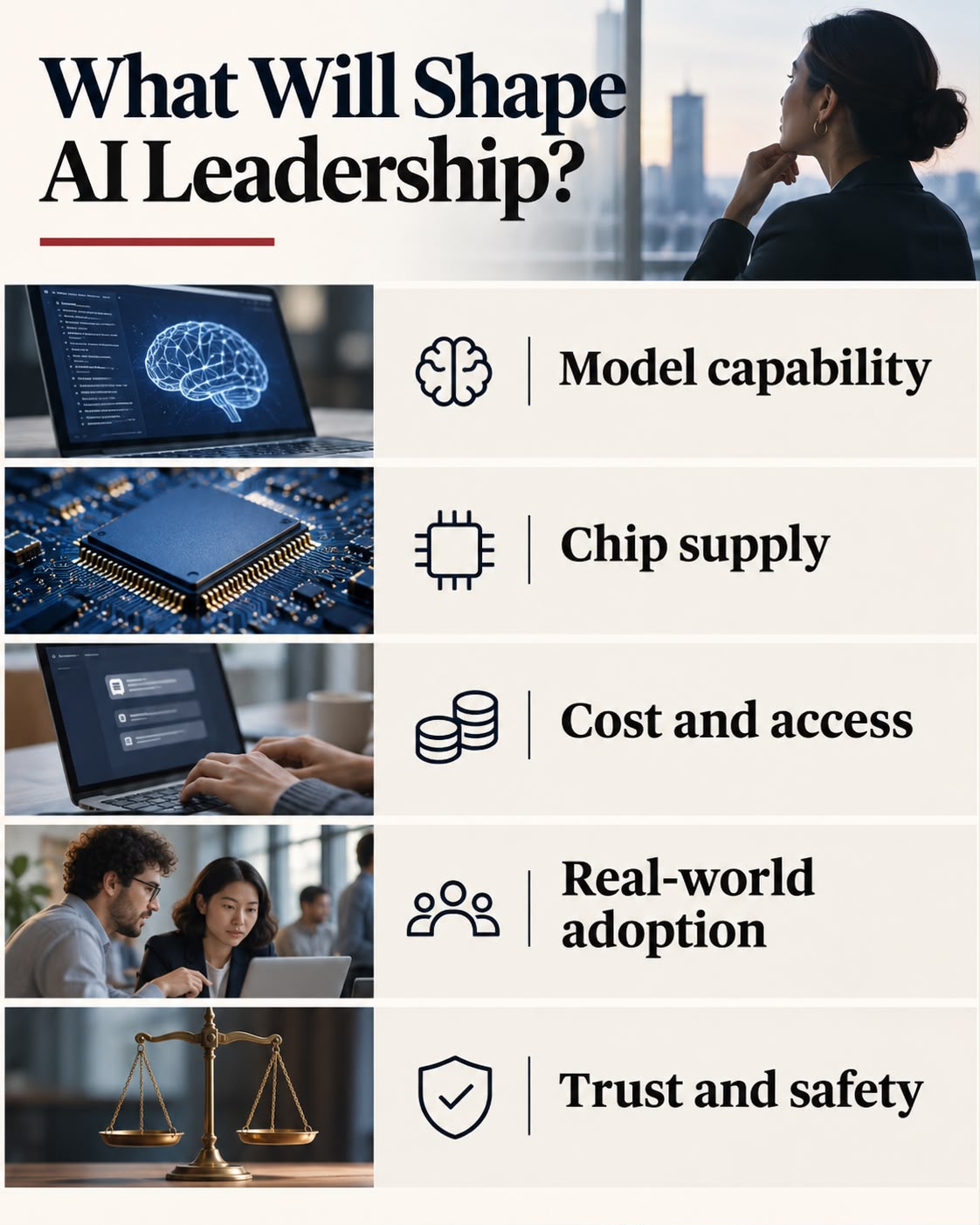
A divided or shared lead: Different companies and countries dominate different layers—research, chips, hosting, applications, or open-weight ecosystems. This is the most plausible outcome in my view. AI is a supply chain and an industry, not a single contest with one finish line.
The bigger question is who benefits
Framing AI as a contest between China and America can obscure the people using it. A publisher wants accurate reporting and trustworthy sources. A small business wants reliable work at a sustainable cost. A student wants an explanation that is correct, accessible, and does not substitute confidence for understanding.
Competition may make stronger tools more affordable, but users will benefit only if they can evaluate claims, understand costs and protect their data. Policymakers, meanwhile, must balance innovation, security and accountability without assuming that capability alone is the same as public value.
Final verdict
The United States enters this phase with significant advantages in capital, infrastructure and frontier development. China has demonstrated a serious capacity to compete and to push adoption through different business and release strategies. The evidence does not justify declaring either side the permanent winner.
The more useful prediction is that leadership will be contested across several fronts at once. For readers and businesses, the best response is to test the tools on real work, verify what they produce, and choose the system that earns trust in practice.