Esports legal issues affect players at every level, from signing a team contract to collecting prize money or promoting a sponsor. The main areas to understand are contract terms, employment status, taxes, age-related rules, intellectual property, advertising disclosures, tournament policies, privacy, and player safety.
The details vary by country, so a rule or protection that applies to one player may not apply to another. Before you sign, compete, or accept a promotion, review the written terms, keep records of payments and obligations, and identify which local laws apply. This guide explains the key risks in plain language and shows when it may be sensible to seek advice from a qualified local professional.
1. Team contracts and player agreements
A team contract can shape a player’s income, schedule, public image, and ability to leave. Before signing, read the entire agreement and check what the team promises as well as what it expects from you.
Pay particular attention to:
- Term and renewal: When does the agreement begin and end? Can the team extend it without your consent?
- Pay and deductions: Is compensation a salary, a stipend, a share of prize money, or a combination? When is it paid, and what can be deducted?
- Prize money: Who receives the winnings first? How soon must the team distribute a player’s share? Are coaches, managers, or the organization also entitled to a portion?
- Termination and transfer: What happens if you are benched, injured, released, or offered a place on another team? Are there exit fees or restrictions?
- Streaming and promotional duties: How many hours must you stream, attend events, or make sponsored posts? Does the team control your channels or their revenue?
- Disputes: Which country’s law applies, and where must a dispute be heard?
Do not rely on a verbal promise that conflicts with the written terms. Ask for unclear terms to be explained and corrected in the document before you sign. A parent or trusted adviser can help younger players, but for major commitments, consider having a lawyer review the agreement.
2. Employment status and working conditions
A contract’s label does not always decide whether you are legally an employee, worker, or self-employed. In Great Britain, government guidance says status should reflect the reality of the working relationship, rather than the category an organization chooses. Status can affect pay and other rights.
For a player, the relevant facts might include who sets practice hours, how closely the team directs the work, whether pay is regular, and whether the player can take on other work. Keep records of schedules, payments, expenses, and messages about duties. If the agreement calls you self-employed but the team controls much of your working day, ask a local labor authority or employment lawyer whether that classification fits your situation. It is a question worth raising before a dispute begins; employment status is one of the esports legal issues that can be obscured by a label.
3. Prize money, sponsorship income, and taxes
Prize money may feel like a one-off reward, but it can still have tax consequences. Salary, streaming revenue, sponsorship payments, merchandise sales, and coaching fees may also need to be reported. The rules vary by country and by the type of income. US tax guidance, for example, provides a tool for certain taxpayers to assess whether a prize or award is taxable; its scope does not cover every player or every country.
Keep the tournament’s payment statement and any records showing deductions. If the team receives the prize first, write down the gross award, the amount withheld, and what you actually received. That paper trail is more useful than trying to reconstruct the split months later. Ask a qualified tax professional in your jurisdiction what to report and whether you should reserve money for a tax bill. For players earning from several channels, this is among the esports legal issues best handled before tax season.
4. Rules for players under 18
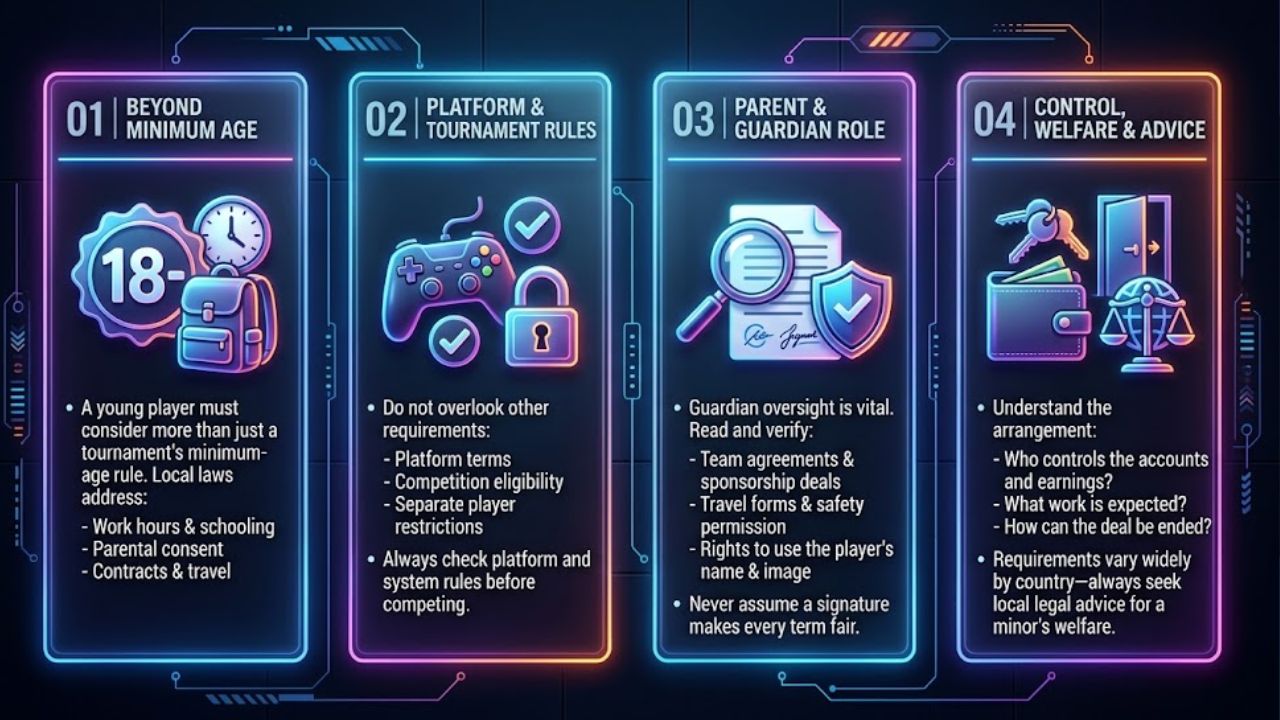
A young player may need to consider more than the tournament’s minimum-age rule. Local laws can address work hours, schooling, parental consent, contracts, and travel. Platform terms and competition eligibility requirements may add separate restrictions.
A parent or guardian should read any team agreement, sponsorship deal, travel form, and permission to use the player’s name or image. Check who controls the accounts and earnings, what work the player is expected to do, and how the arrangement can be ended. Do not assume a parent’s signature makes every term fair or suitable. Requirements vary widely by country, so get local advice before a minor accepts a long-term or paid commitment. These esports legal issues involve a young player’s welfare as much as their competitive future.
5. Copyright, game content, and personal branding
A player may appear in a stream without owning all the material in it. Game visuals, music, characters, logos, and tournament broadcasts can involve rights held by publishers, organizers, or other parties. WIPO’s overview explains that several stakeholders in esports may hold distinct intellectual-property rights.
Before streaming an event or monetizing a highlight reel, check both the publisher’s content rules and the tournament’s broadcast policy. Permission from a streaming platform does not necessarily cover every song or event clip in your video.
Your player handle, likeness, and original videos may also have commercial value. Read the team agreement for the scope and duration of any license to use them, including whether those rights continue after you leave. If you are building a personal brand, unclear ownership terms can become a costly problem later. This balance between your work and others’ rights is central to esports legal issues.
6. Sponsorships and endorsements
Before accepting a sponsorship, pin down what you must deliver: posts, streams, appearances, product use, or exclusivity. Check the duration and termination terms, too. A deal that bars you from working with competing brands may conflict with your team’s existing partners or limit future opportunities.
Players who endorse products may also have disclosure duties. In the United States, Federal Trade Commission guidance says a material connection—such as payment or free products—should be disclosed clearly near the endorsement. It also advises influencers not to rely on someone else to disclose the relationship for them. Other jurisdictions may set different rules.
Be especially careful with claims about health, financial, or gambling-related products. A sponsor’s preferred wording does not make an unsupported claim safe to repeat. Clear terms and honest disclosures protect both your income and your audience’s trust; sponsorships are esports legal issues with reputational consequences as well as contractual ones.
7. Tournament rules and cheating allegations
Tournament rules are not interchangeable. One event may have different requirements for account sharing, anti-cheat tools, eligibility, betting, roster changes, or appeals than another. Read the rules for the specific competition, especially if a suspension or disqualification could affect your season.
If you are accused of a violation, save the notice, relevant messages, and match records. Check the appeal deadline and submit evidence through the stated process. Do not post private evidence or accuse someone publicly while the organizer is still reviewing the matter. Find out who makes the decision, what evidence they can consider, and whether an appeal is available. Treating those rules as fine print can make esports legal issues harder to resolve.
8. Privacy and account security
Tournament registration and team onboarding may require personal information, including payment or identification details. Ask who will receive it, why it is needed, and how it will be stored. Avoid posting your home address, travel schedule, hotel details, or photographs of identity documents.
Use unique passwords and multifactor authentication for gaming, email, streaming, and payment accounts. If a team asks for access to a personal channel, clarify whether it needs account ownership or a limited role. Privacy rules differ by location, but account access should be specific and documented. A compromised account can disrupt your work and expose personal information, which is why privacy belongs among esports legal issues players should address before something goes wrong.
9. Harassment, discrimination, and player safety
Harassment and threats can come from teammates, coaches, fans, or people online. Find out how your team or tournament handles complaints and whether there is a contact outside the coaching or management chain. If something happens, save messages and note dates, locations, and witnesses. For an immediate threat, contact local emergency services or the appropriate authorities.
For a player under 18, parents or guardians should know who supervises them during travel, events, and team activities. Complaint procedures and legal protections depend on the jurisdiction, so seek local guidance when needed. A reporting process that exists only on paper is of little use if players do not know whom to contact.
Final Thoughts
Before signing or competing, keep a copy of the agreement and the event rules, and write down what you are owed and what you have agreed to deliver. Ask questions while there is still time to negotiate. When a decision involves substantial money, long exclusivity, broad rights to your identity, or a difficult exit clause, get qualified local advice. Understanding esports legal issues early gives you a clearer basis for deciding what to accept and when to seek help.
Frequently Asked Questions (FAQs) About Esports Legal Issues
Do esports players need a lawyer?
Not for every event or routine decision. Legal review is most useful before a long-term contract, a broad rights agreement, or a dispute that could affect your income or ability to compete.
Are esports tournament winnings taxable?
They may be. The answer depends on your country and the nature of the payment. Keep payment records and check local tax rules or consult a qualified tax professional.
Can a team use a player’s face or stream content?
That depends on the agreement and applicable law. Check what the team can use, for how long, on which platforms, and whether those rights continue after you leave.