
A legal research answer can look convincing and still be wrong. It may cite a real case but misstate its holding, overlook a later decision, or apply law from the wrong jurisdiction. AI legal assistants can help researchers get oriented faster, but a polished summary is only a starting point.
The practical change is where researchers spend their time. There may be less effort finding search terms and more checking what a system found, what it missed, and whether each source supports the claim. The tools can help organize research; the final analysis still depends on someone who understands the matter and verifies the law.
What AI Legal Assistants Change
Traditional legal research often begins with search terms. A researcher chooses a database, searches by keyword or Boolean operators, narrows results by court or date, then reads the relevant material. Turning a client’s practical question into a useful search takes experience.
AI-powered research adds a conversational layer. A user can describe an issue, specify a jurisdiction, and ask for authorities or a summary. The system may suggest related questions or group cases by theme, giving the researcher a first map of the issue.
Many legal research products pair a language model with a search system connected to legal materials. This approach is often called retrieval-augmented generation, or RAG: the system retrieves documents from a selected collection and uses them to prepare a response. The result depends on the collection, the search process, and the model’s reading of the documents. Links make an answer easier to check, but do not prove that a source supports the claim.
The prompt also needs boundaries. Include the jurisdiction, relevant date, court or level of authority, and facts that could affect the answer. “Find cases about employee dismissal” is too broad for dependable analysis. A better request identifies the legal issue and jurisdiction, asks for binding decisions where relevant, and asks for contrary authority as well as supporting cases.
Where the Workflow Shifts
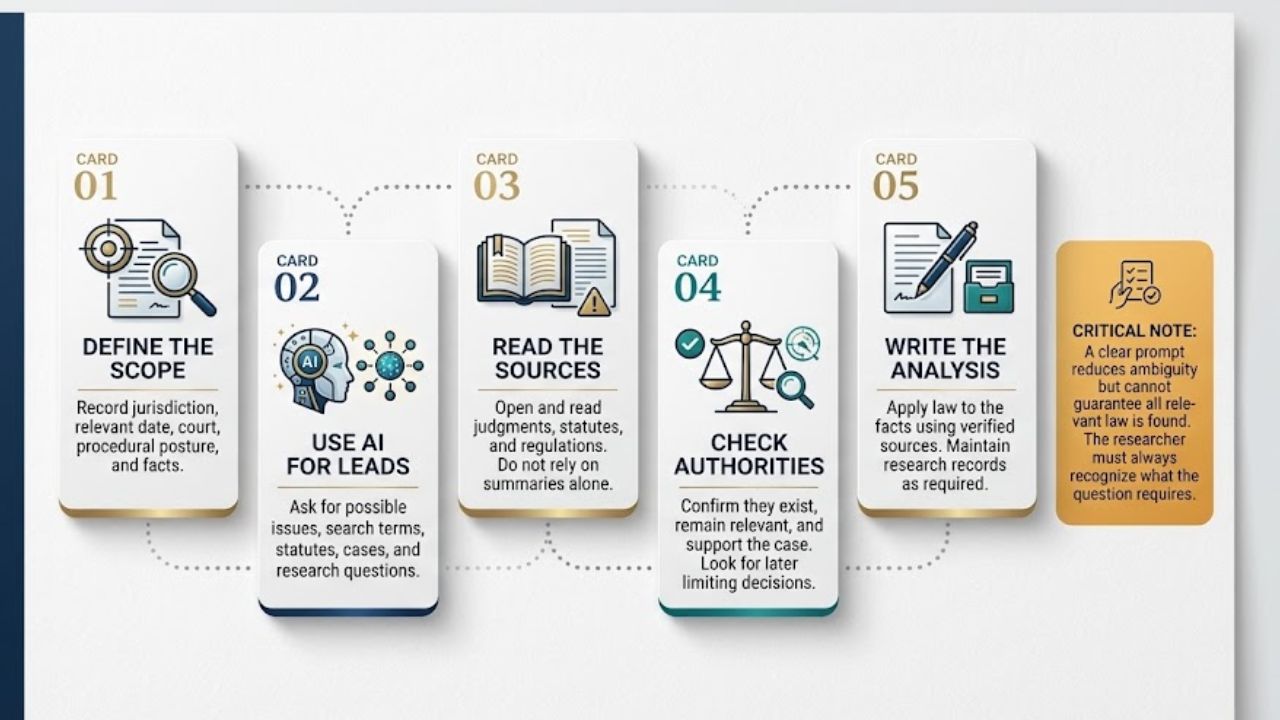
The biggest change is often in the first round of searching and organizing, not in the final legal judgment. AI legal assistants can help identify possible issues, find candidate authorities, summarize a long decision, or prepare an outline for further investigation.
A careful workflow might look like this:
- Define the scope. Record the jurisdiction, relevant date, court, procedural posture, and facts that could change the answer.
- Use AI to find leads. Ask for possible issues, search terms, statutes, cases, and questions that need further research.
- Open the sources. Read the judgments, statutes, regulations, or other primary materials. Do not rely on a generated summary alone.
- Check each authority. Confirm that it exists, remains relevant, and supports the proposition attributed to it. Look for later decisions that limit or reject the rule.
- Write the analysis. Use verified sources to explain how the law applies to the facts. Keep a research record where professional rules or workplace policy require one.
A clear prompt reduces ambiguity; it cannot guarantee that the system found all relevant law. The researcher still needs to recognize what the question requires.
Useful Research Tasks
These tools are most useful when a task involves sorting a large amount of text. A researcher might request a plain-language summary of a lengthy opinion, a comparison of how several courts treated an issue, or a first draft of an issue outline. The benefit is a clearer starting point and less time spent organizing material manually.
Document analysis can help with triage, too. An assistant may extract dates, names, claims, or cited cases from a document set, or flag a possible mismatch between a filing’s description of a case and the source. The researcher must still check whether the extraction is complete and whether the detail matters legally.
Current product pages show how established platforms are adding these functions. Thomson Reuters describes Westlaw Advantage as offering multistep AI research. LexisNexis describes Lexis+ with Protégé as supporting conversational legal research with linked sources and Shepard’s citation tools. These are vendor descriptions of features, not independent evidence of accuracy. Features and availability can vary by country, subscription, and product version.
A general-purpose chatbot may help brainstorm questions or explain unfamiliar terms, but its answer may not draw on a current, jurisdiction-specific legal database. A curated legal collection can make sources more visible. That is a useful workflow difference, not a guarantee that the answer is correct.
What Reliability Research Shows
A 2025 study by researchers affiliated with Stanford and Yale assessed three commercial AI research tools using a set of legal queries. More than one in six queries led Lexis+ AI and Ask Practical Law AI to provide misleading or false information; one-third of the tested Westlaw AI-Assisted Research responses contained a hallucination. The study counted more than invented cases: a response could cite a real source yet misstate it or claim it supported a point it did not.
These figures are not error rates for every product today. The researchers tested particular tools and queries, and the products have since changed. The study does show why a citation alone cannot establish that an answer is sound.
The researchers found errors across different task types, with somewhat higher hallucination rates on jurisdiction-specific and time-specific questions. That is a particular challenge in law: similar language may appear in decisions from different courts, and a rule can change or depend on a procedural detail. A summary can sound plausible while overlooking those distinctions.
For AI legal assistants, speed is only one measure. A useful system should help locate relevant authority, make it possible to check how sources connect to its claims, and show where its answer may be limited. Include verification time when estimating time saved. A fast draft that needs a full rewrite may not save much.
Why Real Citations Can Mislead
Legal errors are not limited to fabricated case names. An assistant may cite a real decision but misstate its holding, attribute a quotation incorrectly, omit a qualification, or apply a rule from the wrong court. It may also miss a later decision that changed the law or a contrary case that should be addressed.
In Mata v. Avianca, a 2023 U.S. federal case, lawyers filed submissions containing nonexistent cases and quotations generated with ChatGPT. The court’s sanctions order focused on the lawyers’ failure to verify the material; it did not treat AI use itself as the misconduct. In June 2026, the Ninth Circuit’s order in Lnu v. Blanche addressed fabricated citations, misattributed quotations, and misrepresentations of real cases. It likewise distinguished using AI during research from filing unchecked errors and making later false statements.
These U.S. cases do not establish a global rule. They illustrate a practical point: responsibility remains with the person who relies on and submits the work. In England and Wales, the Solicitors Regulation Authority’s August 2026 warning notice also emphasizes verification, confidentiality, and effective supervision. Lawyers should check the rules and court requirements that apply in their own jurisdiction.
How to Verify an Answer
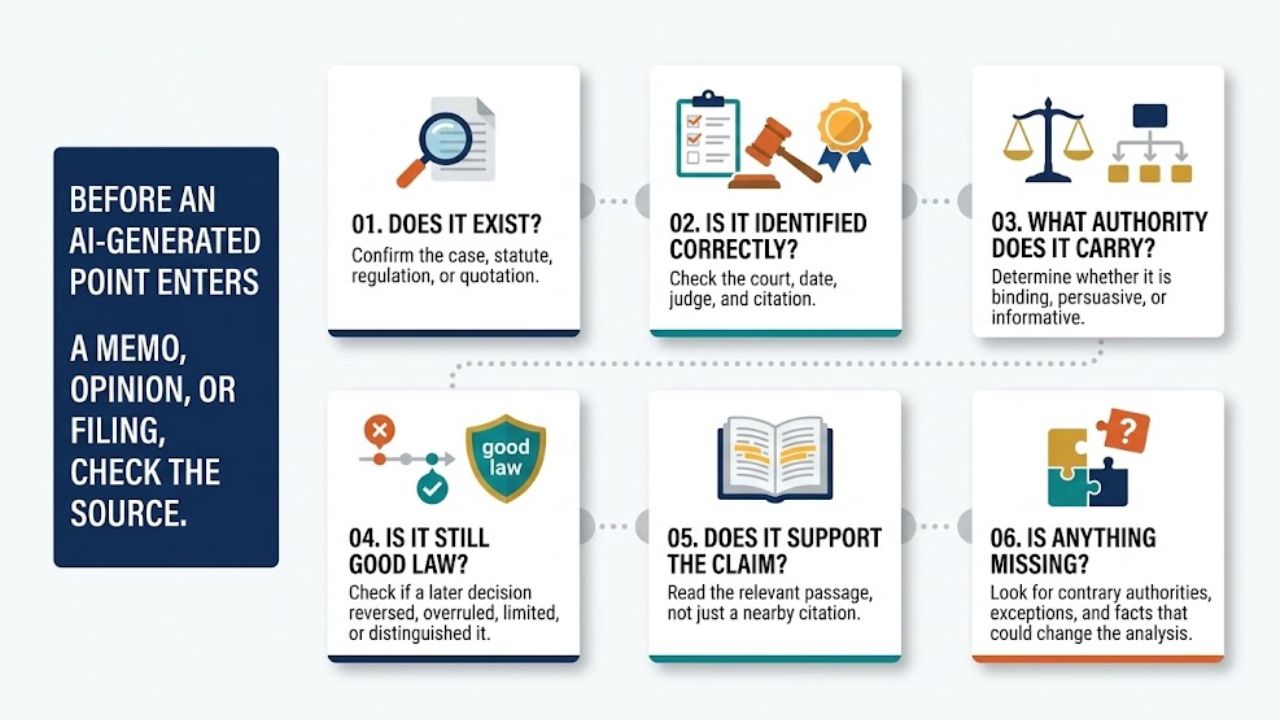
Before an AI-generated point enters a memo, opinion, or filing, check the source itself. Ask:
- Does it exist? Confirm the case, statute, regulation, or quotation.
- Is it identified correctly? Check the court, date, judge, and citation.
- What authority does it carry? Determine whether it is binding, persuasive, or informative for the issue.
- Is it still good law? Check whether a later decision reversed, overruled, limited, or distinguished it.
- Does it support this claim? Read the relevant passage, not just a nearby citation.
- Is anything missing? Look for contrary authorities, exceptions, and facts that could change the analysis.
Citation tools can help show how later decisions treated a case, but a status indicator is a lead for review. It does not replace reading the decisions or checking how the rule applies.
Researchers can test the system’s framing by asking what facts might change the result, which authority points the other way, and whether the answer depends on a particular court or date. These questions may expose gaps; they cannot prove that the system’s list is complete.
A short research record helps colleagues review the work. Note the question and jurisdiction, the sources opened, errors corrected, and the tool’s role in producing a draft. That gives another lawyer a clearer path from the original question to the final analysis.
Client Data and Professional Duties
Legal research can involve confidential facts. Before entering client material into an AI product, a firm should understand how the service stores, uses, and protects that information. Find out whether prompts or documents are retained, whether they may be used to improve a model, who can access them, and what happens when an account or service ends.
A product’s legal focus or sign-in screen does not answer those questions. Use tools approved for the matter and follow client instructions, engagement terms, firm policy, and applicable privacy and professional rules. Remove identifying details from exploratory prompts where possible. If sensitive information must be processed, confirm that the tool and its contractual protections are suitable before uploading it.
The American Bar Association’s Formal Opinion 512 is one example of U.S. professional guidance. It discusses lawyers’ duties involving competence, confidentiality, client communication, reasonable fees, and supervision when they use generative AI. The opinion is based on the ABA Model Rules; those rules and ethics opinions do not apply identically in every jurisdiction. The SRA’s guidance in England and Wales also says solicitors remain accountable for AI-assisted work and must supervise it effectively.
These duties affect firm operations as well as individual research habits. Teams need clear policies for approved tools, training, review responsibilities, client data, and escalation when an answer looks questionable. Convenience does not remove the need for oversight.
How to Choose a Tool
A firm evaluating AI legal assistants should test them on realistic work from its own practice. Include routine questions, jurisdiction-specific and date-sensitive issues, prompts with false assumptions, and questions that require contrary authority. Compare the results with a human-verified research baseline.
Measure the whole task: prompting, opening sources, checking citations, correcting errors, and preparing the final work. Also assess whether the system helps locate useful sources, makes those sources easy to inspect, and fits the firm’s data-protection requirements. Include the people who will use and supervise it in the pilot.
Summarizing public documents, generating search terms, or preparing an issue list can be sensible starting points. Work that may affect advice, a client decision, or a court filing calls for closer review. Reassess performance as systems, source collections, and professional requirements change.
For law students and researchers, a legal assistant can help explain unfamiliar language or suggest a route into a topic. It should not replace learning how to locate and read primary authority. For people without lawyers, an AI explanation may offer a starting point, but it is not a dependable assessment of their rights. Consult official legal sources or a qualified professional in the relevant jurisdiction.
Final Thoughts
AI legal assistants can make the first steps of research easier, but their answers need a human check before they shape advice or appear in a filing. Start with a bounded, lower-risk task, compare the output with primary sources, and measure the time spent correcting it. That is a more useful test than how confident or polished the answer sounds.
Frequently Asked Questions (FAQs) About AI Legal Assistants
Does RAG prevent legal research errors?
No. RAG can give a model access to selected documents, but the model may still retrieve an incomplete source set, misread a passage, or draw the wrong conclusion from a real case.
Should a firm rely on a vendor demonstration to choose a tool?
A demonstration can show the interface, but it is not a substitute for testing realistic work. A firm should check its own jurisdictions, practice areas, and review process, then estimate the time needed to verify and correct answers.
Do legal AI tools cover every jurisdiction?
No. Coverage can depend on the product, subscription, country, and source collection. Before a pilot, confirm that the service includes the courts and materials your team needs, then test it on questions from that jurisdiction.