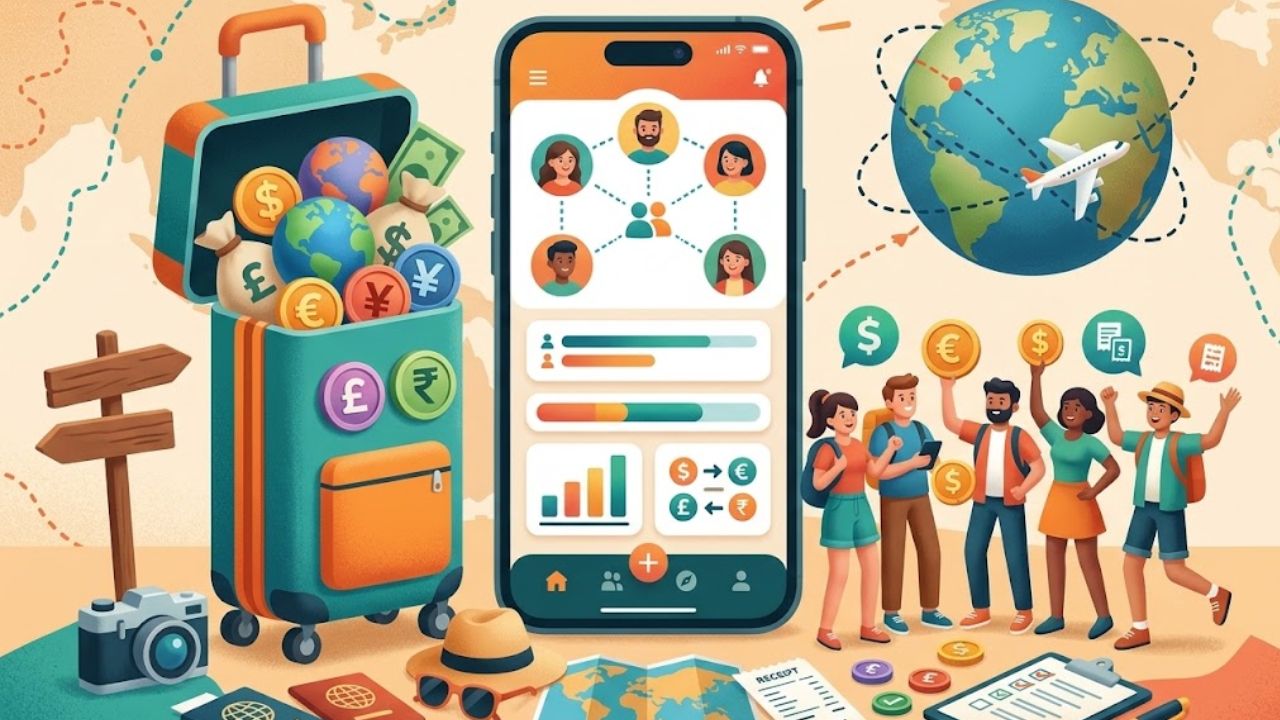
Money can be spread across a current account, credit card, savings account, and payment app. Bringing those pieces together takes time, and it is easy to miss a subscription or misjudge how much is available before payday. Open banking and personal finance are becoming more closely linked because authorized services can use customer-approved account data to help with everyday money tasks.
That access can support budgeting, payments, saving and product comparisons. It does not automatically make any of them cheaper, safer or more accurate. The eight changes below move from routine money management to decisions with greater privacy and credit implications; they are not a ranking.
Open Banking and Personal Finance: What Changes
Open banking lets a customer authorize a third-party provider to access specified account information or initiate a payment through a secure connection. In many services, the customer signs in through their bank rather than giving the provider their banking password.
Rules and services differ by region. EU rules under PSD2 cover account information and payment initiation services. In the UK, HMRC offers an open banking option for paying directly from a bank account through an authorized provider. In the United States, the CFPB says a court stayed the compliance dates for its Personal Financial Data Rights Rule in October 2025; the agency’s page, last modified in January 2026, also describes possible amendments. That rule should not be presented as fully in effect. Open banking and personal finance therefore mean different things depending on where someone lives and which providers they use.
1. Several Accounts can Appear in One Money View
A person might receive a salary into one account, pay bills from another, and use a credit card for daily purchases. A budgeting service with access to participating accounts can bring transactions into one dashboard. That can make it easier to see the household picture without copying figures into a spreadsheet.
The benefit is visibility, not perfect bookkeeping. An app might misclassify a transfer between the user’s own accounts or fail to recognize a merchant. Some accounts may not connect, and transactions may not refresh immediately. Check account coverage and update frequency before relying on the dashboard to decide on a bill or balance. Open banking and personal finance are most useful here when the app saves time while still letting the user correct its work.
2. Budgets can Reflect What Actually Happened
A monthly budget often begins with estimates. Transaction data can help compare those estimates with actual spending. Someone might notice that grocery costs have risen over several weeks or that a bill is higher than expected.
Alerts can help, too, if the selected service offers them. A low-balance notification may give someone time to check an upcoming payment, but it cannot predict every expense or prevent an overdraft by itself. Automated categories and forecasts are best treated as prompts for review. They are not a substitute for checking the underlying transactions. This is a grounded use of open banking and personal finance: the software organizes the information, while the person decides what to change.
3. Saving May Follow Cash Flow More Closely
Some services may use account activity to help a customer set a savings routine—for instance, by moving a chosen amount after income arrives. That may suit a person whose pay varies from week to week better than a fixed transfer scheduled for the same day each month.
Automation can also create a shortfall. If a service does not account for a bill due tomorrow, a transfer could leave too little in the spending account. Before enabling automatic moves, check how the amount is calculated, when it transfers and how to stop or reverse it. Also confirm where the savings are held and what protections apply in that country. Open banking and personal finance can make saving easier to organize, but the user still needs to set a realistic rule.
4. Paying Directly from a Bank Account becomes Another Option
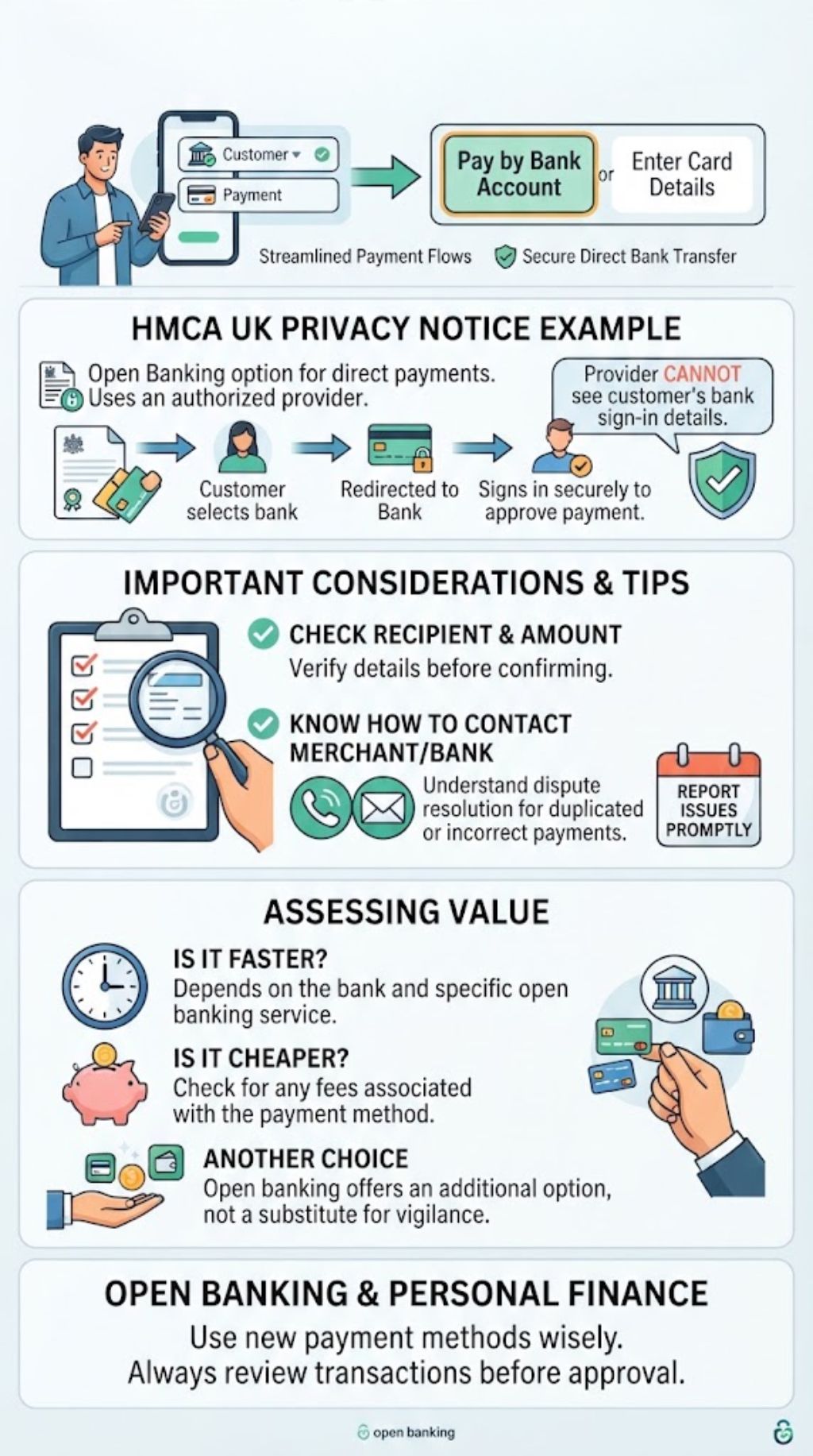
Some payment flows let a customer approve a transaction through their bank instead of entering card details. HMRC’s UK privacy notice describes an open banking option for paying directly from a bank account through an authorized provider. The customer is sent to their bank to sign in and approve the payment. The notice says this method is optional and that the provider cannot see the customer’s bank sign-in details.
That example shows how the process can work; it does not establish that every provider follows the same arrangement. Check the recipient and amount before confirming, and know how to contact the merchant or bank if a payment is duplicated or incorrect. Whether this method is faster or cheaper depends on the bank and service. Open banking and personal finance should offer another payment choice, not a reason to approve transactions without checking them.
5. Recurring Payments May Allow More Flexibility
A customer may authorize a third party to manage recurring transactions under agreed terms. In the UK, the Financial Conduct Authority describes variable recurring payments as a way to authorize trusted providers to manage recurring payments, with the amount or timing varying according to the arrangement.
This could fit a changing bill better than a fixed amount. The details matter: check which company can collect money, whether limits apply and how to cancel the authorization. Do not assume that a recurring permission is harmless because the first payment was correct. Review account activity after setup, and keep track of how to withdraw consent.
6. Lenders May Consider a Fuller Financial Picture
A lender may use customer-authorized transaction data alongside other application information. For someone with a short credit history, regular income or a consistent record of paying expenses could add context. But that information might also show irregular income or low balances.
Sharing data does not guarantee a loan, a lower rate or a fairer decision. Before connecting an account, ask what information the lender will use, how long it will retain it and whether it could affect eligibility or pricing. Compare the full cost and terms with other offers. Here, open banking and personal finance meet a consequential decision: disclose only what you understand and are comfortable sharing.
7. Product Comparisons Can Start with Real Spending
A service with permission to review account activity might help identify recurring bills or balances that matter when comparing financial products. That can make research easier than gathering every figure by hand.
But comparison tools may not include every provider. Their recommendations can also reflect commercial relationships or the limited data they receive. Ask which products are included, how the service earns money, and whether an offer is available in your country. Treat a recommendation as a starting point, then check the provider’s terms yourself. Open banking and personal finance can make comparisons more informed, but they cannot decide which product fits a person’s priorities.
8. Data Permissions become Part of Money Management
A budgeting app may request transaction history; a payment service may ask permission to initiate transactions. Those are different types of access. Read the consent screen rather than treating “connect account” as a single, harmless step.
Verify the provider through the relevant regulator or official directory. Check what data it wants, how long access lasts and how to revoke it. Be cautious if an app asks you to share a bank password or one-time code outside your bank’s own sign-in process.
A secure connection does not guarantee that every provider handles data responsibly, and protections differ by country. HMRC’s notice says its payment provider cannot see customers’ bank sign-in details, but that statement applies to the HMRC process described—not every app. Open banking and personal finance require attention to consent even when the setup feels routine.
Using Open Banking with Care
Start with one specific task, such as reviewing spending across accounts or paying a bill. Then give the service only the access needed for that task.
Before connecting an account, check the provider, read the permission screen and find out how to end access. Keep checking your statements after setup. For a loan, large payment or savings decision, confirm key figures yourself rather than relying only on an app’s summary.
Final Thoughts
The strongest everyday case for open banking and personal finance is convenience: less manual record-keeping and a clearer view of scattered transactions. The weaker promise is that sharing data will automatically improve someone’s financial position. That depends on the quality of the data, the service’s design and the consumer protections available.
Choose a tool because it solves a specific problem. Before connecting an account, make sure you know who receives the data, what they can do with it and how to end access.
Frequently Asked Questions (FAQs) on Open Banking and Personal Finance
Is open banking safe?
It can use secure, authorized connections, but safety depends on the provider, the permissions granted and local protections. Verify the provider and read the consent details before linking an account.
Does open banking give an app unlimited access to my account?
The access should be tied to the permission and service, but the exact data, duration and controls vary. Check what you approved and how to revoke it.
Can open banking improve my credit score?
Not by itself. A lender may consider authorized account data, but sharing it does not guarantee approval, better terms or a higher score.
Is open banking available everywhere?
No. Availability depends on local rules, banks and services. A feature supported in one country may not be available in another.