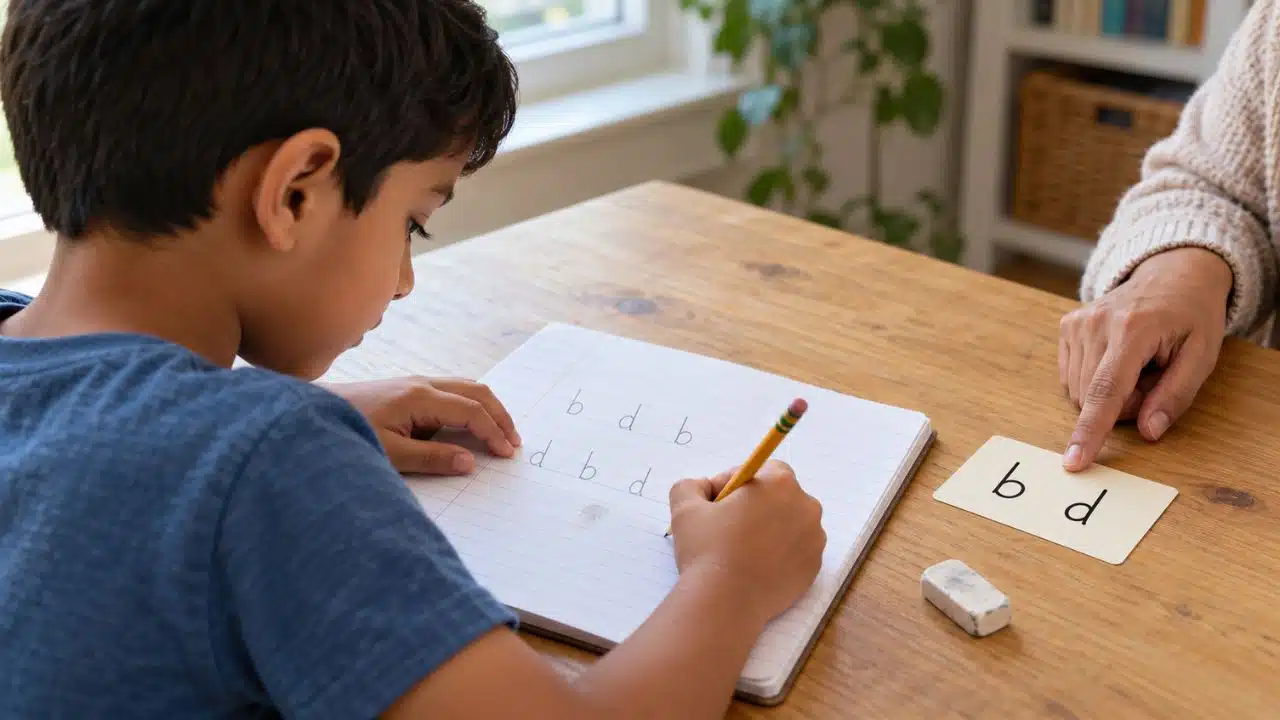
Watching my nephew Fariz learn his letters gave me a personal reason to look more closely at phonics vs sight words. Uppercase letters came more easily at first. Later, I noticed him becoming more comfortable with lowercase letters and letter sounds. He reads and spells comfortably now.
For a child beginning to read English, my recommendation is to make systematic phonics the foundation and introduce useful common words alongside it.
The important detail is what “sight word” means. A word a child recognises immediately may have become familiar through sounding it out and practising it. Phonics and sight-word recognition are closely connected.
Should Phonics or Sight Words Come First?
Start with letter–sound relationships and show children how to use them to read words. This gives a beginner a way to approach an unfamiliar word.
“Systematic” means the teaching follows a planned progression. Children practise what they have learned, then build on it. Knowing letter names is useful, but reading also requires connecting letters with sounds and blending those sounds into words.
The US What Works Clearinghouse identifies strong evidence for teaching awareness of speech sounds linked to letters and for teaching decoding: working out written words using their spellings.
Common words belong in that learning too. In, for example, can be read using straightforward letter–sound relationships once those have been taught. Other common words need an explanation of an unusual or unfamiliar spelling.
Children do not have to learn every phonics pattern before reading sentences. Introduce useful common words as part of their reading practice, explaining the parts they cannot yet work out independently.
Phonics vs Sight Words: What the Terms Mean
These labels describe different things. Understanding the difference makes it easier to choose useful practice.
| Term | What it means | Simple example |
| Phonics | Learning how letters and letter groups represent sounds, then using that knowledge to read and spell. | Blending the sounds represented by m–a–t. |
| Sight word | Any word a particular reader recognises automatically. | Cat can become a sight word after learning and practice. |
| High-frequency word | A word that appears often in text. | In and said. |
| Common exception or tricky word | A word containing an unusual sound–spelling relationship or one not yet taught. | The ai in said needs attention. |
A word can belong to more than one category. Said is common, contains an unusual spelling, and may already be a sight word for a confident reader.
You may also hear phonemic awareness: noticing and working with individual sounds in spoken words. Hearing the separate sounds in “mat” involves phonemic awareness; connecting them to written letters brings in phonics. These skills can develop together.
How Sounding Out Helps Words Become Familiar
Reading researcher Linnea Ehri describes a process called orthographic mapping: connections between a word’s spelling and pronunciation help establish it in memory.
For a beginner, mat may initially require careful blending. With accurate learning and practice, recognising it can become easier. The child connects the written word with its pronunciation and meaning.
This is how sounding out can support automatic word recognition. As more words become familiar, children can read them with less effort and give more attention to what the text means.
There is no universal number of repetitions that guarantees this change. Children need opportunities to read accurately, revisit words, and meet them in meaningful text.
How to Teach Phonics and Common Words Together
For home practice, I would keep the steps simple and follow the sequence the child is learning at school.
Begin With Letter–Sound Links the Child Knows
Ask the teacher which letters and sounds your child is learning and how they say the sounds. This helps keep home practice consistent with school.
Choose a word made from patterns the child has already been taught. If they know the sounds represented by m, a, and t, those letters offer a useful starting word.
Word length alone is not a reliable guide. The has only three letters, but reading it requires more than knowing the first sounds usually taught for t, h, and e.
You can begin aloud: say the separate sounds in a familiar word and help the child blend them. Then show how those sounds connect with their written form.
Show How to Blend and Build a Word
Write mat. Point to each letter and say its sound: the m sound, the short a sound heard in apple, and the t sound. Use the sounds, rather than the letter names “em,” “ay” and “tee.”
Move your finger from left to right as you demonstrate joining the sounds into mat. If the child can say the separate sounds but cannot combine them, show that blending step again and let them try with your help.
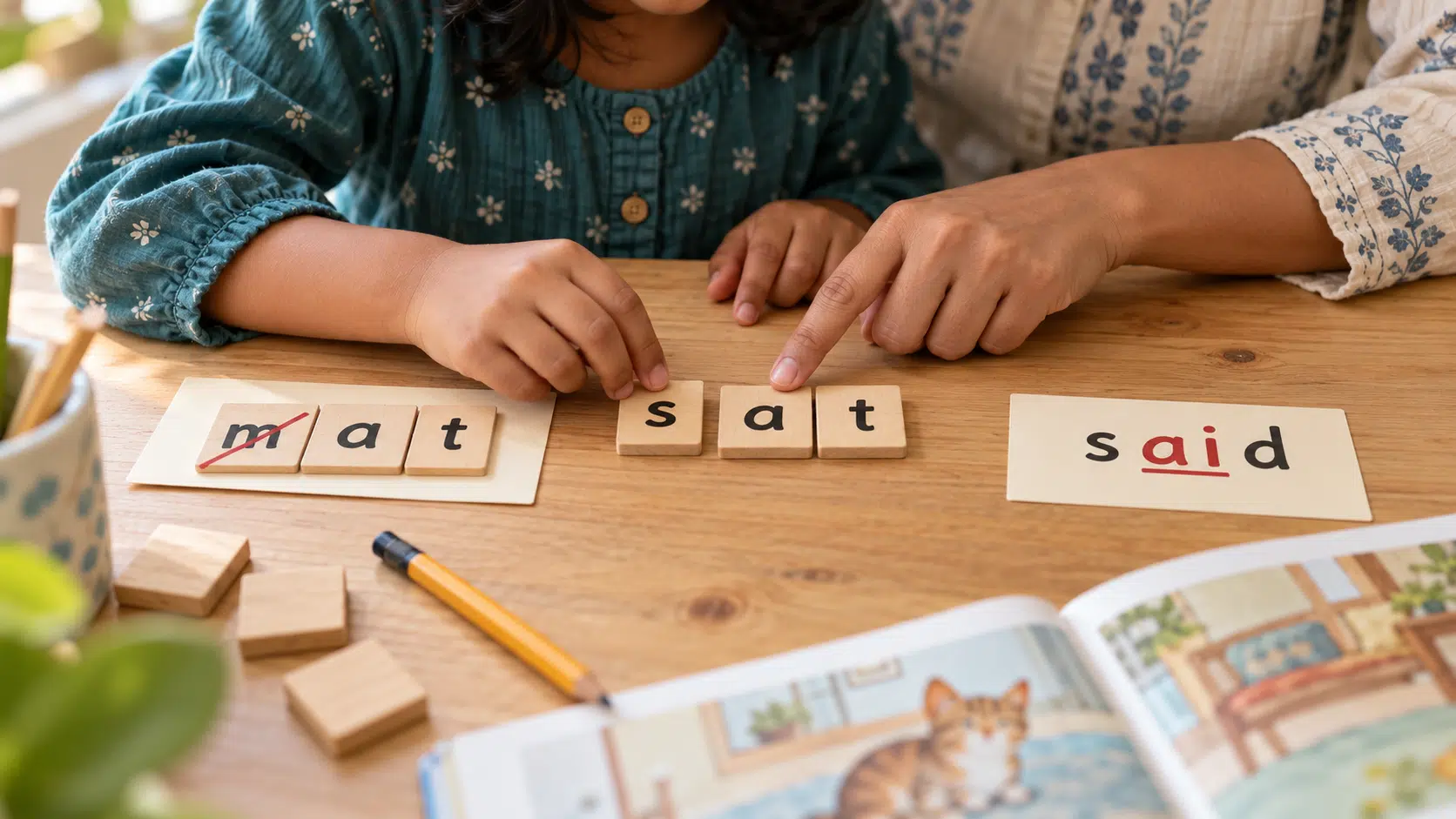
Once s is familiar, change mat to sat. Ask what changed, then help the child read the new word.
Letter tiles are useful when handwriting takes a lot of effort. They allow the child to arrange letters and practise reading the word while writing develops with support.
Explain the Unusual Part of a Common Word
The word said shows how a common word can contain both familiar and unusual parts.
Say the word and check that the child understands it. Then show its spelling as s – ai – d. The s and d represent their usual sounds. In this word, ai represents the vowel sound heard in bed. This gives the child something specific to remember: which part has an unexpected sound.
Some programmes, including the University of Florida Literacy Institute’s, call these “heart words” and mark the unusual part with a heart. The mark draws attention to the spelling that needs extra help.
A word can also be tricky simply because its pattern has not been taught yet. Me becomes more straightforward once the child knows that e can represent its letter-name sound.
Read, Spell and Revisit the Word in Context
After teaching a word, help the child read it in a short sentence. For said, try Sam said yes, provided the other words and their spellings are familiar. Talk briefly about what the sentence means.
Invite the child to build or write the word, check it against a model, and read it again. Return to it later in another suitable sentence.
If the activity becomes frustrating, simplify it. Return to a known word or demonstrate the difficult part. Keep the practice short enough for the child to participate comfortably.
Keep Stories and Conversation Part of Learning
A child can pronounce a word without understanding it. Vocabulary and comprehension need attention alongside word reading.
For the child’s own reading practice, choose books that closely match the spelling patterns and common words they have learned. The teacher can help you find suitable texts.
When you read aloud, choose stories with richer language too. Explain unfamiliar words, ask what might happen next, and talk about the characters. A child can enjoy and understand a story they cannot yet read independently.
If the child is learning English alongside another language, check the meaning of practice words as well as their pronunciation.
Where Educational Learning Apps Helped
Our team at Editorialge developed Alphabet Magic Trace & Phonics, which I have used with my nephew Fariz. It includes uppercase and lowercase tracing, letter matching, phonics activities, and spelling practice.
One observation that stayed with me was his recognising letters beyond the screen, including in books. Books, toys, and other activities were part of his learning, so I cannot attribute that progress to the app alone.
I see the app as an opportunity for extra practice. For a beginning reader, a suitable activity can review something already taught. Then help the child use those letters to build and read a word on paper or with tiles.
Completing a tracing activity does not, by itself, show that a child can read a new word. That next step needs its own teaching and practice.

What I Look for Beyond a Familiar Word List
For me, a familiar word list is only part of the picture. These everyday observations are useful too:
- Can the child attempt a new word containing spelling patterns they have been taught?
- Can they recognise a practised word in another sentence?
- Can they explain the meaning of a simple sentence they have read?
If a child already knows several common words, build on that knowledge. Help them notice the letters and sounds within those words and use those connections when learning new ones.
If reading remains difficult despite suitable teaching and practice, speak with the teacher. Bring a specific example and ask whether the difficulty involves letter–sound knowledge, blending, or understanding the words. Ask what additional teaching or assessment might help; there is no need to wait for a particular birthday to raise a concern.
A Useful Starting Point for Your Next Reading Session
Choose one short word made from letters and patterns your child already knows. Help them blend it if needed, check its meaning, and read it in a suitable sentence. Explain an unfamiliar spelling when one comes up.
That is where I would put the emphasis: helping a child understand how a word works, recognise it more easily with practice, and use that knowledge when the next word appears.
Frequently Asked Questions on Phonics vs Sight Words
1. Do Children Need to Know All 26 Letters Before Blending Words?
No. They can begin blending words made from a small set of letters and sounds they have been taught, while continuing to learn more.
2. What Should I Do With a School Sight-Word List?
Ask the teacher how the words are being taught and which spellings need special attention. Follow those explanations at home, help the child connect letters with sounds, and revisit the words in suitable sentences.
3. Should My Child Sound Out Words They Already Know?
If they recognise a word accurately and immediately, let them read it. They do not need to sound it out every time. Keep practising how to work out unfamiliar words as well.
4. Should I Stop Using Sight-Word Flashcards?
You can keep them for reviewing words that have already been explained. Draw attention to letters and sounds, vary the card order and practise the words in sentences too. Cards are one practice tool, rather than the whole reading lesson.
5. How Many New Words Should We Practise at Once?
Begin with a few, leaving time to explain, read, spell and revisit each one. Adjust to the child’s response and the teacher’s guidance. Covering a long list is less useful than learning a manageable selection accurately.