A machine slows down, a production line develops a bottleneck, or a building uses more energy than expected. A business needs to understand what is happening before it decides what to change. Digital twins technology can help by connecting a digital representation of a real asset or process to information about how it is operating.
The model might help a team monitor conditions, test a proposed change, or estimate what could happen next. Its value depends on the quality of the data and whether people can act on what it shows.
What Is a Digital Twin?
A digital twin is a digital representation of a physical object, process, or system that is updated with information about its real-world counterpart. That information might include sensor readings, maintenance records, design specifications, or operational data.
The word “twin” can suggest a perfect copy. That is rarely necessary. A model designed to track a machine’s temperature, for example, may not need to represent every detail of its construction. It needs to be accurate enough for the task it is meant to support.
Definitions vary across industries. The National Academies describes a digital twin as a virtual representation updated with data from its physical counterpart, with predictive capabilities that can inform decisions. Its definition also emphasizes interaction between the digital and physical systems.
That interaction does not always mean automatic control. A machine may send data to a dashboard, where a technician reviews an alert. In another setup, the model may recommend an adjustment that a person approves before it reaches the equipment.
How Digital Twins Technology Works
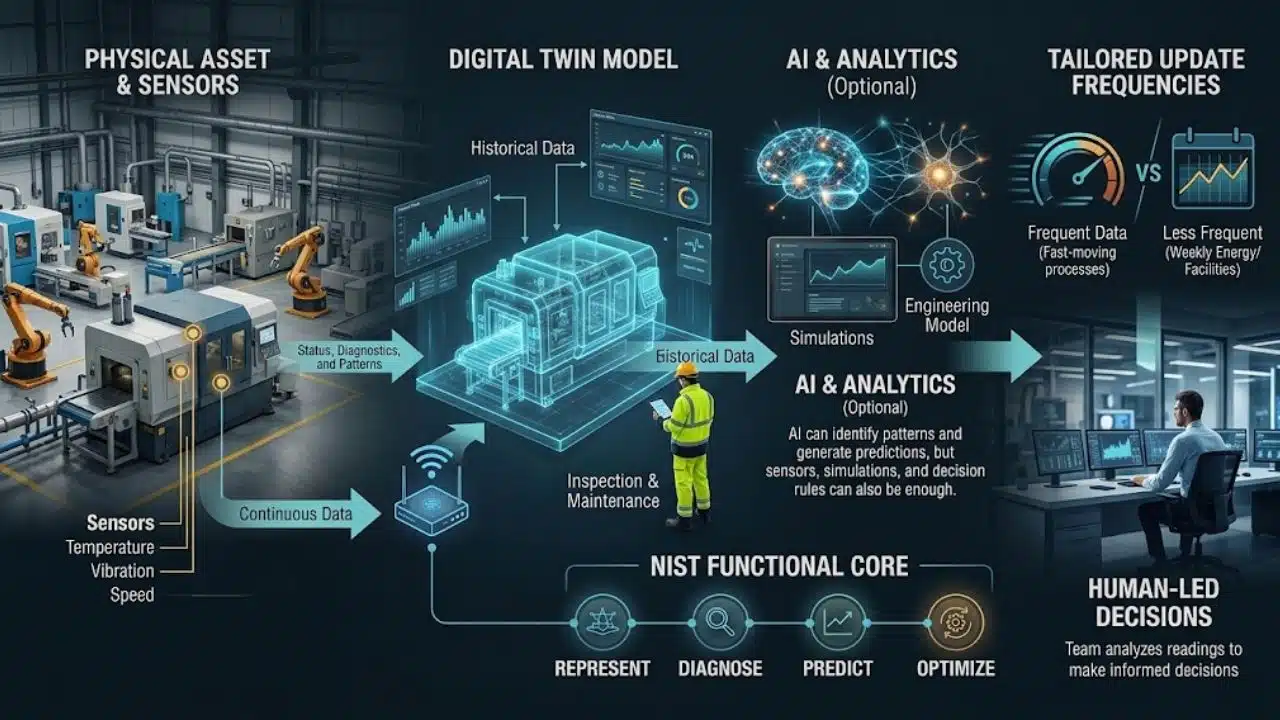
Digital twins technology connects a physical asset or process to a digital model, then uses data and analysis to support decisions. A factory might connect a machine’s model to its temperature, vibration, speed, and maintenance history. If vibration changes over time, the model could help staff investigate whether the machine needs inspection. The team would still need to check the equipment and decide what the readings mean.
Update frequency should match the job. A fast-moving industrial process may need frequent data. A facilities team reviewing weekly energy use may not. Collecting information more often than anyone can use adds complexity without necessarily improving the decision.
Artificial intelligence (AI) can help identify patterns or generate predictions, but it is not required for every twin. Sensors, engineering models, simulation, and clear decision rules may be enough. NIST describes manufacturing twins as tools for representing, diagnosing, predicting, and optimizing operations.
Digital Twin, 3D Model, or Simulation?
A 3D model shows the shape or design of an object. It may be detailed, but it can remain unchanged as the real object’s condition changes.
A simulation tests a model under chosen conditions. Engineers might use one to evaluate a design or production process before making a physical change. A simulation does not necessarily stay connected to a particular asset afterward.
A digital shadow usually describes one-way data flow: information from the physical system updates its digital representation, but the digital side does not send information or control instructions back.
Digital twins technology stays connected to its real-world counterpart over time. It may support monitoring, prediction, testing, or feedback. The National Academies distinguishes twins from traditional modeling and simulation through their connection between models, data, and decisions.
Business Uses
The best use cases involve assets or processes where better information could prevent downtime, improve quality, reduce waste, or make testing a change less costly.
Manufacturing
Manufacturers can model equipment, products, production lines, or facilities. Teams may use a twin to study bottlenecks, compare production schedules, monitor machine condition, or test a process change before applying it on a live line.
For example, a maintenance team could compare vibration readings with service records to decide whether a machine needs inspection during planned downtime. The model can inform that decision, but it cannot guarantee that every failure will be predicted.
NIST identifies manufacturing uses such as equipment health checks, scheduling, virtual commissioning, and predictive maintenance. It also notes that separate twins may be needed for different tasks or lifecycle stages.
Product design and testing
Engineers can use product models to compare designs, estimate performance, or review information gathered after a product enters service. This can be valuable when physical testing is costly or difficult to repeat.
The model’s assumptions matter. A simulation based on ideal conditions may not reflect how a product performs in a hot, dusty, or high-vibration environment.
Buildings and maintenance
A building model might combine information about equipment, temperature, energy use, and maintenance. Facilities staff could use it to investigate unusual energy consumption or decide which system needs attention first.
The practical starting point is usually one system or one recurring problem. Modeling an entire building before confirming that the underlying data is useful can turn a focused project into an expensive data-cleaning exercise.
Supply chains and infrastructure
Businesses may use digital models to explore how a delayed shipment, warehouse constraint, or production change could affect operations. These scenarios depend on timely, consistent records from several systems and partners. If inventory and transport data are incomplete, a polished model can still give a misleading picture.
NASA also describes digital twin work involving space systems and Earth-system modeling, including efforts to forecast wildfire conditions. These examples show the range of applications; they do not establish that a commercial project will produce the same results.
What Should a Business Measure?
The business case for digital twins technology should begin with a decision the company wants to improve. Potential measures include unplanned downtime, defect rates, maintenance costs, energy use, or the time it takes to diagnose a problem.
Consider a plant trying to reduce interruptions on one packaging line. The team could review machine readings and stoppage logs, look for recurring patterns, and test whether a different maintenance schedule or production sequence might help. This is an illustrative scenario, not a claim about a specific company’s results. The actual outcome would depend on the equipment, data, project cost, and whether staff change their process.
A digital twin that produces detailed visualizations but does not change a decision is unlikely to justify its ongoing cost. Define the baseline before building the model so the business can judge whether the pilot helped.
Costs and Risks Businesses Should Plan For
The model is only one part of a project. A company may also need sensors, secure networks, data storage, software integration, engineering work, testing, and staff training. Older equipment can be difficult to connect, and operational records may sit in systems that do not communicate.
Digital twins technology also raises cybersecurity and trust questions. A model may bring together sensitive operational data and connections to equipment or control systems. Businesses need to decide who can access that information, how it is protected, and what could happen if the data is inaccurate or exposed. NIST’s guidance discusses cybersecurity and trust concerns for digital twins.
Predictions need validation, too. A model can become less reliable when equipment, data collection, or operating conditions change. For decisions affecting safety or product quality, teams should document the model’s limits and keep appropriate human review in place.
How to Start a Digital Twin Project
A company does not need to model its entire operation. A focused pilot can show whether a twin solves a problem worth addressing.
- Choose one costly, recurring problem: Repeated stoppages or a persistent production bottleneck are clearer starting points than a vague goal such as “modernize operations.”
- Set the scope: Identify the asset or process and the decisions the model should support.
- Check the data: Find out what is available, how often it updates, and where errors or gaps occur.
- Set a baseline and success measure: Decide what result would justify expanding the project.
- Build and validate a small model: Compare its output with observed behavior and record uncertainty.
- Set review rules: Decide who can approve recommendations and which changes require human oversight.
- Calculate the full cost: Include integration, maintenance, training, and security, not just software.
A digital twins technology pilot should be small enough to evaluate and specific enough to produce a useful answer. If the team cannot identify a decision the model will support, more sensors or a more detailed 3D view probably will not fix the project.
When It Is Worth Considering
Digital twins technology is worth exploring when a business manages complex assets or processes, has useful data about them, and can act on better monitoring or analysis. It may be a poor fit when the process is simple, the data is unreliable, or no team is responsible for using the results.
The technology can sound more advanced than the business problem requires. Sometimes better maintenance records or a straightforward dashboard will answer the question at lower cost. A twin makes more sense when the business needs to connect data with a changing physical system and test decisions over time.
Final Thoughts
Digital twins technology can help a business understand how an asset or process is operating and explore changes before making them. It does not remove uncertainty or guarantee savings. Its value comes from useful data, a model suited to the task, and people who know how to act on the results.
Start with one persistent operational problem. Set a baseline, check the data, and validate the model before relying on its recommendations. A limited project that improves one important decision is a better investment than a large model no one trusts.
Frequently Asked Questions (FAQs) on Digital Twins
Does a digital twin require AI?
No. AI may help find patterns or make predictions, but a twin can also rely on sensors, engineering models, simulations, or standard analysis. Use AI only if it helps answer the project’s specific question.
Does a digital twin need real-time data?
No. The update schedule should match the task. A fast-changing process may need frequent updates; a slower review of building energy use may work with less frequent data.
Can a small business use one?
Yes, if it has a specific operational problem and enough reliable data to study it. A pilot focused on one machine or process is more realistic than modeling the entire company.