


When reading regularly ends in frustration, even a gentle “Shall we try a page?” can meet resistance. A child may guess, rush, ask the adult to take over, or refuse to begin. To build reading confidence, start by making the work manageable and providing clear help with the parts they cannot yet do.
Encouragement matters. So does knowing when another attempt will be useful and when the child needs something explained differently. Asking them to keep trying an unfamiliar spelling pattern will not teach it.
A helpful approach combines focused instruction, successful practice, and continued access to enjoyable books. If difficulties persist, additional support should begin before the child becomes convinced that reading is something they will never manage.
Look Beyond the “Slow Starter” Label
“Slow starter” is an informal description, not a diagnosis or a prediction. Avoid making it part of how a child hears adults describe them.
Reading involves recognising written words and understanding the language and ideas they carry. Children can be strong in one area and need substantial help in another. A child who discusses a story thoughtfully may still struggle to read its simplest sentences.
During a short reading activity, notice where the difficulty appears:
- Remembering taught patterns: Does the child recall the sounds represented by familiar letters or letter groups?
- Blending: Can they say the sounds but struggle to join them into a word?
- Reading accurately: Do they guess from the first letter, miss endings, or substitute words?
- Understanding: Can they explain what happened after reading, or after hearing an adult read?
- Reading aloud: Does the task become noticeably harder when someone is listening?
These observations help you describe the problem. They cannot establish a diagnosis.
Compare what happens when the child reads with what happens when you read to them. Strong understanding when listening, alongside difficulty reading the words, suggests that word-reading skills need attention. Difficulty understanding both versions calls for a closer look at vocabulary and language comprehension, among other factors.
Consider instruction as well as age. A five-year-old beginning formal teaching and a nine-year-old with persistent difficulties need different responses. Ask what has been taught, what the child can do independently, and where progress has stalled.
Build Reading Confidence With the Right Practice Text
For independent practice, choose something the child can read mostly accurately without frequent rescue. If an adult must supply several words in almost every sentence, use that book for supported reading or read it aloud yourself.
For children learning alphabetic writing systems, practice should include opportunities to apply taught letter–sound relationships. Decodable books provide this kind of practice, but they must match the patterns the child knows. A book labelled “decodable” may still be unsuitable for a particular reader.
Ask the teacher: “Which patterns should we practise, and which text uses them?”
Check the actual words rather than relying on an age label or the amount of text on a page. A short sentence can contain several unfamiliar spellings.
If a school book is consistently too difficult, do not quietly turn it into a long nightly struggle. Tell the teacher which words require help and ask how the book is intended to be used. It may be meant for shared reading, or the selection may need adjusting.
Keep More Demanding Books in Their Life
Practice books and listening books serve different purposes. Practice reading lets children work on identifying words. Listening to an adult or an audiobook gives them access to stories, information, and vocabulary beyond what they can currently read independently.
An eight-year-old practising simple words may still want mysteries, football stories, or books about volcanoes. Seek accessible practice material with age-respectful subjects, while enjoying more demanding books together.
Listening does not replace learning to read print. It does mean that difficulty reading need not restrict every book the child encounters. Interesting stories should remain available throughout the learning process.
Set a Small Task and Keep the Agreement
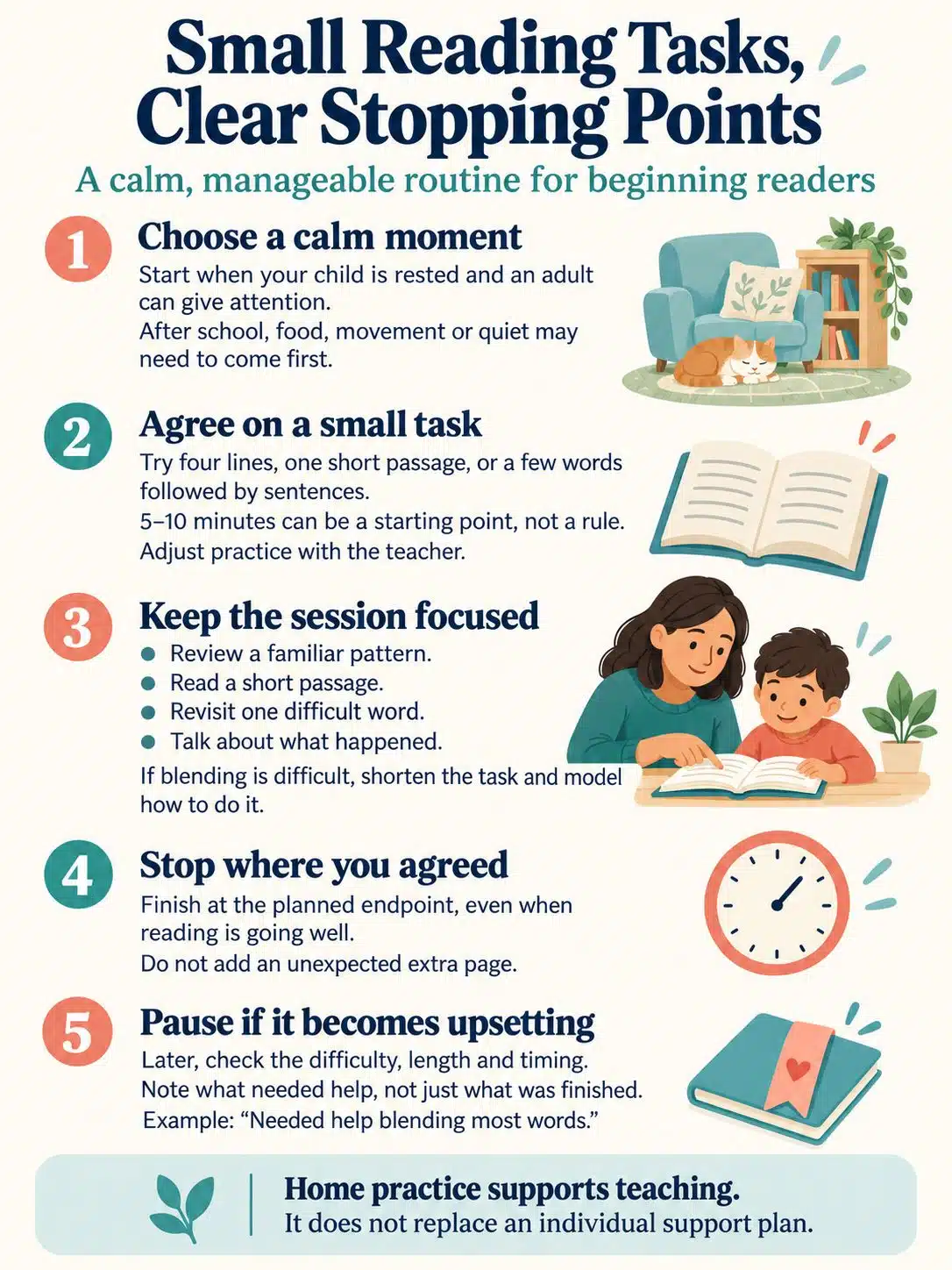
A routine needs to fit the household as well as the child. Choose a time when they are reasonably rested and someone can give calm attention. Immediately after school may work poorly for a child who needs food, movement, or quiet first.
Five to ten minutes of focused home practice can be a practical starting point. It is not a prescribed teaching dose, and it does not replace an individual support plan. Adjust the amount with the teacher.
Before beginning, make the endpoint clear: four lines, one short passage, or a few words followed by sentences.
A session might involve briefly reviewing familiar patterns, reading a short passage, revisiting one difficult word, and talking about what happened. Keep connected reading in the routine rather than spending the entire time on isolated flashcards.
If the child is still learning to blend, reduce the reading task and provide more modelling.
Finish where you agreed. Adding another page because things are going well can make the next session feel less predictable.
When practice becomes upsetting, pause. Later, consider whether the task was too difficult, the session too long, or the timing unhelpful. Record a useful observation for the teacher, such as “Needed help blending most words,” rather than treating completion as the only measure of success.
Give Useful Help With Stuck Words
Allow a little thinking time, then offer help that draws attention to the written word.
For an English word such as sun, if the child knows its letter–sound relationships, try:
“Look at the letters. Say the sounds, then blend them together.”
If they cannot continue, demonstrate. Repeating “Sound it out” more insistently does not supply missing knowledge.
With ship, point out that sh represents one sound. The child needs to blend three sounds, although the word has four letters. A brief explanation might be:
“These two letters work together: ‘sh’. Now let’s blend the sounds.”
For a pattern the child has not learned, explain the relevant part or provide the word. Then return to the sentence. An unfamiliar spelling should not become a prolonged guessing exercise.
Pictures can support discussion and understanding, but they should not be the main way a child identifies an unknown printed word. After working out the word, checking whether it makes sense is useful.
The examples here concern English. Other languages and writing systems require appropriate teaching approaches, so ask the teacher to demonstrate the prompts used in the child’s reading language.
Also distinguish practice from story time. During focused practice, spend time on the pattern being learned. During an enjoyable read-aloud, simply supplying a word may be enough. Every unfamiliar word does not need a lesson.
Reread for a Reason
A familiar passage gives children an opportunity to practise accuracy, phrasing, and expression without facing new words on every line.
Try echo reading: read a sentence aloud, then invite the child to read it. You can also read a short section together before they attempt a manageable part independently.
Choose a purpose. Perhaps the child will notice word endings, pause at punctuation, or read a question with suitable expression. Stop before repetition becomes a battle.
For example, a child might need help with three words in a short passage about a lost dog. Teach those words, read the passage together, and invite another attempt. If the child needs less help, identify that change.
However, smooth reading of a familiar page can reflect memory as well as improved word reading. Include a fresh, short passage with the same taught patterns to see whether the child can apply the learning elsewhere.
Avoid making rereading a speed contest. Fluency includes accuracy, appropriate pace, and expression. Timed assessments can help professionals answer specific questions; ordinary home practice does not need a stopwatch.
Make Encouragement Believable
Specific feedback gives children something they can recognise and repeat:
- “You checked the ending.”
- “You blended that word without my help.”
- “You noticed the sentence didn’t make sense and checked it.”
- “You told me where you needed help.”
To build reading confidence, connect encouragement to something that actually happened. “You’re brilliant at reading” may feel unconvincing after a painful page.
Effort deserves recognition, but effort alone cannot solve every difficulty. A child who has tried repeatedly may need a clearer explanation, an easier task, or more targeted teaching.
If they say, “I’m bad at reading,” acknowledge the experience without accepting the label:
“That page was difficult. Some of those words need more teaching and practice. Let’s ask your teacher which ones to work on.”
Avoid promising that reading will become easy soon. Offer a next step you can deliver.
Keep the child’s other abilities visible, too. Their knowledge, creativity, humour, and kindness should not disappear from conversation because reading needs attention. Literacy progress is one part of their life.
Protect Choice and Privacy
Offer a small choice between suitable texts. The child might also choose where to sit or whether to hear a sentence first.
Limit the choices enough to keep the task workable. Selecting freely from a large shelf may lead to a book they want to enjoy but cannot yet read independently. You can read that book aloud while using something else for practice.
For older beginners, ask teachers or librarians for simple material with age-respectful content. Avoid presenting easier work as a return to “baby books.”
In classrooms, provide rehearsal before asking a hesitant reader to read aloud. A prepared sentence is a more manageable opportunity than an unexpected paragraph. At home, ask before inviting the child to read for relatives.
Keep reading levels and difficulties out of casual public conversation. Children should be able to ask for help without feeling that their struggle has become an announcement.
Leave Room to Enjoy the Story
Read aloud without turning every page into a comprehension test. Explain a word when it matters, discuss a surprising moment, and let the story continue.
One question may be enough: “Why do you think she went back?” A child who dislikes direct questions might prefer talking about an annoying character or drawing a favourite scene.
In multilingual families, share books and conversations in the languages adults use comfortably. Maintaining a home language supports communication and family connection. Families do not need to abandon it to support reading in the school language.
Tell the teacher which languages the child uses and where they have received reading instruction. Difficulty in a newer language needs careful interpretation. It should neither automatically be labelled a disorder nor become a reason to dismiss persistent concerns.
Agree on a Specific Plan With the Teacher
Before buying another workbook or reading subscription, establish what needs teaching. A resource is useful only if it fits that need.
Ask the teacher:
- Which skill currently needs the most attention?
- How is it being taught?
- Which materials and prompts should we use at home?
- How will progress be checked?
- When will we review the plan?
Bring examples. “She knows the individual sounds but cannot blend these words” is more informative than “She needs confidence.”
Keep home monitoring light. Note whether the child reads new words with taught patterns, needs fewer prompts, or understands a passage more clearly. Greater willingness to begin matters, but it does not replace evidence of learning.
If progress remains limited, review the instruction and support rather than simply increasing practice time. Parents should not have to design a specialist intervention through trial and error.
Seek Extra Help Before Frustration Takes Over
Persistent difficulty with letter–sound relationships, blending, accurate word reading, spelling, or comprehension deserves attention. Raise concerns early, particularly when progress is limited or the child is becoming distressed.
You do not need to establish a diagnosis before asking for help.
Start with the teacher or school’s learning-support lead. Share relevant family history and details about teaching and language experience. Assessment may consider reading, spelling, language, and other factors affecting learning; one behaviour cannot explain the whole picture.
Depending on local arrangements, a reading specialist, educational psychologist, or speech-language professional may contribute. Discuss hearing or vision concerns with an appropriate healthcare professional.
Ask what targeted teaching can begin while further assessment is arranged. Access routes vary between countries and schools, but “wait and see” should not replace a clear plan for support and review.
Final Thoughts
For the next reading session, choose one manageable passage and agree on a stopping point. Notice where help is needed and acknowledge one real achievement.
If you cannot find material the child can manage, or the same difficulties keep returning, bring that information to the teacher. To build reading confidence, children need experiences of success backed by instruction that helps them move forward. Make the task achievable, and make the next source of help clear.