
The biggest EdTech failures force me to ask a basic question: what counts as success in education? BYJU’S reached a $22 billion valuation before its parent entered insolvency. In rural Peru, a major laptop program expanded computer access without delivering the expected gains in mathematics and language.
These are different kinds of failure. One concerns the financial health of a business. The other concerns the educational results of a deployment. Both show why impressive numbers need closer examination.
I am interested in the decisions behind those numbers. What did leaders assume? What did they test? What happened when the business, classroom, or community responded differently than expected?
The following cases offer lessons for founders, educators, policymakers, and families. They also show why an education product must earn trust in several ways: through sound finances, reliable delivery, responsible data practices, and useful learning outcomes.
1. BYJU’S: Growth needed stronger financial oversight
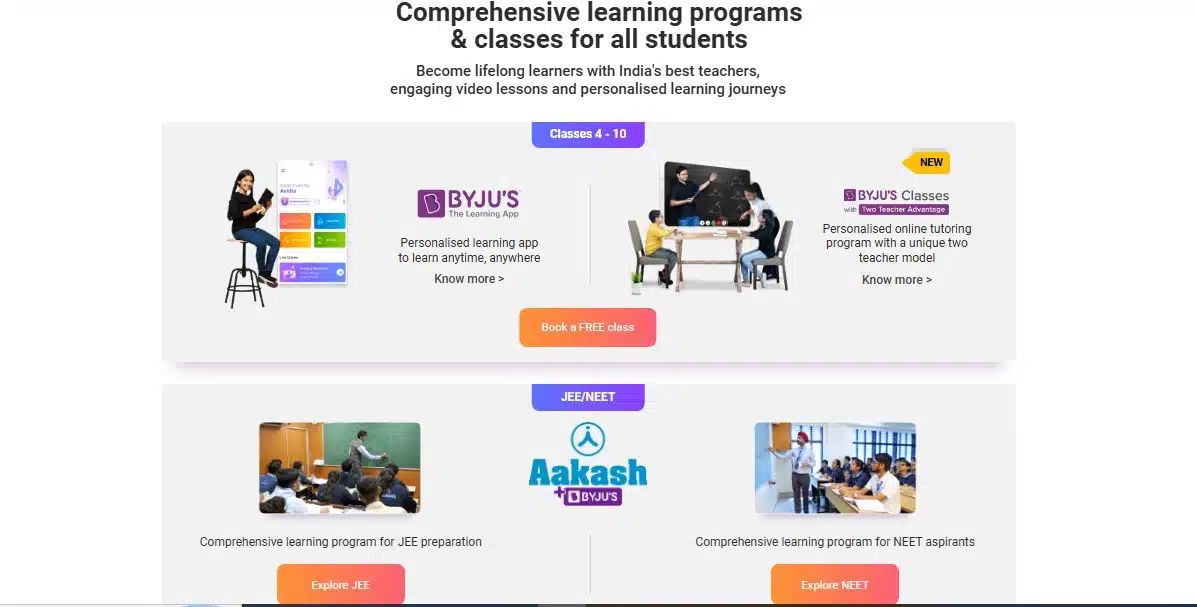
At its peak, BYJU’S became one of the most prominent names in digital education. Its reported $22 billion valuation in 2022 reflected enormous expectations for the business.
By 2024, its parent, Think & Learn, was in insolvency proceedings. Financial reporting had become a serious concern. Deloitte resigned as auditor, and replacement auditor BDO later departed amid disputes over information needed for its work. BYJU’S challenged BDO’s account of the circumstances.
Recovery involved continuing legal disputes. Reporting in September 2026 still described Think & Learn as being in insolvency proceedings.
For me, the central warning is about the foundations beneath rapid expansion. A company needs accurate accounts, responsible borrowing, and leaders who can explain how its commitments will be funded.
That matters especially in education. Families paying for courses depend on a provider’s ability to deliver support over time.
The $22 billion figure was a valuation, not a documented cash loss. Confusing the two would obscure the actual failure.
The lesson: Strengthen financial oversight before expanding the services and commitments that learners depend on.
2. 2U: A larger audience did not fix the debt problem
2U helped universities build and deliver online programs. Its 2021 deal for substantially all of edX’s assets expanded that reach considerably.
The announced price was $800 million in cash. Financing included a new $475 million term loan, adding a substantial obligation to the business.
Its financial reports later revealed the pressure. Marketing and sales expenses reached $372.1 million in 2023. The annual report raised serious doubts about the company’s ability to continue operating without refinancing debt or raising capital.
2U filed for Chapter 11 bankruptcy on July 25, 2024. It emerged on September 13 as a private company. Its previous common shares were canceled without compensation.
The distinction matters: the business continued, while the old ownership structure did not survive.
This case makes me question the assumption that reaching more learners automatically improves a company’s economics. Recruiting students, supporting programs, and servicing debt all require money.
The edX acquisition was part of that picture. Treating it as the sole explanation would oversimplify the financial pressures.
The lesson: Evaluate growth against realistic recruitment costs, operating expenses, and debt repayments.
3. UK e-University: Demand needed testing before the platform expanded
The UK e-University project, known as UKeU, aimed to bring British university education to learners around the world through online courses.
A parliamentary inquiry reported that the venture spent approximately £50 million in public money but attracted only 900 students against a target of 5,600. Its first courses launched in September 2003. The project was effectively wound up in 2004.
The inquiry identified insufficient market research, weak private-sector partnerships, and an approach shaped too heavily by what the venture wanted to offer.
Earlier market studies existed. The problem was that the project did not adequately update and develop its understanding of demand.
An interest in education does not necessarily translate into demand for a particular course. Learners still weigh price, credentials, subject choice, support, and study format.
UKeU’s experience shows the danger of treating a broad market opportunity as proof that a specific product will attract paying students.
The lesson: Test the course offering with prospective learners before committing heavily to the technology behind it.
4. AltSchool: Schools and software proved difficult to sustain together
AltSchool attempted to build personalized-learning technology through a network of small private schools. It attracted approximately $174 million in venture funding.
The company was trying to sustain two demanding operations: running schools and developing a technology business.
An early 2019 report put annual spending on schools and software at roughly $30 million, compared with $7 million in revenue in 2018. Campuses opened and closed, requiring some families to reconsider their children’s schooling.
In 2019, AltSchool announced that it would transfer its four remaining schools to Higher Ground Education. It shifted toward software and professional development under the Altitude Learning name.
The earlier closures reveal the human consequence of an unstable operating model. Moving a child between schools affects relationships, routines, and family decisions.
I would treat continuity as a core requirement for any business operating schools. Experiments need room to change, but families also need dependable arrangements.
The lesson: Assess school operations and software development separately, with realistic funding and continuity plans for each.
5. Knewton: Promising technology needed a dependable route to customers
Knewton raised more than $180 million around its adaptive-learning ambitions. Its original model involved licensing technology to educational publishers.
Those partnerships were central to reaching customers. As publishers pulled back from the earlier model, Knewton shifted toward selling its own courseware around 2017.
The shift changed the business problem. Knewton now had to sell a complete courseware product, alongside developing the adaptive technology behind it.
Wiley announced an agreement to acquire Knewton’s assets in May 2019. The deal included its Alta courseware platform, with the purchase price officially undisclosed.
A subsequent analysis of Wiley’s acquisition disclosures estimated a price below $17 million. That was an inferred figure, not an individually announced deal price. It should not be used to calculate exact investor losses.
The technology found a place within another business. The original independent venture produced a much more modest commercial outcome than its funding suggested.
The lesson: A learning platform needs useful technology, repeat customers, and a distribution strategy that can withstand changes by major partners.
6. LAUSD’s iPad project: The complete teaching system was not ready
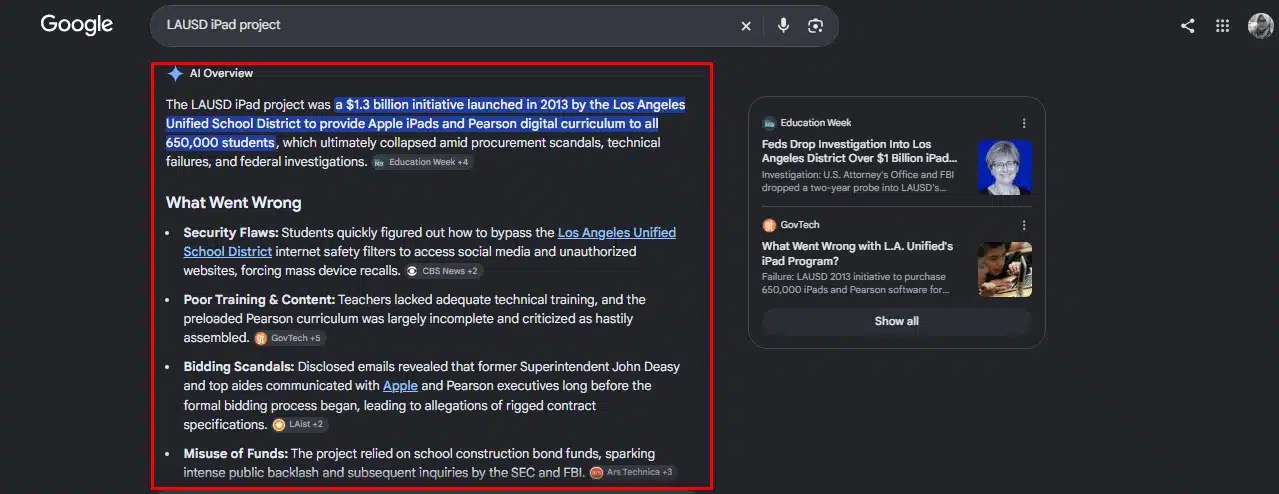
Los Angeles Unified School District’s original iPad and digital curriculum plan was widely described as a $1.3 billion initiative. That number described the proposed scale of the program. It was not a verified total of money lost.
The difficulties became clearer during implementation. An independent evaluation documented incomplete Pearson curriculum, technical problems, and generally low use of the Pearson application.
In 2015, Apple agreed to pay the district $4.2 million over the curriculum dispute. Lenovo agreed to provide $2.2 million in credits. Pearson was a subcontractor, while the settlement involved the hardware companies.
The broader initiative subsequently evolved, with changes to device choices, support arrangements, and planning.
The failure concerned the readiness of the whole instructional system. A device, curriculum, student account, school network, and prepared teacher had to work together.
If an essential part failed, the classroom could lose the benefit of an otherwise successful purchase.
The lesson: Require usable curriculum, dependable access, teacher preparation, and clear supplier responsibilities before expanding a deployment.
7. Amplify’s tablets: Reliability had to come first
Amplify’s tablet strategy combined devices, digital content, and tools for classroom teaching. In Guilford County, North Carolina, quality problems interrupted the rollout.
On October 4, 2013, the district suspended use of Amplify tablets and accessories. Its notice said roughly 10% of 15,000 devices had been returned because of broken screens. It also identified a potential charger safety problem.
The district later strengthened contract specifications and piloted replacement devices before restarting. That is a concrete example of an institution changing its approach after a failed deployment.
The commercial outcome was broader. News Corp recorded a $371 million noncash impairment related to its Amplify business in fiscal 2015. It stopped actively marketing Access products to new customers and sold its digital education businesses that September.
The impairment covered the business. It cannot be attributed solely to the faulty tablets.
In a school, reliability affects instruction directly. Repairs, replacement delays, and troubleshooting compete with time for teaching.
The lesson: Test durability and support under real school conditions, and make delivery and replacement obligations clear in contracts.
8. One Laptop per Child in rural Peru: Access alone did not produce academic gains
Giving a child a computer can open valuable opportunities. The One Laptop per Child deployment in rural Peru showed why access also needs an instructional plan.
A 2012 randomized evaluation covering 319 primary schools found substantial increases in computer access and use after 15 months. It found no evidence of gains in mathematics or language test scores. Some measures of general cognitive skills improved.
A longer-term study released in 2024 examined 531 rural public primary schools using data through 2019. It found no academic achievement gains and identified limited classroom integration and weaknesses in teachers’ digital skills. Students did gain computer skills.
Those results distinguish what the program achieved from what it was expected to achieve. More access and stronger computer skills had value. They did not deliver the anticipated academic improvements in the evaluated deployment.
I would not generalize that result to every laptop program. I would use it to question any rollout that measures success mainly by devices distributed.
The lesson: Connect hardware to curriculum, sustained teacher support, and specific learning goals. Evaluate what students learn as well as what they receive.
9. inBloom: Privacy concerns undermined public acceptance
inBloom aimed to help schools organize student information so different educational tools could use it to support personalized learning.
The nonprofit launched with $100 million in philanthropic support from the Gates Foundation and Carnegie Corporation.
Privacy concerns soon became central to its future. Partners withdrew, and New York passed legislation restricting arrangements of the kind inBloom offered. On April 21, 2014, the organization announced that it would wind down.
Its closure was not the result of a proven mass data breach. The failure centered on acceptance, confidence, and the rules governing student information.
Families needed answers about who could access data, why it would be used, and how they could influence those decisions. Technical security assurances did not settle those questions.
To me, this case shows why privacy belongs in the design of an educational service. Public acceptance cannot be assumed because a system promises useful features.
The lesson: Establish understandable data rules, meaningful oversight, and public participation before asking schools and families to trust a new platform.
10. Edmodo: Free access needed a durable and responsible model
Edmodo gave teachers and students a familiar space for class discussions, resources, assignments, and communication.
Its parent, NetDragon, announced that the free public service would close on September 22, 2022. It said the company would focus on revenue-producing government partnerships and reduce operating costs.
The closure concerned the public platform, rather than every government version of the service.
A separate privacy case followed. In June 2023, a US federal court entered an order resolving allegations involving children’s personal information, including its collection and use for targeted advertising.
The order included a $6 million civil penalty. Payment was suspended because Edmodo could not pay. The chronology matters. The public service closed before the final enforcement order.
For schools, the case raises two practical questions: how does a free platform sustain itself, and can its revenue model respect the limits that should govern children’s data?
It also makes an exit plan essential when teachers build routines around an outside service.
The lesson: Examine financial sustainability, privacy practices, and options for exporting classroom materials before making a platform essential to teaching.
What the biggest EdTech failures should change about our decisions
These cases leave me with four questions I would ask before supporting an EdTech purchase or rollout.
- What educational problem will it solve? Define the intended improvement and the learners who should benefit. Decide how the result will be measured before the deployment begins.
- Can teachers use the complete system reliably? Test curriculum, accounts, accessibility, connectivity, and support together. Include the time teachers spend preparing and troubleshooting.
- Can the provider sustain its commitments? Look beyond investment announcements. Consider recurring costs, financial stability, support arrangements, and what happens if the company changes direction.
- Can families understand and trust its data practices? Explain collection, access, retention, and permitted uses clearly. Give those affected a meaningful role in decisions.
The biggest EdTech failures make me cautious about promises of effortless transformation. Education requires continuity, relationships, and repeated practice. Technology must work within those conditions.
I would judge the next product by the learning it supports, the burdens it creates, and the reliability of the organization behind it. That gives schools and families a firmer basis for deciding whether it deserves a lasting place.
Frequently asked questions on the Biggest EdTech Failures
1. Why do EdTech companies fail?
These cases show several causes: financial pressure, weak demand validation, unreliable products, insufficient instructional support, and loss of trust. They do not establish one universal explanation or a reliable failure rate for the whole industry.
2. Did every organization on this list shut down?
No. 2U emerged from bankruptcy, AltSchool transferred its remaining schools, and Wiley acquired Knewton’s assets. Several cases concern an abandoned strategy or disappointing educational results rather than the closure of an entire company.
3. Was BYJU’S a $22 billion financial loss?
The $22 billion figure was a reported valuation in 2022. It was not a documented cash loss. Valuation, invested capital, debt, and financial losses are different measures and should be described separately.
4. Did One Laptop per Child achieve nothing in Peru?
No. Research found increased computer access and gains in some skills. The limitation was the absence of improvement in core academic outcomes in the evaluated deployment. The findings do not establish that every laptop program will have the same outcome.
5. How can schools reduce the risk of an EdTech failure?
Run a representative pilot, define educational goals, include teachers in evaluation, and examine total costs. Check privacy, technical support, provider stability, and data export options. Establish clear criteria for expanding, changing, or ending the deployment.