Your child can sing the numbers to ten, but calls three blocks “five.” Or they barely join in the song, yet bring you exactly two shoes when you ask. If you are weighing counting vs number names, both examples show why a recital tells only part of the story.
Children can notice amounts, learn number words, and try counting objects at different times. Meaningful counting brings those abilities together: a child says the words in order, gives each object one word, and understands that the last word tells how many objects there are.
You do not need to teach those parts as separate lessons. Two cups for two people or three blocks for a tower give a child something to see, handle, name, and count.
Counting vs number names: what is the difference?
Saying “one, two, three, four” is reciting number names. A song or familiar routine can help a child learn their order. It does not, by itself, show that the child knows what four means.
Counting four toy cars takes more coordination. The child has to keep the words in order while touching or moving each car once. Then they have to recognize that four, the last word they said, describes the whole group.
These abilities can overlap unevenly. A child might recite to ten but skip a car while counting. They might count three cars accurately, then start again when asked, “How many?” Another child may immediately recognize two cars without saying “one, two.”
Each response gives an adult a clue about what to model next. None calls for a harder worksheet or a longer counting drill.
Start with an amount the child can see
Long before children count a group reliably, they encounter differences in amount. A toddler may ask for more fruit, notice an empty bowl, or see that a playmate has a toy while they do not. Adults can put number words alongside those experiences: “Here are two cups. One for you and one for me.”
Keep the examples small and varied. The word two can describe socks today, stones tomorrow, and two people sitting together. Hearing the same word used for different pairs helps a child connect it to the amount rather than to one particular object.
Some children can also recognize a small group at a glance. Hold up two fingers or place three blocks on a mat and give the child a moment to look. They may tell you the amount without counting each item. This quick recognition, called subitizing, is another useful part of early number learning. There is no need to insist that a child count one by one when they already see that there are two.
Number songs still have a place. Sing them because your child enjoys them and because they offer practice with the sequence. Then, at another moment, use a number word where the amount matters: “We need two socks before we go out.” The song and the socks support different parts of learning.
Make counting easy to follow
When a child begins counting objects, watch their hand as well as their words. A finger can race ahead of the spoken numbers; a child can touch one object twice or miss an object tucked behind another. Correcting only the final answer does little to help them find the difficulty.
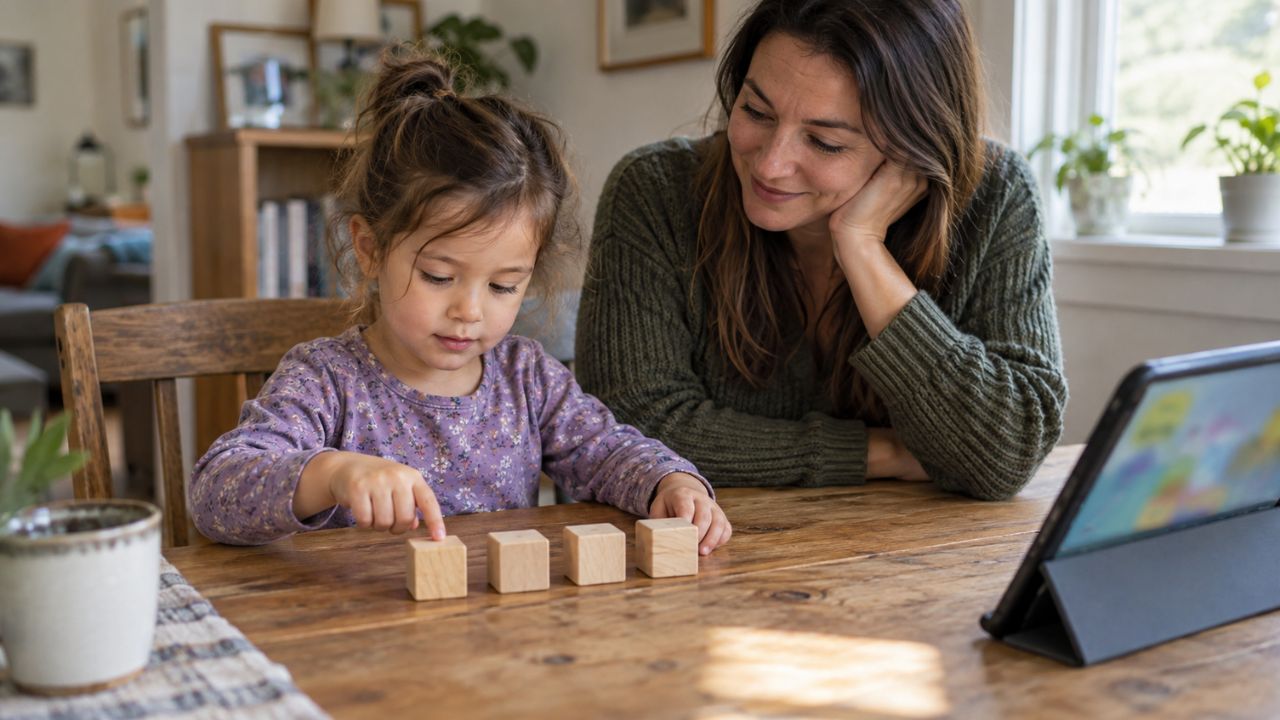
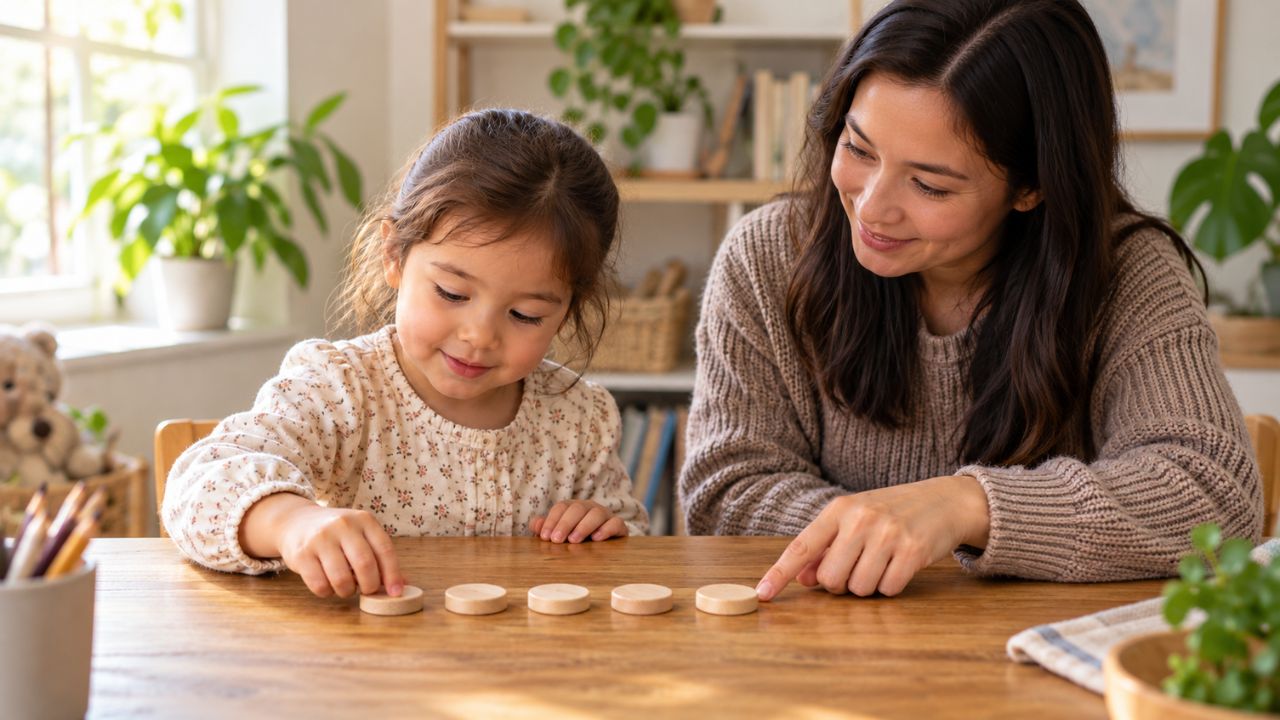
Put three or four blocks in a row. Move each block to the other side as you count it: “One, two, three. Three blocks.” The movement shows which blocks have been counted. When the child is ready, they can move the blocks themselves or point to each one.
If they skip a block, try “This one is still here. Shall we check together?” If they count the same block twice, slow the movement down so one touch goes with one word. Keep the group small while they practise coordinating the two actions.
The sentence after the count matters too. “Three blocks” shows why you counted. A child may count the objects correctly and still recount them when asked, “How many?” They are working out that the last number names the total. You can say, “You counted to three. There are three altogether,” and leave it there.
A neat row is a helpful starting arrangement, but it is not the only arrangement a child will meet. Once a small row feels manageable, spread the same blocks apart and count them again. The group still has the same number of blocks, even though it looks different.
Let numbers help with a real task
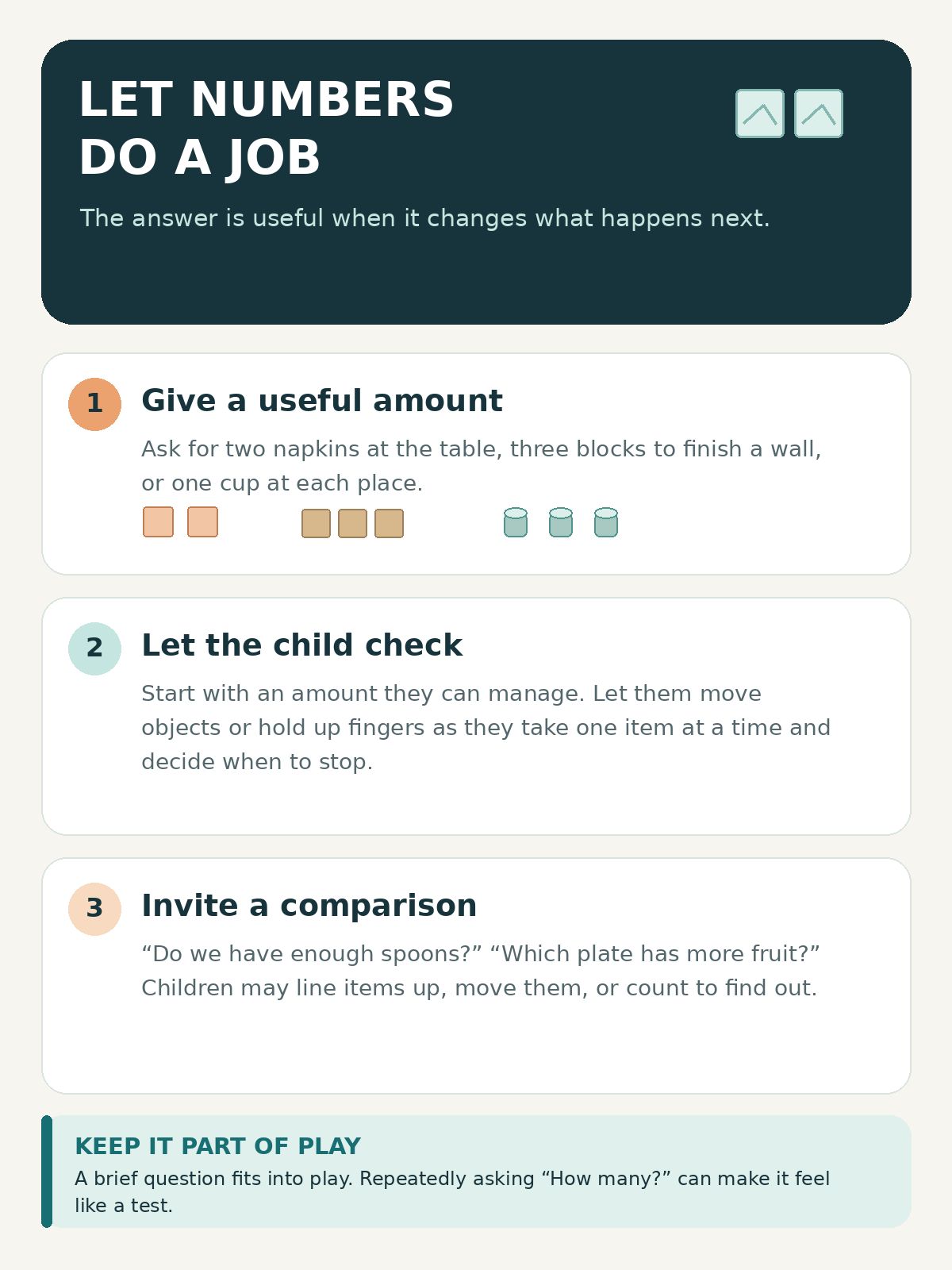
An adult can ask a child to count almost anything. The better opportunities are the ones in which the answer changes what happens next.
At the table, ask for two napkins. If the child brings one, place it down: “We have one. We need one more.” During play, ask for three blocks to finish a short wall. In a daycare room, children can help put one cup at each place before snack.
Giving someone a requested number of objects is a little different from counting a group that is already there. The child must remember the amount, take one item at a time, and know when to stop. Start with a number they can manage. If they need to check by moving the objects or holding up fingers, let them.
Later, a question can invite comparison: “Do we have enough spoons for everyone?” or “Which plate has more pieces of fruit?” Children may line items up, move them between plates, or count. Those methods show their thinking and give you something more useful to respond to than a quick guess.
There is also a limit to how much math talk helps in one sitting. A brief question about the blocks your child is using fits into their play. Repeatedly interrupting that play to ask “How many?” can turn a useful idea into a performance.
Written numbers can join the activity
The spoken word three, three fingers, three stones, and the printed numeral 3 can all represent the same amount. A child may understand some of these connections before others.
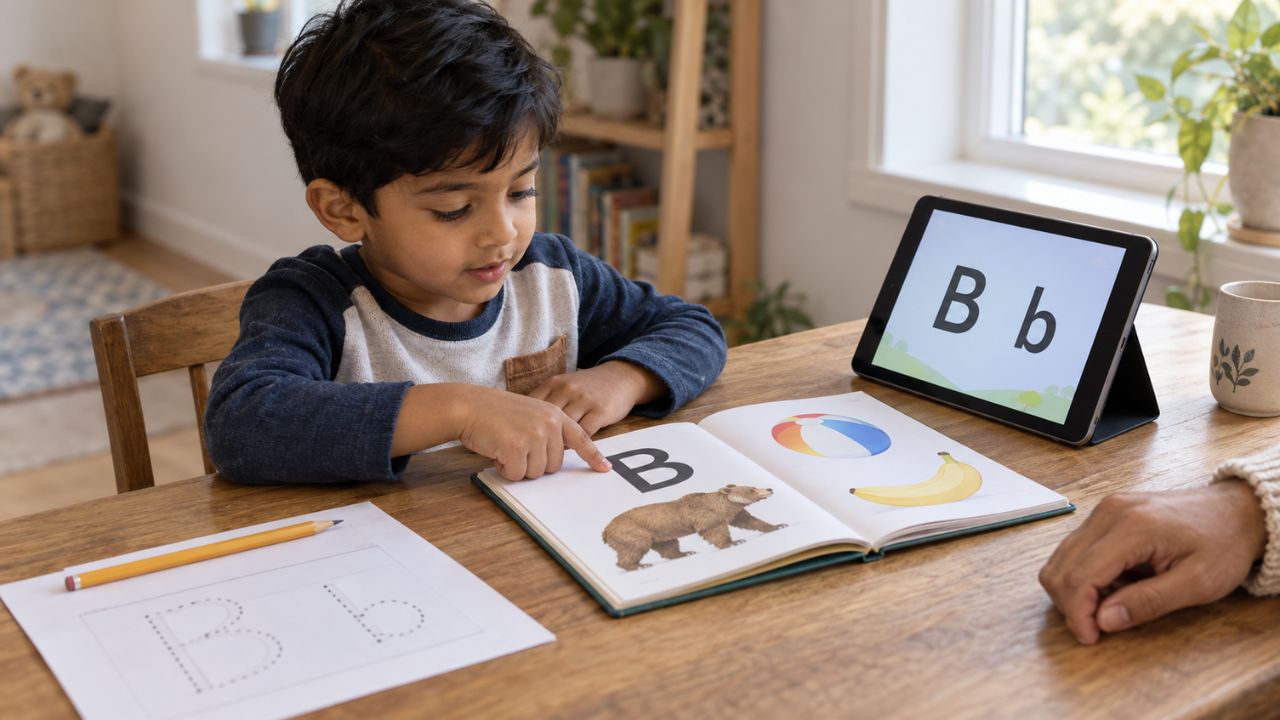
There is no need to wait until counting is perfect before showing a written numeral. After a child makes a group of three blocks, you might show a 3 on a card or in a book: “That says three, like your three blocks.” The symbol now has something concrete to represent.
Be careful about what you infer from numeral cards alone. A child may recognize the shape of 3 but struggle to give you three objects. Another child may make a group of three easily without naming the printed symbol. If you want to understand what they know, invite them to use the number as well as identify it.
When a child gets stuck, change the task
A small adjustment often tells you more than asking the same question again.
If your child mixes up the number words, count a few familiar objects together slowly. They can continue enjoying counting songs while they learn the order.
If they lose track of objects, use fewer items, put them in a row, or let the child move each one after counting it. A scattered pile asks them to remember which objects they have already touched.
If they count correctly but cannot answer “how many,” repeat the final number as the total. At another time, ask them to make a group of that size, perhaps by giving you two blocks.
Notice what the child can do when the task is smaller, quieter, or more hands-on. Counting four blocks beside a caregiver is different from trying to count toys spread across a busy classroom floor. One attempt cannot tell the whole story.
What should you expect between ages two and five?
Across these years, children may begin by using words such as “more” and “all gone,” recognizing tiny amounts, or attempting to count a few objects. Their number words, object counting, and understanding of totals become more connected with time and practice. The pace varies.
The U.S. Centers for Disease Control and Prevention includes “counts to 10” on its age-five milestone checklist. That is a guidepost for discussing development, not a full assessment of a child’s math understanding or a deadline for younger children. A child who can recite to ten may still need practice counting objects; a child who loses their place with ten objects may understand smaller amounts well.
Look beyond a single spoken answer, particularly if a child uses more than one language. They may know number words in their home language that they do not yet use in a classroom language. Showing fingers, matching two groups, or handing over a requested number of objects can also reveal what they understand.
If your child has lost skills they previously used, you have broader concerns about their learning or language, or difficulties persist across familiar activities, speak with a qualified health professional or early childhood specialist. Describe what happens during play and what changes when you use fewer objects or the child’s familiar language. A milestone checklist can help start that conversation, but it cannot diagnose a child.
Final Thoughts
In the end, there isn’t really a race between counting and number names. Children usually start by experiencing numbers through everyday things—counting their fingers, toys, steps, or snacks. As they become more comfortable with counting, they begin connecting those quantities with words like “one,” “two,” and “three,” and eventually with written numbers.
The most important thing is to let these skills grow naturally together. When children can see, say, touch, and count numbers in real-life situations, numbers become more than something to memorize. They become something they can understand and use with confidence.
Frequently Asked Questions
1. What comes first, counting or number names?
For most children, counting comes first. They often learn to count objects and repeat number sequences before they fully understand or recognize written number names.
2. At what age do children start learning to count?
Children can begin developing early counting skills as toddlers. They may first memorize number sequences and gradually learn to connect each number with a specific quantity.
3. What are number names?
Number names are the words we use to describe numbers, such as one, two, three, four, and five. Learning number names helps children connect mathematical quantities with language.
4. Why is counting important for early math skills?
Counting helps children understand quantity, order, and number relationships. These skills create an important foundation for addition, subtraction, and other early math concepts.