
If you want to know which jobs taking over by AI are real and which are hype, look at the tasks, not the job titles. AI is good at work that follows a script: answering common questions, typing data into forms, writing first drafts, and translating plain text. Jobs built mostly on those tasks are shrinking first. Jobs that mix them with judgment, trust, or hands-on work are changing instead of disappearing.
Below are 12 roles where the shift is moving fastest, what the data says, and what workers in those roles are doing about it.
Jobs Taking Over by AI: What the 2026 Numbers Show
AI is now a major reason companies give for layoffs. In May 2026, U.S. employers named AI as the main reason for almost 40% of announced job cuts. AI-linked cuts in the first five months of 2026 reached 87,714, already more than the 54,836 for all of 2025. By July, AI had topped the list of reasons for five months in a row.
The picture is not all bad. Hiring was also up 25% over the previous year, and Andy Challenger said AI is reshaping the job market, not tearing it down. Some economists also warn that a company saying AI caused layoffs does not prove AI was the real reason.
The clearest signal is about young workers. Workers aged 22 to 25 in highly AI-exposed jobs now have employment about 19% below where it would be if they had kept pace with peers in less-exposed jobs. This happens mostly because companies hire fewer young people, not because they fire more.
For a wider view across industries, see our breakdown of how AI is replacing jobs.
The 12 Jobs Taking Over by AI Fastest
1. Customer Service Reps: The Clearest Case of Jobs Taking Over by AI
This is where the change is easiest to see. Salesforce CEO Marc Benioff said the company cut support staff from 9,000 to about 5,000, and AI agents now handle half of customer conversations.
The people who stay take the harder calls: billing disputes, upset customers, and problems the bot cannot fix. Salesforce said it moved hundreds of support workers into professional services, sales, and customer success. That path, from support to account and success roles, is the most common move right now.
2. Data Entry Clerks Among Jobs Taking Over by AI
The World Economic Forum projects a 34% drop in data entry clerk jobs by 2030. AI tools now read invoices, receipts, and forms on their own. Clerks who learn spreadsheet formulas, basic SQL, or data-quality checks are moving into operations and reporting roles.
3. Junior Software Developers Facing Jobs Taking Over by AI
Senior engineers are mostly fine. New graduates are not. Stanford researchers found a 20% drop in employment for software developers aged 22 to 25 since late 2022. AI coding tools now write much of the simple code that juniors used to learn on.
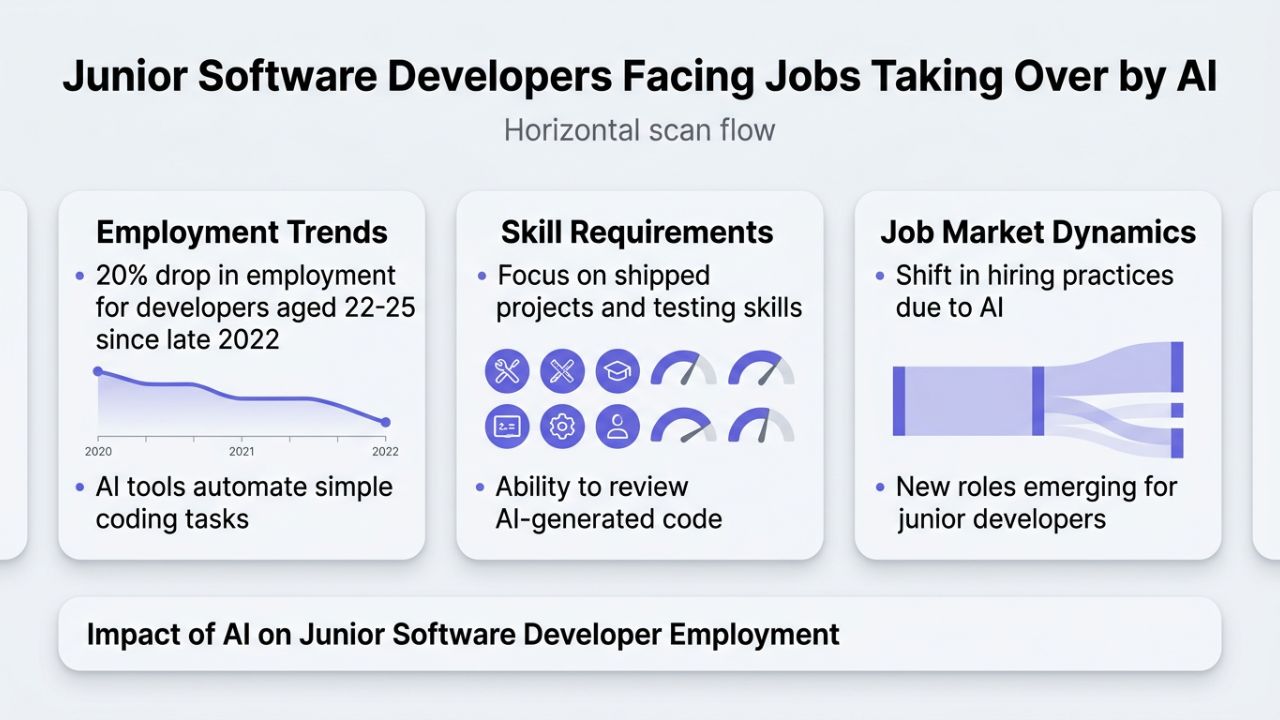
Young developers who get hired tend to show shipped projects, testing skills, and the ability to review AI-written code for bugs and security holes. We cover this shift in more detail at the end of the tech worker era.
4. Translators and Interpreters in the Jobs Taking Over by AI List
In a Microsoft study of Copilot use, 98% of interpreters’ work activities overlapped with tasks AI performs often and fairly well. Machine translation already handles manuals, product pages, and emails.
Human work is moving to post-editing machine output, certified legal and medical interpreting, and cultural localization. Courtrooms and hospitals still want a person who can be held responsible.
5. Writers and Copywriters Hit by Jobs Taking Over by AI
The same Microsoft list included writers and authors, technical writers, journalists, and proofreaders. Product descriptions and basic ad copy are the first to go. Writers holding their ground offer what AI cannot: interviews, original reporting, real subject knowledge, and a strong editing eye for AI drafts.
6. Bank Tellers and Jobs Taking Over by AI
Bank tellers are projected to decline by 35% by 2030. Mobile deposits and chatbots handle most routine requests. Many banks now train tellers as all-round bankers who open accounts, explain loans, and help with fraud issues.
7. Administrative Assistants: Quiet Jobs Taking Over by AI
This one gets less press, but the scale is large. Administrative assistants and executive secretaries are among the clerical roles expected to see the biggest drop in total numbers. AI now schedules meetings, drafts emails, and writes meeting notes.
Assistants who stay useful run projects, manage vendors, and set up AI tools for their team rather than competing with them.
8. Cashiers and Ticket Clerks as Jobs Taking Over by AI
Self-checkout and ticketing apps keep cutting these roles. Still, full automation is harder than it looks. Amazon’s “Just Walk Out” system, sold as AI-driven, reportedly relied on workers in India to review transactions. Many cashiers now move into online order pickup, stocking, and floor support.
9. Graphic Designers Joining the Jobs Taking Over by AI
The WEF added graphic designers to its fastest-declining roles as generative AI reshapes the job market. Simple social posts and stock-style images are now cheap to make.

Designers who adapt focus on brand systems, art direction, motion, and UX. They use AI for rough drafts, then fix what it gets wrong.
10. Telemarketers and Sales Reps in Jobs Taking Over by AI
Microsoft’s list also named telemarketers, and sales representatives ranked among the top jobs for AI applicability. AI dialers and email agents now handle cold outreach. People are moving toward complex B2B deals, where trust and long relationships still close sales.
11. Content Moderators: Fast-Moving Jobs Taking Over by AI
Social platforms now use AI for the first round of content review. TikTok has cut workforce roles as it shifts to AI, including in trust and safety. Human moderators who remain handle appeals, edge cases, and policy work that needs local language and cultural context.
12. Bookkeeping and Accounting Clerks in Jobs Taking Over by AI
The WEF expects sharp declines in roles, including accountants and auditors. Accounting software now sorts transactions and matches records automatically. Clerks are moving toward tax planning, advisory work, and fraud checks, or earning certifications that lead to those roles.
How Workers Are Adapting to Jobs Taking Over by AI
Across all 12 roles, the same few moves keep showing up:
- Moving up to harder work. Support agents take escalations. Writers take reporting. The routine part goes to AI.
- Becoming the person who checks AI. Reviewing AI code, translations, and drafts is now paid work.
- Choosing work that needs people. On the Stanford data, home health aides, a less-exposed job, saw employment rise for the youngest workers.
- Retraining early. The WEF says workers can expect 39% of their current skills to change or become outdated between 2025 and 2030.
It is also worth remembering the full forecast. The WEF expects 170 million new jobs and 92 million lost by 2030, a net gain of 78 million. The jobs are shifting, but they are not all gone.
Final Thoughts on Jobs Taking Over by AI
The best defense is simple. List the tasks you do each week and mark the ones that follow a script. Those are the tasks at risk. Start moving your time toward the rest, and learn the AI tools used in your field now. The list of jobs taking over by AI will keep growing, but workers who manage and check AI are the ones companies keep hiring.