When a child goes missing, a family first searches for their whereabouts. Then it searches for help, reassurance, and answers. The child’s return brings relief. But questions remain: Why did the child disappear? Where were they? Did anyone harm them? Could they face the same danger again? For me, this is the most important test of child protection: Do we simply accept a missing-person report, or do we also take responsibility for helping the child return to a safe life?
Recent events in Bangladesh provide ample cause for concern. But turning that concern into effective demands requires honesty about the evidence. Assuming that every missing child has been abducted is wrong. So is minimizing the danger because most children return. Similarly, a few horrifying incidents cannot justify blaming every family in the country. Nor can violence against children be concealed by calling it a “family matter.”
My position is clear: Missing children and violence against children must be recorded separately, but prevention must recognize the relationship between them. A child fleeing abuse at home may face exploitation outside it. A child lured online may face public humiliation after being rescued. A child’s danger often falls within the responsibilities of several institutions. Dividing those responsibilities must not allow accountability to disappear.
Bangladesh’s Numbers Are Concerning but Claims About Increases Must Be Accurate
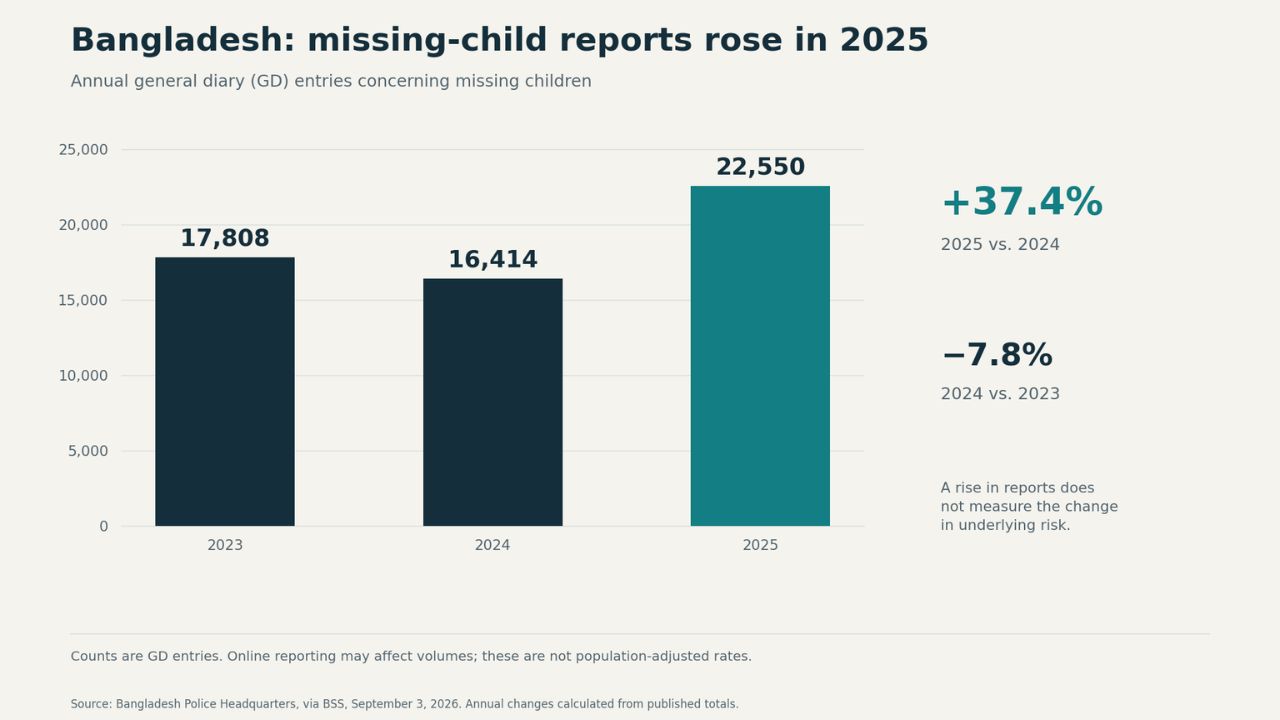
According to Police Headquarters figures published by Bangladesh Sangbad Sangstha (BSS) on September 3, 2026, general diary (GD) entries concerning missing children were as follows:
| Year | GD entries concerning missing children |
|---|---|
| 2023 | 17,808 |
| 2024 | 16,414 |
| 2025 | 22,550 |
The calculated annual change was approximately −7.8% in 2024 and +37.4% in 2025. It is therefore inaccurate to say the number “increases every year.” Police also attributed increased reporting to online GD facilities but did not quantify the separate contributions of changes in actual incidents and reporting.
A complete analysis must distinguish repeated disappearances involving the same child. Easier reporting can make previously hidden problems visible. More reports may therefore reflect administrative improvement, a worsening situation, or both. My demand would be for explanations to come with data that can be checked. The purpose of statistics is neither simply to ease concern nor to intensify it.
Which Age Groups Are Most Often Recorded as Missing?
The same police figures provide the following picture for January–July 2026:
| Age | Recorded as missing | Recovered | Not yet recovered |
|---|---|---|---|
| 0–9 years | 474 | 406 | 68 |
| 10–17 years | 15,243 | 13,273 | 1,970 |
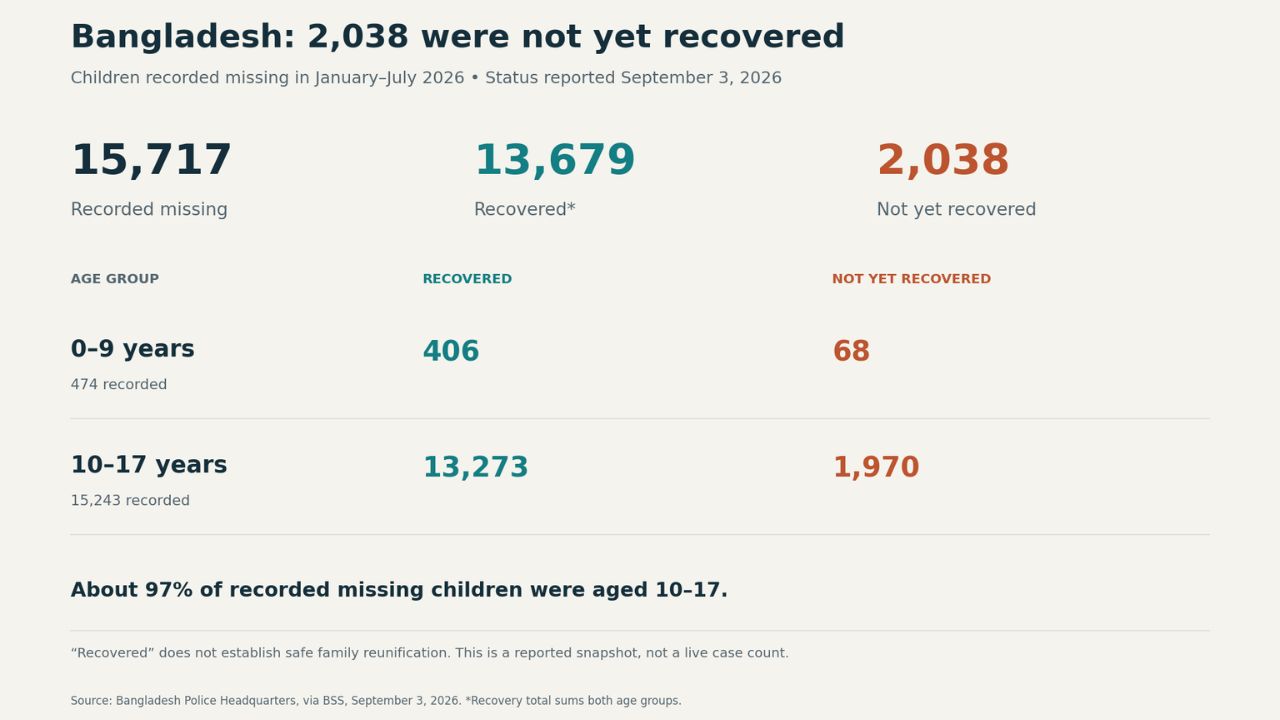
| Total | 15,717 | 13,679 | 2,038 |
The recovery total is the sum of the two age groups. Approximately 97% of the recorded incidents involved children aged 10–17. This is not a population-adjusted risk rate for that age group. The proportion not recovered was approximately 13%; that reflects the position reported in the publication, not an updated list as of the end of September.
This age distribution should change our priorities. Alongside protecting young children from strangers, we need to address adolescents’ home environments, school pressures, safe relationships, online communication, and opportunities to ask for help.
An adolescent who leaves home voluntarily does not lose the right to protection. “Left of their own accord” may be a fact relevant to an investigation; it cannot justify ending responsibility. Nor does the smaller number of young children make their cases less urgent. Each child needs prompt risk assessment based on age, health, last known location, and potential danger.
Three Recent Incidents Raise Three Questions About Responsibility
The following incidents illustrate recent problems. They cannot establish a national rate or explain the causes of every case. Police statements and allegations reported by relevant organizations are not treated here as final findings of a court.
| Published report | Location and age | Verified information | The question it raises |
|---|---|---|---|
| September 19, 2026, UNB; updated September 20 | Sadar Dakshin, Cumilla; 13 years old | Went missing the previous day; the father filed a GD; the body was later recovered. The report describes a police investigation. | What was the timeline for gathering information and searching after the disappearance? |
| September 13, 2026, Ajker Patrika | Madarganj, Jamalpur; 7 years old | Went missing after going to school; the body was recovered three days later; two people were detained. | How is safety ensured between a child’s arrival at school and the school’s assumption of responsibility? |
| September 16, 2026, Jago News | Kafrul, Dhaka; 11 years old | Allegations of prolonged abuse of a child domestic worker; BILS raised concerns about coordination between districts and delays in accepting a case. | Who coordinates the investigation and protection when the child is receiving treatment in another district? |
Sources: UNB, Ajker Patrika, and Jago News reporting on a statement by the Bangladesh Institute of Labour Studies (BILS).
For me, the significance of these incidents extends beyond the severity of the alleged crimes. They show why discussions of protection must bring homes, schools, workplaces, police stations, and hospitals together. Detaining someone may represent investigative progress. But we also need to understand how the danger developed and whether there were earlier warning signs.
Reporting on individual police cases cannot substitute for a national database. A disappearance report, a recovery report, and an arrest report about the same incident are not three separate incidents. Without removing this duplication, a count built from news coverage can itself become misleading.
Violence Inside the Home Must Remain Part of the Discussion
According to Bangladesh MICS 2025 indicators published by UNICEF, 85.7% of children aged 1–14 experienced violent discipline in the preceding month. This is a survey indicator concerning physical punishment or psychological aggression; it is not a rate of abduction, rape, or crimes proven in court.
Meanwhile, Ain o Salish Kendra’s (ASK) news-monitoring-based “Violence Against Children” tables recorded a total of 1,024 in 2025 and 709 during January–August 2026. The second figure covers eight months; the first covers a full year. A direct comparison cannot establish an increase or decrease. These tables do not count all abuse nationwide. One age category is 13–18, so their age boundaries also do not align exactly with police figures covering ages 0–17.
I believe that as long as we see violence only as an act of exceptional cruelty, we will overlook much of the work of prevention. We must close off opportunities to frighten children into silence, dismiss complaints as disobedience, or suppress disclosures to protect an institution’s reputation. This does not mean calling every harsh act a cause of abduction. It means establishing ways to listen to children so that help can arrive before danger becomes more apparent.
Comparing South Asia: Even Within One Region, the Numbers Measure Different Things
Published figures from India, Pakistan, Sri Lanka, and Nepal help show the scale of the problem. But comparing one country’s police records with another country’s news monitoring cannot produce a reliable ranking of safety.
| Country | Verified period and figures | What the figures represent |
|---|---|---|
| Bangladesh | 2024: 16,414; 2025: 22,550 | GD entries concerning missing children |
| India | 2023: 91,296; 2024: 98,375 | Children newly reported missing during the relevant year; unresolved cases carried over from previous years are excluded. |
| Pakistan | 2024: 245; 2025: 365 missing-child incidents | Sahil’s monitoring of news coverage and information received directly; not a national police total |
| Nepal | Fiscal year 2023/24: 6,590 missing; 5,831 reunited with families; 759 still being traced | Published National Child Rights Council figures; an equivalent total for the following year could not be verified here. |
| Sri Lanka | Comparable national missing-child totals for two years could not be confirmed in this research. | NCPA abuse complaints have not been used as missing-child figures. |
India’s 2023 figures come from a parliamentary answer by the Ministry of Home Affairs. Secondary reports citing NCRB data reported 98,375 newly missing children in 2024; the figure should be treated as provisional until the corresponding official NCRB table is directly available. Pakistan’s figures come from Voicepk’s account of the Sahil report, while Nepal’s come from Table 50 of its government report.
Differences also arise in data on violence against children. Sahil’s broader monitoring in Pakistan recorded 3,364 incidents in 2024 and 3,630 in 2025, covering several categories, including sexual abuse, abduction, and missing children. In India, NCRB-based reporting lists 69,191 cases under the POCSO Act in 2024, involving 70,132 child victims. Here, too, the number of cases and the number of children are different.
Sri Lanka’s NCPA document for 2024 gives a district-based total of 8,192 complaints and an offense-category count of 8,746. The document explicitly states that one complaint may include multiple offenses. Citing the NCPA, News 1st reported 10,455 complaints in 2025, including 1,941 outside the authority’s direct jurisdiction. It would therefore be inappropriate to place 8,746 and 10,455 side by side and calculate a straightforward growth rate.
I am not using these figures to declare Bangladesh safer or less safe than its neighbors. Instead, I ask, which country can track the same incident from the first missing-child report through safe family reunification? Where can the public find out what happened after a complaint? Comparing those capabilities would be more useful for policymaking.
Missing Children in Europe, the Americas, and Oceania: What Do Large Numbers Tell Us?
It may be tempting to interpret large missing-child figures in developed countries as evidence that Bangladesh is comparatively safe. But that conclusion would rest on weak methodology. The figures below describe recorded reporting volumes; they do not all count distinct children.
| Country | Published period and figures | Principal limitation for comparison |
|---|---|---|
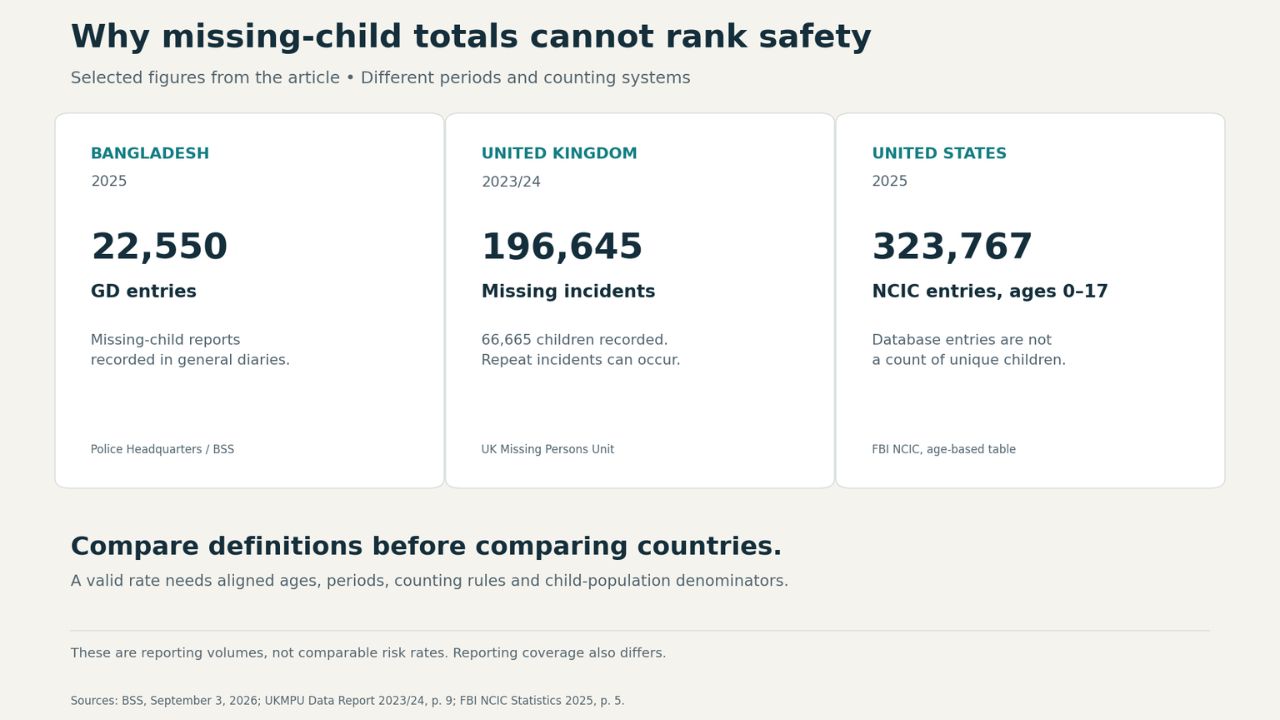
| United Kingdom | 2023/24: 196,645 missing incidents involving children; 66,665 children | The same child may be involved in several incidents; there are also some differences in data provision and definitions. |
| France | 2024: 38,477; 2025: 40,953 | Reports of missing minors, not counts of proven crimes |
| Germany | 2025: approximately 19,200 aged 13 or younger; approximately 87,900 aged 14–17 | ICMEC figures citing the BKA; two separate age categories; an equivalent total for the previous year was not confirmed here |
| United States | 2024: 349,557; 2025: 323,767 | FBI NCIC entries for ages 0–17; these must not be read as a total of distinct children. |
| Canada | 2023: 34,437; 2025: 34,189 | Reports published by the RCMP; the intervening year is omitted, so this is not a claim of a continuous decline. |
| Australia | An AFP-based publication in 2025 describes approximately 50,000 missing-person reports annually across all ages, about half involving ages 13–17. | An approximate annual description, not separate, exact child totals for 2024 and 2025 |
| New Zealand | 2023: 5,427; 2024: 5,186 | Missing alerts concerning children under 16; the same child may be counted more than once. |
Sources: UK Missing Persons Unit, France’s 116 000 service and government publications, ICMEC, FBI, RCMP, and a New Zealand Police response to an official information request.
The UK example is particularly instructive. More than 66,000 children were associated with approximately 197,000 incidents. Repeated disappearances are therefore a policy issue in their own right. Reporting only how many children were found can conceal that repetition.
The US tables also require care. Treating the entry category labeled “Juvenile” as the total for everyone under 18 would exclude minors recorded under other categories. The age-based total has been used here.
To compare rates properly with Bangladesh, we would need the same age range, year, type of incident, and counting method. Rates would then have to be calculated per 100,000 children in the relevant age group. Dividing by the total population would obscure differences in child populations. Even using the correct population denominator would not remove differences in reporting.
Large administrative counts may therefore indicate greater danger but may also reflect more reporting, repeated incidents, or broader definitions. These figures cannot establish a definitive judgment about Bangladesh’s relative position.
The International Picture of Violence: What Does Each Rate Actually Measure?
Comparing violence is even harder than comparing missing-child records. Some countries measure family violence, others sexual offenses, and others maltreatment substantiated by protection authorities. Some surveys measure everyday violent discipline.
| Country | Recent verified indicator | What it cannot be directly compared with |
|---|---|---|
| Bangladesh | MICS 2025: 85.7% of children aged 1–14 experienced violent discipline in the preceding month. | Annual police cases or offenses resulting in convictions |
| France | 2024: 103,700 minor victims of physical violence and 71,100 of sexual violence. In 2025: 114,500 and 76,200, respectively | A distinct-child total cannot be obtained by adding the two categories because some children may appear in both. |
| Germany | 2024: 16,354 recorded cases of suspected child sexual abuse | All forms of violence, or a total covering the same age range for all minors |
| United States | 2024: 532,228 children identified as victims of abuse or neglect; 7.2 per 1,000 children | The true nationwide prevalence of all abuse as estimated through a survey |
| Canada | 2024: 25,938 child and youth victims of police-reported family violence; 345 per 100,000 people aged 0–17 | Violence outside the family and incidents not reported to police |
| Australia | 2023/24: approximately 42,100 children were subjects of substantiated maltreatment following investigation; 7.3 per 1,000 | Bangladesh’s survey of violent discipline in the preceding month |
| New Zealand | Children and young people abused or neglected in state care: 507 in 2023/24; 530 in 2024/25, approximately 10% of those in the relevant care population | An abuse rate covering all children nationwide |
Sources: UNICEF, France’s Ministry of the Interior, a BKA press release, CWLA drawing on US Children’s Bureau data, Statistics Canada, AIHW, and New Zealand’s Independent Children’s Monitor.
Australia’s more recent 2024/25 release gives a rate of 8.3 per 1,000. But most Queensland data are missing from that version, and AIHW advises against direct comparison with earlier releases. The change from 7.3 to 8.3 has therefore not been presented here as evidence of a national increase in maltreatment.
The Office for National Statistics (ONS) for England and Wales also notes that changes in reporting and recording practices can influence changes in police-recorded sexual offenses. A UK row has not been filled by treating sexual-offense totals for all ages as child-specific figures.
These limitations do not weaken an editorial. They protect readers from misleading comparisons. We can say that serious child-protection failures exist in wealthy countries too. But Bangladesh’s 85.7% and Canada’s 345 per 100,000 do not answer the same question. Dividing one by the other to claim that one country is “so many times worse” would be meaningless.
How Many Have Returned, How Many Have Not—and What Does “Recovered” Mean?
The Bangladesh figures above distinguish between recovered and not recovered. But the public needs a more detailed account: found alive and safe, found injured, found dead, returned to family, placed in safe alternative care, and whereabouts still unknown.
I do not assume that a “recovered” label means every child was safely returned to their family. Similarly, not recovered does not establish that a child has died, been trafficked, or left the country. Where a child’s whereabouts remain unknown, the honest answer is that the published information does not establish their location.
International examples suggest ways to improve this accounting. Nepal’s report explicitly identifies family reunification. India’s 2023 figures show a total of 138,609, including unresolved cases from previous years; 89,809 were traced during the year, leaving 48,800 untraced at its end. It would therefore be incorrect to divide the number traced only by the number newly reported missing.
New Zealand Police records show that, of 5,186 alerts from 2024, one remained active as of July 1, 2025; 5,185 had expired or closed. This describes the status of alerts, not the completion of criminal proceedings. An RCMP publication states that 57% of cases were closed within 24 hours and 91% within a week. These outcomes are not a direct, like-for-like comparison with Bangladesh over the same follow-up period.
In my view, a national child-protection report must present search outcomes alongside children’s subsequent safety. If a child fled an abusive home, returning that child without assessing safety would leave even a successful search incomplete.
How Much Justice Is Being Delivered? Arrests, Cases, and Convictions Must Be Distinguished
Finding a child does not establish that an abduction case has been resolved. Filing a case does not mean a trial has begun, and beginning a trial does not mean a conviction has followed.
| Country | Verified information about the process | What it does not establish about justice |
|---|---|---|
| Bangladesh | ASK’s tables list 590 under “Cases filed” for 2025 and 414 for January–August 2026. | These are not national conviction totals; dividing them by recorded incidents cannot produce a conviction rate. |
| India | Missing, previously untraced, and recovered figures are reported separately. | Recovery figures cannot establish success in criminal proceedings. |
| Pakistan | Sahil-based reporting states that 1,812 of 2,003 sexual abuse incidents in 2025 were registered with police. | Registration is not conviction; the remaining incidents are not automatically false allegations. |
| Sri Lanka | A government audit found that 46,813 of 107,663 complaints received from 2014 through April 30, 2025, remained under investigation. | This multiyear complaint backlog cannot be described as a single year’s impunity rate. |
| Nepal | Search and family-reunification outcomes are published. | These are not conviction rates in abuse or abduction cases. |
Sources: ASK, India’s Ministry of Home Affairs, Voicepk’s Sahil-based reporting, Sri Lanka’s Auditor General, and Nepal’s NCRC.
This research could not verify national conviction rates for the five countries over the past two years using the same offense categories, procedural stage, and calculation base. It therefore does not provide a numerical ranking of which country performs better in delivering justice.
Sri Lanka’s audit is particularly relevant. It states that shortcomings in the national database obstructed monitoring of law enforcement progress. The authority also reported staffing constraints affecting updates on the closure of complaints. My lesson for Bangladesh is that having a law is not enough; the progress of each complaint under that law must be visible.
I want to know how long it takes to move from a complaint through investigation, a charge sheet, trial, and final outcome. Where are delays occurring, and why? Where is evidence lacking? How are children and witnesses being supported? Announcing severe punishments cannot answer these questions on its own.
Understanding the Causes Requires More Than Invoking “Social Decay”
Greed, cruelty, and social decay express our anger. But they do not tell us which child needs protection or how to provide it. An inquiry into causes must keep at least several distinct possibilities in view.
- Financial gain and exploitation: Whether an incident involves ransom, theft, labor exploitation, or trafficking must be established through evidence in that case. Assuming that every disappearance is the work of an organized network can obscure other causes.
- Abuse of power by familiar people: WHO identifies parents, caregivers, peers, partners, and strangers among potential perpetrators of violence against children. Safety education therefore cannot stop at avoiding strangers. Children also need opportunities to disclose fear of someone they know.
- Children targeted for revenge: Allegations that someone harmed a child as retaliation in a family or personal dispute are extremely serious. But no reliable national proportion of Bangladesh’s cases motivated by revenge was established here. Suspicion, a possible motive identified during investigation, and a motive established in court must be described separately.
- Pressures behind leaving home: Where a child faces fear of punishment, conflict in relationships, or helplessness, the child needs to be heard. Leaving voluntarily and subsequently becoming a victim of crime are not mutually exclusive. Focusing on the child’s decision must not obscure an adult’s responsibility for exploitation.
- Online grooming and enticement: In February 2025, UNICEF described the case of an 11-year-old child who went missing after contact from an adult online and was later rescued. The case shows why protection must adapt as channels of communication change.
- Weaknesses in institutional responses: It must be clear which police station takes responsibility, which agency supports the child, and who stays in contact with the family. Disputes over responsibility should be documented and reviewed. No family should have to repeat the same account of danger again and again.
Poverty belongs in the discussion, but poor people must not be equated with crime. WHO identifies economic and family pressures as risk factors; these are not proof that a particular person committed an offense. Missing-child figures cannot establish famine either. Famine, poverty, corruption, and failures in child protection are separate questions, and establishing relationships among them requires separate evidence.
For the same reason, a few examples of suspects’ occupations should not be used to blame an entire profession. Without representative national data on occupations in Bangladesh, claims about “who is most involved” would be speculation. Investigations should focus on relationships, access to the child, motive, and evidence.
Parents Have Responsibilities, but They Do Not Bear All the Blame
My expectations of families are practical. There should be regular conversations about where children go, whom they communicate with, and whom they can tell if they are in danger. Responsibility for young children’s travel and supervision needs to be clear. With older children, guidance must be accompanied by trust. If admitting a mistake feels impossible, talking about safety becomes harder too.
It would, however, be unfair to automatically accuse working parents, poor families, single parents, or parents employed abroad of neglect. We must also ask what support a family receives, whether safe schooling and care are available, and whether reporting a concern produces a response.
In my view, the state should provide families with necessary support while ensuring accountability for harmful behavior. A lack of support and deliberate abuse are not the same thing. Keeping a child confined at home is not a solution to safety either. Children have rights to education, play, friendship, and the freedom to grow. Protection should make that life possible.
Why Put a Rescued Child on Public Trial Again?
After a child is rescued, publishing photographs, interrogation videos, and public discussion of personal relationships can cause a second round of harm. Following the 2025 incident, UNICEF criticized the circulation of a police interview and the media’s disclosure of the child’s identity. It also objected to the adult being described as the child’s “boyfriend.”
I believe the media’s success should not be measured only by how many people saw a missing-child post. Editorial responsibility also includes whether the post was updated when the child was found, whether unnecessary identifying information was removed, and whether coverage encouraged humiliating discussion about the child.
Social media publicity can assist a search. But trust is damaged when old photographs are circulated as new incidents, recovery updates are omitted, or speculation is presented as the identity of an offender. The dignity of the child whose safety is being discussed is part of the same responsibility.
A Global Problem, but No Reliable Single Global Missing-Child Total
ICMEC identifies the absence of common definitions and response systems as a major obstacle to reliable global statistics. Adding reports from different countries cannot produce an accurate worldwide total of distinct children who go missing.
WHO’s fact sheet, updated May 7, 2026, states that up to approximately one billion children aged 2–17 worldwide are estimated to have experienced physical, sexual, or emotional violence or neglect in the preceding year. This is a research-based estimate, not a new count of incidents conducted in 2026. The research underlying it is older.
The global context does not reduce Bangladesh’s responsibility. It shows why prevention, complaint handling, safe recovery, and subsequent support must be considered together. We can learn from the strengths of another system but cannot use that country’s large reported numbers to deny problems at home.
The Changes I Would Prioritize
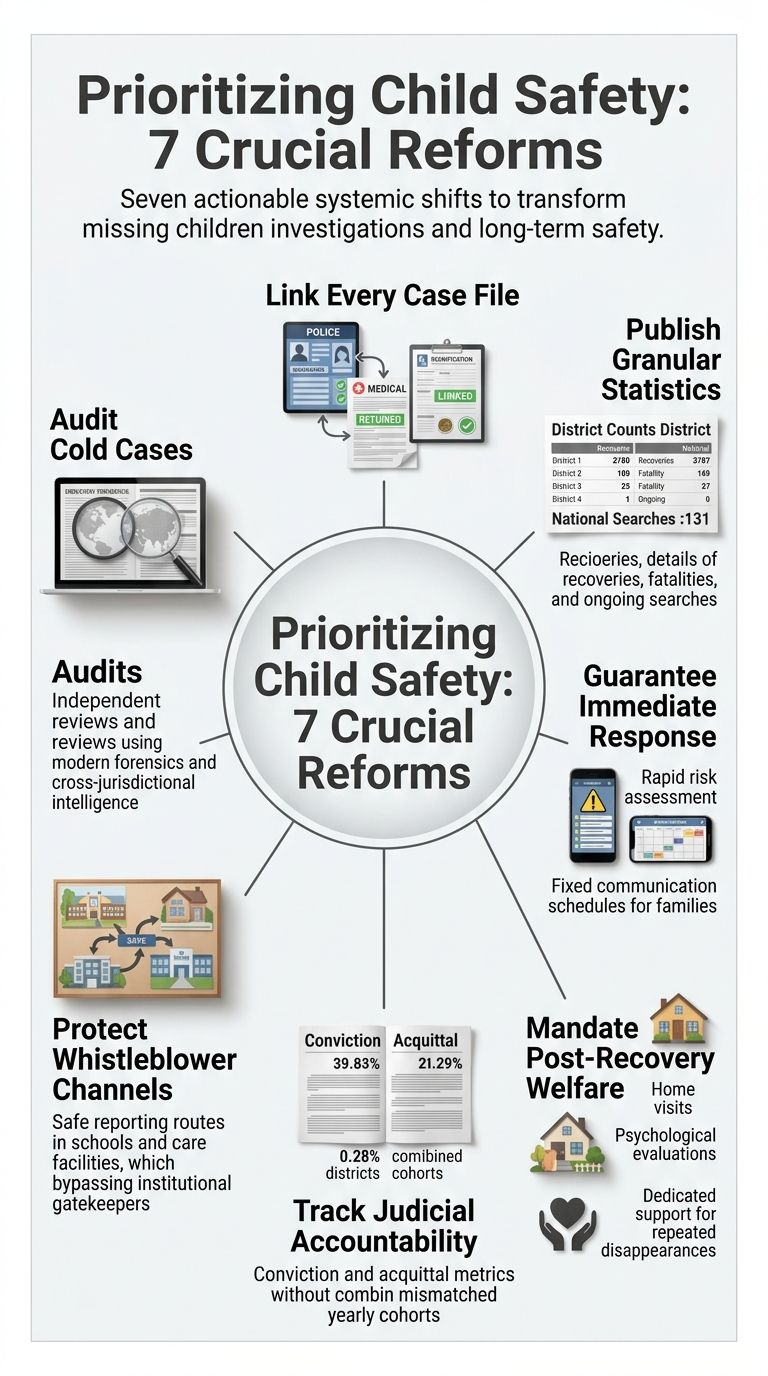
First, each missing child needs a linked record. Relevant officials should be able to connect information about the GD, any subsequent criminal case, recovery, medical treatment, and safe reunification. Public reporting should exclude the child’s identity and provide aggregate outcomes with clear definitions.
Second, regular statistics should be published at police station, district, and national levels. New reports, distinct children, repeated disappearances, children found alive, children found dead, and those still missing should each be counted separately. Revisions to earlier data should also be disclosed.
Third, every report needs prompt risk assessment and an assigned officer. There should be a schedule for communicating with the family. Families seeking news of their child should not have to prove the seriousness of the danger afresh every day.
Fourth, checking safety after recovery should be a required administrative task. This should include sensitive conversations with the child, medical and psychological support where needed, and an assessment of whether the home is safe. Children who repeatedly go missing need a separate support plan.
Fifth, judicial progress must be published. Complaints, investigations, charge sheets, pending trials, convictions, acquittals, and other outcomes should be shown separately. New complaints from one year must not be mixed with verdicts in cases from other years to manufacture a success rate.
Sixth, schools, residential institutions, and environments where children work or receive care must provide safe ways to report concerns. A complaint must be able to reach the appropriate authority without permission from the person accused. The principle that a child’s safety matters more than an institution’s reputation needs practical enforcement.
Seventh, searches for children missing for long periods need regular independent review. A case becoming old does not end the responsibility to answer the family. Reviews should examine whether new information, identification methods, and opportunities for communication across districts are being used.
These changes should be evaluated through real outcomes: How quickly did authorities respond? How many children returned safely? How many faced danger again? What judicial outcomes followed allegations of harm? The number of meetings, campaigns, or technology purchases cannot measure a child’s safety.
A Child’s Return Must Not Mark the End of Responsibility
For me, the most urgent question is not where Bangladesh ranks against other countries. I want answers about how quickly we recognize that a child is in danger, how responsibly we search, and how effectively we ensure a safe life after the child returns.
Not every disappearance is an abduction. Not every recovery is a safe reunification. Not every arrest delivers justice. Recognizing these differences makes our demands more precise.
I want accountability that gives the family of a missing child regular updates, offers a recovered child support instead of humiliation, and moves allegations of crime toward evidence-based investigation and fair justice. Searches for children who have not returned must not be overshadowed by the next high-profile incident. That should be the acceptable standard of our responsibility to children.
Data and Editorial Notes
This is an editorial draft based on public records and news reporting. It does not claim field investigation, interviews with families or police, or examination of the court records in every case. Passages written in the first person present proposed editorial positions; the author should ensure that they reflect their own views before publication. The draft has not undergone independent expert review.
The information-gathering cutoff was September 20, 2026. Each table has its own reporting period. Complete, consistently defined series for missing children, violence, and convictions in 2024–2025 could not be verified for every country. Missing information has not been treated as zero. Using older figures for a country does not mean that no newer information has been published.
In particular, Sri Lanka’s national missing-child total, Nepal’s equivalent missing-child total for the following fiscal year, and two years of comparable conviction rates across the five South Asian countries remain unresolved research gaps. Estimates have not been substituted for these figures. A complete national dataset by division or police station in Bangladesh has not been reconstructed here either; the incidents used are selected examples from news coverage.
Allegations in news reports have been retained as allegations. Children subjected to sexual abuse have not been identified. Not every case in which a body was found after a disappearance has been classified as a homicide without investigation.
Sources of my information:
- BSS: Police explanation regarding missing children, September 3, 2026
- UNB: Comilla University teachers’ missing son found dead
- Ajker Patrika: Body of missing child recovered in Madarganj
- Jago News: BILS condemns abuse of a child domestic worker in Dhaka
- UNICEF: Data on the situation of children in Bangladesh; MICS 2025 indicators
- ASK: Violence Against Children, January–December 2025
- ASK: Violence Against Children, January–August 2026
- India Ministry of Home Affairs: Rajya Sabha answer, 4 February 2026
- The Print: 98,375 kids went missing in India in 2024 and SBI Research, 9 June 2026
- Voicepk: Review of Sahil’s Cruel Numbers 2025 and Sahil’s original report directory
- Nepal NCRC: National Status Report 2081, English edition; tables 50 and 52
- ICMEC: Missing Children Statistics
- The Express Tribune: Sahil’s 2024–2025 comparison
- The Times of India: NCRB 2024 crimes against children and POCSO data
- Sri Lanka NCPA: Child Abuse and Other Child-related Complaints, 2024
- News 1st: NCPA complaints in 2025
- UK Missing Persons Unit: Data Report 2023/24
- France 116 000: 2024 missing reports and 2025 missing reports
- FBI NCIC: 2024 statistics, age-based entry summary
- FBI NCIC: 2025 statistics, age-based entry summary
- RCMP: Just the facts—missing and abducted children, August 2026
- RCMP: 34,437 missing-child reports in 2023
- New Zealand Police: Official Information Act response, 30 July 2025; FYI-hosted official letter
- France Ministry of Interior: recorded physical and sexual violence, 2024
- France Ministry of Interior: recorded physical and sexual violence, 2025
- BKA press release: sexual offences against children, 2024
- CWLA National 2026: federal Child Maltreatment 2024 data; Original US Children’s Bureau report
- Statistics Canada: police-reported family violence, 2024
- AIHW: Child protection—2023/24 maltreatment data
- New Zealand Independent Children’s Monitor: Experiences of Care 2024/25, key findings
- AIHW: Child Protection Australia 2024/25—Queensland exclusion and comparability warning
- ONS: Sexual offences in England and Wales, year ending March 2025
- Sri Lanka Auditor General: National Child Protection Authority audit, 2024
- WHO: Violence against children, updated 7 May 2026
- UNICEF Bangladesh: safeguarding rescued girls, law enforcement and media, 10 February 2025