Finding a separate time for early math can be harder than the math itself. There is dinner to prepare, laundry to fold, shopping to unpack, and a floor that somehow needs tidying again.
Those ordinary jobs already contain useful counting practice. When children practice counting during everyday chores, they connect number words to objects and outcomes they can see. Four spoons are needed because four people are eating. Two shoes make a pair. Five blocks moved into a box leave fewer blocks on the floor.
This does not require turning every household task into a lesson. One small counting job, repeated regularly and stopped before it becomes tiresome, is usually more useful than an elaborate activity that happens once.
What Counting Practice Should Actually Teach
A child who can recite “one, two, three” is using an important skill, but recitation is not the same as counting a group accurately. Object counting brings several ideas together:
- Number order: Number words follow a stable sequence.
- One-to-one correspondence: Each object receives one number word.
- Cardinality: The last number said tells how many objects are in the group.
- Quantity comparison: Groups can contain more, fewer, or the same number of objects.
- Early operations: Adding an item makes a group larger; removing one makes it smaller.
Children often know part of the counting sequence before they can coordinate their words, eyes, and hands. A child may count the same sock twice or say two numbers while touching one block. Moving every counted item into a new place makes the process easier to follow.
Chores also introduce words that belong to early mathematics but are easy to overlook: first, next, last, more, fewer, equal, full, empty, heavy, light, beside, under, and between.
How to Practice Counting During Everyday Chores
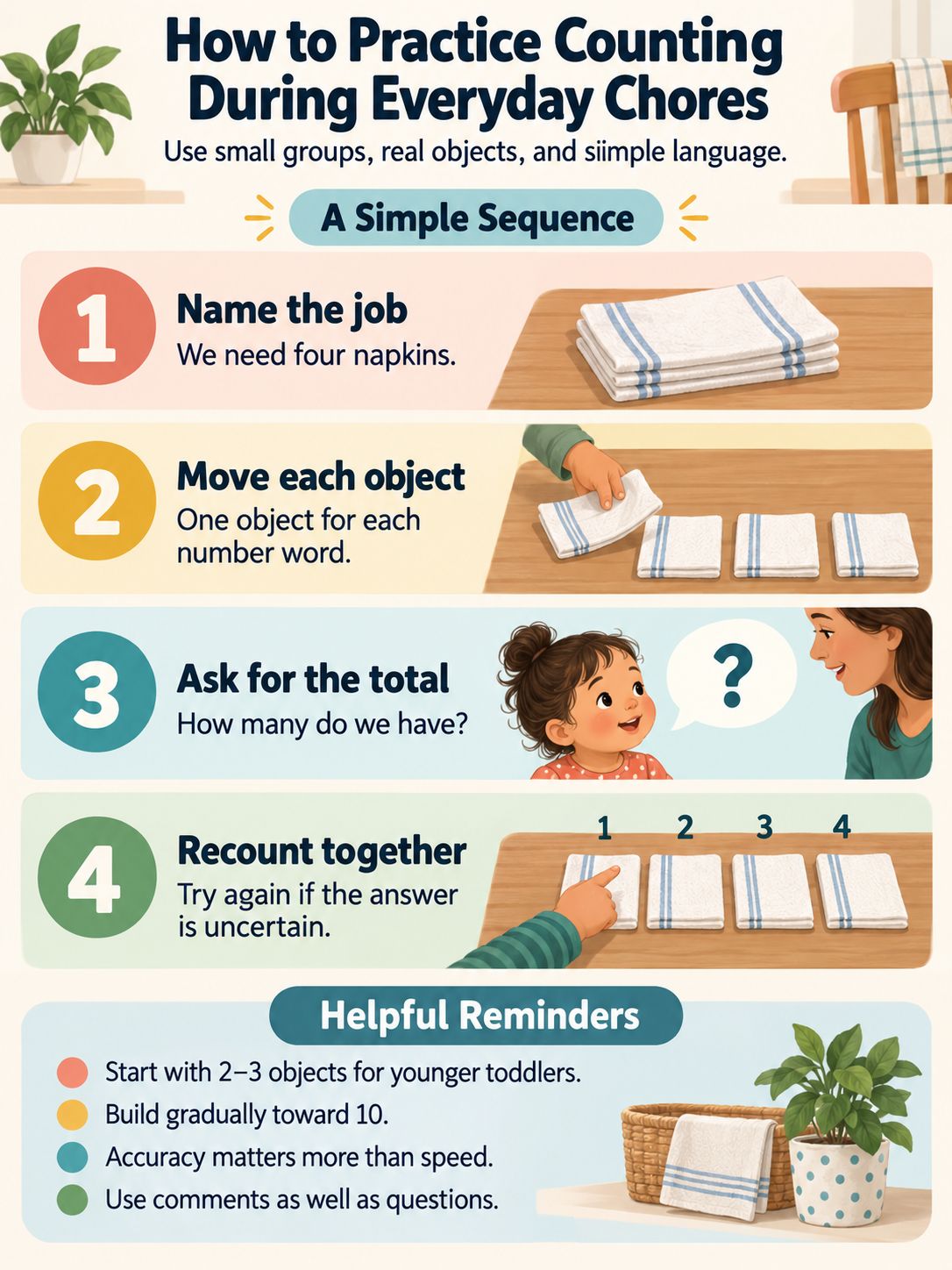
Give the child one clear job and a small number of objects. Whenever possible, let them touch, move, or place each object as they say its number. A request such as “Put four napkins on the table” is more concrete than asking a number question without anything to handle.
For a younger toddler, two or three objects may be enough. Preschool learning frameworks build gradually from small sets toward accurate counting of about 10 objects, but this is a learning path, not a deadline. A correct count of four objects is more useful than a rushed attempt at 20.
A simple sequence works well:
- Name the job: “We need four napkins.”
- Let the child move one napkin for each number word.
- Ask, “How many do we have?”
- Recount together if the answer is uncertain.
Do not make every interaction a question. Comments such as “You put one cup beside each plate” and “This basket has more towels” provide mathematical language without making the child feel examined.
1. Begin With Laundry, but Keep the Detergent Away
Clean laundry is one of the easiest places to start. Socks and towels are light, familiar, and simple to sort. Detergent, bleach, stain remover, and laundry capsules should remain stored out of children’s reach and should never be included in the activity.
An early counter can move three socks into a basket. A child with more experience can pair socks, count the pairs, and then count the individual socks. Sorting by owner, color, or clothing type adds comparison without requiring a separate lesson.
Try prompts that have a visible answer:
- “Can you find two small towels?”
- “Do we have more socks or shirts?”
- “We found four socks. How many pairs can we make?”
Avoid handing a beginner the entire laundry pile. Five items spread on the floor are easier to track than 25 pieces tangled in a basket.
2. Let Table Setting Show Why Numbers Matter
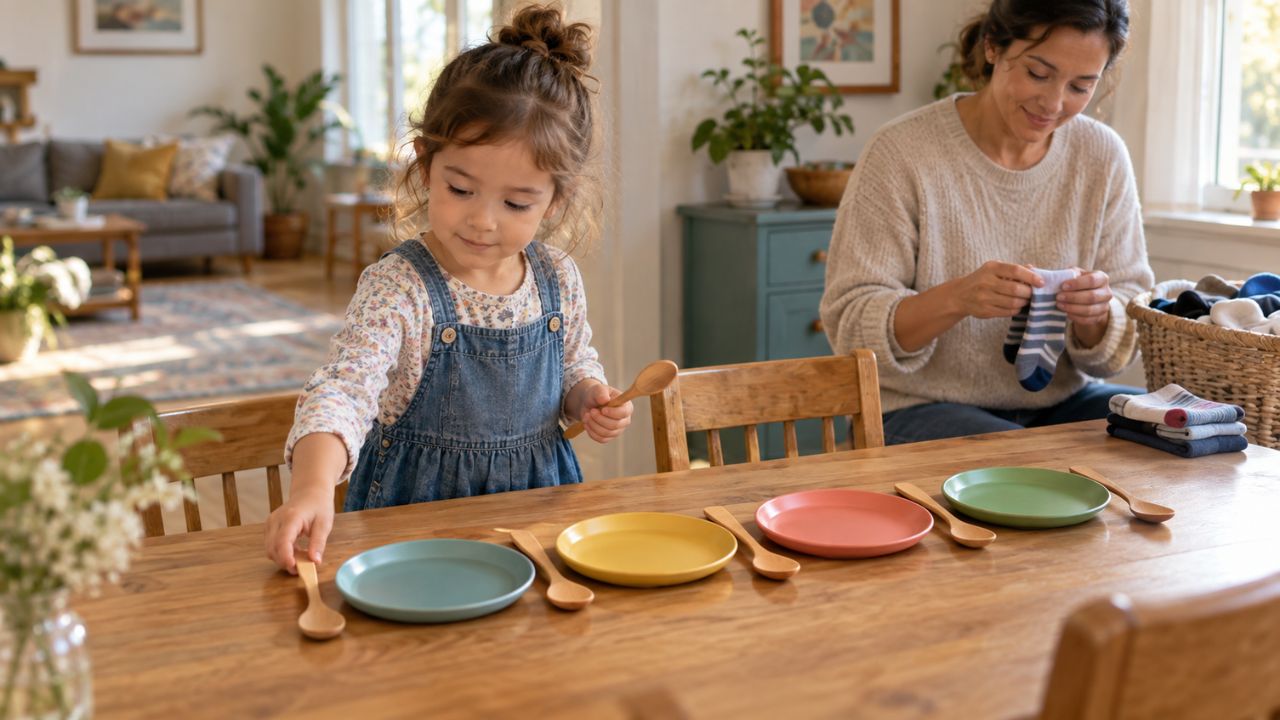
For most families, table setting is the strongest everyday counting activity because the quantities have to match. One person needs one place, and each place needs a plate, cup, or spoon.
Count the places first, then ask the child to bring the same number of safe, unbreakable items. Placing one spoon beside each plate gives one-to-one correspondence a practical purpose.
Older preschoolers can solve small changes: “We have three cups, but four people are eating. How many more do we need?” The child can work out the answer by looking, moving, and checking rather than guessing.
Knives, breakable dishes, hot food, and heavy serving pieces remain adult jobs. There is no educational benefit in making the task riskier.
3. Turn Toy Cleanup Into Small, Winnable Rounds
“Clean the whole room” can feel vague and endless to a young child. “Put five blocks in the box” provides a clear finish line. Follow it with a different job—perhaps three toy animals on the shelf—rather than counting one enormous collection.
Ask the child to slide or carry each item to its destination while counting. If the words race ahead of the hands, slow the movement: one object, one number. Spacing objects in a line can also help.
When only a few toys remain, count down: “Four cars left. Now three.” This draws attention to the quantity getting smaller as objects are removed.
Counting every brick in a large building set is rarely worth the effort. Small, accurate rounds keep the cleanup moving and the mathematics clear.
4. Choose Food Jobs That Can Survive a Miscount
Food preparation gives numbers an immediate purpose, but not every recipe is a good teaching activity. If one extra spoonful could ruin the mixture, give the child a more forgiving job.
They might place five pieces of properly prepared fruit in a bowl, count pieces of bread onto plates, or put three safe ingredients beside the mixing bowl before an adult adds them. Older preschoolers can make equal groups by placing three crackers in each of two bowls, then adding one to see what changes.
Keep children away from heat, sharp tools, raw meat, and cleaning products. Food size and texture also matter. Whole grapes, nuts, popcorn, hard raw vegetable pieces, and other firm or round foods can be choking hazards for young children unless avoided or prepared appropriately. Whole bananas, potatoes, or sealed lightweight packages are safer counting objects than small loose foods.
5. Count a Few Groceries, Not the Whole Shop
Unpacking groceries works best as a short sorting job. A child can find four apples, count two cereal boxes, or group the items that belong in one cupboard.
This routine also creates natural comparison questions: “Which group has more?” “Are there enough yogurts for everyone?” “If one apple goes into the fruit bowl, how many stay in the bag?”
Stop after a few sturdy items. Glass jars, heavy cans, raw meat, medicines, household chemicals, and food that needs prompt refrigeration should remain with the adult. The groceries still need to be put away; extending the exercise until everyone loses patience defeats the point.
6. Add Movement to Simple Cleaning Jobs
For a child who does not want to sit and count objects, movement can make the number sequence easier to hold onto. Count five wipes across a low table, carry three cushions back to the sofa, or take six steps from the bedroom to the laundry basket.
A step or wiping motion disappears once it has been counted, so this is harder than counting objects that remain visible. Begin with a small target and use slow, distinct movements.
Children should not handle disinfectants, dishwasher products, laundry capsules, or other cleaning chemicals. Depending on the surface and the child’s age, a dry cloth, a child-safe brush, or an adult-prepared cloth dampened with plain water may be enough for a real helping job.
7. Use Getting Ready Only When There Is Time
Getting dressed contains useful small sets: two shoes, two socks, one pajama top and one bottom. A child can count buttons, match gloves, or compare how many buttons are fastened with how many remain open.
This is a poor activity when the family is already late. On rushed mornings, finish the routine. Save the counting for bedtime, a quiet weekend, or another moment when the child has time to think. Folding learning into daily life should make the idea easier to understand, not make a stressful transition harder.
Adjust the Challenge Without Turning It Into a Test
Children ages 2–5 vary widely in language, attention, motor control, and number knowledge. When they practice counting during everyday chores, the difficulty should follow what they can do now, not what another child of the same age can do.
- For an early counter: Use groups of one to three. Count together and move each object.
- For a child gaining confidence: Use groups up to five, change the arrangement, and ask for the total after counting.
- For a more experienced counter: Work toward 10, compare groups, make equal sets, or ask what happens when one object is added or removed.
A child may understand quantities but communicate with signs or number words from a language used at home. The mathematical idea does not require one particular language.
When the total is wrong, “Let’s move them over here and count slowly” is more helpful than simply announcing the correct answer. Give the child a moment to spot a skipped or repeated object before stepping in.
Stop when interest disappears. Several brief encounters across an ordinary week offer more useful practice than one session stretched into a battle.
Mistakes That Make Everyday Counting Less Useful
Starting With Too Many Objects
Large groups create tracking problems. Begin with a quantity the child can count accurately, then add one or two objects when that becomes easy.
Letting Words and Hands Fall Out of Sync
Children may point faster than they speak or say several numbers while touching one object. Put the objects in a line or move them into a second container so the child can see what has already been counted.
Asking “How Many?” Over and Over
Constant questioning makes an ordinary job feel like a quiz. Mix questions with useful observations: “There are two red socks and one blue sock,” or “We need one more plate.”
Correcting Too Quickly
A brief pause gives the child time to notice a mistake. If help is needed, recount together instead of turning the activity into a test of speed.
Forcing Math Into Every Routine
Some chores need to be finished quickly. Sometimes a child wants to help without counting. Noticing those limits is part of keeping the practice sustainable.
Final Thoughts
To practice counting during everyday chores, start with the routine that already has the clearest quantities. Table setting is a good first choice for many families: count the people, match one safe item to each place, and check whether anything is missing. Laundry and toy cleanup are useful alternatives when mealtime is rushed.
Keep the group small enough for an accurate count, let the child move the objects, and stop after a few minutes. Once that feels easy, introduce comparison, equal groups, adding one, or taking one away. The value comes from repeating a clear idea in real situations—not from turning the entire day into a math lesson.
Frequently Asked Questions
How long should an everyday counting activity last?
There is no required length. For many toddlers and preschoolers, one small job lasting a few minutes is enough. Stop when the child loses interest, the chore needs to move on, or counting begins to create frustration. The same idea can return during another routine.
Should adults count for a child who keeps getting stuck?
Model the count once, then offer another small group for the child to try. Counting together is also useful when the child is learning the number sequence. Avoid supplying every answer immediately; a short pause gives the child time to point, move an object, or restart independently.
Do children need number cards or worksheets for these activities?
No. The household objects provide the quantity, which is the main idea being practiced. Written numerals can be introduced separately or added later—for example, by placing a card marked “4” beside four spoons—but they are not necessary for useful object counting.
Can children at different counting levels help with the same chore?
Yes, if their jobs are different. One child might place three napkins while another works out how many more are needed for the whole table. Keep the activity cooperative rather than comparing who counts farther or finishes faster.
What if a child refuses to count during chores?
Do not force the activity. The child may be tired, busy with the physical part of the job, or simply uninterested at that moment. Try again during play, a walk, or a calmer routine. Counting during chores is one practical option, not a requirement.